

A specimen’s risk classification, not simply its origin, determines how it must be transported. In Canada, transporting diagnostic specimens under TDG rules means identifying whether a sample is Category A, Category B or eligible for an exemption. Category B packages require the UN3373 mark, while training is generally required unless a Part 6 exemption applies.
That distinction affects packaging, markings and the steps required before dispatch. Getting it right helps protect everyone handling the shipment and keeps it moving safely through transport.
This guide explains how Canadian TDG rules classify infectious substances, what triple-layer packaging involves, and which training requirements and exemptions may apply. It also clarifies the practical differences between Category A and Category B, helping healthcare and laboratory teams understand the rules for preparing a safe, compliant shipment.
Key Takeaways
- Distinguish Category A from Category B by the risk the infectious substance presents, and learn when the UN3373 mark applies.
- Understand when TDG training is generally required and how exemptions for certain patient and animal specimens may apply.
- Use triple-layer packaging principles to protect specimens, contain leaks and select suitable packaging for the shipment.
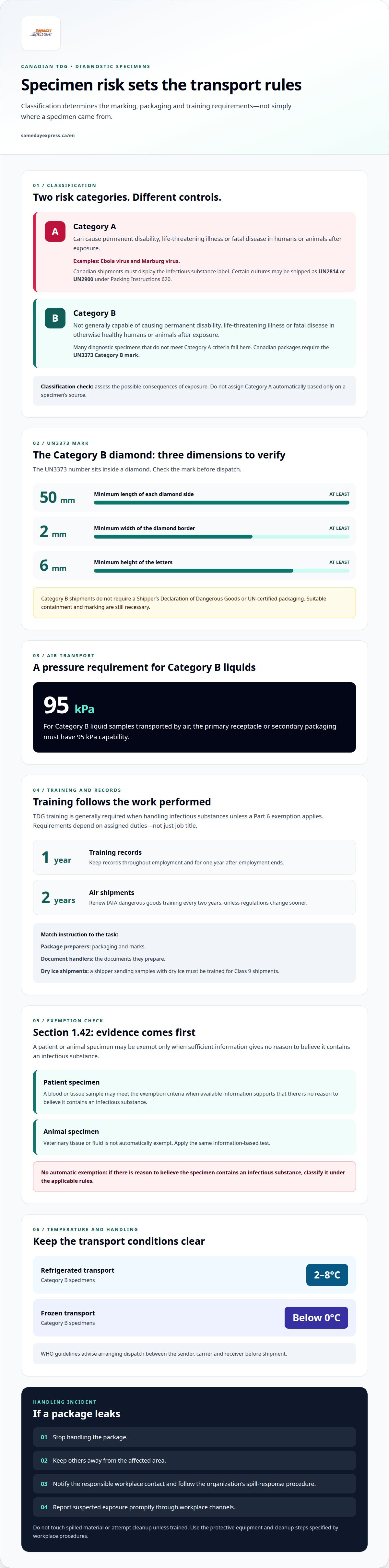
- For Category B liquid samples transported by air, the International Air Transport Association requires a primary receptacle or secondary packaging with 95 kPa capability.
- See how Sameday Express Inc.’s same-day delivery, rush delivery and Direct Drive options can support time-sensitive shipments.
Category A and Category B infectious substances
Under Canadian TDG rules, classification depends on the harm an infectious substance could cause after exposure. Category A and Category B shipments have different marking and handling requirements.
Category A infectious substances
Category A includes an infectious substance capable of causing permanent disability, life-threatening illness or fatal disease in humans or animals if exposure occurs. Classification depends on the consequences of exposure, not simply on the specimen’s source.
Ebola virus and Marburg virus are examples of pathogens classified as Category A, according to the World Health Organization. A culture of a pathogen otherwise classified as Category B may also require Category A treatment when exposure could cause moderate to severe disease. Such cultures are shipped as UN2814 or UN2900 under Packing Instructions 620.
Canadian shipments of Category A infectious substances must display the infectious substance label. Classify the substance correctly before choosing marks or preparing the package. Do not automatically treat every specimen or culture as Category A; apply the relevant risk criteria.
Category B specimens and UN3373 labels
Category B includes an infectious substance not generally capable of causing permanent disability, life-threatening illness or fatal disease in otherwise healthy humans or animals after exposure. Many diagnostic specimens that do not meet Category A criteria fall into this category.
Canadian Category B packages require the Category B mark under Sections 1.39 and 4.22.1 of the TDG Regulations. The mark is the UN3373 number inside a diamond. Each side of the diamond must be at least 50 mm long, its border at least 2 mm wide, and its letters at least 6 mm high.
Category B shipments do not require a Shipper’s Declaration of Dangerous Goods or UN-certified packaging. However, suitable containment and marking are still necessary. Use Category B classification only when the specimen meets the criteria; a serious exposure risk may require Category A controls instead.
Spill and exposure precautions
Spill and exposure precautions are immediate actions to limit contact with a specimen and guide the response under workplace procedures. If a package leaks, stop handling it, keep others away from the affected area and notify the responsible workplace contact.
Couriers and healthcare workers should not touch spilled material or attempt cleanup unless trained to do so. Follow the organization’s spill-response procedure, including its specified protective equipment and cleanup steps. Report a suspected exposure promptly through workplace channels so it can be assessed and documented.
If reusable transport bags become contaminated, decontaminate them appropriately before reuse. Follow workplace procedures and account for the specimen and affected surfaces. Clear reporting also helps the receiving laboratory respond safely to a compromised package.
Training requirements and exemptions
TDG training prepares employees to handle dangerous goods safely and perform their assigned transport duties. In Canada, training is generally required when handling infectious substances unless an exemption applies under Part 6 of the TDG Regulations. The requirement depends on the work performed, not just an employee’s job title. Classification, packaging, marking and documentation tasks can each involve different responsibilities.
Employees who handle infectious substances need training appropriate to their duties. Package preparers need instruction on packaging and marks; employees handling documents need to understand the documents they prepare. Keep training records throughout employment and for one year after employment ends. For air shipments, renew IATA dangerous goods training every two years unless regulations change sooner.
A TDG specimen exemption applies when there is no reason to believe, based on sufficient information, that a human or animal specimen contains an infectious substance. Section 1.42 sets out this Canadian exemption. It is not a blanket exemption for every patient sample or veterinary submission. The available information about the specimen must support the decision that the exemption applies.
An exempt patient specimen is a human specimen meeting Section 1.42’s criteria. For example, a blood or tissue sample may fall within the exemption when sufficient information gives no reason to believe it contains an infectious substance. If that basis is absent, the sample must be classified under the applicable infectious-substance rules rather than treated as exempt by default.
An exempt animal specimen is an animal-derived specimen meeting the same Section 1.42 test. Veterinary samples, such as tissue or fluid, are not automatically exempt because they come from an animal. If available information gives reason to believe the specimen contains an infectious substance, the exemption does not apply; classification determines the handling requirements.
Dry ice can add a separate training consideration. A shipper sending samples with dry ice must be trained for Class 9 shipments. This requirement concerns the dry ice, even when the specimen itself has a different classification. Keep the two decisions distinct: assess the specimen’s infectious risk, then account for dry ice as a dangerous good. Correct training follows the employee’s actual shipping duties and the materials involved.
Triple-layer packaging and absorbent material
For Category B specimens, refrigerated transport is 2-8°C and frozen transport is below 0°C. The WHO guidelines advise arranging dispatch between sender, carrier and receiver before shipment.
Packaging selection and standards
Triple-layer packaging consists of a primary receptacle, secondary packaging and rigid outer packaging, working together to contain a specimen during transport.
Choose packaging suited to the specimen’s form and classification. A liquid sample needs a leakproof primary receptacle; a solid sample needs a sift-proof one. Category B packaging must prevent hazardous material from escaping under normal transportation conditions. In Canada, a Type P650 package must have an outer packaging with a smallest external dimension of at least 100 mm.
For Category A shipments, a Type P620 package used in Canada must comply with CAN/CGSB-43.125. Packaging made outside Canada must meet applicable UN Recommendations and the manufacturing country’s national regulations. The WHO guidelines describe UN Class 6.2 packaging performance tests that include a nine-metre drop test. Follow the package manufacturer’s exact filling and closing instructions.
Absorbent material and packing steps
Absorbent material is placed around a liquid primary receptacle to contain its full contents if it leaks or breaks.
Pack in sequence: close the primary receptacle, add enough absorbent material, then place it inside protective secondary packaging. The secondary layer must protect against breakage, punctures and leaks. Separate or wrap fragile receptacles to prevent them from striking one another. Secure the secondary layer inside rigid outer packaging, adding cushioning to fill empty spaces and limit movement.
Dry ice is a refrigerant that also requires packaging and shipping controls. Under UN Packing Instruction 904, place it outside the secondary receptacle, not inside it. Keep the dry ice arrangement separate from the specimen’s containment layers, and follow the packaging manufacturer’s instructions. Dry ice shipments also require attention to applicable dangerous goods training, as covered in the training requirements section.
Temperature control and transit timing work together. Maintain refrigerated Category B specimens at 2-8°C and frozen Category B specimens below 0°C. Coordinate dispatch and receipt so the laboratory can handle the shipment as planned. The appropriate transit window depends on the specimen’s required condition and the receiving laboratory’s arrangements.
The Sheffield Teaching Hospitals NHS Foundation Trust DX Category B kit checklist includes a 50ml absorbent sheet. Dry ice limits are 200 kg per package and 2.2 kg (5 lbs) in relevant shipment instructions.
Canadian TDG classification of infectious substances
The Transportation of Dangerous Goods (TDG) Regulations govern the transport of dangerous goods in Canada. An infectious substance is material known or reasonably expected to contain pathogens capable of causing disease. Classification determines the applicable containment, marking, documentation and training requirements.
A consignor is the person or organization responsible for preparing dangerous goods for transport. Canada’s Transportation of Dangerous Goods Regulations require consignors of infectious substances to meet requirements for classification, documentation, dangerous goods safety marks, containment, training, emergency response assistance plans and reporting. These duties depend on the substance and shipment, not simply its use in a laboratory.
A human or animal specimen exemption is an exception for specimens with no reason to be considered infectious, based on sufficient information. Section 1.42 of the TDG Regulations allows this exemption when that condition is met. It does not apply automatically to every blood, tissue or veterinary sample. If available information gives reason to believe a specimen contains an infectious substance, it needs classification under the applicable rules.
Category A and Category B are classifications based on the health risk from exposure. Some Category A infectious substances may be shipped as Category B in Canada, but only when conditions in Subsections 2.36(2) and (3) are met. This is a specific regulatory allowance, not a general option to reclassify a sample for simpler shipping. Apply the relevant criteria to the actual substance.
Air transport is governed by additional requirements. Canadian domestic and international air transport of infectious substances must comply with ICAO Technical Instructions and Subsection 12.1(1) of the TDG Regulations. A shipment prepared for road transport may therefore need different handling before it can travel by air. Confirm the transport mode as part of classification and preparation.
UN3549 identifies solid medical waste containing Category A infectious substances. Canada introduced this classification and its associated packing requirements into the 2021 edition of CAN/CGSB 43.125. That makes the waste’s form and contents important: solid medical waste containing Category A substances is not classified in the same way as an ordinary diagnostic specimen. Correct classification connects the material to its required packaging and marks.
For shipments crossing the Canada-United States border, classification remains a key transport decision. More than one regulatory framework may apply, particularly when a shipment travels by air. Before dispatch, identify the substance, transport mode and relevant Canadian requirements, then prepare the containment and documentation accordingly.
What are the steps for safely packing and shipping diagnostic specimens?
Safe specimen shipping follows a sequence: classify, contain, mark and check the shipment before dispatch. Each step helps ensure the package suits its contents and transport mode.
- Classify the specimen. Identify whether it is exempt or an infectious substance, then determine its applicable category. The classification guides packaging, marks and required shipping information.
- Select the packaging. Use packaging suited to the specimen’s form and classification. For a Type P650 package used in Canada, the outer packaging’s smallest external dimension must be at least 100 mm.
- Secure the primary receptacle. Use a leakproof receptacle for liquid samples or a sift-proof receptacle for solid samples. For Category B diagnostic samples transported by air in liquid form, the primary receptacle or secondary packaging must have 95 kPa capability, according to the International Air Transport Association.
- Contain leaks and movement. For liquid specimens, place enough absorbent material around the primary receptacle to absorb its full contents if it leaks or breaks. Protect fragile receptacles from contact, then secure secondary packaging inside rigid outer packaging with cushioning.
- Prepare the shipment for dispatch. Ensure required marks remain visible, including when the package is overpacked. Include sender and recipient names, addresses and phone numbers on Category B packages. Provide the name and telephone number of the person responsible for emergency response information, on the package or in a written document such as a bill of lading.
Air transport requires additional checks. Follow the packaging manufacturer’s instructions for filling and closing the package. Coordinate dispatch among the sender, carrier and receiver before the shipment leaves, so the receiving laboratory is ready to accept and handle the specimen.
Dry ice requires separate attention. Under UN Packing Instruction 904, place it outside the secondary receptacle. Keep the venting and package design suitable for the refrigerant, and account for dry ice in dangerous goods preparation and training. Never use a carrier bag or box as a replacement for rigid outer packaging.
For a time-sensitive specimen shipment, arrange direct delivery with a reliable courier.
For air dispatch, check the documentation as well as the package. The WHO guidelines state that infectious substances sent by air mail must be accompanied by a shipper’s Declaration of Dangerous Goods form. List infectious-substance samples on the shipper’s declaration by millilitres per primary receptacle and number of receptacles; the guide gives a stated commercial limit of 50 ml. Retain one signed copy of the Shipper’s Declaration and submit three copies with the completed shipment. Confirm that the declaration and package details agree before dispatch, and keep the retained copy available for shipment records.
Check quantity limits for Category B shipments: the maximum quantity is 1 litre or 4 kg of solids per primary container, and 4 litres or 4 kg total per package. The WHO guidelines specify that infectious substances must be transported in packaging meeting UN Class 6.2 specifications and Packaging Instruction PI 602. When a package crosses national borders, check whether additional labels, permits, or shipping contents are required for customs and import/export clearance. Complete those checks with the shipment preparations so required documentation and package information are ready for the route.
Sameday Express
Sameday Express offers delivery options for organizations arranging time-sensitive specimen shipments. Once a specimen is classified, packaged and ready, choose a delivery plan based on its route and urgency. Options include same-day delivery, Sameday Direct drive and rush delivery.
Each option serves a different scheduling need. Same-day delivery suits a prepared shipment that needs to arrive on the day it is collected. Rush delivery is available for urgent shipments, while Sameday Direct drive offers direct transport. Choose based on the route and required timing.
For a laboratory or healthcare organization, the handoff begins with a shipment ready for collection and a clear destination. The sender remains responsible for the specimen’s classification, packaging, marks and required shipping information. A delivery service moves the prepared shipment; it does not replace those preparation steps.
Before arranging a time-sensitive delivery, have the essential logistics details ready:
- The pickup and delivery locations.
- The requested delivery timing and why the shipment is time-critical.
- The specimen’s packaging and relevant handling instructions.
- The receiving location’s arrangements for accepting the package.
These details help match the delivery option to the route and timing requirements. Choose based on the movement required, not by changing the specimen’s classification.
Keep regulatory preparation separate from courier booking. The sender remains responsible for correct classification and packaging under applicable requirements. Provide accurate pickup and destination details, and clearly communicate relevant shipping instructions. This supports a smooth handoff and helps ensure the delivery plan reflects the shipment’s needs.
When a correctly prepared specimen needs prompt transport, Sameday Express Inc. offers delivery options to consider. Contact Sameday Express Inc. to discuss your shipment.
Build a dependable specimen handoff
Make each shipment handoff a defined part of your laboratory’s workflow. For transporting diagnostic specimens, keep responsibilities clear from preparation through pickup so handling instructions and destination details accompany the package. A consistent process helps teams avoid confusion during busy collection periods and urgent dispatches.
Make each handoff practical: identify who prepares the package, who communicates its requirements and who receives it. Clear responsibilities help healthcare and laboratory teams coordinate without confusing transport arrangements with classification or packaging decisions. This approach also makes it easier to adapt the workflow when routes, receiving locations or operational needs change.
When a prepared specimen needs prompt transport, Sameday Express offers same-day delivery, Sameday Direct drive and rush delivery. Choose the next step according to the route and timing, then communicate handoff details clearly to everyone involved.
Contact Sameday Express Inc. about specimen transport to discuss your shipment. A clear plan is a practical way to move forward with confidence.
Frequently Asked Questions
What are the Canadian regulations for transporting diagnostic specimens?
Canada’s Transportation of Dangerous Goods Regulations set requirements based on whether a specimen is exempt or classified as an infectious substance. For example, Section 1.42 addresses human or animal specimens with no reason to believe they contain an infectious substance, based on sufficient information. For Category B shipments meeting Section 1.39, a shipping document is not required under the TDG exemption. Air shipments must also follow applicable air transport requirements.
What packaging is required for transporting diagnostic specimens under TDG and IATA rules?
Packaging depends on the specimen’s classification and transport mode. For Category B air shipments, use packaging that meets IATA Packing Instruction 650. The International Air Transport Association states that liquid Category B diagnostic samples transported by air require a primary receptacle or secondary packaging with 95 kPa capability. For Canadian ground shipments, apply the relevant TDG requirements. Check the package’s intended use and follow its manufacturer’s filling and closure instructions.
Disclaimer
Blog Disclaimer
The information published on the Sameday Express Blog is provided for general informational and educational purposes only. While we strive to keep all content accurate and up to date, Sameday Express makes no representations or warranties of any kind, express or implied, regarding the completeness, accuracy, reliability, suitability, or availability of the information contained in our articles.
The content on this blog does not constitute legal, customs, tax, regulatory, financial, or professional advice. Shipping regulations, carrier policies, customs requirements, and transportation laws may change without notice and may vary by destination. Readers should verify current requirements with the appropriate government authorities, carriers, or qualified professionals before making shipping or business decisions.
Sameday Express is not liable for any loss, damage, delays, or consequences arising from the use of, or reliance on, information published on this website. Any actions taken based on the information provided are at the reader's own risk.
References to third-party companies, products, services, or websites are provided for informational purposes only and do not constitute an endorsement or recommendation by Sameday Express.
All blog content, including text, graphics, images, and logos, is the property of Sameday Express unless otherwise stated and may not be reproduced or distributed without prior written permission.
For specific shipping requirements, pricing, transit times, or logistics solutions, please contact Sameday Express directly for personalized assistance.


