

In Montreal, seasonal inventory needs can rise quickly as demand shifts and peak periods approach. The right overflow space isn’t the biggest space you can secure. Seasonal inventory storage holds stock temporarily during a period of higher demand. Planning starts with estimating peak stock volume, how often items need to be accessed, and how long they’ll remain in storage. Those details help Montreal businesses plan space around real stock needs rather than guesswork.
It’s easy to focus on having enough product for the busy season. But excess stock can slow order handling, take up space needed for active inventory, and complicate replenishment if it isn’t organized for access and dispatch.
This guide explains how to estimate the space seasonal stock needs, plan overflow across Canadian markets, and prepare for demand shifts. It also covers how storage and delivery decisions can support smoother operations, reduce handling friction, and keep products moving as the season changes.
Key Takeaways
- Estimate overflow space for your Montreal seasonal stock based on peak inventory, access needs, and storage duration.
- Use past sales, current trends, and lead times to forecast seasonal demand for your Montreal business.
- Plan stock placement around your Montreal customers so inventory can move where local orders are coming in.
- Organize seasonal stock for faster picking, replenishment, and returns as demand shifts in Montreal.
- Review leftover stock and operational challenges after each peak to strengthen your next seasonal inventory plan in Montreal.
1. Sizing seasonal inventory overflow storage by peak stock, access frequency, and exit timing
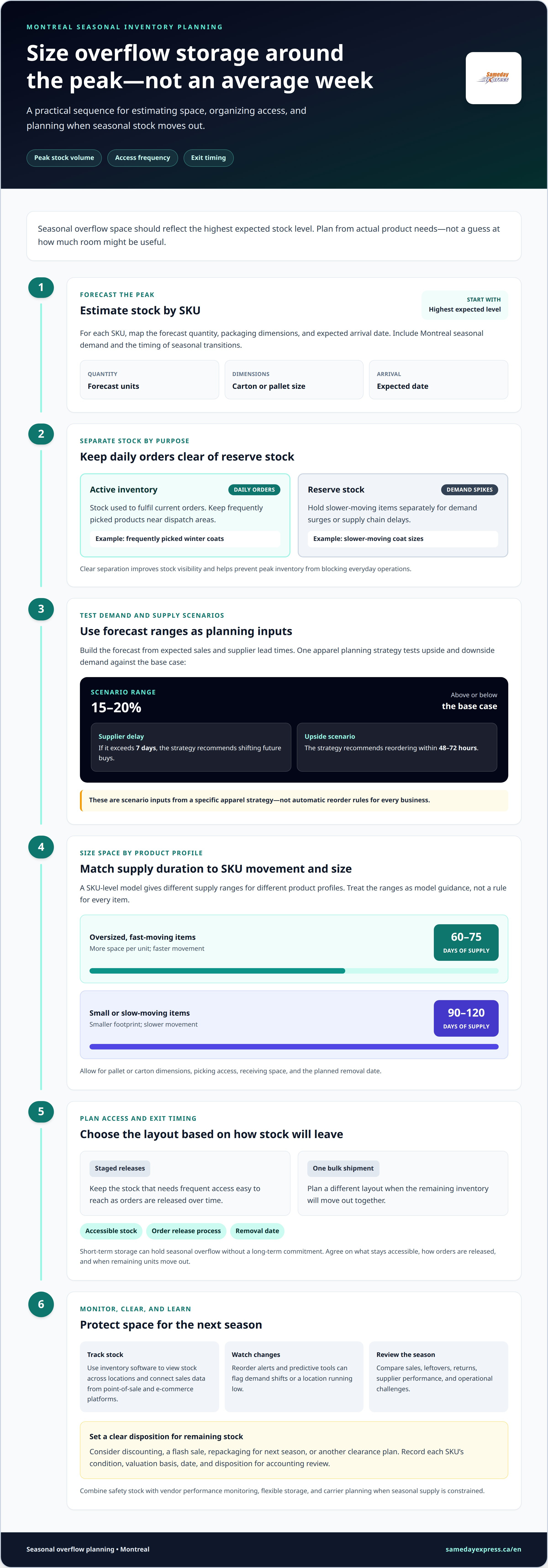
Size overflow space around the highest expected stock level, not an average week. For Montreal businesses, factor local seasonal demand and the timing of seasonal transitions into inventory plans. Start with each SKU’s forecast quantity, packaging dimensions, and expected arrival date. Then separate active inventory, used to fulfil current orders, from reserve stock held for demand spikes or supply chain delays. For example, keep frequently picked winter coats near dispatch areas and slower-moving sizes in reserve. This separation improves visibility and prevents peak stock from blocking everyday logistics.
Build the forecast from expected sales and supplier lead times. A safety stock formula can compare maximum predicted sales and lead times with average historical sales and lead times. For an apparel planning example, one strategy uses upside and downside demand scenarios of 15–20% from the base case. Treat these as scenario inputs, not automatic reorder rules. If a supplier delay exceeds 7 days, that strategy recommends shifting future buys; during an upside scenario, it recommends reordering within 48–72 hours.
Estimate storage by SKU and how often each item must be reached. One SKU-level model recommends 60–75 days of supply for oversized, fast-moving items, and 90–120 days of supply for small or slow-moving items. These ranges come from a specific model, so apply them to the relevant product profile rather than every business. Ask the storage planner to account for pallet or carton dimensions, picking access, receiving space, and the planned removal date. Your exit timing matters: stock leaving in stages needs a different layout from one bulk shipment.
Short-term storage can hold seasonal overflow without a long-term commitment. Agree on which stock stays accessible, how orders will be released, and when remaining units will move out. Before the season ends, review sales, leftovers, returns, and operational challenges. Use that review to decide whether remaining products should be discounted, promoted through a flash sale, repackaged for next season, or otherwise cleared. A defined exit plan reduces the chance that last season’s stock will occupy space needed for new arrivals.
In Canada, the tax and accounting treatment of inventory write-downs or disposals depends on the applicable accounting framework and tax circumstances. Record each SKU’s condition, valuation basis, date, and disposition so an accountant can assess the appropriate entry.
Inventory software can help prevent overstock when it tracks stock across locations and connects sales data from point-of-sale and e-commerce platforms. Real-time visibility can support reorder alerts, while predictive analytics or AI can flag demand shifts before a location runs low.
For seasonal supply constraints, combine safety stock with vendor performance monitoring, flexible storage, and carrier planning. This gives the team options when replenishment slows, without treating every forecast increase as a reason to buy more. Clear stock records also make managing seasonal inventory overflow more accurate, from the first receipt to the final clearance order.
2. What Is Seasonal Inventory Storage?
Seasonal inventory storage provides temporary space for products purchased or held ahead of predictable demand peaks. It keeps early arrivals separate from goods needed for daily orders, then supports release as sales rise. For a Montreal retailer preparing for winter, that could mean storing patio furniture until spring demand approaches. The goal is to align stock timing with sales without filling active operations with every early delivery.
Start planning well before peak demand. Build a forecast using historical sales, current trends, and supplier lead times. Compare the same season across previous years, then account for changes such as product assortment, promotions, and sales channels. For Montreal businesses, consider local weather patterns and delivery schedules when planning stock arrivals. Historical figures provide a basis for estimates, but they need context: a strong promotion or unusual weather can make one season a poor match for the next.
Canadian holiday shopping provides an example of seasonal concentration. Statistics Canada reported that approximately one-quarter of Canadian retail e-commerce sales took place during November and December of the 2018 holiday shopping season. A Montreal retailer can use this pattern to examine its own holiday demand, then plan product arrivals and storage around its sales history. The national figure offers context, not a substitute for a company’s SKU-level forecast.
Forecasting also needs to respond as demand shifts. Retailers can combine sales history with weather patterns and consumer behaviour, then monitor current orders for signs that forecasts are changing. Predictive analytics can flag a product gaining traction before one Montreal location runs low. AI and machine-learning tools can also analyse sales data, but the useful outcome is operational: a timely adjustment to stock allocation, replenishment, or storage plans.
Forecasts remain vulnerable to sudden changes. A warm Montreal winter can slow coat sales; a viral product trend can quickly increase demand. Vendor delays can also disrupt the arrival schedule, even when the sales estimate is accurate. Track forecast versus actual sales, supplier performance, and incoming orders in the same planning cycle. That gives operations a clearer view of whether excess stock reflects early purchasing, delayed demand, or a genuine forecast error.
Plan the storage workflow alongside the inventory forecast. Specify how goods will be received, identified, and released for orders, and decide how returns will re-enter available stock. For example, separating returned products for inspection prevents their status from being confused with sellable inventory. Clear handling instructions help warehouse teams keep seasonal items organized as receipts and orders change.
Holding goods for next year can expose businesses to spoilage, damage, obsolescence, and changing customer preferences. Before retaining stock, assess its condition, product life, packaging, and likelihood of selling next season. Dated designs or seasonal packaging may lose relevance faster than products with year-round use.
For inventory moving between Canadian and U.S. markets, include cross-border shipment planning in the seasonal calendar. For Montreal businesses, this helps connect expected demand with stock-transfer timing and order fulfilment.
3. Planning seasonal inventory overflow storage in Montreal
A Montreal inventory plan starts with demand by destination, not one national stock estimate. Map expected orders across Montreal and nearby markets, then assign inventory to locations near likely demand. For example, a retailer can position winter accessories near Montreal when sales records show higher local demand. This approach helps teams predict where stock will be needed and limit avoidable transfers.
Give your logistics provider a SKU forecast, purchase schedule, shipment dimensions, and expected arrival dates. The provider can compare projected stock with available space, receiving capacity, and dispatch requirements at each Montreal-area location. Clear decision rules matter too: identify which location can release reserve stock, who approves a transfer, and how sales changes affect replenishment. These details support coordinated operations when forecasts shift.
Warehouse capacity can vary across Montreal, so seasonal plans need location-specific assumptions. Assess expected volume, receiving dates, storage requirements, and dispatch schedules for each facility. Avoid treating one location’s capacity as a guide for the entire local network. Build lead times and alternate Montreal-area locations into the plan, especially when several shipments are due during the same peak period.
Inventory visibility across Montreal locations helps prevent one warehouse from holding excess while another faces a shortage. A shared stock view should show sellable quantities, reserved orders, inbound shipments, and transfer status. If sales rise in one part of the city, planners can assess stock elsewhere before placing another purchase. A logistics provider can coordinate movement around order priority, delivery timing, and the impact on existing warehouse work.
Capacity planning should cover peak receiving as well as storage. A provider’s ability to handle seasonal volume depends on inbound timing, pallet or carton profiles, picking frequency, and outgoing order patterns. For example, a holiday promotion can create a concentrated flow of cartons into storage, followed by rapid order releases. Forecasting both flows helps avoid pressure at receiving areas and delays during dispatch.
Review the Montreal network after each seasonal peak. Compare location-level forecasts with actual orders, transfer volumes, late deliveries, and leftover stock. One brand described in a market example reduced late deliveries by 40% without adding warehouse space by balancing inventory across channels and regions. The result illustrates how allocation decisions can matter alongside added capacity. Use each location’s results to adjust purchase plans, reserve levels, and stock placement for the next season. Better alignment can protect profit by reducing avoidable transfers and excess inventory.
4. Business benefits of seasonal inventory management
Seasonal planning helps Montreal businesses keep everyday warehouse operations clear during peak periods. Separating seasonal products from regular inventory gives staff defined picking and replenishment areas. For example, a Montreal retailer can place holiday gift sets in a marked zone while keeping year-round products on standard pick paths. This reduces confusion when order volume rises and makes inventory levels easier to review.
Better availability can protect sales. When a Montreal store is out of an item a customer planned to buy, 21% of consumers will leave and buy it from a competitor. The practical response is to match replenishment priorities to expected demand, then allocate stock to locations where orders are building. This won’t remove every stockout risk, but it gives the team a clearer basis for acting before shelves or online listings run empty.
Inventory planning can also limit excess stock. A just-in-time delivery approach brings in supply closer to immediate demand, which can reduce storage needs and surplus inventory. It suits products with dependable replenishment and predictable sales. For a special seasonal item with a long supplier lead time, however, holding reserve stock may be necessary. The right choice is a product-by-product balance, not one policy applied to every SKU.
Flexible storage can help Montreal businesses handle short peaks without committing to space they won’t need year-round. A third-party logistics provider may offer seasonal storage based on the space required, rather than a long-term lease. That can let a retailer expand its warehouse footprint temporarily, then reduce it as stock moves out. The benefit depends on matching the storage arrangement to receiving dates, access needs, and the planned exit for unsold goods. For operators providing mobile container solutions to meet this overflow, professional portable storage business consulting can help optimize fleet logistics and yard operations.
A focused warehouse layout can improve order flow during a rush. A Montreal e-commerce toy shop preparing for Christmas reported cutting order-processing time in half after creating dedicated picking paths. The example shows how a planned route can reduce unnecessary movement between storage and packing areas. Businesses can apply the principle by placing fast-selling seasonal items along clear pick paths and keeping returns handling separate from outgoing orders.
Seasonal management also creates a repeatable way to measure success. After each peak, compare stockouts, leftover units, order-processing delays, and returns with the previous season. Use the findings to adjust purchasing, storage allocation, and warehouse zones before the next cycle. For example, repeated delays at receiving may call for a different arrival schedule, while slow-selling products may need smaller future orders. These decisions connect customer service with more disciplined inventory control.
5. What causes seasonal inventory overflow and how can businesses forecast demand more accurately?
Overflow often starts when a purchase plan relies on a single demand estimate. Seasonal demand can follow an annual calendar, such as Halloween, but sales still vary with weather, promotions, and customer preferences. A clothing retailer ordering winter jackets in early September may avoid backorders before Black Friday, yet an overly large purchase can leave stock after the selling window. The cause is often a mismatch between order quantity, arrival timing, and actual demand.
Forecasting improves when teams compare past sales with current market conditions. Review sales by product and period, then note what changed: a promotion, a new sales channel, or a supplier delay. Share historical data and sales forecasts with suppliers so purchase timing reflects expected demand. Presales can also show customer interest while providing confirmed orders to guide replenishment. These inputs help distinguish a short-lived sales spike from a broader seasonal shift.
Forecast error can persist even with good records. A product may sell differently after a change in price, design, competition, or weather. In 2022, 46% of consumers planned to save their tax refunds, limiting the seasonal spending companies might otherwise expect. That example reinforces why a past sales pattern should inform, not dictate, the next forecast. Track actual orders against the forecast and revise purchasing when the gap becomes clear.
Use scenarios to make uncertainty operational. Set a base forecast, then model lower and higher demand using factors such as recent sales, supplier lead times, and promotion plans. A market example reports forecast accuracy within 5–15% for top SKUs after changes made ahead of a major sale. Treat that result as an example, not a standard target. The practical step is to identify which products need closer monitoring and which can follow ordinary replenishment.
Supply chain delays can create overflow even when demand forecasts are sound. Late deliveries may arrive after the peak, while teams have already placed replacement orders to protect availability. Monitor vendor performance and inbound dates, and coordinate carrier capacity before seasonal receipts begin. If lead times change, revise order quantities and arrival schedules together. This reduces the risk of duplicate stock arriving when customer demand is already slowing.
After the season, compare forecasted demand with actual sales, returns, and remaining units. Record whether excess stock came from early purchasing, delayed receipts, weaker demand, or a promotion that underperformed. Use the findings to adjust next season’s purchase plan and storage timing. For a retailer serving customers across Montreal, include local delivery timing in the seasonal calendar. Plan seasonal stock movement around the demand window, not after overflow has already accumulated.
Sameday Express
We can support your seasonal stock plan with delivery in Montreal when inventory needs to move quickly between locations or to customers. If a promotion creates urgent orders, Same Day Delivery or Rush delivery can help move time-sensitive shipments. For direct, time-critical shipments, Direct-drive delivery may suit your needs.
Share the Montreal pickup and delivery details, shipment size, and required timing so we can plan around the order’s needs. Our services support stock movement; they don’t replace decisions about how much inventory to purchase or where to store it.
For help with a seasonal shipment, contact us.
Turn your seasonal plan into a Montreal operating schedule
A forecast becomes useful when it shapes what happens next. Set a clear point for releasing stock, assign responsibility for dispatch decisions, and keep the delivery schedule aligned with changing order priorities. A practical plan for managing seasonal inventory overflow should make it easy to act when demand shifts, without leaving urgent orders waiting for the next routine review.
Before the next peak, identify which shipments need faster movement and what information is needed to arrange them. Product quantities, pickup and delivery locations in Montreal, shipment dimensions, and timing help define the logistics requirement. With those details ready, your team can move from seasonal planning to a specific delivery request with less back-and-forth.
If you’re preparing a seasonal shipment or responding to a change in demand in Montreal, contact Sameday Express Inc. to discuss your delivery needs. A clear next step keeps your stock plan moving and helps your team prepare for the season ahead.
Frequently Asked Questions
What Is Seasonal Inventory Storage?
Seasonal inventory storage is temporary capacity reserved for products tied to a defined selling period. Unlike ordinary backroom stock, its inbound schedule, release window, and final disposition are planned around that season. A retailer holding patio sets, for example, can assign them a separate location code. This keeps them visible in inventory reports without counting them as immediately available everyday merchandise.
When Should You Book Q4 Overflow Space?
Arrange Q4 overflow space before suppliers start sending peak-season stock. One planning guide recommends allowing two weeks to set up overflow storage before October receiving. Work backwards from the first inbound delivery, allowing time to organize product locations, label stock, and prepare receiving instructions. Share expected shipment dates and stock volumes early so the storage plan can match the arrival pattern.
How should retailers calculate safety stock and reorder points for seasonal products?
Set a reorder point by adding expected demand during supplier lead time to safety stock. Estimate safety stock by comparing maximum predicted sales and lead times with average historical sales and lead times. For a seasonal product, review the same selling period and account for current promotions or supplier changes. Recalculate when actual orders differ from the forecast, rather than relying on a fixed quantity all season.
What are the best ways to clear excess seasonal inventory without damaging brand value?
Start with a controlled clearance plan rather than applying a broad discount to every product. Prioritize older or less popular variants, while keeping current bestsellers at their regular position. Use a separate sales channel or clearly defined promotion window to avoid resetting customer expectations. Products that remain useful next season may be retained, but first assess their condition, packaging, and the risk of changing customer preferences.
How do markdowns, bundles, and promotions compare for moving seasonal overstock?
Markdowns reduce the price of individual items and can make excess stock easier to compare and buy. Bundles pair a slower-selling seasonal item with a complementary product, which can help move both together. Promotions create a time-limited reason to purchase without permanently changing an item’s displayed price. Choose based on stock age, customer interest, and the margin impact, then track sales by offer type.
How can Canadian businesses choose a third-party logistics provider or temporary storage for seasonal overflow?
Compare providers on their ability to handle peak receiving and outgoing order volume without disrupting regular operations. Check how they report inventory, process orders, manage returns, and communicate stock discrepancies. Confirm that the location suits your main customer markets and that its systems can share useful inventory and shipment data. A clear service scope should define receiving schedules, order instructions, reporting, and stock removal timing.
How can businesses liquidate, donate, recycle, or return unsold seasonal stock in Canada?
Sort unsold goods by condition, resale potential, supplier return terms, and material type. Liquidation can move saleable stock in bulk, while donations may suit usable products that no longer fit the next selling cycle. Keep records of donated items and their disposition for tax purposes. For recycling, separate materials and use programs that accept them; document returned or discarded stock in inventory records.
How can a logistics provider coordinate post-season inventory transfers between Canadian locations or sales channels?
A logistics provider can organize transfers using destination allocations, SKU quantities, shipment readiness, and receiving instructions. Send a transfer plan that identifies which stock moves, where it goes, and whether it supports retail, online orders, or another sales channel. The provider can coordinate pickup and delivery timing, while the receiving team reconciles quantities against the transfer record. This creates a clear handoff and reduces misplaced stock.
Disclaimer
Blog Disclaimer
The information published on the Sameday Express Blog is provided for general informational and educational purposes only. While we strive to keep all content accurate and up to date, Sameday Express makes no representations or warranties of any kind, express or implied, regarding the completeness, accuracy, reliability, suitability, or availability of the information contained in our articles.
The content on this blog does not constitute legal, customs, tax, regulatory, financial, or professional advice. Shipping regulations, carrier policies, customs requirements, and transportation laws may change without notice and may vary by destination. Readers should verify current requirements with the appropriate government authorities, carriers, or qualified professionals before making shipping or business decisions.
Sameday Express is not liable for any loss, damage, delays, or consequences arising from the use of, or reliance on, information published on this website. Any actions taken based on the information provided are at the reader's own risk.
References to third-party companies, products, services, or websites are provided for informational purposes only and do not constitute an endorsement or recommendation by Sameday Express.
All blog content, including text, graphics, images, and logos, is the property of Sameday Express unless otherwise stated and may not be reproduced or distributed without prior written permission.
For specific shipping requirements, pricing, transit times, or logistics solutions, please contact Sameday Express directly for personalized assistance.


