

When urgent freight can’t wait for a scheduled road run, the next available flight may change the delivery plan. Next Flight Out shipping in Canada is an expedited option for time-critical shipments, coordinating pickup and final delivery around an available flight.
The time in the air is only part of the schedule. Freight must reach the airport before the airline’s cargo cutoff, and the route may include a connection. After landing, it must be collected and transported to its destination.
This guide explains how Next Flight Out shipping works, what affects delivery timing, and how domestic and cross-border routes differ. You’ll learn which shipment details and paperwork to prepare to help avoid delays. Pickup, flight monitoring, airport recovery and final-mile delivery each play a role in moving urgent freight to its destination.
Key Takeaways
- Understand the difference between airport-to-airport transport and door-to-door service, including how pickup and final delivery fit into the route.
- Follow the shipment’s path from collection to flight booking, airport transfer, arrival and last-mile delivery.
- Prepare accurate shipment details and paperwork to support customs clearance for permitted Canada-USA shipments.
- Learn how route, flight timing, connections and airport handling can affect delivery time.
- See how Sameday Express’s cross-border shipment, same-day delivery, Sameday Direct drive and rush delivery options can support urgent freight.
What is Next Flight Out shipping?
Next Flight Out (NFO) is priority air transportation for freight that cannot wait for a standard schedule. The shipment is booked on the next suitable available flight, with pickup and delivery coordinated around its departure and arrival.
Priority Flights and Connections
NFO prioritizes a shipment for the next suitable flight with space, based on its origin, destination and timing. Passenger flights may carry cargo, but available capacity and the airline’s cargo cutoff determine which departure works. Getting freight to the airport is another part of the route.
Airport-to-airport service covers transportation between departure and destination airports, with the recipient arranging collection at the destination. Door-to-door service adds pickup from the shipper’s premises and delivery from the destination airport to the recipient. Those extra ground legs can help a factory receive a replacement part or a laboratory send an urgent shipment.
Some routes require a connection rather than a direct flight. Freight travelling between cities without a suitable direct departure may pass through another airport before reaching its destination. Tracking key milestones, including departure, arrival and transfers, helps keep the shipment’s progress visible throughout the route.
Transit-Time Factors
Transit time includes more than the time spent in the air. Pickup, travel to the airport, cargo acceptance, flight schedules, connections, arrival handling and final delivery all affect when freight reaches its recipient. A flight from Alberta to Vancouver takes about 1.5 hours, while a flight from Alberta to Toronto takes about 4 hours. Those flight times don’t represent the full door-to-door journey.
Package size, weight and packaging requirements depend on the airline, aircraft and shipment contents. There is no single limit that applies to every NFO flight; freight must fit the carrier’s acceptance requirements and be packaged to protect it during handling. Dangerous goods offered for air transport must follow ICAO Technical Instructions under Part 12 of Canada’s Transportation of Dangerous Goods Regulations.
If a flight is delayed, cancelled or missed, the shipment may need to move to another available flight, changing its arrival and delivery timing. A missed connection can require another airport transfer. For routes involving Alberta, winter weather from November to March may also add time through de-icing, ground holds or road conditions. Direct-drive transportation avoids flight connections and uses a vehicle for the route, so its timing depends on road distance and conditions.
Next Flight Out service and delivery process
NFO combines courier pickup, air transportation and destination delivery into one express plan. Timing depends on five connected legs, not just the time in the air.
Courier Pickup and Delivery
First, a courier collects the shipment from the shipper’s premises or factory and takes it to the departure airport. The cargo must arrive before the airline’s cutoff. After the flight lands, a destination courier recovers the shipment and completes the last-mile delivery.
For an Alberta shipment, first-mile pickup and travel to the airport cargo facility can take an estimated 45-90 minutes, including dispatch. Destination-airport recovery can take 30-90 minutes after arrival, followed by another 30-90 minutes for delivery in most metro areas. A pharmaceutical shipment’s handling needs should be included in the plan.
Service Comparisons and Delivery Guarantees
NFO targets the next available flight, while overnight express follows an overnight schedule and same-day courier service moves freight by road. Air transport may shorten the main transit leg on a route that takes days by road, but pickup, airport processing and final delivery still take time. Choose based on the deadline and route.
Airline cargo tender cutoffs commonly fall 60-120 minutes before departure, but vary by airline and product. That cutoff is not a delivery-time guarantee. Flight availability, connections, airport handling and destination pickup all affect the final arrival time.
Plan the delivery across five legs: courier dispatch and pickup; travel to the airport and cargo tender; flight and any connection; destination-airport recovery; and final-mile delivery. For an Alberta route, use the 45-90-minute pickup estimate, then account for the flight and the two destination courier stages. Allowing at least an hour of buffer before an Alberta shipment’s deadline helps accommodate timing changes.
Next-day express delivery uses a scheduled overnight movement, while NFO seeks the next suitable departure. NFO shipments are usually moved on the same day and often reach a flight within a few hours of shipper pickup. A missed cutoff can change the planned departure, so the five-leg schedule must be recalculated around the next available flight.
Canadian courier partners and airlines may participate in NFO or same-day transportation, but the route and flight determine which partners handle a particular shipment. The process coordinates a pickup courier, an airline cargo movement and a destination courier; no single carrier name applies to every route. For urgent ground movements, express delivery services can also be part of the transportation plan.
After shipping and customs clearance, a local courier partner picks up the Next Flight Out shipment at its destination and takes it to the recipient. NFO expedites urgent shipments by placing them on the next available flight. The destination courier’s collection and onward transport complete the final handoff, connecting the air journey to delivery. The flight covers the urgent air leg, while the local partner completes the journey after clearance.
Customs, insurance and documentation
Cross-border Next Flight Out shipments between Canada and the United States require customs clearance, which can affect transit time. Domestic Canadian flights do not require customs paperwork. For a cross-border route, a clear commodity description and accurate shipment details help support clearance and airport handling.
Prepare shipment information before pickup. Accurate weight, dimensions and commodity details can help prevent delays. For example, describe a replacement machine part by its actual function and material instead of using a broad label such as “parts.” The paperwork must match the goods being transported.
- Shipment description: identify the commodity clearly and consistently across shipment records.
- Weight and dimensions: provide accurate measurements for airline acceptance and transportation planning.
- Route details: show the Canadian origin and destination, plus the United States crossing point when applicable.
- Customs documents: prepare the documents required for the commodity and route, with information that matches the shipment.
There isn’t one universal list of prohibited or restricted items for every NFO shipment. Airline acceptance and applicable rules depend on the contents; dangerous goods offered for air transport must follow ICAO Technical Instructions under Part 12 of Canada’s Transportation of Dangerous Goods Regulations. Contents and handling needs therefore matter before a shipment is booked.
For a permitted cross-border shipment, customs paperwork travels with the goods so authorities can assess the commodity and process clearance. The required documents depend on the shipment. A replacement component and a pharmaceutical product are different commodities, with potentially different paperwork and handling requirements. Customs clearance can add time even when the flight schedule is the fastest available.
Insurance is separate from customs documentation. Before dispatch, review the applicable coverage, exclusions, claims process and evidence requirements. Keep shipment records and proof of condition together, especially for valuable equipment or sensitive freight. These records help document the shipment if damage or loss occurs during transportation.
Dedicated handling does not remove airline or customs requirements. A shipment can be ready for pickup but still miss its planned departure if its description is incomplete, its measurements are inaccurate or its paperwork does not match its contents. A ground courier can take freight directly to the airport, but the airline must still accept it, and customs clearance can affect cross-border timing.
For example, a Canadian business sending an urgent machine component to a United States facility should confirm its commodity description, dimensions, weight and customs paperwork before pickup. This gives the courier, airline and customs process consistent shipment details. The fastest flight schedule only helps once the freight is accepted and cleared for its route.
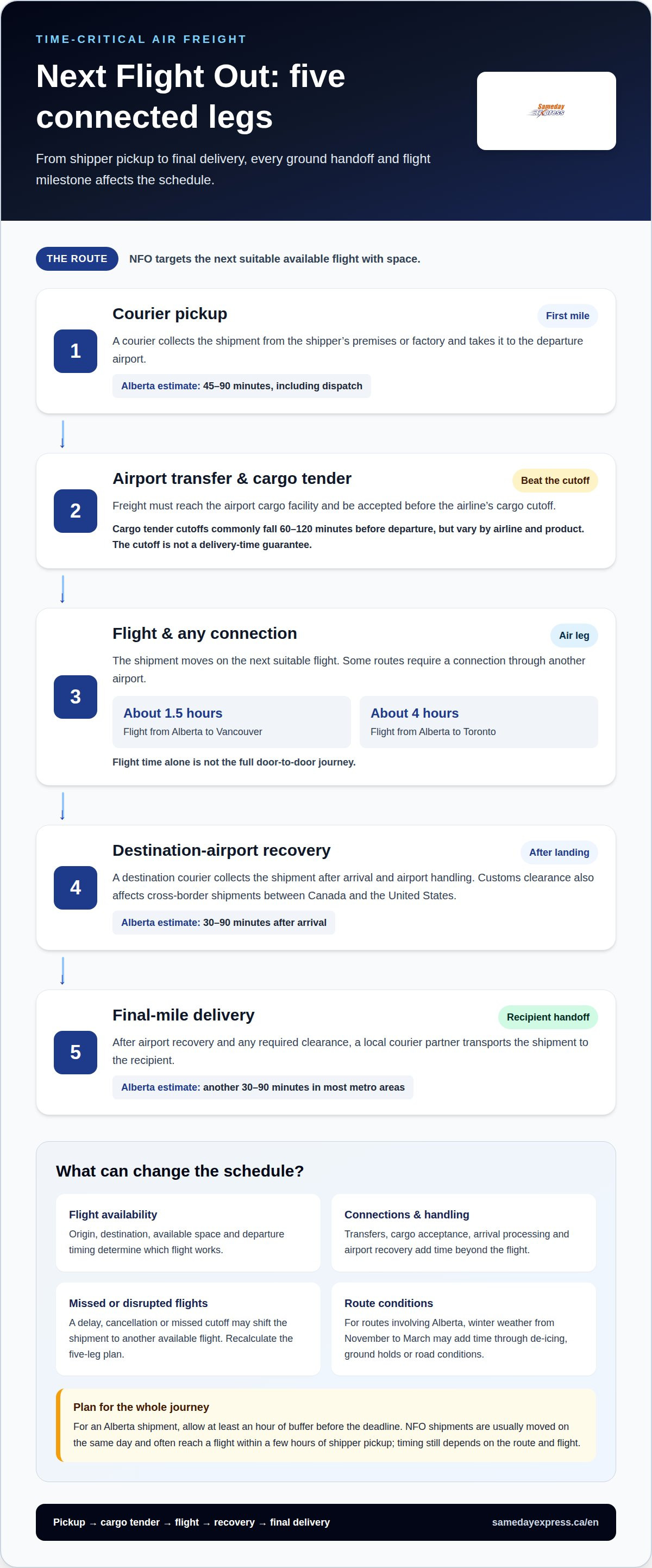
How next-flight-out shipping works
NFO planning starts with the shipment’s origin, destination and deadline. The route is chosen based on flight duration and routing, then matched to an available flight. The freight moves individually as soon as space is available, rather than waiting for standard air freight consolidation or an overnight schedule.
For an Edmonton-to-Toronto shipment, the sequence is practical and time-sensitive:
- A courier collects the freight and takes it to Edmonton International Airport.
- The shipment is prepared and tendered to the airline before its cargo cutoff.
- The airline carries it on the selected flight, with a connection if the route requires one.
- At the destination airport, a courier recovers the freight and takes it to the recipient.
One illustrative Edmonton-to-Toronto plan begins with pickup at 12:45 p.m. Mountain Time. The freight reaches Edmonton International Airport for tender by about 1:45 p.m. Mountain Time. A mid-afternoon flight departs around 3:30 p.m. Mountain Time and lands near 9:30 p.m. Eastern. Final delivery could happen before midnight Eastern, depending on destination handling and courier travel.
The airline cutoff is a key planning point. Cargo tender cutoffs commonly fall 60-120 minutes before departure, varying by airline and product. That means a shipment collected shortly before a flight may miss its tender window, even when the airport is nearby. Dispatch, road travel, cargo acceptance and paperwork all need to fit the departure schedule.
Once dispatched, the shipment is monitored through flight departure, arrival and transfers. If the route includes a connection, tracking its progress matters as much as tracking the first flight. At the destination, airport recovery and the courier’s final trip complete delivery. For cross-border freight, customs clearance also affects when the shipment can continue.
The next available flight does not mean that any flight will work. The origin, destination, timing, cargo space and airline acceptance all shape the route. NFO shipments are usually loaded within a few hours of pickup and usually move the same day. A missed cutoff or changed flight schedule can shift the plan to another available departure.
For a shipment with a fixed deadline, map every handoff from pickup to recipient, not only the time in the air. Arrange urgent freight transportation with the route, deadline and shipment details ready.
Before a Next Flight Out shipment is commissioned, the customer receives an optimal flight route selected with regard to flight duration and routing. This gives the customer a basis for checking the proposed movement against the shipment’s origin, destination and deadline. The flight is only one part of the plan: pickup, airport tender, any connection, recovery and the final courier leg must all fit the delivery window.
Reviewing the route before commissioning puts the available flight and its timing in context. If the planned departure cannot be met, the shipment may need another available departure, so consider the deadline alongside the full sequence of handoffs. For cross-border freight, include customs clearance in the timing plan. Account for the journey from collection through delivery, rather than treating flight time as the entire transit time.
Sameday Express cross-border shipment between the USA and Canada
Sameday Express Inc. handles cross-border shipments between Canada and the United States, as well as urgent domestic deliveries. Businesses can choose between same-day delivery, Sameday Direct drive and rush delivery based on the shipment’s route and deadline.
For a time-critical shipment crossing the border, the delivery plan must account for road or air transport and customs clearance. Clearance can affect transit time, so the shipment description and accompanying paperwork must match the goods. For example, a replacement component travelling from a Canadian facility to a United States site needs accurate commodity details.
Same-day delivery is designed for freight that needs to reach its destination on the day it is collected. A business sending an urgent document or required part may choose this option when pickup and delivery timing align. For cross-border shipments, the route and customs clearance also shape the schedule.
Sameday Direct drive provides a road-based option for shipments that need direct transportation between locations. It can suit a business moving an urgent part between Montreal and Toronto, particularly when a flight schedule does not fit the deadline. Direct drive avoids airline connections, while road distance and conditions still affect transit planning.
Rush delivery is another option when a shipment needs priority handling. It can support an urgent business delivery when a standard schedule is too slow. The right choice depends on the shipment’s origin, destination, required arrival time and contents. For example, a time-sensitive item travelling within Canada may need a different plan from freight crossing into the United States.
Before dispatch, bring together the shipment’s collection point, destination, deadline and handling needs. For cross-border freight, accurate commodity information supports customs clearance. For domestic delivery, consider the route, pickup timing and recipient availability. Sharing these details helps match the service to the delivery requirement.
- Cross-border shipment: for business freight moving between Canada and the United States.
- Same-day delivery: for shipments that need delivery on their collection day.
- Sameday Direct drive: for urgent road transportation between locations.
- Rush delivery: for time-sensitive shipments that need priority handling.
If your business has an urgent shipment between Canada and the United States, contact Sameday Express Inc. to discuss the delivery need.
Set Up Your Next Urgent Shipment
For next-flight-out shipping in Canada, start by defining what a successful delivery means for your operation. Consider the impact of a late arrival, the recipient’s ability to receive the shipment, and whether the deadline is firm or flexible. These priorities help guide a practical decision.
Assign a clear internal owner to coordinate with the sender and recipient. This person can keep the required delivery outcome in view as arrangements progress and respond promptly if plans need attention.
A focused plan reduces uncertainty for everyone involved. Set the priority, align the people responsible and keep the delivery objective clear. With those pieces in place, your team can move forward with greater confidence.
Frequently Asked Questions
What does “next flight out” shipping mean in Canada?
In Canada, Next Flight Out refers to an expedited air option for a logistical emergency, rather than routine replenishment. It can suit a manufacturer waiting for a missing production component or a research team sending an urgent qualification shipment. The defining features are urgency and priority dispatch, not a fixed arrival time. The route, available flight space and shipment’s handling needs shape the plan.
Which Canadian cities and remote areas are covered by next-flight-out shipping?
Coverage depends on the available flight route and whether onward transportation can reach the recipient. Major urban destinations are generally easier to connect through airport and courier networks, while remote communities may need an additional ground leg from the nearest suitable airport. For a remote destination, plan how the final part of the journey will reach the recipient, not just which airport serves the region.
How do I book next-flight-out shipping in Canada, and what pickup or drop-off steps are required?
Start by submitting an urgent-shipping request through Sameday Express’s online quote form or by phone. Specify the need for air-priority service and provide a contact who can coordinate the booking. The arrangements will explain whether pickup is organized or the freight must be tendered at an airport. Follow the instructions and keep the booking confirmation available for everyone handling the shipment.
What items are prohibited or restricted on next-flight-out shipments in Canada?
There is no universal list; restrictions depend on the shipment’s contents, airline acceptance and applicable rules. Dangerous goods offered for air transport must follow the ICAO Technical Instructions under Part 12 of Canada’s Transportation of Dangerous Goods Regulations.
Disclaimer
Blog Disclaimer
The information published on the Sameday Express Blog is provided for general informational and educational purposes only. While we strive to keep all content accurate and up to date, Sameday Express makes no representations or warranties of any kind, express or implied, regarding the completeness, accuracy, reliability, suitability, or availability of the information contained in our articles.
The content on this blog does not constitute legal, customs, tax, regulatory, financial, or professional advice. Shipping regulations, carrier policies, customs requirements, and transportation laws may change without notice and may vary by destination. Readers should verify current requirements with the appropriate government authorities, carriers, or qualified professionals before making shipping or business decisions.
Sameday Express is not liable for any loss, damage, delays, or consequences arising from the use of, or reliance on, information published on this website. Any actions taken based on the information provided are at the reader's own risk.
References to third-party companies, products, services, or websites are provided for informational purposes only and do not constitute an endorsement or recommendation by Sameday Express.
All blog content, including text, graphics, images, and logos, is the property of Sameday Express unless otherwise stated and may not be reproduced or distributed without prior written permission.
For specific shipping requirements, pricing, transit times, or logistics solutions, please contact Sameday Express directly for personalized assistance.


