

A checkout promise can influence whether a shopper completes an order, but it also creates an operational commitment. Shipping solutions for online retailers should support an experience your team can deliver consistently, not just a polished checkout display. The challenge is aligning customer expectations with how your business prepares and dispatches orders.
For Canadian retailers, the right setup depends on the products you sell, order patterns, customer locations, and delivery needs. Understanding these factors helps distinguish routine shipping decisions from unusual or time-sensitive requirements. It also gives your team a practical basis for assessing software, courier services, and logistics support.
This guide explains what shipping solutions can include, how delivery-speed options differ, and what to consider when presenting them at checkout. It also outlines how to assess a Canadian logistics partner and where Sameday Express can help when a shipment needs a direct response. Use these criteria to set operational priorities and build a delivery approach that is clear for customers and manageable for your team.
Key Takeaways
- Shipping solutions can combine order tools, tracking, customer notifications, and delivery services to support fulfilment from checkout to arrival.
- Match delivery speed to the order’s destination and urgency; same-day and rush courier services can suit time-critical local shipments.
- Offer checkout delivery choices that set clear expectations and fit how your customers want to receive their orders.
- Assess a Canadian logistics partner by its coverage, tracking, handling practices, compliance, and fit with your operations.
- For urgent shipments, Sameday Express offers same-day delivery, Sameday Direct drive, rush delivery, and Montreal-to-Toronto Direct drive.
What is a shipping solution?
A shipping solution combines the tools and services an online retailer uses to prepare orders and arrange delivery. It may include shipping software, courier services, tracking, customer notifications, and support for exceptions. For example, a connected system can move a Shopify order from checkout into the retailer’s dispatch workflow. The right setup depends on the store’s products, order volume, and delivery needs.
Software can import ecommerce orders, organize shipment details, and automate label printing. It can also send tracking numbers back to the store, issue delivery notifications, and generate reports on order activity. Integrations with Shopify, WooCommerce, and Magento can reduce manual entry between a sales platform and shipping tools. Before adopting a workflow, test it with a sample order, from import through label creation.
Branded tracking gives customers a familiar place to follow a parcel using the retailer’s name and visual identity. A tracking page can connect the order confirmation with shipment updates, while notifications alert customers when the parcel’s status changes. Clear updates also help customer service staff answer questions using the same shipment history the customer sees. If an order ships in separate packages, make each tracking number easy to identify.
Customer support is another part of the shipping solution. Retailers need a clear process for handling missed deliveries, address corrections, and parcels that stop progressing. Staff can use the order record, tracking history, and carrier communication to explain the next step. Reports can reveal recurring issues, such as products that need extra packaging or delivery locations that often prompt address questions.
Canada-United States parcel shipments add customs paperwork to the process. Shipping software can create customs forms for cross-border parcel shipments, while customs support can help organize shipment information. For example, a retailer shipping a product to a U.S. customer should keep the order record and shipment description consistent. Required forms and handling steps depend on the shipment and service.
Lost, damaged, or delayed parcels can lead to replacement requests, missed delivery expectations, and customer complaints. In Canada, coverage and claim procedures depend on the terms applicable to the shipment. Retailers can support a claim by keeping the order record, tracking details, and evidence such as photos of damaged goods or packaging, then submitting the information through the relevant carrier’s or insurer’s process.
Test a solution by following one sample order through four stages: import, label creation, tracking, and customer notification. Then test a Canada-United States shipment and review how your support team would handle an exception. These checks show whether the software, delivery services, and customer communication work together. The right setup is one your staff can operate accurately while giving customers clear shipment information.
Shipping speed options, including same-day, overnight and expedited delivery
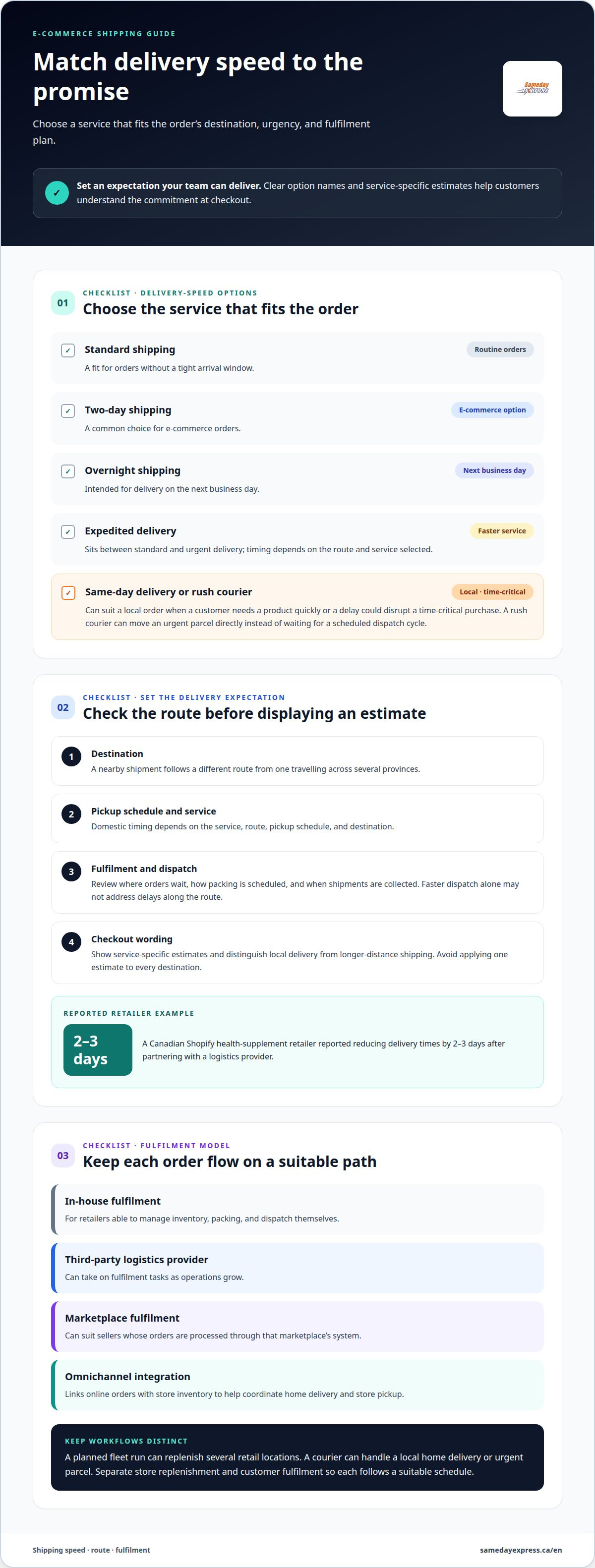
Delivery speed should match the order’s destination, urgency, and fulfilment plan. Standard shipping suits orders without a tight arrival window. Two-day shipping is a common e-commerce option, while overnight shipping is intended for delivery on the next business day. Expedited services fall between standard and urgent delivery, with timing shaped by the route and service selected. Clear option names help customers understand the commitment at checkout.
Same-day delivery can suit a local order when a customer needs a product quickly or a delay would disrupt a time-critical purchase. A rush courier can move an urgent parcel directly instead of waiting for a scheduled dispatch cycle. For example, a retailer could keep routine orders on its standard path and use a faster service for an urgent replacement. State the delivery window clearly for each option.
Domestic delivery timing depends on the service, route, pickup schedule, and destination. A nearby shipment follows a different route from one travelling across several provinces. Show service-specific estimates at checkout and distinguish local delivery from longer-distance shipping. For nationwide orders, use the destination and selected service to set expectations rather than applying one estimate to every customer.
A Canadian Shopify health-supplement retailer reported reducing delivery times by 2-3 days after partnering with a logistics provider. The example shows why retailers should assess fulfilment and transit together: faster dispatch alone may not address delays along the route. Review where orders wait, how packing is scheduled, and when shipments are collected. Those operational details can affect the delivery experience customers receive.
Choose a fulfilment model that fits your team and order flow. In-house fulfilment suits retailers that can manage inventory, packing, and dispatch themselves. A third-party logistics provider can take on fulfilment tasks as operations grow. Marketplace fulfilment can suit sellers whose orders are processed through that marketplace’s system. Omnichannel integration links online orders with store inventory, helping coordinate options such as home delivery and store pickup.
Distribution-centre-to-store fleet deliveries serve a different purpose from individual home orders. A planned fleet run can replenish several retail locations, while a courier can handle a local home delivery or urgent parcel. Separate these workflows in your order system so store replenishment and customer fulfilment follow suitable schedules. Keep pickup timing and packing cut-offs visible to the teams preparing each shipment.
For urgent local orders, same-day delivery for online retailers can complement routine shipping and store pickup. Assign faster delivery to orders with a clear timing need, then communicate the selected service and expected delivery window at checkout.
Domestic options include standard, expedited, two-day, and overnight delivery, with overnight intended for the next business day; same-day service may suit local orders. Actual timing depends on the service, route, pickup schedule, and destination.
Shipping options and checkout choices for online retailers
Canadian online stores can offer standard parcel delivery, expedited service, local courier delivery, and store pickup. Each suits a different order profile. A customer near a store may prefer pickup, while a package going to another province may need a parcel carrier. For a Canada-United States shipment, identify cross-border delivery at checkout and explain any import-related steps before the order is placed.
Retailers can streamline shipping by matching package sizes to products, reviewing carrier options, and avoiding unnecessary packaging. For example, a compact box for a small item wastes less space than using one large box for every order. Track similar shipments over time to see whether packaging changes improve the process.
Set free-shipping eligibility based on order margins and typical basket size, then display the threshold before payment. Show tracking availability and delivery estimates beside each checkout option. Make promises specific to the selected service and destination, and send an update if the order’s status changes. Clear checkout details help customers choose confidently.
Checkout choices should reflect how inventory moves through your business. A retailer with physical locations can offer store pickup when the selected item is available nearby. A local courier may suit an order that needs delivery within the same area. Standard and expedited parcel services support shipments travelling farther. For cross-border orders, present Canada-United States delivery as a distinct option, with import documentation handled as part of the shipment process.
Order volume can influence how retailers choose delivery services and manage inventory. A store shipping occasional orders may prefer a straightforward manual process. As volume grows, shipping software can connect the online store to order records, label creation, and tracking updates. Integration supports consistent order processing, while a clear packing workflow reduces errors between the warehouse and dispatch. Consider these factors when selecting shipping solutions for online retailers.
Review checkout performance using practical signals such as abandoned carts, customer questions about delivery, and order delays. If customers ask whether a package has shipped, improve tracking visibility and notification timing. If pickup orders are delayed, align store inventory records with checkout availability. Shipping solutions for online retailers work best when delivery options and customer updates reflect the store’s actual operations across Canada.
Criteria for choosing a Canadian logistics partner
Start by mapping your Canadian customer locations against a partner’s service area, including rural destinations, remote communities, and the provinces where orders are concentrated. A retailer shipping mainly within one province has different operational needs from one serving customers nationwide. For Canada-United States shipments, assess whether cross-border support fits your order workflow and handles the information required for customs processing.
Next, assess shipment visibility. Find out how tracking information reaches your store and customers, and how quickly status changes appear. Follow a sample order from pickup through delivery, then review its tracking record. Check whether your service team can use that record to answer a customer asking about a delayed package, without sending the customer through several support channels.
Handling matters for products that need specific care. Compare a partner’s procedures with your products, packaging, and delivery requirements. For example, a retailer shipping fragile glassware should assess parcel handling and how damage reports are managed. A business shipping temperature-sensitive goods needs a process suited to those shipments. For cross-border orders, review how shipment records and customs documents are handled.
Canadian online retailers use shipping providers such as Canada Post, UPS, FedEx, Purolator, and DHL. The right fit depends on your destinations, delivery options, shipment types, and support needs. Local couriers are another option for nearby deliveries or shipments requiring direct service.
Check operational fit before changing providers. Review how the partner connects with your ecommerce platform, inventory records, order processing, and returns workflow. For instance, if a returned item needs inspection before restocking, define who receives it and how its status updates inventory. Clear responsibility at each step helps streamline operations and reduce confusion between store staff and logistics teams.
Compliance depends on what you ship and where it travels. For Canada-United States orders, review how shipment details and customs support fit into the process. For regulated or sensitive products, assess handling procedures against the requirements that apply to those goods. Document who prepares shipment information, who can access it, and how exceptions are escalated.
Compare ecommerce shipping solutions using the same sample orders and destinations. Review coverage, tracking, handling, returns, customer support, and platform integration side by side. This gives your team a practical basis for choosing a partner that suits current operations and anticipated order patterns. For cross-border shipments between Canada and the United States, explore cross-border delivery support as part of your logistics planning.
Assess Canada Post, UPS, FedEx, and Purolator against your destinations, shipment types, delivery options, tracking, handling, platform integration, and support needs. The right fit depends on your operations, not a single ranking. Local couriers may suit nearby deliveries or shipments requiring direct service.
Ask providers to substantiate service claims with performance data: a logistics provider reports a perfect order ratio of 99.95%. Facilities near major population centres can deliver to 97% of customers within two days, so compare these measures with your own delivery priorities.
Sameday Express
We provide Canadian online retailers with delivery options for orders that need a faster, more direct response than routine shipping. The right option depends on the destination, urgency, and whether the order is local or travelling farther. We can handle selected orders without routing every parcel through the same delivery plan.
For a customer waiting on an urgent purchase or replacement, our same-day delivery can move the order on the day it is collected. We also offer rush delivery when a shipment needs prompt attention. These services suit time-sensitive cases, such as a replacement that cannot wait for the next regular dispatch cycle.
Our Sameday Direct drive service suits orders that need direct transportation between pickup and delivery points. We can coordinate an important shipment between locations or arrange delivery outside a retailer’s usual parcel workflow. Provide us with the pickup and destination details, parcel readiness, and required timing so we can plan the shipment to suit its needs.
For shipments between business locations, our Direct drive service offers a route-specific option without requiring a retailer to change its routine process for every order. A retailer might use it for time-sensitive replenishment while standard fulfilment continues to handle routine customer parcels. Separating urgent shipments from regular order volume helps match each delivery method to the order.
Before arranging a shipment, identify its pickup location, destination, contents, size, and timing requirements. Then match those details to the need: our same-day delivery for an urgent local order, rush delivery for a time-sensitive parcel, or Sameday Direct drive for direct transportation. This gives retailers a clear basis for choosing among our available options.
Our services are most useful when a routine ecommerce delivery plan cannot meet an order’s timing or route requirements. For standard parcels without an urgent deadline, retailers can continue using their regular shipping workflow. For an urgent order or direct shipment, we provide delivery options that can fit within a retailer’s wider logistics plan.
Contact Sameday Express Inc. to discuss a delivery requirement for your online store.
Make your next delivery decision with confidence
We help you separate routine orders from shipments that need a more direct response. This distinction helps your team choose a suitable service without changing the process for every customer. As you refine shipping solutions for online retailers, focus on the order’s urgency, destination, and checkout delivery commitment.
For time-sensitive shipments, we offer same-day delivery, rush delivery, and Sameday Direct drive. These options support orders that need prompt delivery or direct transportation, while your regular fulfilment process continues to handle other parcels.
Bring the shipment details and delivery requirement together before deciding on the next step. Contact us to discuss a delivery need for your online store and move forward with a clear plan.
Frequently Asked Questions
How can online retailers arrange shipping in Canada?
Retailers can review shipment history and discuss recurring volume with carriers to identify suitable services. A clear record of parcel sizes, destinations, and shipping frequency helps show what services the business needs. Consolidating compatible shipments may also make dispatch more efficient. Assess each service against coverage, delivery options, tracking, and your order patterns.
What are the rules for shipping online orders across Canadian provinces and territories?
Handling requirements depend on what an order contains and where it is going, so no single checklist applies to every parcel. Use a complete destination address, an accurate description of the goods, and packaging suited to the contents. Some products may have additional transport or handling requirements. Before dispatch, identify the requirements that apply to the item and destination, then prepare the shipment accordingly.
How do Canada Post, UPS, FedEx, Purolator, and couriers compare for e-commerce shipping in Canada?
Compare Canada Post, UPS, FedEx, and Purolator against each order’s details, then choose the carrier that fits your service needs. Local couriers can suit nearby deliveries and may offer a practical option for local customers.
What delivery options and times are available for Canadian online stores?
Domestic options include standard, expedited, two-day, overnight for next-business-day delivery, and same-day service for some local orders. Timing also depends on the route and pickup schedule.
Disclaimer
Blog Disclaimer
The information published on the Sameday Express Blog is provided for general informational and educational purposes only. While we strive to keep all content accurate and up to date, Sameday Express makes no representations or warranties of any kind, express or implied, regarding the completeness, accuracy, reliability, suitability, or availability of the information contained in our articles.
The content on this blog does not constitute legal, customs, tax, regulatory, financial, or professional advice. Shipping regulations, carrier policies, customs requirements, and transportation laws may change without notice and may vary by destination. Readers should verify current requirements with the appropriate government authorities, carriers, or qualified professionals before making shipping or business decisions.
Sameday Express is not liable for any loss, damage, delays, or consequences arising from the use of, or reliance on, information published on this website. Any actions taken based on the information provided are at the reader's own risk.
References to third-party companies, products, services, or websites are provided for informational purposes only and do not constitute an endorsement or recommendation by Sameday Express.
All blog content, including text, graphics, images, and logos, is the property of Sameday Express unless otherwise stated and may not be reproduced or distributed without prior written permission.
For specific shipping requirements, pricing, transit times, or logistics solutions, please contact Sameday Express directly for personalized assistance.


