

Two fulfillment services can look similar at first, but the way each provider handles orders can affect how smoothly your operations run as order volumes grow. When comparing fulfillment services, look at receiving, storage, picking, packing, shipping and returns.
A lightweight, single-item order takes less handling than a multi-item order that needs special packaging. Product dimensions, storage requirements, returns and delivery destinations also affect the work involved. Order volume is only one factor in fulfillment operations.
This guide explains common fulfillment processes and how order size, product details, returns and shipping destinations affect the work involved. Use it to understand how orders move through fulfillment and identify which parts of your operation need attention.
Key Takeaways
- Sameday Express provides logistics services for receiving, storage, picking, packing, shipping and returns.
- Vehicles are tracked by GPS, and trained drivers follow chain-of-custody procedures for sensitive materials.
- Order size, product dimensions, packaging needs and return handling all affect the work involved.
- Shipment destinations and delivery speed influence shipping requirements, so order profiles matter when planning fulfillment.
- For urgent shipments, Sameday Express offers same-day delivery, Sameday Direct Drive, rush delivery and Montreal-to-Toronto Direct Drive.
Same-Day Delivery from Sameday Express Inc.
Fulfillment arrangements support recurring inventory and orders. A time-sensitive shipment presents a separate operational need: a particular item must move to a specific destination on an urgent schedule. Sameday Express Inc. offers same-day delivery, Sameday Direct drive, rush delivery and route-specific direct drive for businesses arranging urgent shipments.
These services help businesses define a delivery task clearly. An e-commerce company might need to address an exceptional customer order, while another organization may need a document or replacement item moved for a scheduled operation. Start with the shipment’s purpose and deadline, then provide its pickup and delivery details. This keeps the request focused on the immediate delivery rather than the company’s full fulfillment program.
When same-day delivery fits
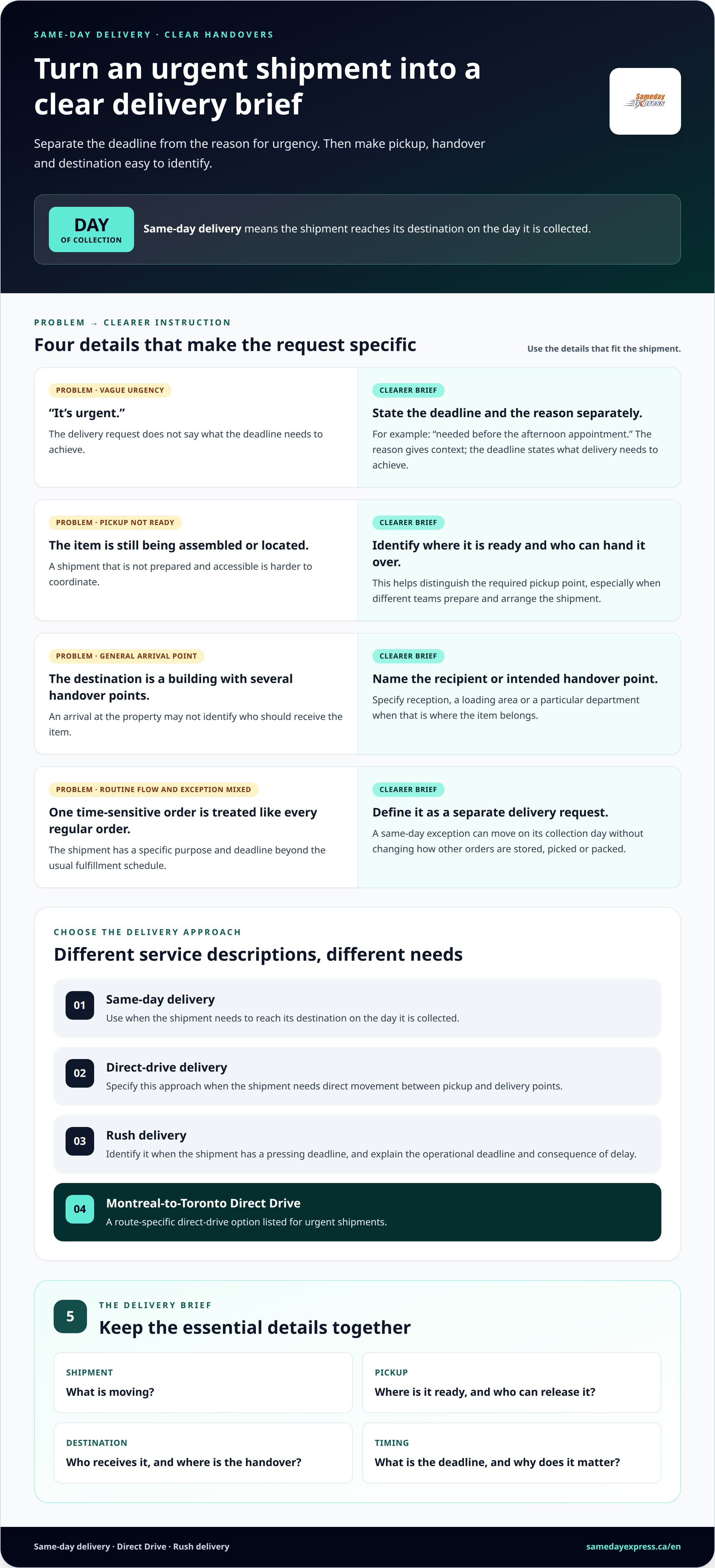
Same-day delivery is for a shipment that needs to reach its destination on the day it is collected. It is relevant when the delivery day itself is the central requirement, such as an urgent business order, an item needed for a scheduled task or paperwork required for an upcoming appointment. The business should communicate the deadline in plain terms so the delivery request reflects the operational need.
Consider an online retailer handling an exceptional customer order. Its usual fulfillment process may cover routine order preparation and dispatch, while this order needs a separate delivery arrangement. Same-day delivery moves that shipment on its collection day without changing how the retailer stores, picks or packs its other orders.
The same distinction applies beyond online retail. A replacement component might be needed at a worksite before a planned task can proceed. A signed document may need to reach a recipient before a meeting. In each case, there is a specific item and a time-sensitive outcome. Describe that outcome to give the delivery request a practical focus.
Make the request clearer by separating the deadline from the reason for urgency. The reason provides useful context, such as a customer commitment or scheduled activity. The deadline states what the delivery needs to achieve. For example, “needed before the afternoon appointment” describes a more specific constraint than “urgent.” This helps everyone understand the shipment’s priority.
Collection readiness is another practical part of planning. A shipment that is prepared and accessible is easier to coordinate than one still being assembled or located. The person arranging the delivery should be able to identify where it is ready for pickup and who can hand it over. This is especially useful when a business has several receiving or dispatch points and the shipment is being prepared by a different team from the one arranging delivery.
A clear receiving point matters at the destination as well. A building may have several entrances, departments or delivery desks. Naming the intended recipient or handover point distinguishes the required delivery from a general arrival at the property. At a business location, internal instructions can clarify whether the item belongs at reception, a loading area or a particular department.
Same-day delivery works best as a defined response to a specific shipment need. It gives a business an option when an item’s delivery date cannot follow the ordinary schedule. The request is easier to coordinate when it identifies the shipment, its ready time, the destination and the deadline in terms both sending and receiving teams understand.
How Sameday Direct drive serves urgent shipments
Direct-drive delivery is the right service type to specify when a business needs direct movement between pickup and delivery points. It describes the delivery approach, rather than defining urgency only by the delivery day. A business might choose it for a particular shipment that supports a time-sensitive operation.
For example, a company may have an item ready at one facility and need it at another for a scheduled business task. The sender should identify what is moving, the destination and required timing, then state that direct-drive delivery is the requested approach. This turns a general request for speed into a specific logistics requirement.
Direct-drive delivery can also keep an exception distinct from routine order flow. A business may have a recurring fulfillment process for regular shipments, while a particular item serves a different operational purpose. Giving it a separate delivery request helps teams track its priority without changing the wider fulfillment routine.
Preparation within the sending business can support a clear handover. The item should be identifiable, its destination information should be available, and the person coordinating the shipment should know who can release it. The receiving team can also be informed about the expected delivery and the person or department responsible for accepting it. These are straightforward coordination details, not additional delivery services, and they make the business’s instructions easier to follow.
It is useful to describe the direct-drive need in terms of the operation it serves. A request might relate to a production task, a business-to-business order or a time-sensitive internal transfer. The context tells the delivery team why the shipment has priority, while the origin, destination and timing define the movement required. Keeping those details distinct makes the request more precise and helps avoid confusion between the service choice and the business reason behind it.
For an e-commerce business, this arrangement can address an individual delivery exception without changing how routine orders are fulfilled. For an organization with several operating locations, it can describe the movement of a specific item between sites. In either case, the request concerns a defined shipment, not a change to the entire logistics model.
When rush delivery is the right fit
Rush delivery suits a shipment with a pressing deadline. It signals that an item has become a priority in the business’s schedule. Explain the operational deadline and the consequence of delay, then identify rush delivery as the requested service.
For example, a business may learn that a recipient needs an item earlier than expected. A planned task may also be brought forward, changing the delivery priority. In these situations, the request should explain what has changed and what outcome is now needed. That context helps distinguish a genuine rush requirement from a routine shipment that simply needs to be tracked as part of normal operations.
Rush delivery and same-day delivery describe related but different parts of a request. Rush delivery signals urgency; same-day delivery specifies the required delivery day. If both apply, state both clearly. This removes guesswork about the deadline and keeps the request focused on the result the shipment needs to support.
Link urgency to a business event where possible. A scheduled installation, customer handover or work task waiting on a particular item gives the request a concrete reason. Identify the latest useful arrival time and whether the recipient has a specific receiving point. This is more actionable than simply labelling the shipment “important.”
Rush delivery can help manage exceptions while routine fulfillment and dispatch plans continue as usual. If only one order or item has an immediate deadline, assign it a separate priority. This lets the business handle the exception as a distinct delivery task without treating every shipment as urgent.
Clear communication between sender and recipient supports the delivery request. The recipient should know what item is expected and who will receive it. The sender should have a contact who can clarify handover details. These steps help prevent avoidable delays caused by uncertainty about where the item belongs or who is ready to accept it.
When explaining a rush request, focus on the delivery outcome instead of using urgency labels interchangeably. State whether the shipment needs same-day delivery, direct-drive delivery or urgent movement through a rush request. If more than one description applies, give the required timing and service type together. Clear instructions help align the delivery with the business need.
Route-specific direct drive
A route-specific direct-drive service applies when a business needs a shipment moved along a defined route. The origin and destination are central to the request, distinguishing it from a general urgent delivery. Sameday Express offers Montreal-to-Toronto direct drive for shipments between those locations.
This service can suit a particular order, component or document moving between the named locations. State the direction of travel and the exact pickup and delivery points. A city pair describes the broad route; the business addresses specify where the shipment starts and where it must be received.
A route-based request is useful when different teams manage the sending and receiving locations. The sending team can confirm that the item is ready, while the recipient prepares for the handover. Naming a contact at each end clarifies who is arranging the shipment and who will accept it.
Connect the route to the shipment’s purpose. An item might support a scheduled task, fulfil an urgent order or reach a colleague responsible for the next stage of work. The reason provides context, while the route and deadline define the delivery request.
Route-specific direct drive addresses an individual movement between defined points. It is separate from broader questions about inventory storage or serving a company’s general customer base. This makes it easier to treat the shipment as a discrete requirement while other orders continue through their usual fulfillment process.
Do not rely on the route name alone as a complete set of instructions. Include the pickup address, destination, shipment description and receiving contact. If a deadline is tied to an event, state it directly. Shipment-level details help ensure the route request reflects the job that needs to be done.
Define the requirement before choosing
A precise delivery request begins with practical details about the shipment. Be ready to describe:
- Shipment: Identify the item or order and provide enough detail for the receiving team to recognize it.
- Collection: State where it is ready and identify the person who can hand it over.
- Destination: Provide the delivery location and the appropriate receiving point.
- Deadline: Explain the time-related business need in direct terms.
- Service requirement: Identify same-day delivery, Sameday Direct drive, rush delivery or the route-specific direct-drive option that fits the request.
This information keeps the service request focused and separates the shipment from the wider business process around it. A warehouse team may prepare the item, a manager may set the deadline and a recipient may confirm the handover point. When each person understands their role, fewer questions remain unanswered.
Set the deadline according to the actual operational need. A fixed appointment or scheduled task creates a specific arrival requirement. A preference for faster delivery is different, so describe it accurately. Clear wording shows whether the shipment supports a firm business commitment or a general desire to move it promptly.
For recurring e-commerce orders, treat a time-sensitive delivery as a distinct exception, not a replacement for standard fulfillment. Routine orders can continue through the usual preparation and dispatch process, while the urgent shipment follows a separate request. This helps manage customer expectations and keeps exceptional delivery apart from regular order handling.
Choose service descriptions that match the shipment’s actual need. Same-day delivery specifies the required delivery day. Rush delivery signals urgency. Direct-drive delivery identifies the delivery approach, while a route-specific option names a defined route. State the relevant service, then explain the deadline, purpose and handover requirements.
Preparation is also a coordination responsibility. The sending team should know when the item will be ready, and the receiving team should know where it will be accepted. If someone other than the person arranging delivery will release the item, identify that contact. Naming the intended recipient can also clarify instructions when a business spans departments or locations.
These details are useful for more than urgent orders. They create a clear record of what the business asked to move and why the timing matters. That clarity can help internal teams coordinate future exceptions and distinguish urgent shipments from standard dispatches. The goal is not to add complexity, but to make the request understandable to the people responsible for releasing and receiving the item.
Sameday Express offers same-day delivery, direct-drive delivery, rush delivery and Montreal-to-Toronto direct drive for businesses arranging time-sensitive shipments. Describe the item, route, deadline and handover points to give the request a clear operational basis.
Contact Sameday Express Inc. to discuss an urgent delivery requirement.
Frequently Asked Questions
What makes up fulfillment costs?
Fulfillment costs typically combine receiving, inventory storage, order picking and packing, packaging materials, shipping and returns. The total may also include account or technology charges and extra services such as product kitting. A business shipping fragile items, for example—such as online retailer VanityBathroomWorld handling mirrors and basin units—may need more protective packaging than one shipping compact, ready-to-pack goods. The work involved in each order, not just order volume, shapes the total.
How does a 3PL calculate fulfillment costs for your business?
A third-party logistics provider bases charges on your inventory, order patterns, products and shipping needs. It may consider how goods arrive, how much storage they occupy, the number of items picked per order, packaging requirements, delivery destinations and returns. A business with multiple product types or special packing instructions may need different handling from one shipping identical items. The quote reflects the services and activity involved.
How is 3PL fulfillment priced in Canada?
In Canada, 3PL fulfillment is commonly priced as separate service charges or as a bundled charge per unit or order. A quote may also account for storage, inbound receiving, shipping, returns, and account-related services. The billing structure matters: a bundled rate can make the base charge easier to interpret, while separate line items show what each activity contributes. Compare what the quoted services include, not just the headline rate.
What are the common fulfillment center pricing models?
The main approaches are per-service pricing, where activities such as storage or packing have separate charges, and per-unit pricing, where a defined fulfillment service is billed for each unit or order. Some agreements also set charges by volume or apply tiers as activity changes. The key distinction is how the provider groups work and bills for it. Review which tasks are included and which remain separate before comparing models.
How much do fulfillment centres charge per order in Canada?
There is no single per-order amount for every Canadian business. Charges depend on what the rate includes, the number of items in each order, handling and packaging requirements, and whether shipping or storage is bundled. A simple order may require less work than a multi-item order with custom packing. To compare quotes, assess the full order profile and related charges, not one line in isolation.
What are typical Canadian fulfillment center storage fees per pallet, bin, or cubic foot?
Storage may be billed by pallet space, bin or shelf location, or occupied cubic footage. The billing unit depends on how inventory is stored and how much warehouse capacity it uses. Storage duration and product requirements may affect the charge too. Bulky stock may be billed differently from compact items, even when the number of products is similar.
What additional fulfillment center fees should businesses expect, such as setup, account, packaging, or returns fees?
Potential additional charges include account setup or technology services, packaging materials, return inspection and restocking, label printing, and extra handling such as kitting. Some providers include certain materials in the packing charge and bill for others separately. Returns may involve receiving an item, assessing its condition and deciding whether it can re-enter inventory. Applicable charges depend on the services and handling steps in the agreement.
How do fulfillment center pricing models compare: pay-as-you-go, tiered, subscription, and volume-based?
Pay-as-you-go pricing ties charges to the services used. This can suit changing activity, though totals may be less predictable. Tiered pricing changes rates at set activity levels; subscription pricing uses a recurring charge for specified services. Volume-based pricing links rates to order or unit volume. These approaches can overlap with per-service and per-unit billing, so compare the billing basis, included work and any minimum commitment.
Disclaimer
Blog Disclaimer
The information published on the Sameday Express Blog is provided for general informational and educational purposes only. While we strive to keep all content accurate and up to date, Sameday Express makes no representations or warranties of any kind, express or implied, regarding the completeness, accuracy, reliability, suitability, or availability of the information contained in our articles.
The content on this blog does not constitute legal, customs, tax, regulatory, financial, or professional advice. Shipping regulations, carrier policies, customs requirements, and transportation laws may change without notice and may vary by destination. Readers should verify current requirements with the appropriate government authorities, carriers, or qualified professionals before making shipping or business decisions.
Sameday Express is not liable for any loss, damage, delays, or consequences arising from the use of, or reliance on, information published on this website. Any actions taken based on the information provided are at the reader's own risk.
References to third-party companies, products, services, or websites are provided for informational purposes only and do not constitute an endorsement or recommendation by Sameday Express.
All blog content, including text, graphics, images, and logos, is the property of Sameday Express unless otherwise stated and may not be reproduced or distributed without prior written permission.
For specific shipping requirements, pricing, transit times, or logistics solutions, please contact Sameday Express directly for personalized assistance.


