

An aircraft part, lab sample or time-critical business shipment can’t wait for a route built around transfers. A direct drive freight service moves freight from pickup to destination in a dedicated vehicle, without detours or unnecessary stops. For urgent shipments within Canada or between Canada and the United States, this means a direct route with real-time GPS tracking and a focus on delivery timing.
Urgent freight requires more than speed. You need reliable coordination, visibility while the shipment is moving and a service that fits the delivery window. Direct drive can support same-day and rush shipments, including cross-border transport, while avoiding terminals and cross-docking.
This article explains how direct drive supports Canadian and Canada-U.S. shipping, what helps keep routes reliable, and how tracking works. You’ll also learn when this approach suits urgent deliveries, what to consider for sensitive shipments, and how 24/7 availability on advance notice can support time-critical logistics.
Key Takeaways
- Learn how direct transport can support Canadian shipments without unnecessary stops or transfers.
- Understand the differences between less-than-truckload and full truckload shipping when planning a route.
- See how carrier coordination and shipment tracking can help keep delivery status visible.
- Identify when same-day or rush delivery may suit a time-critical pickup.
- Find out how advance-notice, around-the-clock availability can support urgent delivery needs.
Canadian Direct Drive Freight Services
Across Canada, Direct Drive road transportation moves a shipment from pickup to destination in a dedicated vehicle, with no transfers or unnecessary stops. It suits urgent business freight, important documents, fragile goods and sensitive materials. A time-critical shipment can travel directly between a supplier and a production site instead of joining a route with multiple scheduled transfers.
Specialized transport starts with the shipment’s requirements. A lab sample, delicate component or pallet needs clear handling instructions and a pickup plan suited to its size and destination. Direct transport can reduce handoffs. Suitable packaging and clear instructions help the driver handle the goods as intended. The vehicle and route must also fit the shipment.
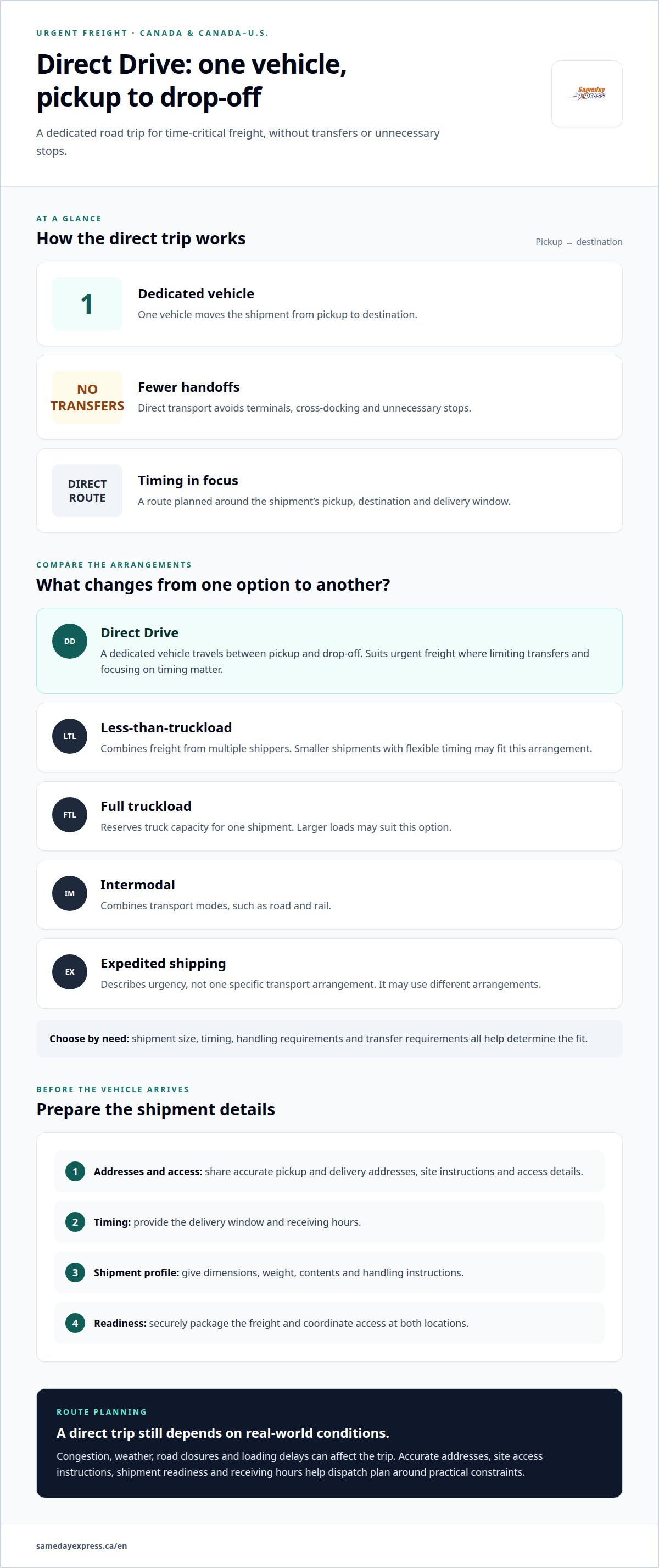
Direct Drive is one option within Canadian freight transportation. Intermodal transport combines modes, such as road and rail, while a full truckload uses the truck’s capacity for one shipment. Less-than-truckload shipping combines freight from multiple shippers. An interlining agreement coordinates transportation between carriers and may involve a handoff. Direct Drive instead centres on one vehicle moving the shipment from pickup to drop-off.
To book and prepare a shipment, provide the pickup and delivery addresses, timing, dimensions, weight, contents and handling instructions. Make sure the freight is securely packaged and both locations are ready for the vehicle.
- Share accurate pickup and delivery details.
- Describe the shipment and its handling needs.
- Prepare the freight and coordinate access at both locations.
Direct transportation limits transfers, but it can’t eliminate road risks. Congestion, weather, road closures or loading delays may affect the trip. A dedicated vehicle may also be less suitable when delivery timing is flexible and freight can move through a consolidated shipping plan. Match the service to the shipment’s urgency, handling needs and route to decide whether Direct Drive is the right fit.
Reliable Shipping and Delivery Routes
A dependable freight plan starts with accurate pickup and delivery details. Dispatch can then account for receiving hours, loading access, shipment dimensions and the delivery window. For example, a pallet bound for a production facility may need to arrive in line with its receiving dock schedule. Sharing these details early helps prevent avoidable delays at either end of the trip.
Direct drive, less-than-truckload (LTL), full truckload (FTL) and expedited shipping describe different arrangements. LTL combines freight from multiple shippers; FTL reserves truck capacity for one shipment. Direct drive focuses on a dedicated trip between pickup and delivery, while expedited describes urgency and may use different transport arrangements. Shipment size, timing, handling needs and transfer requirements help determine the best fit.
For domestic transportation, provide an accurate description of the goods and their handling needs. Dangerous-goods requirements depend on the shipment’s contents and applicable rules. Customs procedures do not apply to a domestic route. Clear shipment information helps the carrier plan appropriate handling without assuming every load has the same requirements.
Direct transportation can suit different freight sizes when the vehicle can carry the shipment safely. A carton of business documents, a fragile component or a pallet may qualify, depending on dimensions, weight, packaging and handling needs. Larger loads may suit FTL, while smaller shipments with flexible timing may fit LTL. The shipment’s requirements guide the decision.
There is no single typical transit time between Canadian cities. Distance, road conditions, pickup readiness, receiving hours, and route details shape the schedule. A direct trip between two distribution centres, for instance, needs a plan based on the actual addresses and delivery window. A map estimate alone cannot account for every pickup and receiving constraint.
To support reliable routing, provide complete addresses, site access instructions, contact details, and the receiving window. Ensure the shipment is ready when the vehicle arrives, and tell dispatch promptly about changes. This gives the route plan practical details beyond the distance alone. Explore Canadian delivery options for transportation needs that call for a direct, time-focused route.
For an outbound freight movement, a shipper's declaration is described under paragraph 7(a) of Part VII of Schedule VI to Canada's Excise Tax Act. Keep this declaration in view when preparing shipment details, and ensure the people coordinating pickup and delivery have the information needed to plan the movement. Clear, consistent paperwork can support communication about the load and its route, alongside the addresses, site instructions, and receiving window provided for the shipment.
Carrier Coordination and Shipment Tracking
A direct shipment still requires coordinated pickup, dispatch and receiving. Before assigning a vehicle, the carrier needs the origin and destination, shipment dimensions, handling instructions and delivery window. For example, a laboratory pickup may require a named receiving contact and clear directions to the loading entrance. Accurate details help dispatch plan the trip and reduce avoidable calls or delays.
Coordination continues while the vehicle is moving. Dispatch can relay changes such as a revised delivery entrance, an unavailable recipient or a road closure affecting the route. A useful update explains what changed, where the shipment is and what action is underway. This gives the shipper and recipient practical information to adjust staff or dock schedules.
Real-time GPS tracking provides a view of the vehicle’s location during transit. It helps dispatch follow the route and share progress with people waiting at the destination. Tracking shows location, not the condition of the goods or proof of delivery by itself. For temperature-sensitive medications or fragile components, handling instructions and delivery confirmation address different parts of shipment control.
Insurance, liability and tracking serve different purposes. Real-time GPS tracking reports vehicle location, while coverage terms define responsibility for loss or damage. The shipment description, packaging, declared value and agreed service terms can all affect how responsibility is handled.
For lab samples or other sensitive materials, chain-of-custody documentation can record each handoff. A practical record may identify who released and received the package and when the transfer took place. With a direct vehicle trip, fewer handoffs can simplify recordkeeping. The shipper should also provide clear instructions for restricted access or delivery to a specific department.
Use a consistent coordination sequence for each shipment:
- Record the pickup and delivery addresses, contacts, and access instructions.
- Confirm the shipment description, packaging, and handling requirements.
- Share the delivery window and any receiving constraints with dispatch.
- Follow tracking updates and communicate route or contact changes promptly.
- Record delivery confirmation and any required chain-of-custody handoff.
For example, if a receiving dock closes earlier than expected, an update can prompt dispatch to coordinate access before arrival. Clear ownership of updates keeps the shipper, driver and recipient aligned. It also makes exceptions easier to trace after delivery, especially when the shipment requires a named recipient or documented handoff.
Time-Sensitive Pickup and Delivery
A delayed pickup can interrupt production, postpone a repair or leave a clinic waiting for supplies. Direct-drive courier services use a dedicated vehicle to travel from pickup to drop-off, without detours or unnecessary stops. Sameday Express provides same-day delivery, making this option suitable when a shipment needs to move on the day it is collected. The plan depends on the route, shipment readiness and receiving arrangements.
Start by defining the deadline clearly. “Deliver today” is less useful than a receiving window and a named contact at the destination. For example, a manufacturer awaiting a replacement component should share the part’s location, the plant’s receiving entrance and when staff can accept it. These details let dispatch coordinate pickup and delivery as one movement.
Preparation matters as much as the drive. An unready package, insecure packaging or incomplete delivery instructions can delay the handoff. Before the vehicle arrives, have the item packed, labelled for the recipient and accessible at the agreed pickup point. The receiving team should know who will accept it and where.
For urgent business freight, dispatch coordination can follow a practical sequence:
- Record the shipment’s contents, dimensions, handling needs, and pickup location.
- Set the delivery deadline and provide a receiving contact and access details.
- Make the package ready before the driver reaches the pickup point.
- Share changes promptly, such as a revised entrance or recipient contact.
- Confirm receipt with the destination contact after delivery.
These steps help align the driver, shipper and recipient. They also make time-sensitive transport more predictable, because each party understands what happens next. For a pharmacy delivery, for instance, clear recipient details help direct the package to the intended location instead of an unattended loading area. Sensitive contents may require specific handling instructions before pickup.
Same-day delivery is useful for urgent documents, a replacement machine component or supplies needed to keep scheduled work on track. It is less suited to freight with a flexible deadline that can move through a consolidated route. A direct trip limits transfers but cannot eliminate delays caused by traffic, road conditions, late freight readiness or restricted receiving hours. Build the schedule around the shipment’s real deadline and practical pickup and delivery conditions.
24/7 Availability
Round-the-clock freight availability matters when a shipment cannot wait for a standard dispatch window. An urgent replacement component needed to address an aircraft-on-ground situation is one example. AOG service operates 24/7 for critical aviation parts delivery. A separate premium urgent-delivery option is available 24/7 on advance notice, so planning still begins with the shipment details and timing.
Advance notice helps dispatch organize an evening or weekend pickup. Provide the collection address, destination, shipment description, readiness time and receiving contact. For example, a maintenance team arranging an aircraft part can identify the hangar entrance and the person accepting delivery. Clear details help coordinate pickup with the site’s access arrangements.
Availability does not mean every shipment follows the same plan. A carton ready at a staffed loading dock differs from a part held at a secured facility. The pickup contact, site access, packaging and delivery instructions all shape coordination. A defined receiving window also helps avoid sending a vehicle to a location that cannot accept the freight.
For urgent after-hours requests, keep the shipment information together and share any changes promptly. A practical dispatch handoff includes:
- The exact pickup and delivery addresses.
- A named contact at each location and current phone details.
- The shipment’s contents, packaging, and handling instructions.
- The required delivery time and any site access restrictions.
- Confirmation that the freight is ready for collection.
These details are especially useful when the destination is a hospital, laboratory or aviation facility with controlled access. A receiving contact can guide the driver to the correct entrance and confirm the handoff. For cross-border shipments between Canada and the United States, timing also depends on border processing and shipment documentation. Share those details during coordination; a direct route does not replace border procedures.
Use around-the-clock transport when a delay could interrupt an aircraft repair or leave an essential shipment waiting until regular operations resume. For routine freight with a flexible deadline, a scheduled service may be a better fit. To arrange urgent transportation, contact our delivery team with the pickup details, destination, and required timing.
Sameday Express Direct Drive Services
We help Canadian businesses choose a delivery option based on shipment urgency and route requirements. Our services include same-day delivery, Sameday Direct drive, rush delivery, and direct drive between Montreal and Toronto. Each option addresses a different need, from a shipment required on collection day to freight that needs a direct trip. The pickup details and deadline help shape the plan.
Same-day delivery can suit a business that needs an item to reach its destination on the day it is collected. For example, a company in Montreal may need documents delivered to a partner before a scheduled meeting. Sharing the collection point, recipient details, and delivery timing helps establish the shipment’s requirements and coordinate the next steps.
Direct-drive delivery suits businesses seeking transportation straight from pickup to delivery. It may work for a time-critical package travelling from a warehouse to a production site or a component needed at a service location. The contents, dimensions, handling needs, destination and timing help define the request and determine whether a direct trip fits the shipment.
Rush delivery serves businesses that need priority attention for an urgent shipment. A delayed supply or replacement item can interrupt scheduled work, so clear pickup and receiving details matter. Provide an accurate address, a contact at each end and any site access instructions. These details help coordinate delivery without relying on assumptions about the location or handoff.
The Montreal-to-Toronto direct drive option is relevant for businesses moving freight between those cities. Share the pickup and delivery addresses, shipment description, and required timing so the transportation plan reflects the actual route. Businesses can consider the available services according to their needs:
- Same-day delivery: for an item needed at its destination on collection day.
- Sameday Direct drive: for freight requiring direct transportation.
- Rush delivery: for urgent shipments where timing is a priority.
- Montreal-to-Toronto direct drive: for direct transport between these cities.
Before arranging a shipment, gather its contents, dimensions, pickup address, destination, preferred timing and receiving contact. These details help clarify the service requirements. A direct trip may suit urgent freight, while a flexible deadline may call for a different arrangement. Matching the option to the shipment’s route and delivery needs supports efficient planning.
Contact us to discuss your shipment and delivery requirements.
Plan Your Next Shipment with Confidence
The next step is to turn your delivery requirement into a workable shipment plan. Set the deadline, identify receiving constraints, and gather the pickup address, destination, freight description and contact details. This gives dispatch a clear starting point and helps match the service to the shipment’s urgency.
We offer Same Day Delivery, Direct-drive delivery and Rush delivery. A direct drive freight service can suit a shipment that needs a dedicated trip instead of a consolidated route. The right option depends on the pickup, destination, timing and handling needs. Clear information helps define the movement without assumptions about the route or deadline.
Prepare the shipment details before reaching out, especially when timing is tight or the receiving site has access limits. Include a named contact and confirm the package is ready for pickup. If delivery must meet a firm receiving window, include it with the other shipment details. This provides a practical starting point and helps clarify the next steps.
Contact us about freight to discuss your shipment. With the key details in hand, you can move forward with a clear plan for your delivery needs.
Frequently Asked Questions
Why Use a Direct Drive Courier Service?
Choose direct drive when a shipment’s timing or handling makes intermediate transfers undesirable. A legal team sending signed documents for a scheduled business meeting, for example, may value a single-vehicle trip and a clear delivery plan. The service can also suit urgent replacement parts or sensitive packages. It is less useful when freight has a flexible deadline and can travel through a consolidated shipping arrangement.
What Does Direct Drive Freight Service Mean in Canada?
In Canada, a direct drive freight service moves a shipment in a dedicated vehicle from pickup to destination, rather than routing it through planned consolidation stops. The shipment stays on a direct trip, although normal road conditions can affect progress. To plan one, provide the carrier with the contents, dimensions, pickup readiness, delivery address and receiving contact.
Which Canadian Freight Carriers Offer Direct Drive Service?
We offer Sameday Direct drive for businesses needing direct transportation. Our related options include same-day delivery and rush delivery, which can fit different shipment deadlines. To identify a suitable service, share the freight description, pickup and delivery details, and required timing. This gives us practical information to assess the shipment and coordinate the movement. No other carrier list is needed to understand this available option.
What Canadian shipping rules apply to direct drive freight, including customs and dangerous goods?
For domestic transportation, provide an accurate description of the goods and their handling needs. Dangerous-goods requirements depend on the shipment’s contents and applicable rules. Customs procedures do not apply to a domestic route.
Disclaimer
Blog Disclaimer
The information published on the Sameday Express Blog is provided for general informational and educational purposes only. While we strive to keep all content accurate and up to date, Sameday Express makes no representations or warranties of any kind, express or implied, regarding the completeness, accuracy, reliability, suitability, or availability of the information contained in our articles.
The content on this blog does not constitute legal, customs, tax, regulatory, financial, or professional advice. Shipping regulations, carrier policies, customs requirements, and transportation laws may change without notice and may vary by destination. Readers should verify current requirements with the appropriate government authorities, carriers, or qualified professionals before making shipping or business decisions.
Sameday Express is not liable for any loss, damage, delays, or consequences arising from the use of, or reliance on, information published on this website. Any actions taken based on the information provided are at the reader's own risk.
References to third-party companies, products, services, or websites are provided for informational purposes only and do not constitute an endorsement or recommendation by Sameday Express.
All blog content, including text, graphics, images, and logos, is the property of Sameday Express unless otherwise stated and may not be reproduced or distributed without prior written permission.
For specific shipping requirements, pricing, transit times, or logistics solutions, please contact Sameday Express directly for personalized assistance.


