

Scaling logistics for a growing business starts with finding what slows orders down and improving the process before adding capacity. Map each step from purchasing through delivery, define clear performance measures, and use the results to decide where to adjust workflows, technology, inventory, or transportation. This creates a practical operating plan for growth instead of relying on rushed fixes.
As demand increases, disconnected systems and manual work make shipments harder to manage. Stock may be unavailable where customers need it, while staff spend time correcting records or chasing delivery updates. These problems can undermine customer service and make resource planning less reliable.
This guide explains how to find bottlenecks, automate repeatable tasks, and manage inventory and fulfilment more effectively. It also covers warehouse-location decisions and how to assess whether a third-party logistics provider fits your operation. Use these steps to build a network that can respond to changing demand while keeping daily processes clear and accountable.
Key Takeaways
- Map each step from procurement to delivery to spot where delays, errors, or hand-offs slow the operation.
- Set measurable performance goals, then use connected tools and automation to reduce manual work and improve visibility.
- Review stock levels, warehouse workflows, and order accuracy to balance availability with efficient fulfilment.
- Assess where customer demand is concentrated to decide whether positioning inventory closer to key markets could improve delivery.
- Choose a logistics partner whose services fit your shipment needs, delivery expectations, and plans for growth.
1. Assessing supply chain processes and bottlenecks
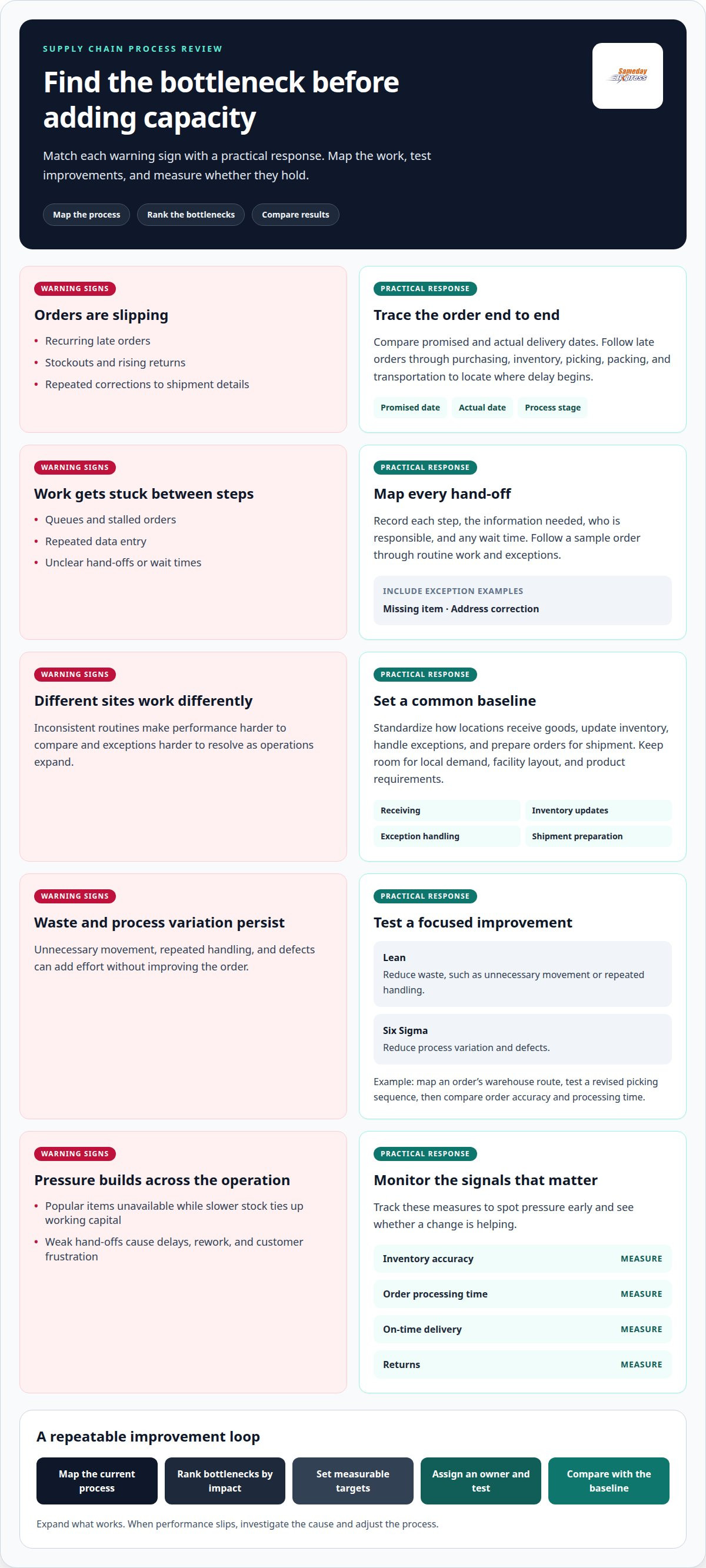
Recurring late orders, stockouts, rising returns, and repeated corrections to shipment details are common warning signs. They often point to a process that cannot keep pace with demand, not simply a need for more capacity. Compare promised and actual delivery dates, then trace late orders through purchasing, inventory, picking, packing, and transportation. As suppliers, distribution centres, routes, and transport modes multiply, this end-to-end view becomes essential.
Map the supply chain from procurement to the customer’s door. Record every hand-off, the information needed, the person responsible, and any wait time. Follow a sample order through the process, including exceptions such as a missing item or an address correction. Queues, repeated data entry, and stalled orders can reveal bottlenecks. Customer feedback and logistics performance data help show where delays are affecting service.
Standardize repeatable work before expanding it across facilities. Document how each location receives goods, updates inventory, handles exceptions, and prepares orders for shipment. Use consistent definitions for order accuracy and on-time delivery so teams can compare results fairly. Standardization does not require every site to handle every product identically. It establishes a common baseline while allowing for local demand, facility layout, and product requirements.
Start by standardizing order entry, inventory updates, picking, packing, labelling, and shipment hand-offs. These tasks involve frequent decisions and repeated data entry, making them practical candidates for consistent procedures and eventual automation. For example, standard exception codes can distinguish a stock discrepancy from a carrier delay. Clear codes help teams find the cause instead of treating every late order as the same problem.
Lean and Six Sigma provide structured approaches to process improvement. Lean focuses on reducing waste, such as unnecessary movement or repeated handling. Six Sigma uses a disciplined method to reduce process variation and defects. A team might map an order’s route through a warehouse, identify avoidable steps, and test a revised picking sequence. Compare order accuracy and processing time before and after the change to assess its effect.
The main risks of scaling are stockouts, delivery delays, and cash-flow pressure. Poor inventory visibility can leave popular items unavailable while slower-moving stock ties up working capital. Weak hand-offs can delay orders, cause rework, and frustrate customers. Expanding without clear processes also makes it harder to see where resources are tied up. Monitor inventory accuracy, order processing time, on-time delivery, and returns to spot pressure early.
Build your scaling plan on evidence, not assumptions. Map the current process, rank bottlenecks by their impact on customers and operations, and set measurable targets. Assign an owner to each improvement, test changes in a defined workflow, and compare results with the baseline. For scaling logistics for a growing business, this repeatable review builds flexibility: expand what works and investigate the causes when performance slips.
2. Digitization and automation for operational efficiency
Digital logistics tools help teams process orders consistently as shipment activity grows. Start with the data behind each decision: product identifiers, quantities, destinations, shipment status, and inventory availability. When these fields differ between systems, staff may have to reconcile records manually. A shared data structure gives each platform a more reliable basis for processing and reporting.
Canadian regulations, taxes, and customs requirements can affect shipment records and workflows. Requirements depend on the goods and destination, particularly for shipments between Canada and the United States. Include relevant shipment information in order records and review it before dispatch. This helps teams prepare documentation and manage exceptions without disrupting routine processing.
Choose software according to its function. Inventory management software records stock changes, a warehouse management system coordinates warehouse tasks, and a transportation management system supports routing and shipment monitoring. Connect these tools to sales and order platforms through APIs or EDI, which let systems exchange data. This can reduce duplicate entry and keep order, inventory, and shipment records aligned.
Automate a workflow only after its rules are clear. Label creation, shipment processing, status updates, and order routing are common repetitive tasks. For example, an order system can send an approved address and product details to shipping software to prepare the shipment record. Define an exception path for incomplete addresses, mismatched quantities, or unavailable services so automation flags problems instead of passing errors forward.
Test integrations against real operating scenarios before rolling them out across the business. Process a standard order, a multi-item order, and an order that needs staff review. Compare the source record with the information received by each connected platform. Check that changes to an order update inventory and shipment details correctly. Testing can also reveal duplicate records, missing fields, and unclear responsibility for resolving errors.
Measure performance after implementation. Compare processing time, order accuracy, shipment-status visibility, and manual corrections with the previous workflow. Review the results with employees who use the systems every day. If an automated rule creates repeated exceptions, adjust the rule or improve the source data before scaling logistics for a growing business. The goal is accurate execution, not automation for its own sake.
Returns can add useful information to digital workflows. Record each return’s reason, product, and inspection result, then review patterns for recurring fulfilment or product issues. For cross-border orders, consistent records also help teams organise shipment information across the hand-off. Businesses planning those routes can consult Canada-U.S. cross-border shipping information from Sameday Express Inc. as part of their workflow design.
Successful digitisation relies on thoughtful integration and ongoing evaluation. As order volumes increase, optimising logistics workflows can help prevent delays, higher costs, and dissatisfied customers. Manual handling of orders, labels, and tracking can take more time and increase the risk of errors as a business grows, so a scalable approach can streamline operations. APIs or EDI can share data with other platforms, reducing duplicate entry and manual reconciliation while supporting data-driven decisions for long-term efficiency.
3. Inventory management and fulfillment optimization
Forecast inventory and shipping demand by comparing product-level sales history with open orders, planned promotions, seasonality, and supplier lead times. Separate regular demand from one-time spikes, such as a large customer order, before setting replenishment targets. Review forecast accuracy after each planning cycle. If actual sales consistently differ from the forecast, adjust your assumptions before placing the next purchase order.
Set inventory policies according to product behaviour, rather than applying one rule to every item. Fast-moving products may need more frequent replenishment, while excess slow-moving stock can tie up space and working capital. Use inventory turns to identify products moving quickly or slowly, then consider demand patterns and supplier timing before changing order quantities. Track stockouts, too, since repeated shortages may mean reorder points need attention.
A warehouse management system can coordinate the detailed work behind fulfilment. Use location records to direct staff to the right product, and record picks as orders are assembled. When an order contains items stored in different areas, for example, a clear pick sequence can reduce backtracking. Review the warehouse layout as product velocity changes, and position frequently picked items for efficient access.
Plan inbound and outbound routing together. An incoming shipment may replenish an order due to leave soon, so receiving schedules should account for outbound commitments. Use cross-docking when incoming goods are already assigned to ready orders and can move to outbound staging instead of storage. This depends on reliable arrival information and coordinated receiving and dispatch plans.
A transportation management system can help compare routes and coordinate deliveries to different destinations. Group shipments by service requirements, destination, and readiness, then compare planned routes with actual delivery results. A late inbound arrival, for example, may make a planned dispatch impractical. Updating the shipment plan promptly helps the team respond and communicate a more accurate status.
Use a warehouse management system to track inventory locations and order progress through receiving, picking, packing, and dispatch. Review discrepancies by product and location instead of making broad stock adjustments. If one item repeatedly shows a mismatch, inspect its receiving record, storage location, and pick history to find where the count diverges.
Review inventory turns, order accuracy, processing time, on-time delivery, and returns as a connected set of indicators. A high return rate for one product may point to picking errors, while repeated dispatch delays may reflect a staging or routing issue. Compare patterns by product and destination, then adjust replenishment, warehouse practices, or transportation plans to address the specific cause.
4. Locating inventory closer to customers
Moving inventory closer to customers can shorten delivery routes and improve service, but it also adds locations to manage. Start by mapping customer orders by destination, product, and delivery timing. Compare order concentration across your customer base before deciding whether one warehouse can serve shipments efficiently. Build the distribution network around actual order patterns, not assumptions about where customers might be.
Test the decision against fulfilment records. Identify where orders originate, how long each route takes, and where shipments miss the promised delivery window. Compare the current setup with a proposed location or stock point. Account for inbound transportation, storage capacity, replenishment timing, and the work needed to keep inventory accurate at each site. A closer location helps only when stock is available as orders arrive.
More locations can increase flexibility, but splitting inventory may leave the wrong products in the wrong place. Review demand by product and destination, then decide which items to stock locally and which to keep centralized. A frequently ordered item in a high-demand area may warrant nearby stock, while a slower-moving product may be fulfilled from a central facility. Revisit these decisions as order patterns change.
Set customer delivery service-level agreements around realistic fulfilment steps. Define when an order is accepted, processed, dispatched, and considered delivered. These milestones make it easier to compare the customer promise with warehouse and transportation performance. If a delivery window depends on stock arriving from another facility, include that transfer in the plan instead of measuring dispatch alone.
Order tracking should show useful status changes from order placement through delivery. Connect inventory availability, fulfilment progress, and shipment updates so customers are not left with an order confirmation as their only information. Clear statuses such as “preparing,” “shipped,” or “delivered” show what is happening. Consistent updates also help service teams answer questions using the same shipment record.
Before investing in another facility, weigh the expected service improvement against added operating complexity. Consider replenishment routes, stock accuracy, staffing, and how each site will share order information. A regional node can support faster delivery where demand is concentrated; a central warehouse may suit a dispersed customer base with predictable shipping needs. The right network depends on product movement, delivery commitments, and the ability to keep stock balanced.
Review results by destination and fulfilment location. Track on-time delivery, order accuracy, stockouts, and the time from order placement to delivery. If orders in a particular area regularly miss their service-level agreement, determine whether the cause is inventory placement, processing, or transportation. Adjust the network only after finding the constraint. This connects each change to a customer outcome and gives the business a clear basis for expanding its logistics footprint.
5. Selecting third-party logistics providers
Outsourcing logistics can give a growing business access to external expertise, resources, and flexibility. A third-party logistics provider, or 3PL, may handle defined functions such as warehousing, order fulfilment, or transportation. Start by identifying the operational pressure you need to address, such as expanding delivery coverage or managing seasonal order peaks.
Choose between in-house fulfilment, a 3PL, and a fourth-party logistics provider, or 4PL, based on the control and coordination you need. In-house teams retain direct control over daily processes. A 3PL performs agreed logistics activities, while a 4PL typically coordinates multiple providers and the wider supply chain. Compare each model against your capabilities, order patterns, and expansion plans.
Assess a prospective partner against the work your business needs done. Review its service area, shipment types, systems, reporting, and ability to adapt as volumes or destinations change. A business expanding into new Canadian regions, for example, may need a partner that supports those routes and provides clear delivery updates. Match capabilities to operational requirements, not broad claims.
Define responsibilities before the partnership begins. Document order cut-off processes, inventory records, shipment hand-offs, exception handling, and customer updates. Set service-level measures that reflect your needs, such as order accuracy and on-time delivery. Assign a contact for routine coordination and a clear escalation path for delayed or incomplete shipments.
Plan the transition in stages. Begin with a defined group of products, routes, or fulfilment tasks. Compare the results with the existing process and resolve issues such as mismatched inventory records or incomplete shipment data. A controlled transition gives teams time to learn the new workflow before extending it to other orders or locations.
Keep the relationship active after launch. Review performance reports with the partner, discuss recurring delays, and agree on practical process changes. If growth shifts demand toward new destinations, revisit service coverage and delivery expectations. Shared forecasts and regular operational reviews help both teams plan capacity and respond to changing shipment needs.
Keep ownership of customer commitments, even when a partner does the work. Make sure customer-facing delivery promises align with actual fulfilment and transportation steps. Consistent records help your team respond accurately as order statuses change. Use service results and customer feedback to decide whether to adjust the agreement, change the workflow, or bring specific activities back in-house.
If delivery requirements include cross-border shipments between Canada and the United States, account for that route in your partner assessment and shipment planning. For support with logistics needs as your operation grows, explore logistics support options.
share updates promptly. One or two carriers may not meet changing regional or delivery needs; multiple carriers can support expansion and flexible options without additional integrations. Partners should adapt, customize solutions, and offer supply-chain insights.
Sameday Express: same day delivery
Sameday Express Inc. can support businesses that need urgent shipments moved without waiting for a routine shipping cycle. Its same-day delivery, rush delivery, and Sameday Direct drive options suit time-sensitive orders that need a direct delivery plan. For shipments between Montreal and Toronto, Montreal to Toronto Direct Drive provides a route-specific option.
These services can address urgent delivery needs as part of a broader logistics plan. Use them when a shipment's timing or destination calls for a faster, direct approach than your standard fulfilment workflow.
Contact Sameday Express Inc. to discuss your delivery needs.
Make your next logistics change count
Growth is easier to manage when each operational change has a clear owner and a practical measure of success. Choose the next constraint to address, document the intended improvement, and review the result before expanding the change across your operation. This keeps scaling logistics for a growing business focused on customer needs, not change for its own sake.
For an urgent shipment that falls outside your usual workflow, Sameday Express Inc. offers same-day delivery, Sameday Direct drive, and rush delivery. These options can support time-sensitive delivery needs alongside your regular logistics plan.
Discuss your delivery requirements with Sameday Express Inc.. A clear next step can help you keep shipments moving while your business grows.
Frequently Asked Questions
How can a growing business reduce shipping costs and negotiate carrier rates in Canada?
Reduce shipping costs by reviewing shipment patterns, packaging, service levels, and carrier invoices before negotiating. Group orders by destination when timing allows, remove excess packaging, and compare the service used with the customer promise. Prepare lane-level shipment volumes, parcel dimensions, seasonal peaks, and delivery requirements for negotiations. Ask carriers to explain surcharges and invoice adjustments, then assess proposals against service performance, not the quoted rate alone.
How should a business select warehouse locations and plan inventory distribution across Canada?
Choose warehouse locations by matching customer demand and delivery commitments with replenishment routes and operating needs. Map order destinations across Canada, then compare how each candidate site would serve those demand areas. Distribute fast-moving products where orders are concentrated, while keeping slower-moving items in fewer locations to avoid fragmented stock. Before adding a facility, model transfers between sites and define how teams will handle replenishment, inventory records, and regional demand changes.
What Canadian regulations, taxes, and customs rules affect scaling logistics?
Canadian regulations, taxes, and customs requirements can affect shipment records and workflows, especially for goods moving between Canada and the United States. Include relevant shipment information in order records and review it before dispatch so teams can prepare the required documentation and handle exceptions.
Disclaimer
Blog Disclaimer
The information published on the Sameday Express Blog is provided for general informational and educational purposes only. While we strive to keep all content accurate and up to date, Sameday Express makes no representations or warranties of any kind, express or implied, regarding the completeness, accuracy, reliability, suitability, or availability of the information contained in our articles.
The content on this blog does not constitute legal, customs, tax, regulatory, financial, or professional advice. Shipping regulations, carrier policies, customs requirements, and transportation laws may change without notice and may vary by destination. Readers should verify current requirements with the appropriate government authorities, carriers, or qualified professionals before making shipping or business decisions.
Sameday Express is not liable for any loss, damage, delays, or consequences arising from the use of, or reliance on, information published on this website. Any actions taken based on the information provided are at the reader's own risk.
References to third-party companies, products, services, or websites are provided for informational purposes only and do not constitute an endorsement or recommendation by Sameday Express.
All blog content, including text, graphics, images, and logos, is the property of Sameday Express unless otherwise stated and may not be reproduced or distributed without prior written permission.
For specific shipping requirements, pricing, transit times, or logistics solutions, please contact Sameday Express directly for personalized assistance.


