

Opening a business shipping account in Canada means choosing a provider that suits your shipping needs, submitting business and billing details, and completing any required account review. If you’re looking into how to get a business shipping account, start by identifying what you ship, where it needs to go, and how often you send it. These details help you compare account options and services.
A shipping account can simplify day-to-day shipping, but billing arrangements and setup steps vary by provider. To understand how to get a business shipping account, compare each option with your shipping patterns and your team’s workflow.
This guide explains how business shipping accounts work, what information you may need to provide, and what to consider during setup and verification in Canada. It also covers when a dedicated delivery service may suit a time-sensitive shipment better than routine parcel processing.
Key Takeaways
- Choose an account that fits your shipping frequency, destinations, and parcel types.
- Review which services and conditions apply to your account before using it.
- Prepare your business details and payment information for registration and verification.
- Select a personal or business account based on who ships and how your team works.
- For time-critical deliveries, consider whether same-day delivery, rush delivery, or a direct drive suits the shipment.
Business shipping discounts and bulk mail pricing
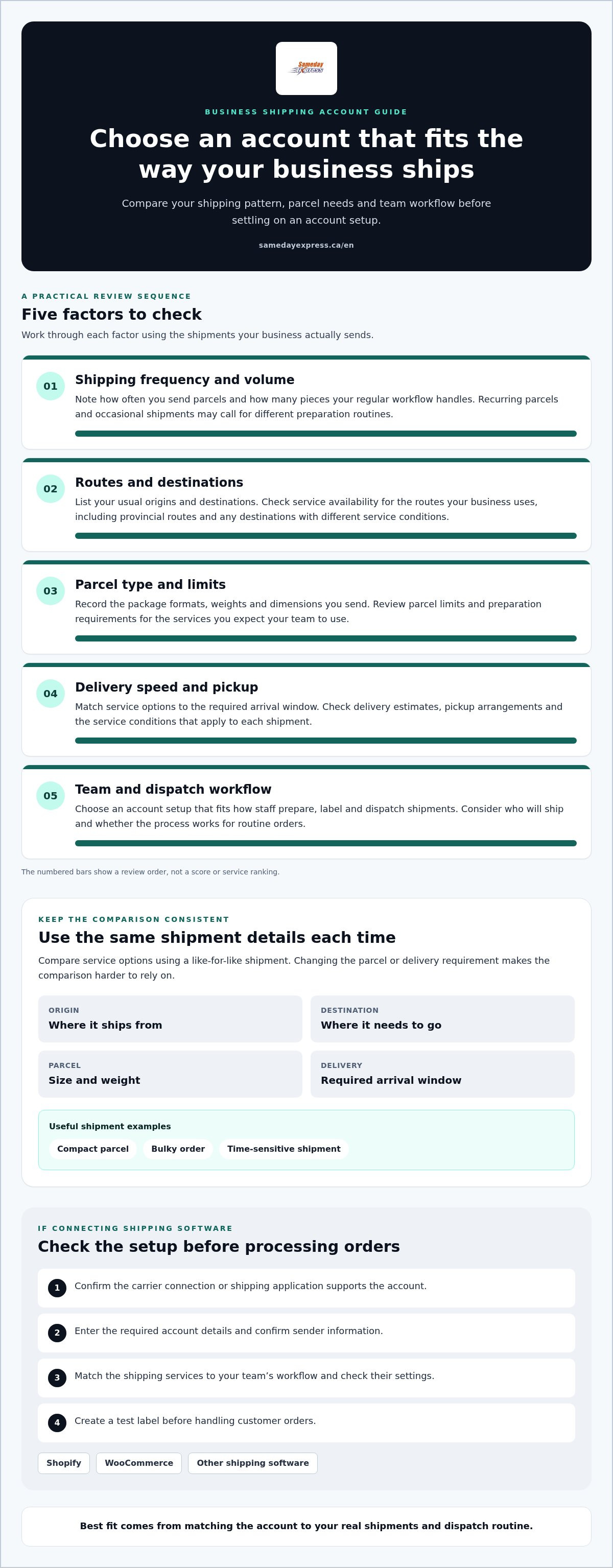
Business shipping accounts help organize how a company prepares recurring parcels and mail. The right setup depends on shipment volume, destinations, parcel details, and delivery speed. Review which services an account includes, what shipment information it stores, and whether its workflow fits your regular dispatch routine.
How do I compare Canada Post and courier business shipping accounts for price and delivery speed? Compare the same shipment details across each provider’s service options, then review the delivery estimates. Use an identical origin, destination, parcel size, weight, and arrival window to keep the comparison consistent.
For domestic shipments, list the routes and package types your business uses most often. A retailer mailing lightweight orders has different operational needs from a company sending bulky products across provinces. Compare service availability, pickup arrangements, delivery estimates, parcel limits, and account conditions that affect how staff prepare each shipment.
Bulk mail requires preparation steps that differ from sending individual parcels. Before choosing a mailing workflow, identify the number of pieces, their format, and how your team can sort and prepare them. A recurring campaign, for example, may need a repeatable process for organizing addressed pieces, while occasional parcels can follow the company’s usual shipping workflow.
How do I connect a shipping account to Shopify, WooCommerce, or other shipping software? Select a carrier connection or shipping application that supports the account, then enter the required account credentials. Map the services your team will use, confirm sender details, and create a test label before processing customer orders.
- In Shopify, review the carrier or shipping-app connection and test an order label.
- In WooCommerce, configure the chosen shipping extension and confirm its service settings.
- In other software, match account details, shipping services, and label workflows before launch.
What are the rules for using a Canadian business shipping account to ship internationally? Use an eligible cross-border service and provide complete shipment and recipient details. Prepare accurate item descriptions and the customs information requested in the shipping workflow, since incomplete details can interrupt processing.
For international shipments, compare destination coverage, delivery estimates, service conditions, and the information required for each shipment. A parcel going to one country may need different details from one sent elsewhere. Keep the item description, recipient information, and package contents consistent across the order record and shipping documents.
Build a practical comparison using representative shipments: a domestic parcel, a bulk mailing, and a cross-border shipment. Record each shipment’s details and workflow requirements. This helps you identify which account setup fits your business operations, rather than choosing based on one service feature alone.
Commercial Rates and Business Rate Card savings
A business rate card lists the shipping charges tied to an account’s services. It can make quotes for repeat shipments more consistent, but its value depends on the services your business actually uses. Compare its terms with rates for matching shipments, not with a discount label alone.
Start by asking what the rate card covers. Check whether it includes domestic parcels, cross-border shipments, or both. Note the services, delivery speeds, eligible destinations, and account conditions. Compare a shipment between two provincial centres separately from one going to a remote destination.
Read each rate alongside its calculation basis. A charge may depend on parcel weight, dimensions, destination, and selected service. Check whether the card uses actual weight or dimensional weight, and how oversized packages are treated. A lightweight but bulky box can compare differently from a compact parcel of the same weight.
Then review charges beyond the base transportation rate. Look for possible fuel, remote-area, pickup, residential-delivery, or address-correction charges. Their application varies by provider and shipment. A rate card that appears cheaper for a standard parcel may not produce a lower total for a delivery requiring extra handling.
Use a consistent comparison process:
- Choose representative shipments from your order records.
- Record each parcel’s origin, destination, weight, and dimensions.
- Match the delivery speed and service features across quotes.
- Compare the complete charge, account conditions, and delivery estimate.
Test one compact parcel, one bulky order, and one time-sensitive shipment. This shows whether the business rate card works across your shipping mix or mainly benefits one type. Keep the shipment details identical in every quote; changing dimensions or service speed makes the comparison unreliable.
Ask how rate-card discounts are applied. Some arrangements may use a fixed rate, while others may depend on shipment characteristics or account terms. Confirm how often rates can change, which services qualify, and whether the card has minimum-use conditions. These details determine whether quoted savings remain useful as your shipping pattern changes.
Finally, compare the card with your business’s real dispatch process. A lower rate may not suit orders that need a tighter delivery window or direct handling. For those shipments, review urgent business delivery options alongside standard rate-card services, then weigh speed and handling against the account’s routine shipping needs.
Shipping account benefits
A business shipping account can bring shipment administration into one workflow. A retailer sending online orders, for example, can create labels under its business profile instead of re-entering sender details each time. Depending on the account, it may also support saved addresses, shipment records, or centralized billing. These tools reduce repeat data entry and make shipping activity easier to review.
Centralized records help teams reconcile orders and deliveries. Staff can match a tracking reference with an order number, recipient, and dispatch date. That record can help answer a customer asking about a late parcel and give finance staff a clearer way to match shipping charges with business activity.
Payment arrangements can support routine accounting. Depending on its terms, an account may let a business pay through an invoicing arrangement or a stored payment method. An online store, for example, can separate shipping activity from an employee’s personal payment card. Review billing cycles, account access, and who can approve or view transactions.
Shipping accounts can also connect with order-management tools. A business using Shopify or WooCommerce may be able to link an account through a supported carrier connection or shipping application. Staff can then transfer order details into a label workflow. Test the setup with a sample order, confirm sender information, and check that the selected service appears correctly.
- Fewer repeated entries: saved sender details can speed up label preparation.
- Clearer records: shipment references help connect dispatches with orders.
- Team access: assigned account permissions can separate shipping tasks from billing review.
- Workflow connections: compatible software can move order details into shipping steps.
For businesses with several staff members, defined account roles can make daily dispatch more orderly. One employee might prepare labels while a manager reviews account activity. This separation helps the team follow a consistent process as staff rotate between packing, customer service, and administration.
Business accounts can also help manage recurring shipping patterns. A company sending replacement parts, subscription orders, or documents can keep shipment details together. Reviewing those records helps identify common destinations and service needs, so the business can plan packaging supplies, dispatch routines, and customer updates around its actual order flow.
Choose an account for the operational benefits your team will use. Before setup, list who ships, which software they use, and what records finance needs. A small business shipping from one location may value simple billing and saved details. A multi-user team may prioritize access controls and connected order processing. If your distribution needs eventually expand beyond in-house parcel dispatch, logistics consultancies like Warenous can assist in connecting your business with specialized 3PL providers.
Account setup fees and credit-card verification
Setup fees, shipment minimums, and contract terms are set out in each provider’s account agreement. Review setup charges, recurring minimums, billing cycles, rate changes, contract length, and cancellation terms before accepting.
How do I open a Canada Post business shipping account? Start with Canada Post’s business account registration process, enter your business and contact details, then follow the prompts to select services and billing preferences. Complete any payment or account verification steps shown before shipping.
How do I set up a business shipping account with UPS, FedEx, or Purolator in Canada? Use the chosen carrier’s Canadian business registration process, provide the requested company information, and select account and payment options. Follow its verification steps, then review the account terms before creating labels.
Prepare your details before starting an application. Keep the business’s legal name, operating address, primary contact, email, and phone number consistent across the form. Have the billing address and preferred payment details ready. If the application requests business identification or registration documents, use current records that match the company information.
- Business legal name and operating address
- Shipping and billing contacts
- Business email and telephone number
- Payment method and matching billing address
- Business registration details, if requested during registration
Credit-card verification links a payment method to the account. Enter the cardholder name and billing address as they appear on the card account, then complete the carrier’s verification prompt. A mismatch between the billing address and entered details can interrupt setup, so review both before submitting.
Treat account approval and payment verification as separate steps. A carrier may assess the business account independently from the payment method. Follow each on-screen instruction, save the account reference, and retain any confirmation message. If a transaction or verification prompt fails, correct the billing details before submitting again.
Before activation, read the account agreement carefully. Identify whether billing is per shipment, invoiced, or charged to a saved card. Note who can add users, change payment details, or access shipment records. A business with separate dispatch and finance staff, for example, can assign account access according to each person’s role.
Keep a copy of the accepted terms and account confirmation with business records. Record the account contact, billing method, and any applicable minimums in the same file. This gives staff a clear reference when reconciling carrier charges or updating account details. Use the account after completing the required registration and verification steps.
Fees, shipment minimums, and contract terms vary by provider and are set out in its account agreement. Check setup charges, recurring minimums, billing cycles, rate changes, contract length, and cancellation terms before accepting.
Choosing a personal or business shipping account
Choose an account type that matches who ships, how orders are managed, and how billing is handled. Compare the account terms with your business’s actual shipping workflow.
Personal and Business Account Differences
A personal account is generally organized around an individual’s shipments, while a business account is set up around a company’s shipping and billing details. The distinction matters when employees prepare parcels, the company tracks shipping records, or finance staff reconcile charges.
Before selecting an account, consider who will create labels and manage payment information. A sole proprietor shipping occasional orders, for example, may prefer a simple individual workflow. A company with separate dispatch and finance staff may need business-level records and access managed for multiple users.
Review the terms instead of relying on the account name alone. Compare how each option handles sender details, billing, user access, shipment history, and software connections. A business account suits your operation only if its features and conditions match the way your team works.
Use these questions to guide the comparison:
- Will the company or an individual be responsible for shipment charges?
- Do several employees need access to shipping tasks or records?
- Must shipment details connect with order or accounting software?
- Does the account’s billing process fit your company’s reconciliation routine?
Minimum Volume for New and Small Businesses
A new or small business can apply for an account without a volume minimum when the provider’s terms allow it. Minimums are provider-specific, so don’t assume every business account requires a set shipping volume or offers the same terms.
Check whether a minimum applies to account access, discounted rates, or a particular service. Conditions can differ. A business might open an account under one set of terms, for example, while a separate rate arrangement depends on shipment activity.
Estimate your shipping pattern before choosing. List the parcels you expect to send, their destinations, and how often orders leave your premises. A new online shop with occasional orders should compare likely activity with any account requirements, rather than choosing based on projected growth alone.
Ask how the provider treats months with fewer shipments and whether account terms change as volume shifts. Read the minimum, billing, and cancellation clauses together. This helps you understand whether a low-volume period affects charges, access, or rate eligibility.
For a practical decision, compare personal and business account terms against your current process. Consider who ships, which records the business needs, and whether volume conditions fit present demand. Reassess when staff, order systems, or shipping frequency change.
Sameday Express: same day delivery
Sameday Express Inc. offers same-day delivery for business shipments with deadlines that routine account workflows may not suit. Choose a service based on the shipment’s route and required delivery timing. Rush delivery can address urgent dispatch needs, while Sameday Express Inc. direct drive offers direct transport for time-sensitive shipments. For shipments between Montréal and Toronto, Montreal to toronto direct drive is a route-specific option.
A shipping account can support repeat parcel processing, but a time-critical delivery may call for a dedicated service instead. Consider the destination, urgency, and whether the shipment needs direct transport. This helps your team distinguish routine shipping from urgent consignments.
To discuss a delivery need, contact Sameday Express Inc..
Put your shipping plan into action
Use your account choice to set a clear process for routine orders and exceptions. Decide who prepares shipments, who reviews account activity, and how your team flags deliveries that cannot follow the usual schedule. This makes account setup a working part of daily operations, not just another registration step.
The practical next step in how to get a business shipping account is to match it with delivery needs that routine parcel processing won’t cover. Sameday Express offers same-day delivery, rush delivery, and Sameday Direct drive for businesses handling time-sensitive shipments. These services can complement an account used for regular parcel processing.
Define the shipment details before arranging an urgent delivery: pickup point, destination, parcel description, and required timing. Clear information helps your team communicate the need and select a suitable service without delaying dispatch.
For your next time-critical shipment, contact Sameday Express about shipping. A defined process and the right delivery option can help your business move forward with confidence.
Frequently Asked Questions
What risks or extra charges should I check before opening a business shipping account?
Check how shipment measurements, delivery exceptions, and account access can affect your bill. Review how a carrier handles remeasured parcels, address corrections, failed delivery attempts, and returns. Check the invoice dispute process and how quickly you must report an error. Limit account access to staff who prepare or approve shipments, and remove access when their roles change. These checks help prevent avoidable charges and billing disputes.
What are the fees, minimums, and contract terms for Canadian business courier accounts?
Fees vary by provider and shipment. Review the base rate and possible fuel, remote-area, pickup, residential-delivery, or address-correction charges. Check for minimum-use conditions, which services qualify, how often rates can change, and the account’s billing terms.
Disclaimer
Blog Disclaimer
The information published on the Sameday Express Blog is provided for general informational and educational purposes only. While we strive to keep all content accurate and up to date, Sameday Express makes no representations or warranties of any kind, express or implied, regarding the completeness, accuracy, reliability, suitability, or availability of the information contained in our articles.
The content on this blog does not constitute legal, customs, tax, regulatory, financial, or professional advice. Shipping regulations, carrier policies, customs requirements, and transportation laws may change without notice and may vary by destination. Readers should verify current requirements with the appropriate government authorities, carriers, or qualified professionals before making shipping or business decisions.
Sameday Express is not liable for any loss, damage, delays, or consequences arising from the use of, or reliance on, information published on this website. Any actions taken based on the information provided are at the reader's own risk.
References to third-party companies, products, services, or websites are provided for informational purposes only and do not constitute an endorsement or recommendation by Sameday Express.
All blog content, including text, graphics, images, and logos, is the property of Sameday Express unless otherwise stated and may not be reproduced or distributed without prior written permission.
For specific shipping requirements, pricing, transit times, or logistics solutions, please contact Sameday Express directly for personalized assistance.


