

Could a missed handoff put a production schedule, patient workflow, or aircraft turnaround at risk? Reliable shipping solutions for enterprise start by matching each shipment to its deadline and handling needs, rather than forcing every delivery into the same route or service.
A delayed shipment can disrupt operations, while sensitive goods need careful handling and clear custody procedures. Managing parcels, freight, and fulfillment through separate providers can add coordination when your team needs a dependable plan. This guide explains how to match shipment urgency, handling requirements, and logistics services to business operations across Canada.
We’ll cover when same-day delivery, rush shipping, or Direct Drive can support time-critical shipments with fewer handoffs, and how specialized medical courier and AOG services address distinct business needs. You’ll also see how warehousing and e-commerce fulfillment connect delivery with ongoing logistics. The goal is a practical shipping plan with the right service for each shipment.
Key Takeaways
- Build reliable shipping solutions for enterprise by matching each shipment’s deadline, size, handling needs, route, and frequency to the right service.
- Compare same-day delivery, next-day, overnight, rush, Direct Drive, and Next Flight Out according to the shipment’s deadline. Same-day delivery means delivery on the day it’s collected.
- Separate one-time urgent deliveries from recurring distribution to decide when courier service, Direct Drive, full truckload, warehousing, or 3PL may fit.
- Plan sensitive shipments around their handling and custody requirements, including lab samples, test kits, biological materials, and healthcare goods.
- Create a clear shipping brief with the origin, destination, deadline, shipment details, handling instructions, and delivery frequency.
Enterprise Shipping: What Businesses Need to Plan For
Reliable enterprise shipping starts with the shipment, not a default service. A routine parcel, an urgent document, a pallet, and a time-critical item have different deadlines, handling needs, and delivery constraints. A useful plan accounts for what’s moving, where it must go, when it’s needed, and what visibility your team requires.
Enterprise shipping solutions are delivery and logistics services matched to a business’s shipment requirements, handling needs, visibility expectations, and operational deadlines. A well-defined plan also distinguishes recurring shipments from one-off requests. That helps businesses align transport with broader supply chain decisions, as outlined in this Supply Chain Management Overview.
For a quick introduction to reliable shipping, watch this video:
How business shipping needs differ by shipment
The delivery deadline and shipment size help determine the route, vehicle, and service model. A document may need a fast, direct trip, while a pallet calls for a plan suited to larger freight. For urgent or sensitive materials, handling instructions and custody procedures can matter as much as speed. Match the service to the shipment’s purpose and requirements.
- Routine parcels: Plan around regular dispatch patterns and receiving schedules.
- Urgent documents: Set the required arrival time and avoid unnecessary handoffs.
- Pallets: Provide dimensions and quantity when planning transport.
- Time-critical materials: State the deadline, handling instructions, and any custody requirements.
- Recurring distribution: Map regular volumes and destinations separately from one-time urgent requests.
Combining every shipment under one fixed approach can create friction. A routine distribution schedule may not suit a same-day request, while treating every parcel as urgent may not fit ongoing operations. Separate recurring workflows from exceptions, then match each shipment to its actual priority.
What reliability means in a B2B shipping relationship
Reliability starts with clear expectations and a service model suited to the task. Define collection and delivery details, shipment contents, handling instructions, and timing requirements. For sensitive materials, communicate custody and care needs before dispatch so everyone responsible understands what the shipment requires.
Visibility matters, too. Our vehicles are tracked by GPS, helping businesses follow shipment movement. Direct communication helps teams respond to changes or clarify delivery details. When timing is critical, agree on who can provide updates and resolve questions. Direct Drive can reduce handoffs for time-sensitive shipments, with no transfers, terminals, or cross-docking.
Using separate providers can mean different booking processes, status updates, and delivery procedures. We support business deliveries and logistics needs with services matched to the shipment and deadline, helping your team coordinate through a clearer operating plan.
How Enterprise Delivery Options Match Different Shipping Deadlines
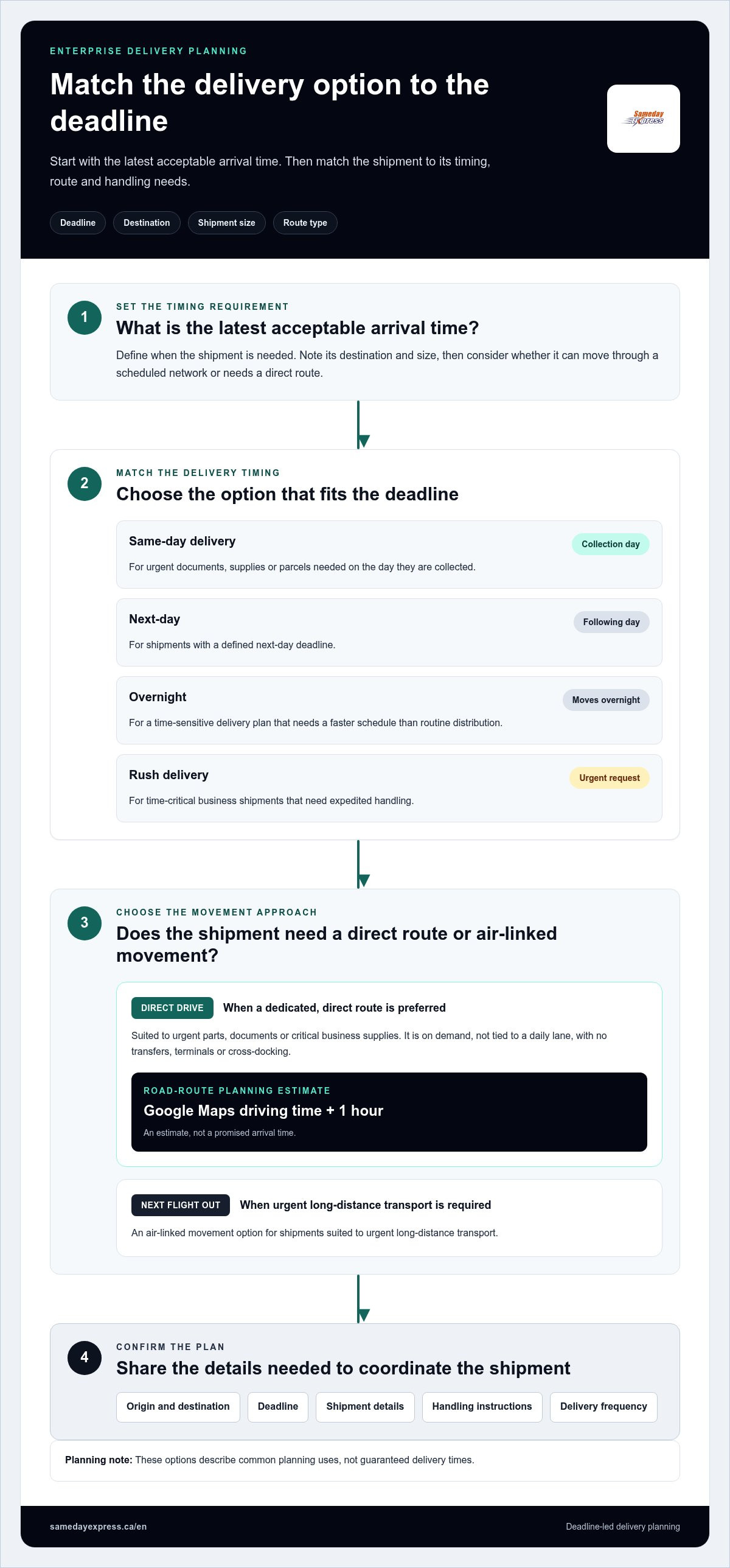
Let the delivery deadline determine the service. Start with the latest acceptable arrival time, then consider the destination, shipment size, and whether the delivery can move through a scheduled network or needs a direct route. This helps businesses apply reliable shipping solutions for enterprise to each request instead of treating every shipment as equally urgent.
The options below describe common planning uses, not guaranteed delivery times. Same-day delivery means the shipment is delivered on the day it’s collected. Next-day and overnight services suit different schedules, while rush delivery addresses an urgent requirement. For perspectives beyond delivery modes, the Logistics Officer Association Journal offers articles on logistics and related practices.
| Service | Urgency or timing need | Shipment profile |
|---|---|---|
| Same-day delivery | Arrival is needed on collection day | Urgent documents, supplies, or parcels |
| Next-day | Delivery is planned for the following day | Shipments with a defined next-day deadline |
| Overnight | Shipment moves overnight for a time-sensitive delivery plan | Items that need a faster schedule than routine distribution |
| Rush delivery | An urgent request needs expedited handling | Time-critical business shipments |
| Direct Drive | A dedicated, direct route is preferred | Urgent parts, documents, or critical business supplies |
| Next Flight Out | Urgent long-distance transport is required | Shipments suited to air-linked movement |
When direct-drive delivery fits a time-critical shipment
Direct Drive suits shipments where a dedicated route and fewer handoffs support the delivery plan. An urgent replacement part, a document needed for a business decision, or critical supplies may call for this approach. It is an on-demand service, not tied to a daily lane, with no transfers, terminals, or cross-docking. For road-route planning, use Google Maps driving time plus one hour as an estimate, not a promised arrival time.
When air-linked or scheduled delivery options make sense
For urgent long-distance shipments, Next Flight Out can be considered when air-linked transport better fits the deadline and destination. Same-day delivery is tied to collection day; next-day delivery suits a following-day requirement; overnight shipping is planned around movement overnight. Choose based on the required arrival time, route, and shipment profile, not the service name alone.
Define the latest useful arrival time first. Then compare delivery options against the destination and shipment needs. Businesses can review Sameday Express delivery services when planning a suitable route and service model.
Compare Enterprise Shipping Models by Shipment Type and Operational Need
Choose a shipping model by considering both the individual shipment and the workflow it serves. An envelope sent once for an urgent decision has a different purpose from a full truckload moving as part of regular distribution. Reliable shipping solutions for enterprise need to cover both: responsive delivery for exceptions and coordinated logistics for ongoing operations.
Delivery services move shipments from one point to another; warehousing and fulfillment support inventory storage and order preparation for dispatch. This distinction helps clarify whether the immediate need is transport, inventory handling, or a connected plan for both. The University of Manitoba Supply Chain Management Program provides a broader Canadian perspective on supply chain management and its role in responding to change.
Courier and freight options for different shipment sizes
Courier delivery can suit envelopes and parcels with a defined recipient and deadline. As shipment size grows, the plan may call for freight transport, including full truckload service for larger loads. Size alone doesn’t determine the service. Urgency, destination, and whether the shipment is a one-time request or part of recurring distribution also matter.
Use this as a starting point:
- Envelopes and parcels: Consider courier delivery for individual items and smaller business shipments.
- Urgent individual shipment: Consider Direct Drive when a dedicated trip fits the timing need.
- Larger loads: Assess freight requirements, including whether a full truckload suits the shipment.
- Ongoing order volume: Consider warehousing or 3PL support alongside transport.
These categories frame the decision, but the shipment details matter. Provide the size, destination, and required timing together. A parcel with a strict dispatch deadline may need a different plan from a pallet included in a scheduled distribution run. For urgent dispatch, clarify that delivery is needed on the day of collection before selecting a service.
Warehousing, 3PL, and e-commerce fulfillment
Warehousing supports inventory storage. Third-party logistics, or 3PL, can connect logistics activities for a business, while pick-and-pack fulfillment covers preparing individual customer orders for shipment. For e-commerce fulfillment, consider not only how an order travels, but how inventory is stored, selected, packed, and handed off for delivery.
A one-off urgent shipment calls for a focused transport plan. Recurring distribution or online order volume may need coordinated inventory and order preparation, with delivery as one part of the workflow. Sameday Express provides business shipping and logistics services for needs ranging from envelopes to full truckloads, alongside warehousing, 3PL, and pick-and-pack fulfillment.
To plan the right model, separate immediate exceptions from regular activity. Record what moves, how often it moves, the shipment sizes involved, and whether the need is transport alone or transport plus inventory handling. These details give your team a clear basis for matching the service to the operation.
Plan Secure, Time-Critical Shipping for Healthcare, Aviation, and Cross-Border Needs
Sensitive shipments don’t all need the same handling. A lab sample, a temperature-sensitive medication, and an aircraft part have different priorities. A dependable plan reflects what each item is, how it needs to be handled, and when it must arrive. Reliable shipping solutions for enterprise account for these differences instead of treating every urgent shipment as a standard parcel.
Before dispatch, define the shipment contents, delivery deadline, handling instructions, and receiving contact. For shipments between Canada and the United States, include accurate shipment and destination details and plan for customs-ready transport. Clear preparation supports coordination without making assumptions about customs requirements.
Medical courier handling and chain of custody
Lab samples, test kits, biological materials, healthcare goods, and temperature-sensitive medications call for careful handling. Sameday Express provides medical courier services focused on healthcare regulations. Our drivers are trained to handle sensitive materials and maintain appropriate chain-of-custody procedures. Clear instructions help establish responsibility as a shipment moves from collection to delivery.
For a medical shipment, the dispatch brief should identify the material, handling instructions, required timing, and receiving contact. Don’t assume procedures for one item automatically suit another. A test kit and a medication may have different handling requirements, even if both are time-sensitive. Share the relevant instructions so our courier team can plan for the specific shipment.
AOG and Canada-U.S. time-critical shipments
When an aircraft is grounded, a delay in receiving a critical part can affect maintenance and operational plans. Sameday Express provides a 24/7 AOG service for urgent critical aviation parts delivery. Identify the required part, delivery deadline, and pickup and receiving details to help focus the transport plan. For more on urgent transport planning, review specialized transport for critical shipments.
Our vehicles are tracked by GPS, supporting shipment visibility during transport. For time-critical movements, visibility and direct communication help teams follow progress and coordinate with the receiving location. Include the part details, pickup and delivery points, deadline, and any relevant receiving instructions when arranging the shipment.
Cross-border shipping also needs coordination between the shipment plan and customs-ready transport. Keep shipment and destination information clear, and account for the border movement when setting the delivery schedule. A Canada-to-U.S. shipment has different coordination needs from a domestic delivery, so include the route in the initial plan.
- Healthcare: Specify the material, handling instructions, and custody procedures.
- AOG: State the aircraft-on-ground urgency, part details, and delivery deadline.
- Cross-border: Include shipment and destination details in the transport plan.
For urgent medical, AOG, or Canada-to-U.S. shipping needs, plan a time-critical shipment with Sameday Express.
Build a Reliable Enterprise Shipping Plan with Sameday Express
A clear shipping brief turns delivery requirements into practical service decisions. It helps your team separate urgent exceptions from regular distribution, communicate handling needs, and plan around each shipment’s destination and frequency. Reliable shipping solutions for enterprise begin with useful information shared before dispatch.
Use a consistent briefing process for one-time requests and recurring shipments. Keep the details concise, but specific enough to guide the logistics plan.
A practical briefing checklist for enterprise shipments
Start with the deadline and contents. Then add the details that shape the delivery plan. For recurring shipments, include frequency and typical load type. For an urgent request, state the immediate priority.
- Urgency: Give the required delivery date or deadline and identify any time-critical need.
- Contents and size: Describe what’s moving, with dimensions or load type where relevant, such as parcels, pallets, or a full truckload.
- Handling: Include sensitive-material instructions and chain-of-custody needs, if applicable.
- Route: Identify the origin and destination, including whether the shipment crosses the Canada-to-U.S. border.
- Frequency: Note whether the request is one-time, recurring distribution, or part of an order-fulfillment workflow.
This brief gives the team at Sameday Express Inc. a practical picture of the request. It also helps your business distinguish immediate delivery needs from ongoing logistics requirements.
Choose a logistics partner for ongoing business needs
Business shipping can involve urgent delivery, freight, specialized healthcare logistics, and ongoing fulfillment. Sameday Express Inc. works with businesses across Canada to support varied delivery and logistics needs. Our medical courier, AOG, and fulfillment services address distinct operational requirements.
Match the logistics partner’s capabilities to the work your team needs done. A laboratory may need to transport lab samples or biological materials; an aviation operator may need urgent AOG parts delivery; an e-commerce business may need warehousing and pick-and-pack fulfillment. Sameday Express Inc. supports these needs as part of a B2B logistics relationship.
Separate urgent exceptions from regular activity. This helps your team brief a one-time rush shipment while keeping routine freight, inventory, and order preparation in view. Update the brief as shipment patterns change so the plan continues to reflect your operations.
Sameday Express Inc. supports business delivery, freight, and fulfillment through our logistics services for businesses. Share your shipment priorities with us to plan an approach suited to your operation.
Put Your Enterprise Shipping Plan into Action
Turn your shipping requirements into a working plan your team can use. Start with the delivery needs that affect daily operations, then identify where a time-critical request needs a different approach. A clear brief gives your logistics partner the information needed to coordinate services as business needs change.
With more than 25 years of experience, Sameday Express works with businesses to plan reliable shipping solutions for enterprise, from urgent deliveries to ongoing logistics needs. Share your shipment priorities and discuss an approach suited to your operation.
Discuss your enterprise shipping needs with Sameday Express. A focused plan helps your team move forward with greater clarity and confidence.
Frequently Asked Questions
What should an enterprise include in a time-critical shipment request?
Explain why the shipment is urgent and what a delay could affect. This context helps your team set priorities when several requests arrive at once. Include site access constraints, such as a receiving dock’s operating window or a required check-in process. For reliable shipping solutions for enterprise, identify who can make decisions if plans change, so instructions don’t stall while teams seek approval.
Is urgent delivery support available outside regular business hours?
Yes. Sameday Express accepts urgent delivery requests 24/7 with advance notice. For an after-hours request, have the person authorizing the shipment ready to explain its operational priority and respond to questions. This can help when a facility needs a critical item before its next shift or a maintenance team is working against a changing schedule. Clear decision-making helps keep the request moving.
Can a Canadian business ship to the United States with Sameday Express?
Yes. Sameday Express supports shipments between Canada and the United States. Businesses can use this service to send a replacement component to a U.S. service location or move business supplies to a receiving team. Include the delivery in your cross-border operating plan so the sending department and receiving team can coordinate around the shipment’s expected arrival.
What types of shipment sizes can enterprise shipping services handle?
Sameday Express handles shipments from envelopes and parcels to full truckloads. For an unusual or mixed load, describe how many pieces are involved and whether items need to stay together. Note practical loading or receiving constraints, such as limited unloading space. These details help your shipping team describe the shipment clearly and plan its movement at both ends of the route.
How does chain of custody support medical courier shipments?
Chain of custody helps an organization maintain accountability for sensitive items as responsibility passes through the delivery process. For a lab shipment, coordinate with the receiving team so it knows who is authorized to accept the item and how to route it internally after arrival. This supports continuity between courier delivery and the organization’s own intake procedures, while recognizing that materials may follow different workflows.
Can one logistics partner support both delivery and e-commerce fulfillment?
Yes. Sameday Express offers delivery alongside warehousing, third-party logistics, and pick-and-pack fulfillment. This can help an online business coordinate logistics support as order activity changes, rather than manage every task as a separate relationship. For example, a business can plan fulfillment around product launches or seasonal demand while keeping delivery connected to the broader operation.
Disclaimer
Blog Disclaimer
The information published on the Sameday Express Blog is provided for general informational and educational purposes only. While we strive to keep all content accurate and up to date, Sameday Express makes no representations or warranties of any kind, express or implied, regarding the completeness, accuracy, reliability, suitability, or availability of the information contained in our articles.
The content on this blog does not constitute legal, customs, tax, regulatory, financial, or professional advice. Shipping regulations, carrier policies, customs requirements, and transportation laws may change without notice and may vary by destination. Readers should verify current requirements with the appropriate government authorities, carriers, or qualified professionals before making shipping or business decisions.
Sameday Express is not liable for any loss, damage, delays, or consequences arising from the use of, or reliance on, information published on this website. Any actions taken based on the information provided are at the reader's own risk.
References to third-party companies, products, services, or websites are provided for informational purposes only and do not constitute an endorsement or recommendation by Sameday Express.
All blog content, including text, graphics, images, and logos, is the property of Sameday Express unless otherwise stated and may not be reproduced or distributed without prior written permission.
For specific shipping requirements, pricing, transit times, or logistics solutions, please contact Sameday Express directly for personalized assistance.


