

What if the biggest holiday shipping risk isn’t the rush itself, but treating every order as if it can follow the same route? A practical holiday season shipping strategy for business separates predictable order volume from shipments that can’t wait. That distinction helps protect inventory flow and customer commitments when dispatch schedules tighten.
Seasonal demand can be difficult to forecast. Picking and packing delays, busy carrier networks, and cross-border paperwork can all add pressure. A clear plan gives your team a process to follow before the rush, with realistic dispatch cut-offs and timely customer updates.
This 2026 guide covers how to prepare inventory and fulfilment workflows, organize shipping communications, and set an escalation path for time-critical orders. You’ll also learn when a shipment needs a faster, direct response instead of the standard fulfilment flow. For urgent exceptions, Sameday Express offers Same Day Delivery with direct non-stop transport, pickup within 60 minutes, and real-time GPS tracking.
Key Takeaways
- Build a holiday season shipping strategy for business that connects demand forecasts, available stock, fulfilment capacity, and customer updates.
- Use a clear order workflow to catch inventory mismatches before products are promised across sales channels.
- Choose different handling paths for routine orders and exceptions, based on urgency, shipment sensitivity, and delivery requirements.
- Give your team a repeatable playbook for preparation, daily order reviews, issue escalation, and post-peak improvements.
- Use Sameday Express for time-critical shipments that need direct non-stop transport and delivery documentation.
Why a Holiday Season Shipping Strategy Matters Before Orders Peak
As holiday orders rise, customers still expect clear delivery information and dependable dispatch. Inventory may be spread across sales channels, suppliers may face competing demands, and fulfilment teams must balance regular work with seasonal orders. Without a plan linking these moving parts, decisions become reactive. Staff may release orders before checking stock or struggle to decide which delay needs immediate attention.
A holiday shipping strategy connects demand forecasts, stock levels, fulfilment capacity, dispatch choices, and customer updates. It gives teams a shared view of operations, so a change in one area informs the next decision. This is the practical value of applying Supply Chain Management Principles to seasonal operations: coordinate connected activities instead of treating shipping as a separate final step.
A peak-season shipping plan is a shared sequence for matching expected orders to available stock, fulfilment capacity, dispatch, and customer communication.
Forecast demand and identify seasonal pressure points
Use previous seasonal sales as a reference, then compare them with current order trends and planned promotions. You don’t need to predict every order. Focus on where pressure could build and prepare a response before your team is working against a deadline.
- Flag products that sold quickly in past seasons or are central to upcoming promotions.
- Review supplier dependencies and replenishment steps that could affect those products.
- Separate known busy periods from uncertain demand, and note what new information could change the plan.
For example, a planned promotion may create a predictable order surge, while a newly popular item may bring less certain demand. Treat these situations differently. Check stock more often for products facing predictable pressure, and leave room to adjust where demand is harder to anticipate.
Set business priorities before the rush begins
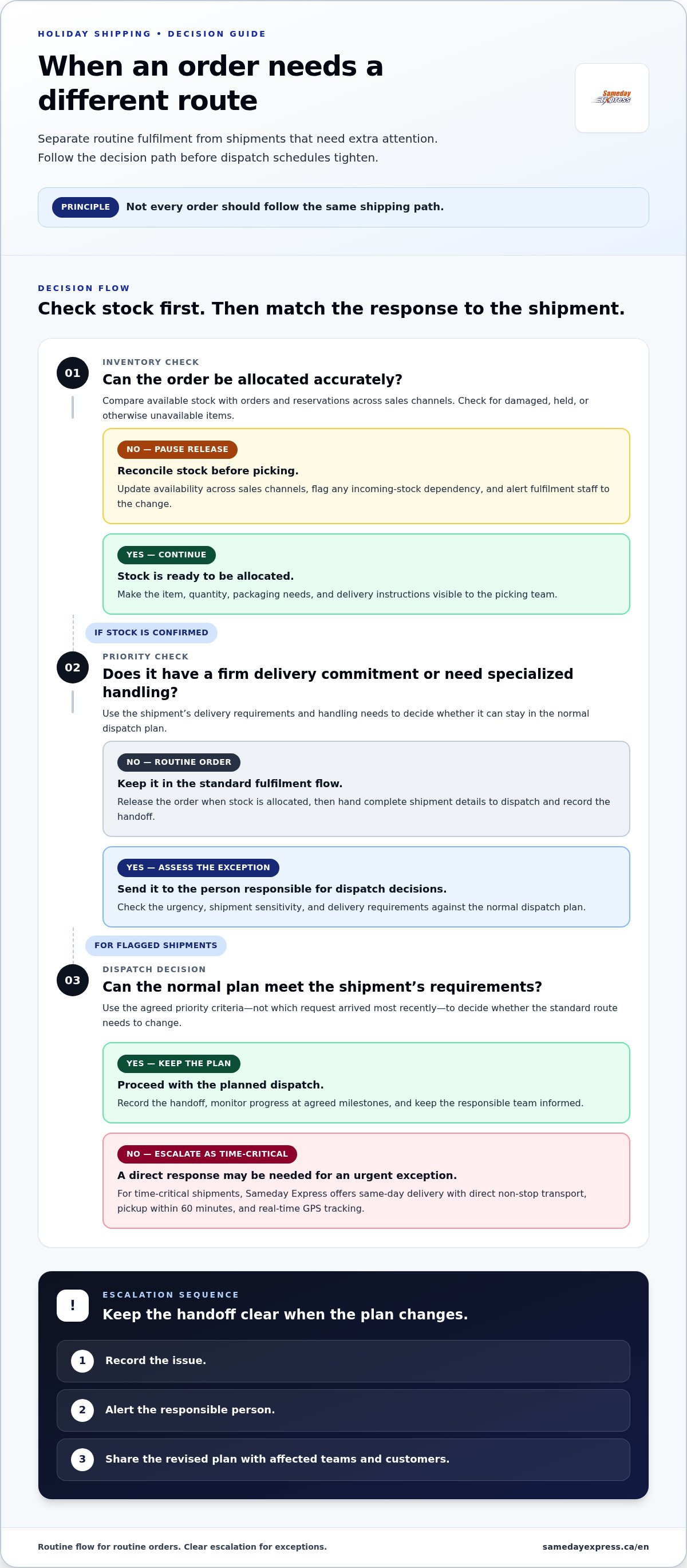
Agree in advance which customer commitments, products, and shipment types need the closest attention. A priority might be an order tied to a firm delivery commitment or a shipment that needs specialized handling. Clear criteria help staff assess exceptions consistently instead of making rushed decisions based on whichever request arrived last.
- Assign an owner for inventory checks and another for releasing orders to fulfilment.
- Name who sends shipment updates and who decides when the normal dispatch plan needs to change.
- Choose a shared channel for flagging stock gaps, supplier delays, and time-critical exceptions.
Keep the escalation path simple: record the issue, alert the responsible person, and share the revised plan with affected teams. Before seasonal volume rises, walk through likely disruptions together. Staff will then have a clear next step when conditions change, without assuming every order needs the same response.
Connect Holiday Inventory, Fulfilment, and Shipment Visibility
A stock count only helps when the order system, fulfilment team, and dispatch desk use the same information. During a busy season, an online order can arrive while a product is reserved elsewhere, replenishment is delayed, or packing supplies are running low. Connect each stage so staff can see what’s ready, what needs attention, and what has left the facility. That connection is an operational part of a holiday season shipping strategy for business, not just a warehouse task.
Inventory visibility helps keep peak-season orders aligned with what your team can actually fulfil and dispatch.
- Check stock. Compare available quantities with orders and reservations across sales channels. Use one shared process to record damaged, held, or otherwise unavailable items.
- Confirm supply. Review replenishment status for products expected to move quickly. Update the plan when supplier timing or quantities change, and flag orders that depend on incoming stock.
- Prepare orders. Release orders for picking only when the stock can be allocated accurately. Make sure warehouse staff can see the item, quantity, packaging needs, and delivery instructions.
- Dispatch. Give the dispatch owner complete shipment details, including the destination and delivery commitments. Record the handoff so an order doesn’t sit between packing and collection.
- Monitor progress. Update order status at agreed milestones and route exceptions to the person responsible for decisions and customer communication.
Prepare stock and shipping materials for peak demand
For fast-moving products, review stock levels alongside replenishment needs instead of waiting for orders to expose a shortage. Prepare packaging and labels for the expected shipment mix, and make the process for changing inventory clear. If a supplier delay affects an item, update its availability across sales channels and alert fulfilment staff before more orders are released against it.
Accurate inventory across channels reduces the chance of accepting orders for unavailable products. It also helps staff distinguish sellable stock from units already assigned to another order. When plans change, identify who updates the inventory record, who adjusts order release, and who shares the change with the warehouse. That handoff makes the same information actionable across teams.
Keep order status and shipment updates clear
Agree on status points that matter to staff and customers: order received, stock issue identified, order packed, dispatched, and delivery confirmed. Assign one owner for each internal update and one for customer-facing shipment communication. This prevents conflicting messages, especially when dispatch timing changes or an order needs attention.
For Same Day Delivery shipments handled by Sameday Express, real-time GPS tracking provides visibility while the delivery is in progress. It supports the update workflow but doesn’t replace the team member responsible for communicating with the customer. For time-sensitive shipments, Sameday Express logistics services include Same Day Delivery. A connected workflow gives inventory, fulfilment, dispatch, and customer updates a clear handoff at every stage.
Choose the Right Shipping Response for Routine and Urgent Orders
Peak season calls for a clear distinction between orders that fit the planned dispatch cycle and shipments that need an exception. A holiday season shipping strategy for business should set decision points before the rush: How urgent is the commitment? Does the shipment need specialized handling? What delivery confirmation is required? Can the normal fulfilment process meet the need? Same Day Delivery is an escalation option for eligible urgent shipments, not the default for every order.
Routine orders
Urgency: Fits the planned dispatch schedule. Sensitivity: Standard handling based on the product and business procedures. Confirmation: Follow the usual order-status and customer-update process. Fulfilment: Pick, pack, and release through the regular workflow.
Urgent exceptions
Urgency: A customer commitment or operational need can’t wait for the normal dispatch cycle. Sensitivity: Identify special handling or documentation requirements before release. Confirmation: Choose a response that provides the delivery confirmation the recipient needs. Fulfilment: Assign an owner to coordinate the exception and inform affected teams.
Use this comparison as a decision aid, not a rigid rule. An order may be urgent and still need specialized handling, so speed alone cannot determine the response. Record why an order is escalated, who approved the change, and what update the customer should receive. This keeps routine orders moving through the planned process while giving time-critical shipments a defined route.
Match shipment urgency to the appropriate response
Routine orders should follow your established dispatch schedule and customer communication process. For an urgent shipment that needs a direct response, Sameday Express Same Day Delivery uses direct non-stop transport, with pickup within 60 minutes. The service includes real-time GPS tracking, signature confirmation, and proof of delivery with photo. These features support shipment visibility and a documented handoff.
Before escalation, confirm the delivery commitment, shipment details, recipient instructions, and required proof of receipt. This quick review helps your team choose a suitable response without treating every late order as equally time-critical.
Flag sensitive shipments for specialized handling
Some shipments need more than a faster dispatch decision. Sameday Express Bioscience & Testing supports biological materials with temperature-controlled transport, chain-of-custody documentation, and HIPAA-compliant handling. Medical Courier includes temperature monitoring, DG-trained drivers, medical protocol compliance, hospital dock delivery, and Emergency STAT service. Keep handling requirements visible to staff from order release through handoff.
For additional context on critical shipments, the related guide Transport Spécialisé : Le Guide Complet Pour les Envois Critiques covers specialized transport considerations. In your seasonal workflow, flag sensitive contents early so the response accounts for handling needs as well as urgency.
Build a Repeatable Holiday Shipping Playbook for Your Team
A shipping playbook turns seasonal plans into steps staff can follow under pressure. Build it around the work cycle: prepare before demand rises, review open orders each operating day, manage exceptions as they occur, and assess what happened after peak activity. A holiday season shipping strategy for business works best when it has clear owners, shared records, and a defined response for when the original plan no longer fits.
Set up a pre-peak readiness check
Before seasonal volume builds, confirm who owns inventory records, supplier communication, packaging readiness, and order release. Document which shipment categories use routine dispatch, which need urgent escalation, and which require specialized handling. Keep the playbook easy to use so staff can find the next step and the right decision-maker without searching through old messages.
Agree on how teams record a change and pass it along. A useful readiness check covers:
- Inventory and supply: Who updates stock records when a count differs from the system or a supplier reports a delay?
- Order release: Who can hold or release affected orders, and how will warehouse staff learn about the change?
- Packaging and dispatch: Who confirms the required materials are ready and shipment information is complete?
- Customer communication: Who shares an update if the dispatch plan or expected delivery information changes?
Keep one record for the issue, decision, owner, and customer update. It gives teams a reliable reference when a shift change or handoff occurs.
Manage exceptions and review outcomes
During peak operations, use a consistent exception path instead of relying on informal messages. Staff should record the disruption, alert the responsible lead, assess the affected orders, and decide whether to adjust fulfilment or escalate a time-critical shipment. Weather disruption, supplier delays, stock variance, and urgent customer needs can each trigger a review. The response should reflect the shipment’s actual requirements.
- Review open orders. Identify orders affected by the issue and note their current processing or shipment status.
- Assign a decision owner. Direct the exception to the person authorized to change the plan.
- Share verified information. Update affected teams and customers with confirmed facts. Don’t promise a delivery outcome that hasn’t been verified.
- Close the record. Note the resolution and any follow-up required so the issue doesn’t disappear from the team’s view.
After peak activity, review shipment records, recurring delays, inventory gaps, handoffs, and customer questions. Look for patterns. Repeated stock discrepancies may point to a record-update problem, while unclear delivery updates may mean communication ownership needs to change. Carry those findings into the next seasonal readiness check. For a time-critical exception, Request a Quote from Sameday Express.
How Sameday Express Inc. Supports Time-Critical Holiday Shipments
A seasonal plan needs a reliable route for orders that can’t stay in the standard dispatch queue. Sameday Express supports business customers with time-critical shipments and fulfilment needs. Its Same Day Delivery service can help when an urgent order needs a direct response, while Warehousing & Fulfillment supports ongoing order preparation.
Use Same Day Delivery when an exception cannot wait
When a shipment becomes time-critical, direct non-stop transport offers a different response from routine dispatch. Same Day Delivery from Sameday Express includes pickup within 60 minutes, real-time GPS tracking, signature confirmation, and proof of delivery with photo. These features give the sending team visibility during transit and a record of delivery for its shipment files.
Use this option for eligible urgent shipments, not as the default for every seasonal order. Before arranging an exception, prepare the shipment details, recipient information, and delivery instructions. This helps your team communicate clearly and align the shipment with the customer’s operational need. Same-day delivery is guaranteed when conditions allow, so avoid promising an outcome before it is confirmed.
All shipments are fully covered end-to-end. For orders that need a documented handoff, signature confirmation and proof of delivery with photo provide useful records after the shipment reaches its destination. Real-time GPS tracking supports visibility while it is in transit, so your business can share verified status information with people waiting for the delivery.
Connect seasonal fulfilment with specialist logistics
Seasonal readiness also depends on the work before dispatch. Warehousing & Fulfillment from Sameday Express includes a secure storage facility, inventory management, pick-and-pack services, same-day fulfillment, and returns processing. These services connect stock handling and order preparation with shipment planning, helping businesses organize fulfilment as seasonal orders move through the workflow.
For example, inventory management supports a clearer view of stored products, while pick-and-pack services prepare orders for release. Same-day fulfillment supports orders that need prompt processing, and returns processing helps manage goods coming back after delivery. Plan these activities alongside your own order reviews and customer communication.
For aviation emergencies, Sameday Express offers AOG, Aircraft on Ground service, with a dedicated AOG hotline. Have the part details, delivery destination, and operational urgency ready when escalating an aviation shipment so the request is clear from the outset.
Include a specialist logistics route in your holiday plan before an exception arises. To discuss a shipment or fulfilment requirement, Request a Quote.
Put Your Holiday Shipping Plan Into Motion
A plan becomes useful when it shapes everyday decisions, not just the preparation meeting. Before seasonal activity builds, set a regular time to review whether the playbook reflects current demand, team capacity, and customer commitments. Give staff a simple way to flag changes early so the right person can act before a small disruption affects more orders.
That ongoing discipline turns a holiday season shipping strategy for business into a working tool. Keep the process practical: clarify who owns the next decision, record what has changed, and make sure affected teams know what to do. As the season unfolds, use what you learn to adjust the plan while there is still time to respond.
If your business needs support with a time-critical shipment or seasonal fulfilment, take the next step with Sameday Express. Request a Quote and put a clear logistics plan in place for the holiday period.
Frequently Asked Questions
When should a business start planning holiday-season shipping?
Start before seasonal order volumes rise, using your sales cycle and supplier lead times to set a workable schedule. Build in time to compare past sales with current demand and check whether inventory and fulfilment capacity can support planned promotions. Set internal readiness checkpoints, then review them as new information comes in. This gives teams room to adjust assumptions and responsibilities before orders put the process under pressure.
How can a business prepare for a sudden increase in online orders?
Check available inventory across sales channels and identify items that could run short. If the same product is listed on several channels, make sure a sale in one channel is reflected in the stock available elsewhere. Keep suppliers informed about expected demand, prepare packaging and labels, and clarify who releases orders. A written escalation path helps staff handle a demand spike consistently instead of making conflicting decisions.
Can Sameday Express handle urgent holiday shipments outside regular business hours?
Yes. Sameday Express provides professional service 24/7 for urgent delivery requests. Same Day Delivery uses direct non-stop transport, with pickup within 60 minutes and real-time GPS tracking. Same-day delivery is guaranteed when conditions allow. For a clear request, include the shipment’s origin and destination, required delivery deadline, and a contact person who can answer questions about the shipment or handoff.
How can a business confirm that a shipment was delivered?
Use the shipment’s tracking information and delivery documentation to check its status and update the related order record. Same Day Delivery includes real-time GPS tracking, signature confirmation, and proof of delivery with photo. Store the documentation with order details, such as the customer reference or purchase order, so staff can retrieve it if a customer asks about receipt or an internal team needs to verify the handoff.
What should a business include when requesting a shipping quote?
Provide the shipment’s origin and destination, preferred pickup timing, delivery deadline, package or load details, and any handling requirements. For sensitive contents, describe the shipment type and relevant handling or documentation needs. Include a contact person and recipient instructions that could affect delivery. Clear details help Sameday Express understand the request and identify a suitable logistics option. Use the Request a Quote form to submit the information.
Can holiday orders be stored and fulfilled before they ship?
Yes. Sameday Express Warehousing & Fulfillment includes a secure storage facility, inventory management, pick-and-pack services, same-day fulfillment, and returns processing. This can support businesses that want stock stored and orders prepared before dispatch. For example, an e-commerce team can describe how products should be tracked, picked, packed, and handled when returned. Include those workflow details in a Request a Quote so the fulfilment requirement is clear.
Disclaimer
Blog Disclaimer
The information published on the Sameday Express Blog is provided for general informational and educational purposes only. While we strive to keep all content accurate and up to date, Sameday Express makes no representations or warranties of any kind, express or implied, regarding the completeness, accuracy, reliability, suitability, or availability of the information contained in our articles.
The content on this blog does not constitute legal, customs, tax, regulatory, financial, or professional advice. Shipping regulations, carrier policies, customs requirements, and transportation laws may change without notice and may vary by destination. Readers should verify current requirements with the appropriate government authorities, carriers, or qualified professionals before making shipping or business decisions.
Sameday Express is not liable for any loss, damage, delays, or consequences arising from the use of, or reliance on, information published on this website. Any actions taken based on the information provided are at the reader's own risk.
References to third-party companies, products, services, or websites are provided for informational purposes only and do not constitute an endorsement or recommendation by Sameday Express.
All blog content, including text, graphics, images, and logos, is the property of Sameday Express unless otherwise stated and may not be reproduced or distributed without prior written permission.
For specific shipping requirements, pricing, transit times, or logistics solutions, please contact Sameday Express directly for personalized assistance.


