

What makes urgent LTL shipping Canada businesses can rely on? The route matters as much as the booking. When freight moves through terminals, transfers or cross-docking, each extra handling point can add coordination and waiting. If your shipment is too large for parcel service but doesn’t need a full truckload, the delivery plan should match its deadline.
Standard LTL networks consolidate freight from different shippers. A time-critical shipment may need a more direct approach. Our Direct Drive service moves freight directly, avoiding terminal transfers and cross-docking along the planned route. It gives businesses an option for moving partial freight without relying on a scheduled consolidation process.
This guide explains how to assess urgent LTL options, prepare freight for pickup and give dispatch the details needed to plan a direct move. Use the checklists to organize shipment size, weight, dimensions, pickup and delivery requirements, and handling needs. You’ll also learn how direct-drive logistics can reduce unnecessary handling and help you choose an approach that fits your shipment’s urgency and size.
Key Takeaways
- Urgent LTL shipping Canada can suit partial freight when timing matters as much as shipment size.
- Compare scheduled consolidation with Direct Drive to understand how fewer transfers, terminals and cross-docking affect handling.
- Share pickup and delivery addresses, contact details, ready time, dimensions and handling needs so dispatch can plan the move.
- Prepare freight before pickup with secure packaging and clear labels to support efficient handling.
- Match the service plan to your freight’s size, urgency, route and handling requirements.
Urgent LTL Shipping in Canada: What It Means for Time-Critical Freight
A shipment doesn’t need to fill a trailer to be urgent. Less-than-truckload (LTL) shipping refers to freight that takes up less than a full trailer, often sharing trailer space with freight from other shippers. A pallet of commercial goods can be a partial load and still be needed quickly to keep a business operating. Less-than-truckload (LTL) shipping describes how freight space is shared, not how quickly a shipment will move.
LTL describes shipment size, not delivery urgency. For urgent LTL shipping Canada businesses need to assess both how much freight must move and when it needs to arrive. The right plan depends on the deadline and route, not simply on whether the shipment fills a trailer.
How LTL freight differs from a full truckload
With scheduled LTL, a carrier groups freight from different shippers into a shared network. A business sending one pallet can use trailer space without booking the entire vehicle. This can suit freight that doesn’t require dedicated movement, but LTL itself doesn’t set a specific delivery window.
A dedicated move assigns a vehicle to a specific shipment or planned route rather than relying on the same consolidation process. The practical difference is how freight is routed and handled. Scheduled networks organize shared loads. Direct movement can reduce intermediate steps when timing calls for a more direct plan.
When an urgent shipment needs a different plan
A production interruption may leave a worksite waiting for a replacement part. A deadline-driven business shipment may also need to reach its recipient without waiting for the next consolidation stage. In either case, consider the delivery deadline alongside the freight’s size.
In a scheduled network, freight may pass through transfers, terminals or cross-docking, where goods are moved between vehicles or loads are reorganized. These steps support consolidation, but can add waiting or handling between pickup and delivery. A time-critical shipment may call for a more direct route with fewer intermediate stops. Sameday Express Inc. provides Direct Drive and rush delivery for urgent commercial freight.
- Production interruption: Identify the part or supply needed to resume work and the delivery deadline.
- Essential replacement part: Share accurate pickup and delivery details so dispatch can plan the movement.
- Business deadline: Explain what the shipment supports and when it needs to arrive.
Match the transport plan to the shipment’s operational impact. If freight is sensitive or the route requires specialized planning, our guide to specialized transportation offers more context for critical shipments.
Urgent LTL Shipping Options: Scheduled Freight or Direct Drive?
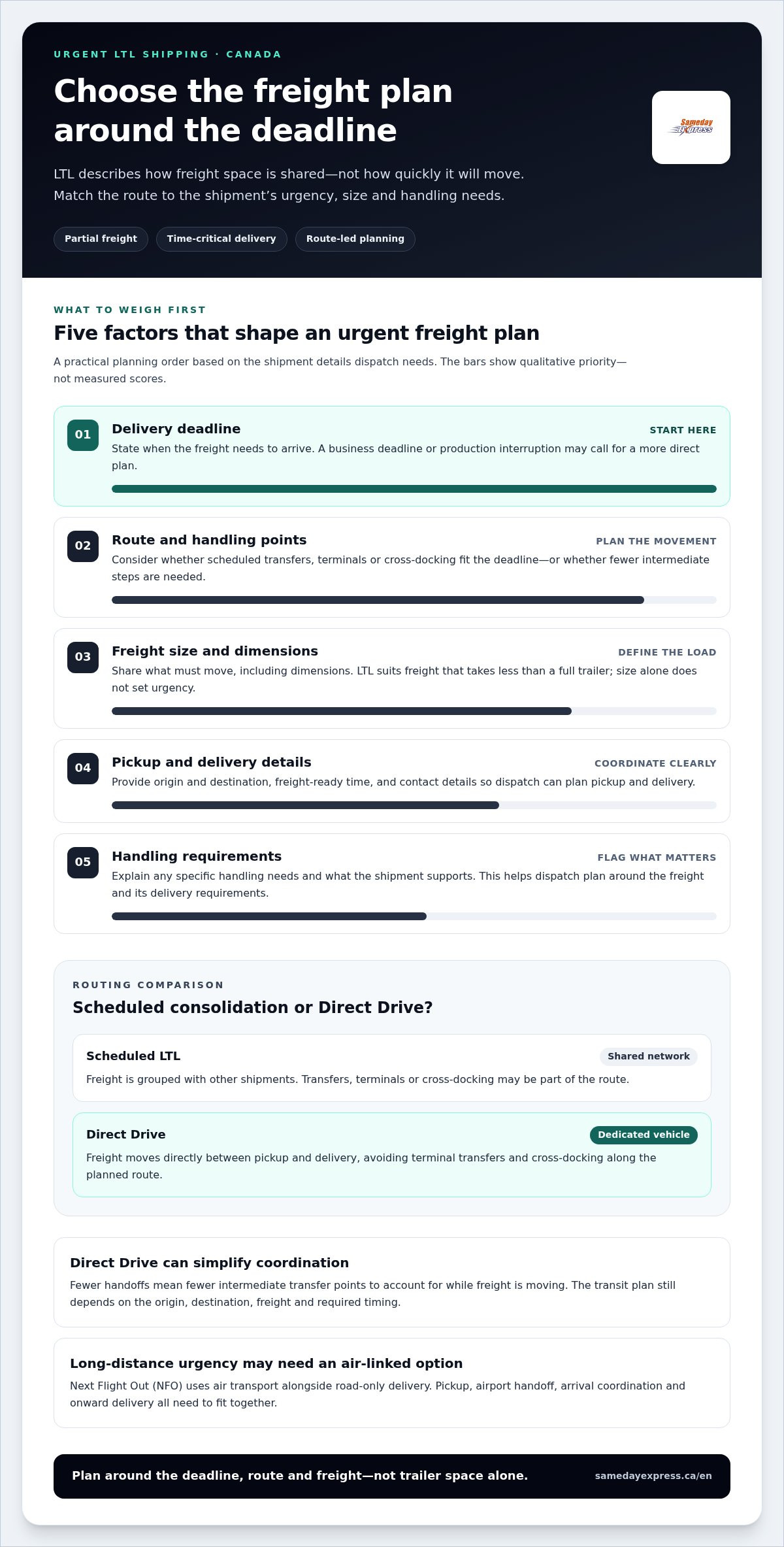
Scheduled freight and Direct Drive serve different routing needs. Scheduled LTL consolidates shipments into a shared network. Direct Drive is an on-demand option for freight that needs a more direct journey. When arranging urgent LTL shipping Canada businesses should weigh the deadline, route, shipment details and handling requirements, not just the amount of trailer space needed.
Direct-drive delivery moves freight by dedicated vehicle from pickup to delivery, avoiding terminal transfers and cross-docking along the planned route. Fewer intermediate steps mean fewer handoffs to coordinate. The transit plan still depends on the origin, destination, freight and required timing.
| Consideration | Scheduled consolidation | Direct Drive |
|---|---|---|
| How freight moves | Freight is grouped with other shipments in a network. | A dedicated vehicle carries the shipment directly between pickup and delivery. |
| Handling points | Transfers, terminals or cross-docking may be part of the route. | No transfers, no terminals and no cross-docking on the direct route. |
| Planning focus | Fit the shipment into scheduled network movements. | Plan around the specific shipment, route and timing requirement. |
What changes when freight moves by Direct Drive
With Direct Drive, a vehicle moves freight between pickup and delivery rather than carrying it through terminal consolidation. Fewer handoffs can simplify coordination by reducing intermediate transfer points to account for while the freight is moving. Sameday Express Inc. provides Direct Drive and rush delivery for time-critical commercial shipments. Dispatch plans around the shipment details and route.
Share the origin and destination, when the freight will be ready, its dimensions and handling needs, and the delivery deadline. These details help dispatch plan a practical route and coordinate pickup and delivery.
When air-linked service may suit urgent long-distance freight
For a critical long-distance shipment, Next Flight Out (NFO) uses air transport as an option alongside road-only delivery. Air-linked movement involves more than the flight: pickup, airport handoff, arrival coordination and onward delivery must fit together. Provide clear shipment details and timing requirements to coordinate these steps. This approach can suit a time-critical shipment travelling a long distance.
For urgent commercial freight moving by road, our Direct Drive and rush delivery services are planned around the shipment’s route and timing needs. A same-day delivery plan also depends on the full movement, including pickup coordination and the final handoff. Explore the same-day delivery business guide for additional planning context.
How to Assess an Urgent LTL Shipment Before Dispatch
A dispatch plan is only as useful as the shipment information behind it. For urgent LTL shipping Canada businesses should describe the freight, pickup and delivery conditions, and the deadline clearly. Missing details make it harder to match a load with a suitable vehicle and route. A quick review before requesting transport helps dispatch plan the move and reduces avoidable questions when time is tight.
Information to provide when requesting urgent transport
Start with the locations and timing. Give complete pickup and delivery addresses, on-site contact names and phone numbers, and the time the freight will be ready. State the delivery deadline and explain the operational consequence if it’s missed, such as a delayed production run or scheduled business handoff.
- Freight and packaging: Describe what’s shipping, how it’s packed, and whether it’s loose, boxed, palletized or otherwise secured.
- Quantity and size: Provide the number of pieces, pallets or other handling units, plus each item’s dimensions and weight where available.
- Loading needs: Explain how the freight will be loaded and whether the pickup or delivery site has specific access or handling requirements.
- Timing and contacts: Share the ready time, receiver availability, deadline and contacts at both ends.
- Special handling: Flag sensitive, temperature-sensitive or confidential contents before dispatch.
Be precise about the deadline. “As soon as possible” doesn’t tell dispatch whether freight must arrive before a shift change, a scheduled installation or another fixed event. Include receiving constraints so pickup and delivery coordination can account for them.
Shipment size also affects the plan. Transport needs range from envelopes and parcels to pallets and full truckloads. Don’t assume a small shipment is automatically simple, or that larger freight must follow a standard schedule. Accurate quantities, dimensions and loading details help identify a practical option for the load.
Handling requirements for sensitive freight
Some contents need careful handling beyond ordinary freight coordination. Identify lab samples, test kits and biological materials by shipment category, and describe any handling instructions supplied for the shipment. For sensitive or confidential freight, clear information helps the logistics team plan appropriate care without guessing about the contents or requirements.
A chain of custody documents responsibility for a shipment as it is handled and passed along. If your organization requires records of who is responsible at key handoffs, state that need before pickup and provide the relevant instructions. This is especially useful for sensitive shipments, where a clear record supports accountability from collection through delivery.
Before dispatch, check that the shipment details match the site instructions. Confirm the freight will be ready at the stated time and that the receiving contact can accept it. These checks give dispatch a clear basis for planning urgent transport and help keep pickup and delivery coordinated.
How to Reduce Delays and Protect Freight in Urgent Transport
Urgent LTL shipping Canada runs more smoothly when the freight, pickup and delivery are ready before dispatch. Clear information helps the team plan the vehicle and route, while secure packaging and accessible labels support careful handling. Accurate shipment details give dispatch a reliable basis for planning an urgent move.
Use this sequence to keep coordination focused:
- Confirm freight readiness. Check that the shipment is packed, identified and available at the stated pickup time.
- Share complete details. Provide addresses, contacts, dimensions, quantity, handling needs and the delivery deadline.
- Coordinate the handoff. Confirm loading access, pickup instructions and receiver availability before the vehicle arrives.
- Monitor the movement. Keep designated contacts reachable and follow shipment updates while freight is in transit.
Prepare freight for pickup and delivery
Choose stable packaging suited to the freight’s contents and expected handling. Secure the contents so they don’t shift during transport, and make sure each handling unit can be identified. Use clear, visible labels with the delivery information. These checks help reduce uncertainty at pickup and delivery, especially when several pieces or pallets are part of one shipment.
Before dispatch, arrange loading access and confirm the receiving location can accept the freight. Share site instructions with the pickup and delivery contacts. For example, if a receiving contact must meet the driver at a designated entrance, communicate that arrangement in advance. Readiness at both ends helps avoid preventable pauses during handoff.
Keep shipment coordination clear while it’s moving
One clear point of contact can keep updates and decisions organized. Name someone who can answer questions about pickup, delivery or changed site instructions, and make sure that person is reachable during the planned movement. Keep the recipient’s contact information current too. Clear communication matters when timing is tight.
Sameday Express Inc. vehicles are tracked using suivi par GPS (GPS tracking), supporting suivi en temps réel (live tracking) of vehicle movement. Shipment visibility can help your team stay informed and coordinate with the receiving location. It doesn’t replace accurate addresses, ready times or delivery instructions. Those details remain essential for dispatch planning.
Urgent delivery requests are available 24/7. Share the shipment’s deadline and operational context so dispatch can plan around the actual requirement.
For urgent commercial freight, arrange time-critical delivery with Sameday Express Inc. and provide the details needed to coordinate pickup, movement and delivery.
Arrange Urgent Canadian Freight with Sameday Express Inc.
Urgent freight needs a plan built around the shipment, not a one-size-fits-all service label. Shipment size, deadline, route and handling requirements all shape the practical approach. A partial load may suit a direct vehicle when it needs prompt movement, while a larger shipment may call for full truckload transport. The right fit depends on the freight and what its delivery supports.
Sameday Express Inc. provides commercial delivery across Canada, with more than 25 years of experience coordinating time-critical shipments. Our Direct Drive and rush delivery services support businesses that need urgent freight moved with fewer intermediate handling steps. Share the delivery deadline and operational context so dispatch can plan around the requirement.
Match the shipment to a practical delivery approach
For urgent freight that needs direct road movement, Direct Drive assigns a vehicle to carry the shipment between pickup and delivery without terminal transfers or cross-docking along the planned route. This can suit partial freight when avoiding additional handoffs is a priority. Rush delivery offers another way to arrange time-critical commercial transport.
Full truckload shipments are also part of our freight services, but an urgent LTL shipment doesn’t automatically require a full trailer. The shipment’s volume, loading requirements and route help determine a suitable plan. Explain whether the freight is a parcel, palletized load or larger shipment, then share the deadline and any special handling instructions. Dispatch can use those details to coordinate the transport plan.
Start an urgent shipment request
For a clear request, prepare the essential information before arranging dispatch:
- Freight: Describe the contents, packaging, quantity, dimensions and handling needs.
- Pickup: Provide the full address, an on-site contact and when the freight will be ready.
- Delivery: Share the destination, receiver contact and any receiving arrangements.
- Deadline: State when the shipment must arrive and what the timing supports.
Clear details help our team coordinate pickup and delivery professionally. Sameday Express Inc. vehicles are tracked by GPS, giving the team visibility during transport. Urgent requests are available 24/7, so businesses can begin time-critical shipment planning when urgent needs arise.
For urgent LTL shipping Canada, provide the shipment details, pickup readiness, destination and deadline to start dispatch planning. Request urgent freight service for your commercial shipment.
Make Your Next Urgent Shipment Easier to Launch
Time-critical freight is easier to coordinate when your team has a simple response plan before the next disruption. Decide who can approve an urgent shipment, who will prepare the freight details, and who will stay available for pickup and delivery updates. Clear roles help your business move from an unexpected need to a dispatch request without internal delays.
For urgent LTL shipping Canada businesses can prepare a reusable shipment profile with the usual freight description, packaging, handling notes and site contacts. Update it whenever the shipment or receiving arrangements change. When a deadline is at risk, your team can focus on the current route and requirements instead of gathering basic information from scratch.
Put your plan into action with Sameday Express Inc. Request urgent freight service and share the shipment details your team has prepared. A clear starting point helps us coordinate the next step with you.
Frequently Asked Questions
What is urgent LTL shipping in Canada?
Urgent LTL shipping moves a partial load on a plan that prioritizes a time-sensitive delivery need. A business arranging urgent LTL shipping Canada-wide should explain what the freight supports, such as restocking before a scheduled production run. Dispatch can consider that operational context alongside the freight and route. LTL describes a shipment that takes less than a full trailer; on its own, it doesn’t set an arrival time.
Can LTL freight be delivered the same day in Canada?
Same-day delivery may suit an urgent LTL shipment, depending on the route, pickup readiness and delivery requirements. For example, a business sending replacement stock should have it packed and accessible before pickup, and ensure someone can receive it. Sameday Express offers same-day delivery for time-sensitive business shipments. Share the required delivery deadline so dispatch can plan around the shipment’s details.
How is urgent LTL shipping different from regular LTL shipping?
Regular LTL commonly follows scheduled network movements, while urgent shipping puts more focus on the delivery requirement. A shipment with a flexible receiving window may fit scheduled movement; one tied to a production restart may need a more direct plan. The key distinction is the priority given to timing, not the load’s size. Freight details and route still shape the suitable approach.
What information do I need to arrange urgent freight shipping?
Prepare complete pickup and delivery information, a description of the freight, the number of pieces, dimensions, packaging, pickup readiness and the required arrival deadline. Also note how the freight will be loaded and who can make decisions at each site. If the receiving contact has a limited window, include it in the request. Consistent details help dispatch plan without relying on assumptions.
Is direct-drive shipping suitable for partial loads?
Yes, Direct Drive can be considered for urgent freight that doesn’t fill a truck. The question is whether a direct vehicle movement suits the route, deadline and shipment requirements. For example, a partial load needed to support a time-sensitive business operation may benefit from a plan with fewer handoffs. Share the freight’s size and delivery need so the route can be planned around its requirements.
Can urgent shipments be tracked while in transit?
Sameday Express vehicles are tracked by GPS, supporting visibility while a shipment is moving. Your team can use available shipment updates to coordinate with the receiving contact, prepare for arrival and manage the handoff. Keep the recipient’s phone number current and ensure someone is available to receive the freight. GPS tracking supports coordination, while accurate delivery details remain essential.
Can urgent medical or laboratory shipments be transported across Canada?
Sameday Express provides specialized medical courier services for lab samples, test kits, biological materials, medical devices and pharmaceutical products. Before transport, identify the contents and share the handling instructions supplied by your organization, including any temperature-sensitive or confidentiality needs. If your shipment requires a chain-of-custody record, explain the required handoffs and documentation at the outset. Handling and timing depend on the shipment details.
Disclaimer
Blog Disclaimer
The information published on the Sameday Express Blog is provided for general informational and educational purposes only. While we strive to keep all content accurate and up to date, Sameday Express makes no representations or warranties of any kind, express or implied, regarding the completeness, accuracy, reliability, suitability, or availability of the information contained in our articles.
The content on this blog does not constitute legal, customs, tax, regulatory, financial, or professional advice. Shipping regulations, carrier policies, customs requirements, and transportation laws may change without notice and may vary by destination. Readers should verify current requirements with the appropriate government authorities, carriers, or qualified professionals before making shipping or business decisions.
Sameday Express is not liable for any loss, damage, delays, or consequences arising from the use of, or reliance on, information published on this website. Any actions taken based on the information provided are at the reader's own risk.
References to third-party companies, products, services, or websites are provided for informational purposes only and do not constitute an endorsement or recommendation by Sameday Express.
All blog content, including text, graphics, images, and logos, is the property of Sameday Express unless otherwise stated and may not be reproduced or distributed without prior written permission.
For specific shipping requirements, pricing, transit times, or logistics solutions, please contact Sameday Express directly for personalized assistance.


