

Preventing package damage in transit starts before a parcel is picked up. A shipment can be tracked and delivered on schedule, yet still arrive damaged if its packaging does not protect it from movement and handling. Damage can disrupt operations and create replacement or reshipment work, especially when it is unclear what went wrong.
Reducing that risk takes more than a stronger box. Packaging, handling instructions and transport conditions need to suit the shipment’s size, sensitivity and urgency. For time-critical deliveries, a direct route with fewer handoffs may also reduce opportunities for unnecessary handling.
This guide explains how to prepare packages for transit, communicate handling requirements and choose a delivery plan that fits the shipment. It also covers how tracking, documented handoffs and delivery records can improve visibility when a problem needs to be reviewed. Use these steps to build a practical process for protecting goods and keeping operations on track.
Key Takeaways
- Preventing package damage in transit starts with addressing risks your team can control, from weak packaging to unclear handling instructions.
- Match the box and cushioning to the shipment’s size, weight and fragility, then check for movement and weak seams before dispatch.
- Packaging, shipment visibility and delivery planning address different risks. Choose each to suit the shipment’s urgency and sensitivity.
- Use a repeatable pre-shipment check with clear responsibility for packing, labelling and recording the shipment’s condition.
- For suitable urgent shipments, Sameday Express Same Day Delivery includes direct non-stop transport, real-time GPS tracking and pickup within 60 minutes.
Why packages get damaged in transit, and what businesses can control
A damaged shipment can delay an order, trigger replacement or reshipment work, and interrupt operations that depend on goods arriving in usable condition. The disruption can be especially difficult when a business cannot tell whether the cause was weak packaging, handling or transport conditions.
Some risks are within your control. Assess the item, choose suitable packaging, secure its contents and provide clear handling instructions. Other events during transport are less predictable. Good preparation helps reduce exposure, but it cannot guarantee that damage will never happen.
Watch this overview of the kinds of issues that can affect goods during transit:
Which transit risks can damage a package?
Contents that shift can strike each other or the inside walls of the box, causing scratches, breakage or dislodged parts. Compression may occur as packages are stacked or loaded, while impacts can happen during routine movement. Moisture is another risk. It can affect the outer packaging or the item itself, even when internal cushioning is adequate. Unclear handling instructions can leave sensitive contents without the care they need.
- Movement: Empty space lets items slide, tip or collide.
- Compression and impact: A box or its contents may be pressed or struck during handling and stacking.
- Moisture: Exposure can weaken packaging or damage contents, depending on the item.
- Handling uncertainty: Missing or unclear instructions can make special care harder to identify.
Distinguish damage to the package from damage caused by insufficient internal protection. A wet or crushed outer box may point to exposure or pressure, while an item broken inside an intact box may indicate that it moved or lacked enough cushioning. These clues can guide a review, although they do not always establish exactly what happened.
How to assess the shipment before packing
Start with the item, not the box. Check its fragility, shape, weight and sensitivity to movement. Identify protruding parts, delicate surfaces or components that could loosen. If a shipment contains several items, consider whether each needs its own separation to prevent contact during transit.
Identify special handling or temperature requirements before packing. These needs can affect the materials and instructions used to prepare a shipment. Clear notes help communicate requirements across a handoff. For shipments where financial protection matters, businesses may also review Shipping insurance, while keeping in mind that it does not prevent physical damage.
Use the assessment to decide what you can control and what needs to be addressed in the transport plan. Careful packaging reduces avoidable risk, but no packaging method can rule out every impact, exposure or handling issue in transit.
How to package a shipment to reduce transit damage
A consistent packing sequence helps your team protect goods before dispatch. Match the box and cushioning to the item, secure every component, then seal and label the package. To prevent damage in transit, limit movement inside the package and provide suitable protection from routine handling.
Choose the right box and internal cushioning
Use a sturdy box in good condition that fits the shipment without squeezing its contents. An oversized box can leave room for items to shift; a tight fit may press fragile parts against the walls. Choose cushioning that surrounds the contents, limits movement and keeps delicate items apart.
- Inspect the item. Check for fragile surfaces, loose parts, unusual shapes and areas that need extra protection.
- Select the box. Choose a strong outer package sized to hold the contents and protective materials without excessive empty space.
- Protect individual items. Wrap delicate goods and separate multiple items so they cannot collide. Keep components together where needed, while preventing them from knocking against one another.
- Cushion the contents. Place protective material around the items and fill remaining gaps. Gently shift the box to check whether anything moves. Add or adjust cushioning if it does.
- Position and close the contents. Keep items stable inside the box and make sure no part presses against a weak area of the outer packaging.
- Seal and label. Close all openings securely, then place the delivery label flat on a visible outer surface.
Seal, label, and prepare the package
Apply tape securely across openings and seams so the box stays closed during routine movement. Make sure the delivery label is legible and visible, with no folds or tape obscuring key details. Add handling labels when they communicate a specific need, but do not rely on labels to protect contents that are loose, exposed or poorly cushioned.
Some contents need instructions beyond ordinary parcel handling. For liquids, protect containers against leaks and keep them stable within the package. For temperature-sensitive items and biological materials, identify the handling requirements before packing and use packaging suited to those needs. Clear instructions communicate what the contents require, while the packaging provides physical protection.
Before dispatch, check that the outer box is intact, the seams are secure and nothing shifts inside. If delivery timing also matters, explore Sameday Express delivery options as part of your shipment plan. Good packing remains the first practical step in preparing a package for transit.
Packaging versus transport: match protection to the shipment
Packaging, shipment visibility and delivery planning address different risks. Protective materials limit movement and cushion the contents. Tracking gives your team information about a shipment’s status. The delivery plan determines how it moves and how many handoffs it may involve. Preventing package damage in transit means selecting the right combination, not expecting one measure to do every job.
Shipment need: Fragile or breakable contents
Relevant control: Secure internal cushioning and separation to limit movement and contact.
Shipment need: Need to know where a delivery is
Relevant control: Real-time GPS tracking supports shipment visibility, but it cannot prevent physical impact or replace proper packing.
Shipment need: Urgent business delivery with a concern about extra handling
Relevant control: Direct non-stop transport may reduce intermediate handoffs. The package still needs suitable protection.
Shipment need: Sensitive medical or biological contents
Relevant control: Match handling, temperature controls and shipment records to the contents’ requirements.
When direct delivery may suit an urgent shipment
For a time-critical business delivery, direct non-stop transport provides a direct route from pickup to destination. Fewer intermediate handoffs may reduce opportunities for unnecessary handling, such as repeated transfers between vehicles or sorting points. Sameday Express Same Day Delivery includes direct non-stop transport and real-time GPS tracking. A direct route does not remove the need to cushion, secure and label the shipment appropriately.
Tracking serves a separate purpose. It helps a business follow shipment status and improve visibility during delivery, but a location update cannot show that an item is undamaged. Keep packaging and handling instructions suited to the contents, even when a shipment takes a direct route.
When shipment sensitivity calls for specialized handling
For medical shipments, Sameday Express Medical Courier includes temperature monitoring, DG-trained drivers, medical protocol compliance, hospital dock delivery and Emergency STAT service. For Bioscience & Testing shipments, temperature-controlled transport, chain-of-custody documentation and HIPAA-compliant handling support the shipment’s specific handling requirements. These controls support careful handling and accountability; they do not replace protective packaging.
Plan the handoff as well as the journey. Make sure the receiving location and delivery instructions are clear, particularly when the shipment requires a specific receiving point or time-sensitive attention. For sensitive contents, records that show who handled the shipment and when can help teams maintain visibility from dispatch through delivery. Apply the privacy and handling procedures required for the shipment, rather than assuming one protocol suits every item.
Choose controls based on the main exposure: cushioning for movement, direct transport to reduce intermediate handling, tracking for visibility, and specialized procedures for sensitive contents. When urgency and shipment sensitivity overlap, align the packaging and delivery plan before dispatch.
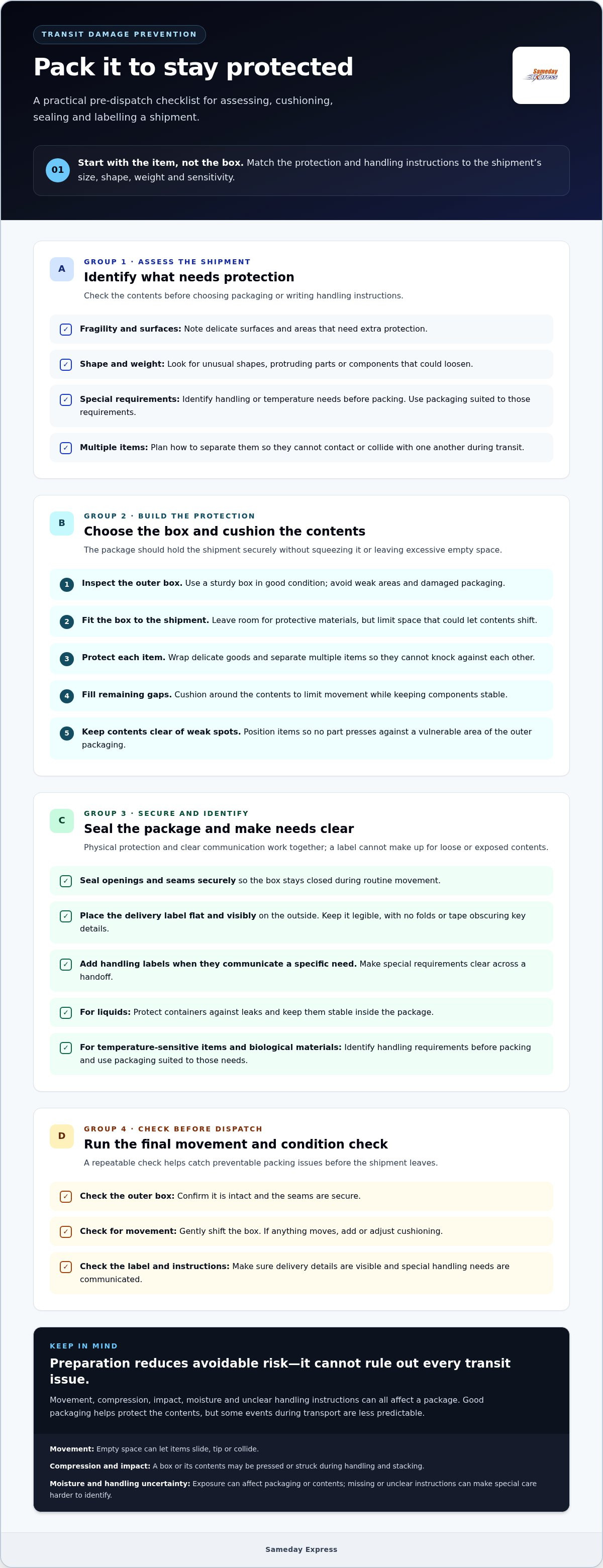
A pre-shipment checklist for preventing package damage
A repeatable dispatch check gives your team a final chance to catch problems before a shipment leaves. Assign packing and labelling responsibilities clearly: the packer checks the contents and package, while the person preparing dispatch verifies the label and handling instructions. A consistent process matters especially when shipments are urgent and there is little time to repack.
Damage risk is easier to manage when packaging, handling and dispatch checks align. Use the checklist below for each shipment, adapting it to the contents and handling requirements.
What to inspect before the package leaves
The packer should inspect the contents, cushioning and outer package before sealing or dispatch. Check for movement, loose components, weak seams and visible damage. If the shipment contains multiple items, confirm they are secured and separated so they cannot strike one another. The dispatcher then verifies that the label is readable and instructions are clear.
- Contents: Check that items are immobilized, separated where needed and free of visible damage before packing.
- Components: Look for loose parts or accessories that could shift during routine movement.
- Box and closures: Inspect the outer package for damage, weak seams, open edges or insecure closures.
- Labels: Confirm that the delivery label is legible, visible and attached to a flat surface.
- Instructions: Make sure any required handling directions are clear and attached to the package.
- Responsibility: Record who completed the packing check and who cleared the shipment for dispatch, according to your process.
If an item moves when the closed package is gently shifted, stop and correct the packing before dispatch. A handling label can communicate a requirement, but it cannot compensate for contents that are loose or inadequately protected.
What to document if damage is reported
Set a consistent process for collecting details if a recipient reports damage. Ask them to retain the packaging and document the condition of both the outer parcel and affected contents. Photographs can help show visible damage and how the contents were packed. Keep the request practical and follow your organization’s procedures for recording the report.
Match the report to shipment details, such as the delivery record, package description and dispatch information. Note when the damage was identified and what was affected. A clear record can help your team review the packaging and handoff process, though it will not always establish where or when damage occurred. Keep incident notes with the related shipment records, following your internal practices for access and retention.
Clear checks support reliable dispatch, especially for time-sensitive business shipments. To plan a delivery around your shipment’s timing and handling needs, Request a Quote from Sameday Express.
How Sameday Express Inc. supports time-sensitive shipments
Good packaging and a clear dispatch process remain essential, even when a shipment is urgent. Once your team has prepared the package and identified its handling needs, the delivery plan can help reduce avoidable delays and extra handoffs. Sameday Express supports businesses with time-sensitive shipments through Same Day Delivery and Rush delivery.
What businesses can expect from Same Day Delivery
Same Day Delivery is designed for urgent pickup and delivery within hours. Pickup is available within 60 minutes, and the shipment travels by direct non-stop transport. This can reduce intermediate handling for suitable deliveries. Real-time GPS tracking gives your team visibility into shipment status while it is on the move.
Delivery records help document the handoff. Same Day Delivery includes signature confirmation and proof of delivery with photo. These records support visibility and documentation, but they do not replace suitable packaging or handling instructions. All shipments fully covered end-to-end.
Same-day delivery is guaranteed when conditions allow. Build the delivery plan around the shipment’s requirements and the recipient’s availability, and prepare the package to protect its contents throughout transit.
Choose a logistics service around the shipment’s needs
Match the service to the task. Same Day Delivery can suit an urgent shipment that needs direct transport and prompt pickup. Rush delivery is another option for time-critical business needs. In either case, provide accurate pickup and delivery details, explain any handling requirements, and have the package ready so the handoff can proceed efficiently.
For businesses with ongoing storage and order-preparation needs, Warehousing & Fulfillment can support inventory management, pick-and-pack services, same-day fulfillment and returns processing alongside urgent delivery planning. Keep the immediate shipment’s priority clear: distinguish an urgent parcel from broader inventory or order workflows, and share the key delivery details with the team responsible for dispatch.
Use Sameday Express Same Day Delivery to coordinate urgent transport with your shipment’s handling needs. Preventing package damage in transit still depends on the full process: prepare the shipment appropriately, communicate its requirements and choose a delivery plan that suits its urgency.
Planning an urgent business shipment? Request a Quote.
Make shipment protection part of your process
Turn package preparation into a consistent operating practice. Assign clear responsibilities, keep a pre-dispatch check accessible to staff, and review damage reports for patterns your team can address. A recurring issue may point to a packaging step or handoff instruction that needs adjustment. These process improvements can help your team respond consistently as shipment needs change.
Preventing package damage in transit takes attention at every stage, from preparation to delivery planning. Sameday Express brings over 25 years of experience supporting business delivery needs, including urgent shipments with real-time GPS tracking. Build your next shipment plan around its contents, handling needs and required timing, then put that plan into action with a reliable delivery partner.
Request a Quote for your upcoming business shipment.
Frequently Asked Questions
Does faster shipping prevent package damage?
No. Faster shipping does not prevent impacts, pressure or movement inside a poorly packed box. Speed can help meet a deadline, but it is not physical protection. A fragile item can still break on a short route if it is loose inside the package. Treat delivery speed and packaging as separate decisions, and prepare the shipment to protect its contents throughout handling.
Should I write “Fragile” on a package?
Yes, if the contents need careful handling, a visible “Fragile” label can communicate that need to people handling the parcel. Keep the label easy to see and pair it with clear instructions if the shipment has specific handling requirements. Do not rely on the label alone: it cannot stop contents from shifting or protect them from impact. Pack the item so it has suitable support inside the box.
Can I reuse a box when shipping fragile items?
Yes, if the box is still sound and can protect the item. Before reusing it, check for crushed corners, punctures, damp areas, soft or weakened panels, and seams that no longer hold securely. Remove or cover old delivery labels and markings so they do not cause confusion. If the box has lost its shape or strength, choose another package rather than relying on extra tape to compensate.
How should I pack multiple fragile items in one box?
Wrap each item separately, then place dividers or cushioning between them so they cannot touch or collide. Arrange the contents so heavier items do not rest on delicate ones, and keep every item from shifting when the box is gently moved. For example, glassware should be individually protected with gaps filled around and between pieces. If you cannot keep the items separated and stable, use more than one box.
What should I do if a package arrives damaged?
Document the damage promptly and contact the sender or shipping contact to follow the relevant reporting process. Keep the packaging and take clear photos of the exterior, cushioning and affected contents before discarding anything. Note which items are damaged and whether the outer box also shows signs of impact or moisture. These details can help your business review the incident and decide on next steps.
Does GPS tracking show whether a package is damaged?
No. GPS tracking can show location or shipment progress, but it cannot reveal the physical condition of the contents. A delivery scan or proof of delivery also confirms a handoff, not that an item inside is intact. If a package arrives with visible damage, record its condition and inspect the contents. Use tracking records alongside photos and shipment details when reviewing what happened.
Disclaimer
Blog Disclaimer
The information published on the Sameday Express Blog is provided for general informational and educational purposes only. While we strive to keep all content accurate and up to date, Sameday Express makes no representations or warranties of any kind, express or implied, regarding the completeness, accuracy, reliability, suitability, or availability of the information contained in our articles.
The content on this blog does not constitute legal, customs, tax, regulatory, financial, or professional advice. Shipping regulations, carrier policies, customs requirements, and transportation laws may change without notice and may vary by destination. Readers should verify current requirements with the appropriate government authorities, carriers, or qualified professionals before making shipping or business decisions.
Sameday Express is not liable for any loss, damage, delays, or consequences arising from the use of, or reliance on, information published on this website. Any actions taken based on the information provided are at the reader's own risk.
References to third-party companies, products, services, or websites are provided for informational purposes only and do not constitute an endorsement or recommendation by Sameday Express.
All blog content, including text, graphics, images, and logos, is the property of Sameday Express unless otherwise stated and may not be reproduced or distributed without prior written permission.
For specific shipping requirements, pricing, transit times, or logistics solutions, please contact Sameday Express directly for personalized assistance.


