

Keeping logistics in-house can feel like the safest way to retain control. But when routine orders stretch your team, an urgent shipment can expose the limits of that model. The choice between outsourced vs in-house logistics is not simply about handing over operations or keeping every task under your roof.
It is reasonable to ask whether an outside partner will follow your processes and protect your service standards. At the same time, staffing, systems and shipment peaks all require time and capacity. The right balance depends on what your team can handle reliably and which shipments need specialized or time-critical support.
This guide compares the practical demands of each model, including staffing, capacity, oversight and service. You will learn which logistics activities may suit outsourcing, how to maintain visibility and accountability, and how to match routine work with urgent or sensitive shipments. The goal is a dependable operating model built around your business, not an all-or-nothing decision.
Key Takeaways
- Compare outsourced vs in-house logistics by the level of control, capacity and service each function requires.
- Map each shipment’s journey to see which planning, storage, preparation and delivery tasks your team should own.
- Use a hybrid model to retain oversight of core processes while assigning selected logistics work to an external partner.
- Separate routine fulfillment from urgent or sensitive shipments when deciding how each should be handled.
- See how Sameday Express can support outsourced logistics through Warehousing & Fulfillment and time-critical delivery services.
Outsourced vs. In-House Logistics: What Each Model Means
In-house logistics means your company manages the people, processes and assets involved in moving or fulfilling goods. Your team may plan shipments, organize inventory, prepare orders, arrange dispatch and oversee delivery. The business sets the workflow and handles the work with staff and resources it manages directly.
Outsourced logistics means assigning specific logistics tasks to an external service provider. That can include transport, warehousing or fulfillment, without transferring every function or decision. The practical distinction is simple: in-house logistics puts the work under your operational management; outsourced logistics assigns agreed work to an external provider while your business retains oversight.
For a concise comparison of the two operating models, watch this video:
What in-house logistics typically covers
An in-house operation may manage shipment planning, staffing, inventory records, order preparation and delivery processes. Your business decides how tasks move between teams, what information is recorded and how exceptions are handled. Control, however, does not mean unlimited capacity. Keeping the operation internal also means assigning people, time and resources to its daily demands.
These responsibilities can be split. For example, a business might retain customer communication and inventory oversight while assigning transport to an external provider. The business still decides what needs to ship and monitors stock, but the delivery work is handled outside the company. This division can preserve visibility over customer commitments without requiring the business to manage every movement itself.
What outsourced logistics can include
Outsourcing can apply to separate parts of the shipment journey. Transport covers moving goods between locations. Warehousing covers storing goods, while fulfillment covers preparing orders for dispatch. A business can assign one function or combine selected functions, then keep other responsibilities with its own team.
Third-party logistics, often shortened to 3PL, is a plain-language term for logistics work performed by an outside provider. The Third-party logistics (3PL) overview describes the broader concept. For this decision, focus on the specific services being assigned and the tasks your staff will continue to manage. In the outsourced vs in-house logistics decision, the key question is not simply who owns the process, but who performs each task and who remains accountable for the result.
This function-by-function approach helps businesses avoid an all-or-nothing choice. You might keep inventory decisions and customer service in-house, for instance, while outsourcing transport or order preparation. Define the handoff clearly: what information the provider receives, which team tracks progress and who handles exceptions. That clarity keeps internal oversight connected to reliable day-to-day execution.
How In-House and Outsourced Logistics Work Day to Day
A shipment passes through several connected steps, from the first delivery request to confirmation that it arrived. In a mixed operating model, your team and an external logistics partner can each handle parts of that journey. The handoffs matter: responsibilities, shipment details and updates need to move with the goods.
Outsourcing can transfer selected logistics tasks while internal teams retain defined responsibilities for priorities, inventory and customer communication. Tracking helps both sides coordinate, but it does not replace oversight. Your team still needs to act on delays, changed priorities or delivery exceptions.
Where internal teams retain direct oversight
Your business can set inventory priorities, determine which orders take precedence and communicate commitments to customers. The people and systems involved will vary by company. A smaller operation may coordinate these tasks across a few roles; another may assign them to separate teams.
Clear dispatch priorities help staff distinguish routine orders from urgent shipments. For example, an order with a fixed delivery window should be flagged before routine dispatch is arranged. Your team can provide the shipment details and service priority, then monitor progress and manage customer updates.
Where an external logistics partner can take responsibility
A partner’s role depends on the service assigned. With Warehousing & Fulfillment, work includes a secure storage facility, inventory management, pick-and-pack services, same-day fulfillment and returns processing. Your team can retain oversight of stock decisions while the partner handles agreed storage and order-preparation tasks. Define how inventory information and order instructions are shared so both sides work from current details.
For a time-critical shipment, Same Day Delivery provides direct, non-stop transport, pickup within 60 minutes and real-time GPS tracking. Signature confirmation and proof of delivery with photo provide a record of completion. These details support coordination, while your business remains responsible for setting the shipment priority and responding to changes that affect the customer.
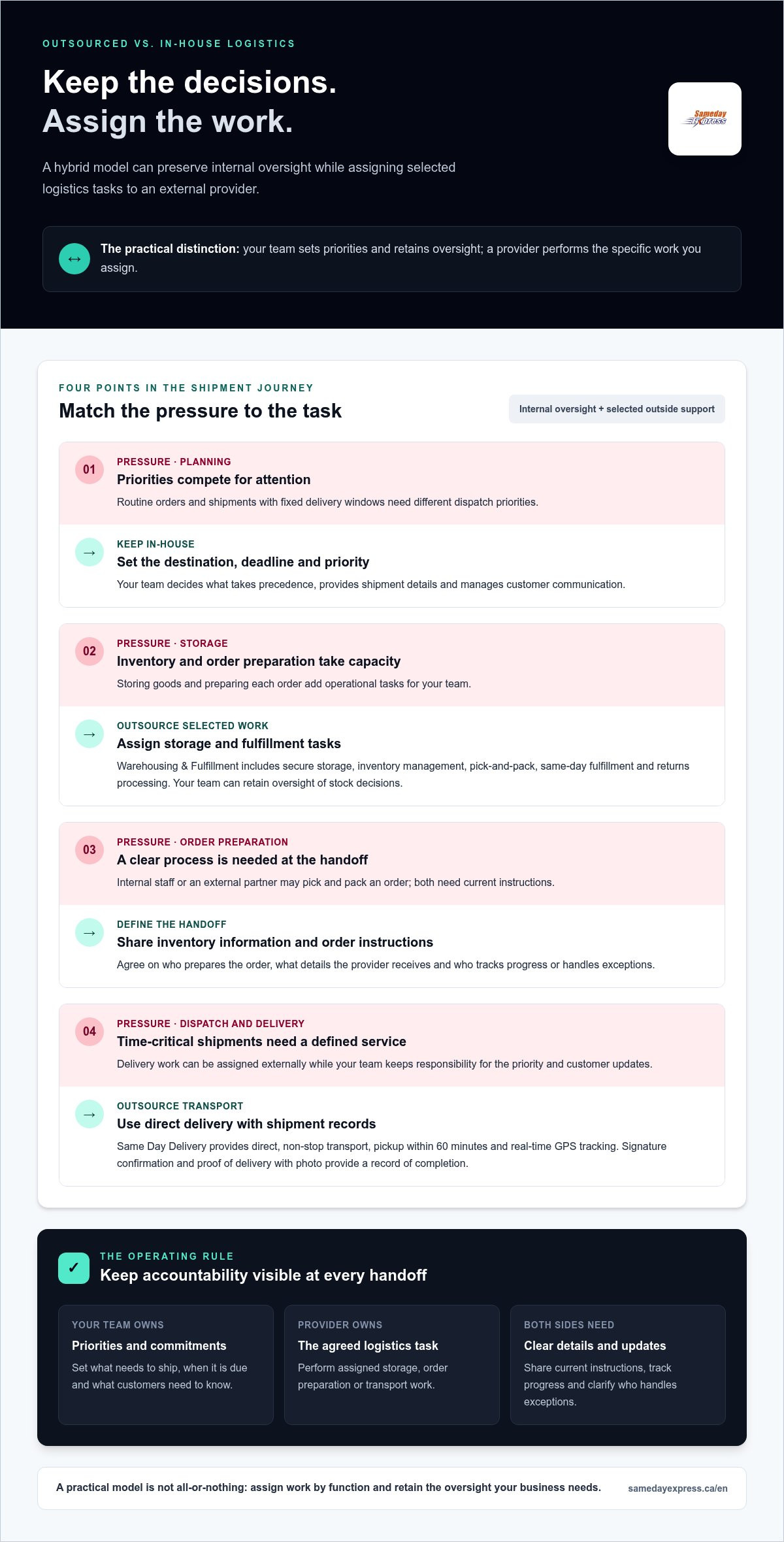
A practical shipment workflow can assign ownership at each step:
- Planning: Your team identifies the destination, deadline and service priority.
- Storage: Inventory stays under internal management or is held through Warehousing & Fulfillment.
- Order preparation: Internal staff or an external partner picks and packs the order according to the agreed process.
- Dispatch and delivery: Your team arranges the delivery or assigns transport to a partner, then follows progress.
- Proof of delivery: The delivery record is returned so staff can close the order and update the customer.
This division makes outsourced vs in-house logistics a day-to-day operating question: who performs each task, who provides updates and who acts if plans change? For businesses assessing a direct delivery option, Sameday Express Same Day Delivery can handle the transport step while your team retains shipment priorities and customer contact.
Outsourced vs. In-House Logistics: Compare Control, Urgency and Handling
Control, workload and shipment requirements can point to different logistics models within the same business. An in-house team may be best placed to set inventory priorities and customer commitments, while an external partner takes on a defined transport or handling task. Outsourcing changes who performs that work. It does not require your business to give up internal oversight.
Use this comparison to identify where each model may fit. Actual responsibilities depend on the process your business assigns and retains.
| Factor | In-house logistics | Outsourced logistics |
|---|---|---|
| Control | Your team directs internal processes and decisions. | Your team sets the agreed requirements; the provider performs assigned tasks. |
| Internal workload | Staff manage the activities kept within the company. | Selected operational tasks move to a provider, while retained responsibilities stay internal. |
| Shipment visibility | Visibility depends on the information and processes your team uses. | Tracking or delivery records can provide updates, but staff still oversee priorities and exceptions. |
| Urgency | Your team sets priority and coordinates the response using its own operation. | An assigned time-critical service can support urgent shipments with defined delivery features. |
| Specialized handling | Internal teams follow the processes they manage for the shipment. | A service with relevant handling procedures can take responsibility for specified tasks. |
When direct internal control matters most
Keep close internal ownership where inventory decisions, customer communication or company-specific workflows need direct coordination. For example, staff may decide which orders take priority, approve changes and explain delivery updates to customers. Assign clear owners for inventory records, service decisions and customer contact. Internal control gives your business decision-making authority, but it does not by itself establish faster or more reliable delivery.
When external capacity or specialized handling matters
For an urgent delivery, Same Day Delivery includes pickup within 60 minutes and real-time GPS tracking. Your team has a delivery status to work with, while staff still set priorities and respond to changes. For medical shipments, Medical Courier includes temperature monitoring, DG-trained drivers, medical protocol compliance, hospital dock delivery and Emergency STAT service. These requirements make clearly assigned handling responsibilities especially important.
Bioscience & Testing provides temperature-controlled transport, chain-of-custody documentation and HIPAA-compliant handling for lab samples, test kits and biological materials. These service features clarify what the external partner handles and what your organization continues to oversee. For a shipment with special handling needs, document the requirements and the internal contact responsible for updates before dispatch.
A hybrid model can combine internal control of inventory, service choices and customer relationships with external support for transport or specialized handling. The right split depends on the shipment and the responsibilities your team needs to retain. Review Sameday Express services for your business.
How to Decide Which Logistics Functions to Outsource
Make the decision task by task. A clear assessment shows which work your team can manage consistently, where external support fits and who remains accountable. This is a practical way to approach outsourced vs in-house logistics without treating the choice as all or nothing.
- Map the shipments. Group them by urgency, size, handling needs, destination and proof-of-delivery requirements. Separate routine orders from urgent deliveries, sensitive materials and shipments with specific documentation needs.
- Define the service requirements. Record what each shipment needs from pickup through delivery. Flag medical shipments, Bioscience & Testing shipments and AOG - Aircraft on Ground parts for their specialized processes. For Canada-USA express shipping, identify Cross-Border Transport as the relevant service category.
- Review internal capacity. Identify the people and processes available to plan dispatch, prepare orders, manage inventory and communicate with customers. Consider whether the work can be handled reliably during normal operations and when urgent priorities arise. Do not assume every business needs the same staffing or systems.
- Assign ownership. Decide which tasks stay with your team and which require external support. You might retain inventory decisions and customer communication while outsourcing transport, warehousing or fulfillment. Make each handoff clear.
- Set oversight expectations. Establish how your team will receive tracking information, status updates and delivery documentation. Assign someone to monitor exceptions and notify customers when plans change.
Map shipments and service requirements
Keep routine fulfillment distinct from time-critical or sensitive movements. A standard order may follow a regular preparation and dispatch workflow. A medical shipment may need temperature monitoring, DG-trained drivers, medical protocol compliance, hospital dock delivery or Emergency STAT service, depending on its requirements. Bioscience & Testing includes temperature-controlled transport, chain-of-custody documentation and HIPAA-compliant handling. Record the handling instructions and delivery evidence each category needs, rather than relying on a general “priority” label.
Urgent deliveries also need a defined route through your workflow. Same Day Delivery may suit a shipment that cannot wait for routine dispatch. The right choice depends on the shipment’s deadline and requirements, not simply its size or destination. Same-day delivery is guaranteed when conditions allow, so confirm that the service fits the shipment’s timing and handling needs.
Assign ownership and oversight
Write down who approves shipment priorities, maintains inventory records, coordinates with the logistics partner and answers customer questions. Tracking supports visibility, but it does not make decisions for your team. Keep an internal owner responsible for reviewing updates, following up on exceptions and confirming that required delivery records reach the right people.
This framework gives your business a specific starting point: map the work, define service needs, then assign tasks and oversight. Review logistics services for your shipment requirements.
How Sameday Express Inc. Supports Outsourced Logistics
Outsourcing can be limited to the function your team needs support with. Sameday Express works with businesses that want to assign defined logistics tasks while retaining internal responsibility for priorities, inventory decisions and customer communication. The handoff can focus on a particular shipment need rather than changing how your entire operation is managed.
For storage and order preparation, Warehousing & Fulfillment includes a secure storage facility, inventory management, pick-and-pack services, same-day fulfillment and returns processing. These functions support businesses that want an external partner to manage the physical flow of stock and orders while internal teams continue to guide product and customer decisions.
For delivery, identify the type of shipment and the work you want assigned. Same Day Delivery is designed for time-critical shipments. Your team can set the priority and provide delivery instructions, while the service handles the assigned transport task. The guide Livraison le jour même : Le guide complet pour les entreprises offers more context for planning urgent delivery needs.
Support for urgent and specialized shipments
When an aircraft is grounded, AOG - Aircraft on Ground supports emergency aviation parts delivery through a 24/7 service and dedicated AOG hotline. Its features include direct airport delivery, customs clearance assistance and real-time status updates. These defined services help aviation teams assign the delivery task while retaining responsibility for the part requirement and operational decisions.
For healthcare organizations, Medical Courier supports medical shipments, including temperature-sensitive medications and hospital supplies. Its features include temperature monitoring, DG-trained drivers, medical protocol compliance, hospital dock delivery and Emergency STAT service. Bioscience & Testing handles lab samples, test kits and biological materials, with temperature-controlled transport, chain-of-custody documentation and HIPAA-compliant handling. Assigning a specialized shipment function gives internal teams a clear division of work while they retain oversight of their priorities and communications.
Choose the function that best fits your current need: storage and order preparation, routine delivery, or support for an urgent or specialized shipment. Define what your team will continue to manage and which task should be handled externally. This keeps the operating model focused on your business requirements.
Choose the next step for your operations
Before making a change, identify the task to assign and the internal contact who will oversee the handoff. A clear scope helps your team keep decisions and customer relationships where they belong while gaining support for a specific logistics function.
Explore Sameday Express logistics services.
Set a Clear First Step for Your Logistics Model
Your logistics model can evolve as shipment needs change. Rather than treating outsourced vs in-house logistics as a permanent, all-or-nothing choice, start with one function that creates a clear operational challenge. Define what a successful handoff looks like, who will oversee it and how your team will review the process. This gives you a practical basis for deciding whether to expand external support or keep more work in-house.
The right arrangement should fit the shipments you handle and the responsibilities your team needs to retain. A clear plan helps protect service priorities while making room for dependable external support where it makes sense.
Ready to discuss the logistics function your business wants to outsource? Request a Quote.
Frequently Asked Questions
What is the difference between outsourced and in-house logistics?
In-house logistics means your company directs the people and resources doing logistics work. With outsourced logistics, an external provider performs tasks assigned by your business. The distinction is about who carries out the work, not who sets every business priority. For example, your team can decide how orders are prioritized while assigning a defined delivery task externally. This division is central to choosing an outsourced vs in-house logistics model.
Is outsourced logistics right for a small business?
It can be, if a specific logistics task is taking time or capacity away from core work. A small business might keep customer relationships and purchasing decisions internal while assigning order preparation or delivery to an external partner. Start with one clearly defined function, then consider how your team will share instructions, manage exceptions and review results. Outsourcing should address an operational need, not add unnecessary handoffs.
Can a business outsource delivery but keep inventory management in-house?
Yes. Your team can maintain stock records, decide when to replenish products and determine which orders are ready, while an external provider handles delivery. For example, staff could release a packed order for dispatch and retain responsibility for inventory adjustments after shipment. Agree on how dispatch status and completed deliveries are reported so stock records and order records stay aligned.
What does a third-party logistics provider handle?
A third-party logistics provider handles the specific logistics functions a business assigns. Depending on the arrangement, that may include transport, storage or order preparation and fulfillment. It does not automatically mean the provider manages customer service, purchasing or every inventory decision. Define the scope in practical terms: which orders are included, what information is shared, and where the provider’s responsibility ends.
How can a business maintain visibility when logistics are outsourced?
Set a consistent process for receiving shipment updates and recording them against the right order. Decide who reviews status changes, who follows up on delays and how delivery documentation reaches the team that closes the order. For example, customer service staff may need a clear handoff from dispatch before replying to a delivery query. Tracking helps inform decisions, but your team still owns follow-up.
Can outsourced logistics support urgent same-day shipments?
Yes. Same Day Delivery can support urgent shipments when the order is ready to move and the required pickup and delivery details are clear. The service includes pickup within 60 minutes, direct, non-stop transport, real-time GPS tracking, signature confirmation and proof of delivery with photo. Same-day delivery is guaranteed when conditions allow, so do not treat every urgent request as having the same requirements.
What should a business review before outsourcing fulfillment?
Review the order flow from stock release to dispatch, including how items are picked, packed and recorded. Identify special packing instructions, inventory update points, returns processing and who resolves order exceptions. Also map how customer questions will reach the right person. A sample order can help reveal missing instructions before a wider handoff. Keep ownership of product decisions clear, even if fulfillment tasks move outside the business.
Disclaimer
Blog Disclaimer
The information published on the Sameday Express Blog is provided for general informational and educational purposes only. While we strive to keep all content accurate and up to date, Sameday Express makes no representations or warranties of any kind, express or implied, regarding the completeness, accuracy, reliability, suitability, or availability of the information contained in our articles.
The content on this blog does not constitute legal, customs, tax, regulatory, financial, or professional advice. Shipping regulations, carrier policies, customs requirements, and transportation laws may change without notice and may vary by destination. Readers should verify current requirements with the appropriate government authorities, carriers, or qualified professionals before making shipping or business decisions.
Sameday Express is not liable for any loss, damage, delays, or consequences arising from the use of, or reliance on, information published on this website. Any actions taken based on the information provided are at the reader's own risk.
References to third-party companies, products, services, or websites are provided for informational purposes only and do not constitute an endorsement or recommendation by Sameday Express.
All blog content, including text, graphics, images, and logos, is the property of Sameday Express unless otherwise stated and may not be reproduced or distributed without prior written permission.
For specific shipping requirements, pricing, transit times, or logistics solutions, please contact Sameday Express directly for personalized assistance.


