

No: “5-ton” doesn’t mean a truck can always carry exactly five tons of freight. A 5-ton truck delivery service uses a vehicle suited to commercial loads, but the usable payload depends on the truck’s rated capacity and the shipment’s weight and dimensions. The label alone isn’t enough to determine whether a particular load fits.
That distinction matters when you’re planning a heavy or high-volume delivery and need the right vehicle, timing and route. This guide explains how a 5-ton straight truck differs from a tractor-trailer, what affects payload, which delivery options may suit your shipment, and how scheduling and transit time are assessed. You’ll also learn what shipment details to prepare so the delivery can be arranged efficiently.
Key Takeaways
- “5-ton” describes a truck class, not a promise that the full load can weigh five tons; check the vehicle’s rated payload against your freight.
- A straight truck has its cab and cargo body on one vehicle, making it a practical option for certain commercial shipments.
- Delivery timing depends on the route, pickup and receiving arrangements, and shipment details, so prepare these before scheduling.
- For heavy or high-volume freight, share the shipment’s weight, dimensions, quantity, and handling needs to help determine a suitable delivery plan.
- Transport Canada’s National Safety Code applies to commercial-vehicle drivers and carriers operating vehicles over 4,500 kg, including extra- and intra-provincial operations.
How a 5-ton straight truck fits commercial freight
A straight truck has its cab and cargo body on the same vehicle, unlike a tractor-trailer with a separate trailer. This format can suit commercial freight that needs more room than a cargo van provides but doesn’t require a larger combination truck. The “5-ton” label alone doesn’t confirm usable payload. Match the shipment’s total weight and dimensions to the vehicle’s rated capacity before dispatch.
Compared with a cargo van, a straight truck can carry larger or palletized freight. A larger truck may be a better fit when a shipment exceeds a straight truck’s payload or cargo-space limits. Choose based on the freight’s dimensions and weight, loading access, and receiving-site conditions.
For a practical look at box-truck operations and load fulfillment, watch this video:
For licensing, distinguish the driver’s requirements from carrier and vehicle obligations. Transport Canada says the National Safety Code applies to commercial-vehicle drivers and carriers operating vehicles over 4,500 kg, including extra- and intra-provincial operations. Insurance needs depend on the operation and jurisdiction, so review the carrier’s credentials and coverage for the freight and route.
There is no single typical rate for 5-ton delivery across Canada. A shipment-specific quote reflects the route, freight dimensions, weight, timing, and handling requirements.
Delivery costs depend on the work involved, not just the truck label. Provide the pickup and delivery addresses, shipment dimensions and total weight, loading requirements, and timing. These details help determine the vehicle and route requirements for a quote.
Delivery areas and same-day options depend on pickup and destination locations, dispatch timing, and route distance. For a same-day courier or freight shipment in Canada, share both addresses and when the shipment will be ready. The route and requested timing shape the delivery plan.
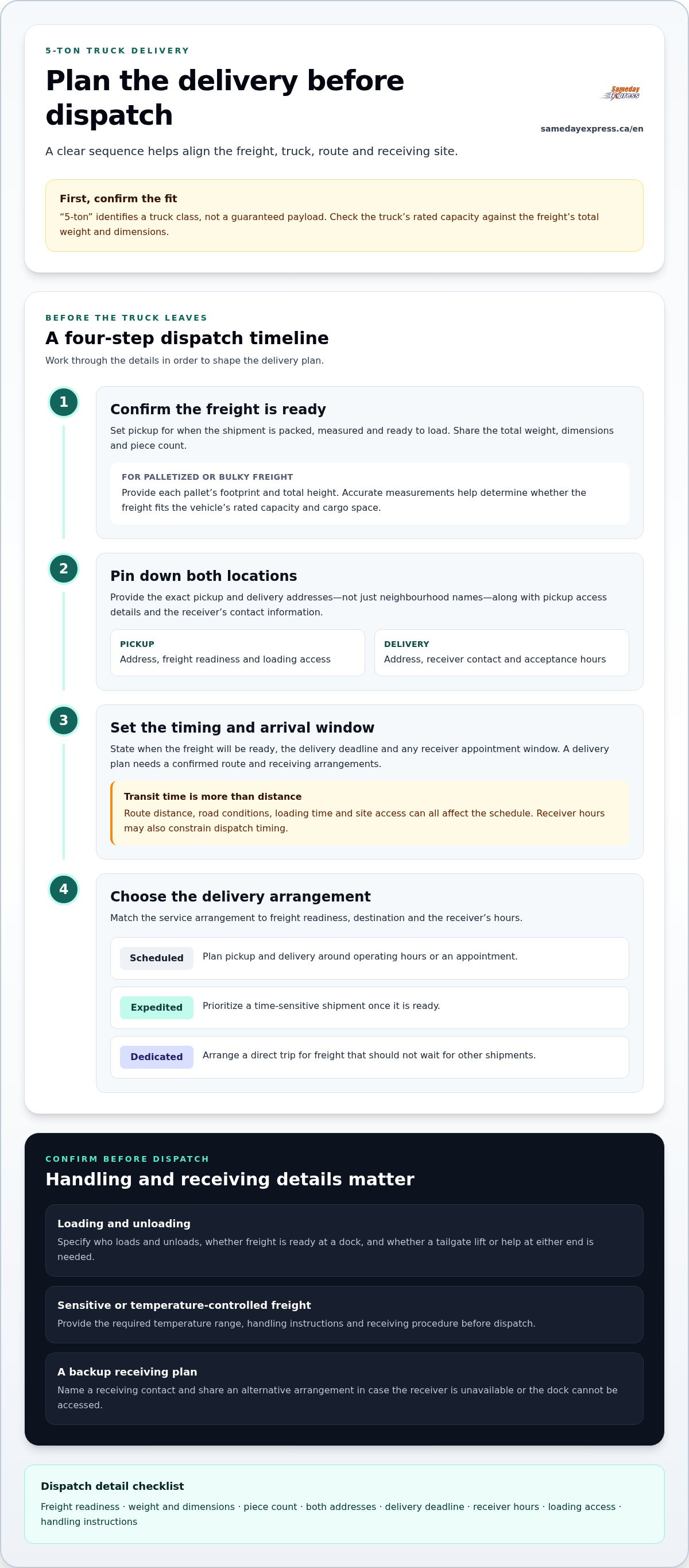
Palletized freight and bulky goods require accurate measurements, including each pallet’s footprint and total height. State the piece count and whether the site has a loading dock or requires ground-level delivery. For example, a tall pallet may need a different loading plan from several compact skids.
For temperature-controlled freight, provide the required temperature range and handling instructions before dispatch. Confirm that the transport arrangement can maintain those conditions throughout the trip. Include the receiving contact and delivery procedure, especially for sensitive goods.
For secure freight storage and redelivery, establish the receiving plan before the truck departs. Provide a named contact, delivery instructions, and an alternative arrangement in case the receiver cannot accept the freight. Clear instructions help prevent delays if a dock is inaccessible or the recipient is unavailable.
Delivery options and guaranteed city-wide timelines
Commercial deliveries can be scheduled, expedited, or arranged as a dedicated trip. The right option depends on when the freight is ready, its destination, and the receiving site’s hours. A delivery timeline should identify the pickup point, delivery address, and arrival window. “Across the city” alone does not define a service commitment. Even a shipment between two parts of the same city needs a confirmed route and delivery window.
Do 5-ton truck deliveries include loading, unloading, or a tailgate lift? These are separate handling details, so specify each in the booking instructions. State whether freight is ready at a dock, requires a liftgate, or needs help at either end. For example, a pallet delivered to a site without a loading dock needs a different plan from freight collected directly by a forklift.
For a reliable timeline, share when the freight will be ready and the receiver’s acceptance hours. A scheduled delivery can be planned around a receiving appointment; an expedited trip prioritizes movement after pickup. A dedicated trip may suit freight that must travel directly rather than wait for other shipments. These describe service arrangements, not fixed arrival times. Route distance, road conditions, access restrictions, and loading time all affect the schedule.
At any Canadian address, a downtown delivery may involve different access and receiving arrangements from an industrial site near a major route. Provide the exact pickup and delivery addresses, not just neighbourhood names. Include dock instructions, contact details, and any appointment window. If the receiver closes before the planned arrival, dispatch timing must account for that constraint. Any city-wide guarantee should define its geographic boundary and when the delivery clock starts.
- Scheduled: Set pickup and delivery around operating hours or an appointment.
- Expedited: Prioritize a time-sensitive shipment once it is ready.
- Dedicated: Plan a direct trip for freight needing focused transport.
- Handling: State who loads and unloads, and whether a tailgate lift is needed.
Before dispatch, organize the details in sequence: confirm freight readiness, provide both addresses, state the delivery deadline, and describe site access. That information helps align the truck, route, and receiver. Avoid treating an estimated drive duration as a guaranteed arrival time; loading, traffic, and building access can change the schedule. For urgent freight, review the available delivery arrangements and provide the route and required timing when planning the shipment.
Delivery scheduling and transit-time information
Scheduling connects freight readiness, pickup access, route planning, and receiver availability. Transit estimates depend on the entire movement, not distance alone.
Delivery Scheduling
Set the pickup window for when the freight is packed, measured, and ready to load. A truck that arrives before the shipment is prepared can lose valuable time. For example, a warehouse should identify the loading contact and the pickup point.
Transit planning also requires the destination’s receiving hours and any appointment requirements. A route ending at a business with limited receiving hours needs different timing from one ending at a staffed receiving dock. Share the delivery deadline, access instructions, and contact details when arranging transport.
Build the schedule from these details:
- The exact pickup and delivery addresses, including unit or dock information.
- The shipment’s ready time and any required arrival window.
- Loading access, site restrictions, and the receiving contact.
- Any handling or delivery instructions that could affect stop time.
For a route between locations, road conditions and building access can affect arrival timing. A delivery estimate should account for pickup, travel, and unloading, rather than treating map distance as the entire trip. If the receiver changes its appointment, update the schedule before dispatch.
Booking the Service
To book a 5-ton truck delivery service, provide the pickup and delivery addresses, freight details, ready time, and required arrival window. These details allow the shipment and route to be assessed together.
Prepare the shipment details before requesting transport. Include the total piece count, dimensions, weight, and whether the freight is palletized. For example, provide clear quantities and measurements for several skids so the vehicle plan reflects the actual load. Add any special handling instructions that affect loading or delivery.
Then provide the operational details that shape the trip:
- Name the pickup and receiving contacts, with working phone numbers.
- State the pickup window and destination receiving hours.
- Describe dock access, security procedures, or appointment requirements.
- Identify the delivery deadline and any time-sensitive constraints.
Before dispatch, check that the pickup and delivery addresses, contact names, and requested timing are accurate. A missing unit number or closed receiving desk can delay the handoff. Keep the receiver informed of the planned arrival window and promptly share any changes. For a multi-stop shipment, list each address in delivery order and identify the freight for each stop. Clear booking information gives dispatch a practical basis for coordinating the truck, route, and handoff.
Large-volume and heavy-weight deliveries
For a large commercial shipment, vehicle selection starts with the complete load, not the “5-ton” label. Check the truck’s rated payload and cargo dimensions against the freight’s total weight and space requirements. Include packaging, pallets, and any equipment shipped with the goods. A load that fits the cargo body may still exceed the vehicle’s rated capacity.
Prepare a shipment profile before requesting transport. Record the total weight, number of pieces, measurements, and how each item is secured. For example, a shipment of machinery may have fewer pieces than a pallet order but require more floor space. Accurate dimensions help determine whether the freight fits through the vehicle’s cargo opening and can be positioned safely.
Weight distribution matters as much as total weight. A dense machine placed at one end presents a different loading challenge from evenly distributed cartons. Provide the weight of individual items when it varies substantially. Also identify fragile, top-heavy, or irregular freight, since these characteristics affect how the load can be arranged and secured.
- Weight: Share total weight and individual item weights where available.
- Dimensions: Measure length, width, and height, including pallet bases.
- Quantity: List each skid, crate, machine, or loose piece.
- Access: Describe loading equipment, dock access, and delivery-site restrictions.
Palletized freight requires both footprint and height measurements. An order with several standard pallets may use less floor space than a single oversized crate. Note whether pallets can be stacked, must remain upright, or need to be unloaded first. This sequence is especially useful when one truck carries orders for multiple receiving points.
Bulky goods can be limited by shape, not weight. Long materials, wide equipment, or unusually shaped crates may not fit through the cargo opening, even if the total load is light. Measure the widest and longest points, and provide photographs or handling notes if the shape is difficult to describe. Identify stairs, narrow entrances, or restricted loading zones at the destination.
If a shipment exceeds the vehicle’s payload or usable cargo space, divide it into compatible loads or choose a different vehicle class. Do not assess suitability by pallet count alone. A few dense industrial components, for instance, can weigh more than a larger group of lightweight cartons. A clear load list lets dispatch assess capacity before assigning a truck.
Before pickup, label each piece with its destination and handling instructions. Match the labels to the packing list, then confirm the pickup and receiving contacts. For multi-stop freight, group and mark each delivery separately. These steps reduce sorting delays and help ensure the right goods reach each commercial recipient.
Payload and truck-class caveats
Before hiring, compare your shipment’s actual weight and dimensions with the truck’s rated payload and cargo space. Review the carrier’s credentials and insurance coverage for your freight, and establish whether the route stays within one province or crosses provincial boundaries.
Payload Considerations
Payload is the freight a vehicle can carry, not its class label. Ask for the specific vehicle’s rated payload, then compare it with the complete shipment weight, including pallets and packaging. A dense machine, for example, may exceed the available capacity even when it takes up little floor space. Confirm the weight and dimensions of each large item, not just the shipment’s overall volume.
Weight distribution and cargo shape also affect whether a load fits. A single heavy component may need different placement from evenly packed cartons. Share the widest and tallest measurements, along with details of items that must remain upright. These specifics help assess whether the freight suits the vehicle’s usable cargo area and can be loaded appropriately.
Truck-Class Suitability
The “5-ton” description does not, by itself, establish a vehicle’s legal classification or exact payload. Check the actual vehicle and operating details against the route and freight requirements. According to Transport Canada, Canada’s National Safety Code applies to commercial-vehicle drivers and carriers operating vehicles over 4,500 kg, including extra- and intra-provincial operations.
When hiring, ask the carrier to identify the truck assigned to the shipment and explain how its capacity suits your load. Confirm the applicable operating credentials and insurance details, including whether the coverage suits the freight. Requirements can depend on the vehicle and operation, so routes within a province and those crossing provincial boundaries may involve different operating contexts.
Use this checklist before confirming a booking:
- Compare total freight weight with the assigned vehicle’s rated payload.
- Provide dimensions, piece count, pallet details, and weight distribution.
- Confirm the truck’s cargo space suits the shipment’s longest and tallest items.
- Review carrier credentials and insurance coverage for the route and freight.
- State whether the shipment travels within one province or across provincial boundaries.
A 5-ton truck delivery service is suitable only when the specific vehicle, shipment, and route align. If freight exceeds the payload or cargo-space limit, request a different vehicle class or split the load. Give dispatch complete measurements and route details before assigning a truck. Prepare your freight delivery request with the shipment’s weight, dimensions, and destination so the transport requirements are clear.
Sameday Express Inc.: same day delivery
Sameday Express Inc. offers same day delivery, rush delivery, and Sameday Direct drive for urgent commercial shipments. These options suit businesses that need freight moved promptly rather than held for routine dispatch. For critical timelines, its direct-drive service provides a focused, route-specific transport option across the country.
When arranging transport, share the pickup and delivery addresses, freight details, ready time, and required arrival window. This information helps determine a suitable delivery option and schedule. Direct-drive delivery may suit freight that needs a focused trip, while Rush delivery addresses an urgent dispatch need.
For commercial freight that needs prompt movement, contact Sameday Express Inc. to discuss your delivery.
Set your next commercial delivery in motion
Make your freight plan ready for dispatch by coordinating your shipping and receiving teams. Decide who will release the load, who will accept it, and who can resolve access issues at either location. A clear point of contact at both ends helps keep the handoff organized when plans change.
A 5-ton truck delivery service can support commercial freight when the vehicle matches the load and the delivery plan fits the receiving site. For time-sensitive shipments, Sameday Express Inc. offers same day delivery, Sameday Direct drive, and rush delivery. Select the option that suits your shipment’s urgency, then have the pickup and delivery details ready.
Share the route, freight information, and timing requirements so the delivery can be arranged around your business needs. Contact Sameday Express Inc. to arrange delivery and take the next step with a clear plan.
Frequently Asked Questions
Does “5 ton” mean the truck can always carry exactly five tons?
No. “5 ton” is a truck-class label, not a guarantee that the vehicle can carry five tons of freight. The usable payload depends on the specific vehicle’s rating and configuration. Before loading, compare the shipment’s documented weight, including packaging and pallets, with the assigned truck’s payload specification. A scale ticket or supplier weight record can help avoid relying on rough estimates.
What is a 5 ton straight truck?
A 5-ton straight truck is a commercial vehicle with its cab and cargo body mounted on the same chassis. It doesn’t pull a separate trailer, as a tractor-trailer does. This integrated design can suit business freight that needs an enclosed cargo space. For example, a distributor may move boxed inventory from a warehouse to a retail receiving area in one vehicle.
What is a 5-ton truck delivery service in Canada?
In Canada, a 5-ton truck delivery service arranges commercial freight transport using a truck in this general class. Businesses may use this type of delivery for palletized goods, equipment, or shipments that exceed parcel-carrier needs. The plan depends on the route, freight, and requested timing. Provide the origin, destination, shipment details, and receiving instructions when arranging the move.
What are the dimensions and payload capacity of a 5-ton truck?
There isn’t one standard cargo-body dimension or payload figure for every 5-ton truck. Measurements and capacity depend on the vehicle and body configuration, so review the specific truck’s specifications. Sameday Express Inc. lists a Hino 195 payload of 4,470 kg. Check cargo-body length, width, height, and opening measurements against your freight before selecting a vehicle.
What items can a 5-ton truck deliver?
A 5-ton truck delivery service can carry suitable commercial freight, such as packaged inventory, office equipment, manufacturing components, or palletized supplies. The shipment must fit the vehicle’s cargo space and stay within its rated payload. For example, a business replenishing a store may ship cartons alongside boxed display fixtures. Provide item descriptions, measurements, and weights so the load can be assessed accurately.
Disclaimer
Blog Disclaimer
The information published on the Sameday Express Blog is provided for general informational and educational purposes only. While we strive to keep all content accurate and up to date, Sameday Express makes no representations or warranties of any kind, express or implied, regarding the completeness, accuracy, reliability, suitability, or availability of the information contained in our articles.
The content on this blog does not constitute legal, customs, tax, regulatory, financial, or professional advice. Shipping regulations, carrier policies, customs requirements, and transportation laws may change without notice and may vary by destination. Readers should verify current requirements with the appropriate government authorities, carriers, or qualified professionals before making shipping or business decisions.
Sameday Express is not liable for any loss, damage, delays, or consequences arising from the use of, or reliance on, information published on this website. Any actions taken based on the information provided are at the reader's own risk.
References to third-party companies, products, services, or websites are provided for informational purposes only and do not constitute an endorsement or recommendation by Sameday Express.
All blog content, including text, graphics, images, and logos, is the property of Sameday Express unless otherwise stated and may not be reproduced or distributed without prior written permission.
For specific shipping requirements, pricing, transit times, or logistics solutions, please contact Sameday Express directly for personalized assistance.


