

When a shipment is time-critical, every handoff can add delay. We move freight directly from pickup to destination with our no-stop trucking service, providing a practical option for urgent deliveries that need a dedicated, point-to-point route.
Businesses need reliable transport for more than standard parcels. We handle lab samples, test kits, biological materials, medical supplies, and critical aviation parts that may require careful, time-sensitive handling. The cargo and delivery requirements determine the right transport approach.
We explain which trucking activities suit direct, no-stop transport and what types of cargo it can carry. You’ll also learn how urgent medical, aviation, and business shipments fit in, so you can identify when direct-drive delivery or rush delivery is the right next step.
Key Takeaways
- We recommend direct, no-transfer trucking when a shipment’s deadline makes extra handling or terminal stops a concern.
- We match the transport plan to the cargo’s size, handling needs, and delivery urgency.
- We compare a single direct vehicle with team-driver and standard truckload options based on route and required arrival time.
- We estimate time savings by considering the full route and any transfers or freight handling that standard service may involve.
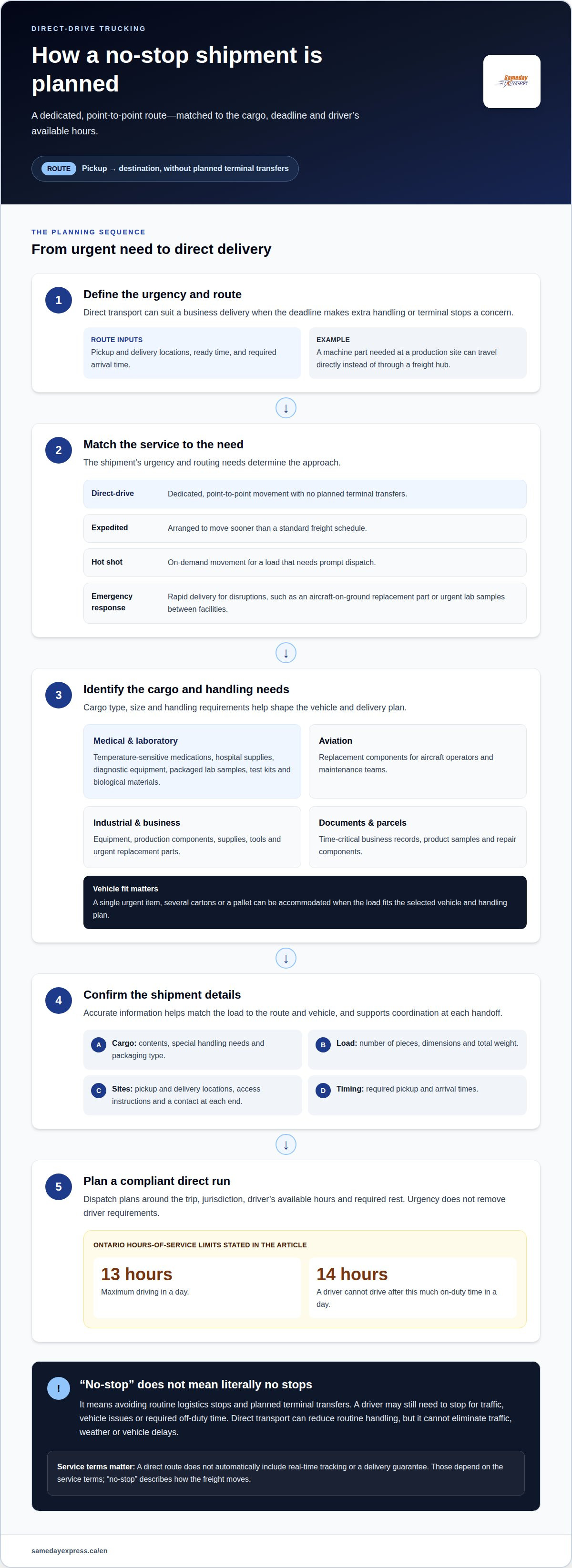
- We follow Ontario rules: drivers cannot drive more than 13 hours in a day or drive after 14 hours on-duty in a day, even on urgent runs.
Applicable trucking activities
Direct-drive trucking moves a shipment from pickup to destination without planned terminal transfers. It suits urgent business deliveries where extra handling could disrupt a schedule. For example, a machine part needed at a production site can travel directly instead of passing through a freight hub.
A no-stop trucking service is a dedicated, point-to-point movement planned around one shipment’s route. “No-stop” means avoiding routine logistics stops, not ignoring road safety or driver requirements. A driver may still need to stop for traffic, vehicle issues, or required off-duty time.
Expedited transport is trucking arranged to move a shipment sooner than a standard freight schedule. Businesses may choose it when a deadline cannot wait for a regular pickup or delivery cycle. An urgent replacement component travelling between two facilities is one example.
Hot shot trucking is an on-demand movement for a load that needs prompt dispatch. Businesses may use it for an unexpected equipment shortage, a time-critical document, or a small shipment needed at another worksite. The service is defined by urgency and routing needs, not by a specific cargo type.
Emergency-response trucking supports disruptions that require rapid delivery. An aircraft-on-ground situation, for example, may call for a replacement part at a maintenance location. Medical and laboratory operations can also need urgent pickups, such as moving lab samples or test kits between facilities.
These transport approaches share a practical purpose: reducing delays from scheduled lanes, consolidation, or terminal transfers. They can suit business deliveries, urgent replenishment, and intercity movements. The plan depends on pickup and delivery locations, shipment size, deadline, cargo-handling needs, and the driver’s available hours.
Risks and limitations: Direct transport can reduce routine handling, but it cannot eliminate traffic, weather, or vehicle delays. Drivers must also follow applicable hours-of-service requirements, so urgency does not permit unlimited driving.
Booking: A provider typically needs pickup and delivery addresses, the ready time, required arrival time, shipment dimensions and weight, and handling instructions. Include a site contact at each end so dispatch can coordinate collection and delivery.
Tracking and guarantees: A direct route does not automatically include real-time tracking or a delivery guarantee. These depend on the service terms; “no-stop” describes how the freight moves.
Hours-of-service requirements regulate commercial drivers’ driving and off-duty time. Applicable rules depend on the trip and its jurisdiction, so dispatch must plan the route around the driver’s available hours and required rest. Even a direct journey needs a compliant schedule.
For a company assessing whether trucking is its main income activity, the stated threshold is based on gross business revenue: more than 50% of that revenue must come from trucking activities. This measure concerns the business’s revenue mix, rather than whether a particular delivery is direct, expedited, hot shot, or emergency-response work. The revenue share describes the primary source of the business’s income, while the shipment can still be characterized by its urgency, route, and handling needs.
Cargo we carry
We carry business freight on direct trucking routes, assigning each shipment to a vehicle for a point-to-point trip. Our service can accommodate a single urgent item, several cartons or a pallet, provided the load fits the selected vehicle and handling plan. For example, we can move a replacement pump between facilities. The shipment’s dimensions and deadline shape the arrangement.
We transport medical cargo between pharmacies, clinics, hospitals and laboratories. This includes temperature-sensitive medications, hospital supplies, diagnostic equipment and packaged lab samples. Tell us the handling requirements when booking. Clear instructions help us plan appropriate handling without making assumptions about the contents.
We transport biological materials that may need controlled handling. A laboratory shipment could contain specimens or test kits destined for analysis or clinical use. Packaging, labelling and handling instructions should match the material’s requirements. For a time-sensitive pickup, give us the receiving location and delivery contact to help prevent delays at handoff.
We carry aviation cargo for aircraft operators and maintenance teams. This can include a replacement component delivered to an aircraft maintenance location. The shipment’s dimensions, weight, packaging and destination access affect vehicle selection and loading. Accurate details matter: a part that cannot be loaded safely cannot follow the planned direct route.
We carry industrial cargo, including equipment, components and supplies used in production and business operations. An urgent replacement part can help a facility address a supply interruption. We can also move tools or equipment between worksites. Before dispatch, tell us whether the shipment is a loose item, boxed freight or a secured pallet.
We deliver documents and small parcels, including time-critical shipments such as signed business records, product samples and components needed for repairs. Their small size does not remove the need for accurate pickup instructions, a named receiving contact and secure packaging suited to the item.
Before booking, give us the cargo information we need to match the load with the route and vehicle:
- Describe the contents and state whether they need special handling.
- Provide the number of pieces, dimensions, total weight and packaging type.
- Identify pickup and delivery locations, access instructions and site contacts.
- Give the required pickup and arrival timing.
These details help us distinguish a small parcel from freight requiring pallet space or careful loading. If your business needs to coordinate urgent cargo movements, urgent delivery planning can help us match the shipment’s needs to a direct route.
How does no-stop trucking compare with team-driver and standard truckload service?
We move shipments on a dedicated vehicle along a planned direct route with our no-stop trucking service. The truck avoids routine terminal transfers and does not combine the load with other freight. For example, we can send a manufacturer’s replacement component straight to a facility facing a supply interruption. This approach prioritizes direct movement and fewer handling points over shared capacity or driver rotation.
With team-driver service, two qualified drivers share the driving work on one truck. While one drives, the other can rest, allowing the vehicle to keep moving for more of the trip. We can help arrange this service for a long-distance shipment on a tight schedule. The truck still has to account for road conditions, required stops, and applicable hours-of-service rules.
Our standard truckload service moves enough freight to fill a trailer or reserve its capacity. You can choose it for a large, planned load that can travel within our regular schedule. A full trailer of packaged inventory moving from a distribution centre to a retailer is one example. The trip may include scheduled pickup windows, route planning, and operational stops.
The main differences are the shipment’s urgency, how we assign the truck, and how the route operates. Our direct transport avoids planned freight transfers. Team-driver transport changes who drives, not necessarily whether freight is transferred. Standard truckload focuses on moving a larger load within a scheduled freight operation. These distinctions matter when you select a service for a deadline-sensitive shipment.
- Route: Our direct trucking follows a point-to-point plan; standard freight may follow a broader operating schedule.
- Drivers: We can assign one driver to a dedicated direct run, while team service shares driving between two.
- Load: We can match a small urgent shipment with direct transport or a trailer-load shipment with truckload service.
- Handling: Fewer planned transfers can reduce handling steps, but safe loading and delivery still matter.
Choose a service based on your delivery deadline and the full shipment profile. We can move a critical replacement part needed at a worksite directly. A large inventory replenishment with a flexible arrival window may suit our standard truckload service. For a long route with a tight schedule, we can help you consider team-driver service, provided the plan meets driver and cargo requirements.
Before dispatch, we compare the pickup window, destination, load dimensions, weight, and required arrival time. For example, a pallet requiring a delivery appointment may need different coordination than a single boxed component. The decision is not simply about the “fastest truck”; it is about matching the route, capacity, handling, and timing.
We offer direct, team-driver, and standard truckload services as different operating approaches, not interchangeable speed guarantees. Traffic, weather, road restrictions, and driver requirements can affect any trip. Give us a clear deadline and accurate shipment details so we can recommend an appropriate transport plan.
How much faster is no-stop trucking than standard freight service?
Transit time is the elapsed time between a shipment’s pickup and delivery. A no-stop trucking service can shorten that interval by avoiding planned freight transfers, terminal handling, and waits for consolidation. The time saved depends on the route and the steps a standard shipment would otherwise take. There is no single time saving that applies to every Canadian shipment.
Standard freight service is a scheduled operation that may combine shipments or move them through terminals. For a shipment travelling between Montreal and Toronto, the delivery window depends on the carrier’s schedule, handling process, and route. Direct transport can remove some of those steps, but it still has to account for road conditions and driver requirements.
Compare elapsed time fairly by using the same pickup and delivery points for both services. Start when the freight is ready for collection and end at delivery. Include scheduled pickup waits, terminal transfers, sorting, and delivery appointments in the standard-service window. For a direct run, account for dispatch, loading, road travel, and receiving arrangements.
Consider a replacement component needed at a Toronto facility. If standard freight waits for a scheduled departure or passes through a terminal, those steps add time beyond driving. A direct route can avoid those planned delays by assigning the shipment to a point-to-point movement. The actual difference depends on when the component is ready and when the receiving team can accept it.
Several variables shape the comparison for a route such as Montreal to Toronto:
- Pickup timing: A shipment ready after a scheduled collection window may wait for the next service movement.
- Handling: Each planned terminal transfer adds a handling stage that direct transport may avoid.
- Route conditions: Traffic, weather, road restrictions, and construction affect both service types.
- Delivery access: A receiving dock’s hours or appointment process can affect the final handoff.
- Driver requirements: Hours-of-service rules affect how a driver can complete a trip.
A useful comparison focuses on the full pickup-to-delivery window, not just the distance between cities. For example, a direct truck may leave sooner but face a road delay, while scheduled freight may already be moving. Dispatch timing and transfer requirements can matter as much as the route itself.
For a time-critical shipment, provide the ready time, destination, and required arrival time before dispatch planning begins. The provider can then assess whether direct transport addresses the main delay, such as terminal waiting or a missed pickup schedule. This gives your team a route-specific comparison instead of relying on a general speed claim.
Hours-of-service requirements can also be relevant when assessing a proposed movement. In Ontario, an individual leasing a commercial motor vehicle for no longer than 30 days is exempt from hours-of-service requirements. That exemption is specific to the stated leasing circumstance, so it should not be treated as a general measure of how much faster a no-stop service will be.
Separately, under the CRA's trucking-industry penalty policy, payments of service fees to a particular business must total more than $500 in a calendar year to meet the stated threshold, excluding GST/HST. This threshold concerns service-fee payments, not a transit-time comparison, so it does not establish an expected time saving.
What Canadian hours-of-service rules apply to no-stop truck drivers?
Hours-of-service rules limit when commercial drivers can drive and require off-duty time. In Ontario, Ontario Regulation 555/06 under the Highway Traffic Act sets these requirements for commercial motor vehicles with a gross weight or registered gross weight over 4,500 kilograms. A direct route does not suspend the rules or allow a driver to skip required rest.
A driving limit is the maximum time a driver may operate a commercial vehicle within a stated period. In Ontario, a driver must have 10 hours off-duty in a day, cannot drive more than 13 hours in a day, and cannot drive after 14 hours on-duty in a day. These are separate limits, so reaching any one can affect the planned trip.
The elapsed-time limit measures the period after a required off-duty break. After at least eight hours off-duty in Ontario, a commercial driver cannot drive after 16 hours have elapsed. For example, we plan a shipment’s route and dispatch time to fit within the driver’s available hours. A direct trip may still require a pause or a different schedule.
A cycle is the rolling period used to track accumulated on-duty time. Ontario drivers may follow either of these cycles:
- Seven-day cycle: A driver cannot drive after being on-duty for 70 hours in a period of seven consecutive days. The driver must take 36 consecutive hours off-duty to start a new cycle.
- 14-day cycle: A driver cannot drive after being on-duty for 120 hours in a period of 14 consecutive days. After accumulating 70 hours on-duty, the driver must take 24 consecutive hours off-duty before driving. A new cycle requires 72 consecutive hours off-duty.
The 14-day cycle also requires at least 24 consecutive hours off-duty in the preceding 14 days. We account for this requirement alongside the daily limits when planning dispatch. An urgent load cannot override the driver’s available hours or required rest.
These limits affect a shipment’s realistic departure and arrival plan. For example, if a Montreal-to-Toronto run would exceed the driver’s remaining permitted hours, we plan around the required off-duty period. “No-stop” describes direct freight movement, not continuous driving without legally required rest.
Ontario has a separate daily-log exemption for certain drivers. A driver may qualify when operating solely within a 160-kilometre radius of the day’s starting location, returning there at day’s end, and working for only one operator that day. This is a log exemption, not a general waiver of hours-of-service limits.
For an urgent Ontario delivery, plan a time-critical shipment around the route, pickup timing, and driver hours. We build a compliant schedule around required rest before dispatch, not after a deadline becomes difficult to meet.
Sameday Express
We help businesses move urgent shipments when a standard freight schedule does not fit the delivery window. Depending on the route and deadline, our same-day delivery, rush delivery, or Direct Drive services can provide a more direct option. For shipments between Montreal and Toronto, a Direct Drive keeps the plan focused on that route.
Share the pickup and delivery locations, shipment details, ready time, and required arrival time. These details help us shape a practical transport plan around your cargo and deadline, including the driver’s available hours.
If you need a direct delivery plan for a time-critical shipment, contact us to discuss your requirements.
Make the next shipment decision with confidence
Before arranging a no-stop trucking service, decide what the delivery needs to support: a production schedule, a laboratory workflow, aircraft maintenance, or a customer commitment. Identify whether the arrival time is fixed or flexible, and what a delay would affect. This gives your transport plan a clear business priority rather than relying on an urgency label alone.
We offer Same Day Delivery, Direct-drive delivery, and Rush delivery for businesses with urgent transport needs. Choose the option that fits the shipment’s purpose and timing, then align the receiving team around the planned handoff. A clear operational goal helps everyone focus on the same outcome.
Contact us to discuss your shipment and its delivery requirements. With a defined priority and a practical plan, you can move forward with greater clarity.
Frequently Asked Questions
What does no-stop trucking service mean?
We describe it as a transport arrangement, not a distinct cargo category or a promise that a truck will never pause. Ask us how we define the service in our dispatch plan, including whether we assign a vehicle to one shipment and how we handle required operational stops. This distinction helps us set clear expectations for shipment status updates and delivery planning.
What shipment types and routes are eligible for no-stop trucking?
We can transport shipments that fit the assigned vehicle and can be loaded, secured, and delivered at the specified sites. Route suitability also depends on road access, site restrictions, and receiving arrangements. Share any dock, gate, or appointment requirements when requesting our service. For a cross-border route, customs documentation and border processing must also be included in the transport plan.
Disclaimer
Blog Disclaimer
The information published on the Sameday Express Blog is provided for general informational and educational purposes only. While we strive to keep all content accurate and up to date, Sameday Express makes no representations or warranties of any kind, express or implied, regarding the completeness, accuracy, reliability, suitability, or availability of the information contained in our articles.
The content on this blog does not constitute legal, customs, tax, regulatory, financial, or professional advice. Shipping regulations, carrier policies, customs requirements, and transportation laws may change without notice and may vary by destination. Readers should verify current requirements with the appropriate government authorities, carriers, or qualified professionals before making shipping or business decisions.
Sameday Express is not liable for any loss, damage, delays, or consequences arising from the use of, or reliance on, information published on this website. Any actions taken based on the information provided are at the reader's own risk.
References to third-party companies, products, services, or websites are provided for informational purposes only and do not constitute an endorsement or recommendation by Sameday Express.
All blog content, including text, graphics, images, and logos, is the property of Sameday Express unless otherwise stated and may not be reproduced or distributed without prior written permission.
For specific shipping requirements, pricing, transit times, or logistics solutions, please contact Sameday Express directly for personalized assistance.


