

A tight delivery deadline is only useful when the estimate accounts for the route, shipment and pickup timing. To request an estimate for an expedited trucking service, provide the pickup and delivery addresses, when the freight will be ready, the required arrival time, and the shipment’s dimensions, weight and handling needs. For cross-border freight, include the relevant shipment details and customs paperwork information.
Transit time depends on the route, shipment readiness and transport mode. A direct drive avoids transfers and terminal delays, while other freight options may involve additional handling. Sharing a firm delivery deadline helps determine which approach suits the shipment.
This guide covers what to include when requesting a freight estimate, how to assess the proposed transit time and prepare your shipment, and what to expect from delivery updates. You’ll also learn how urgent, same-day and direct-drive options can serve time-critical business shipments, including deliveries within Canada and across the Canada-U.S. border.
Key Takeaways
- Include pickup and delivery locations, freight details, ready time and delivery deadline when requesting an estimate.
- Assess transit time by considering the route, transport mode and any transfers or handling steps.
- Use urgent shipping when a delay could disrupt a time-critical business operation.
- Prepare accurate shipment measurements and secure packaging; include customs paperwork details for cross-border freight.
- Agree on how delivery updates will be shared so your team can follow progress and prepare for arrival.
Expedited ground freight and time-critical shipping
A reliable expedited trucking company in Canada should explain the route, vehicle plan, handling steps and delivery updates before pickup. Compare those details with your deadline, then confirm who is responsible for each handoff, especially for cross-border freight.
Expedited ground freight puts a shipment’s deadline ahead of routine consolidation. Standard freight commonly combines shipments, shares equipment and follows regular schedules. A dedicated vehicle can carry freight directly from pickup to delivery, avoiding transfers and terminal handling. For example, a time-sensitive pallet may travel in a dedicated truck rather than wait for other freight heading in the same direction.
Vehicle choice depends on the shipment’s dimensions, weight and loading needs. These examples show why accurate freight measurements matter when selecting equipment.
Some expedited freight services use team trucking, with two drivers keeping a truck moving around the clock. Other shipments may use air freight, charter aircraft or a next-flight-out option. Air transport can suit long-distance routes when ground transit does not fit the deadline. A Boeing 747 is one aircraft type that can be chartered for expedited freight. Air options can also require ground transport at pickup or delivery, so the full route includes each transfer, not only flight time.
Freight brokers can coordinate transport between shippers and carriers across North America. Their role may include matching shipment needs to available capacity and arranging a transport plan. Clarify whether the plan uses a dedicated vehicle, shared freight, air service or a combination. For Canada-U.S. shipments, account for customs documents and release preparation in the overall schedule. Freight movement can slow if border paperwork or communication with a broker or receiver is incomplete.
For sensitive freight, consider handling requirements as well as speed. State any special instructions when requesting an estimate, such as whether the shipment must remain with one vehicle or needs specific handling. A dependable logistics plan identifies pickup and delivery points, freight size, the deadline, transport mode and expected handoffs. Those details help distinguish a direct truck movement from an air-and-ground plan.
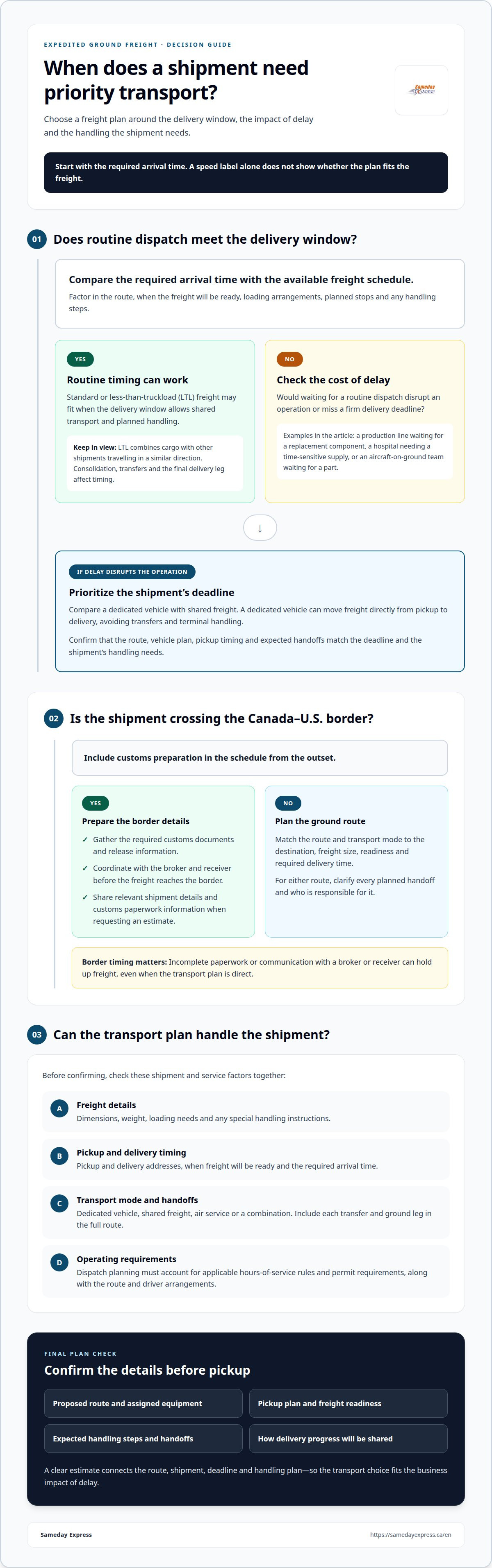
Before confirming, ask for the proposed route, assigned equipment, pickup plan and method for sharing progress updates. Match each part of the plan to the shipment’s deadline and handling needs. This practical review helps you choose an expedited trucking service suited to the freight, rather than relying on a speed label alone.
Business situations that warrant urgent shipping
Urgent freight matters when waiting for a routine dispatch could disrupt an operation. A production line awaiting a replacement component, a hospital needing a time-sensitive supply, or an aircraft-on-ground team waiting for a part each faces a clear deadline. In these cases, priority means planning around the delivery window and destination, not simply marking freight as urgent.
Canadian commercial vehicle requirements depend on the carrier’s operation and route. Transport Canada’s commercial vehicle safety resources describe the regulatory environment for extra-provincial and cross-border carriers. Dispatch planning must account for applicable hours-of-service rules and permit requirements, along with the route and driver arrangements.
Standard freight commonly follows routine schedules and may share equipment with other shipments. Expedited transport prioritizes a particular shipment’s deadline. For example, a business facing a production interruption may need direct transport rather than waiting for its freight to join a scheduled load. The right choice depends on the consequences of delay, the destination and how much time remains before delivery is needed.
Less-than-truckload (LTL) freight combines cargo with other shipments travelling in a similar direction. It can suit a shipment that does not fill a trailer when the delivery window allows for shared transport and planned handling. If the receiver needs the freight sooner, compare the LTL schedule with a dedicated option. Transfers, consolidation and the final delivery leg all affect whether the plan meets the deadline.
Cross-border shipments need customs preparation built into the schedule. Canadian businesses importing commercial goods should determine their goods’ classification, understand applicable duties and taxes, and arrange release, according to the Canada Border Services Agency. Prepare the required customs documents and coordinate with the broker and receiver before the shipment reaches the border. Missing release information can hold up freight even when the transport plan is direct.
Service selection depends on urgency, freight size, route, handling needs and required delivery time. These factors also influence the resources needed for transport, so provide them clearly when requesting an estimate. A shipment with flexible timing may fit standard or LTL freight; a firm operational deadline may call for priority handling or a dedicated vehicle. For a Canada-U.S. shipment, include customs preparation in the schedule from the outset.
To organize the next move, set the required delivery time, identify the receiver and gather shipment details before contacting a logistics provider. A clear request helps align the transport plan with the actual business impact of delay. Explore urgent freight logistics when a shipment needs a time-critical plan.
How do I know what the transit time is?
A useful transit estimate starts with the pickup address, destination, freight readiness and required delivery time. The carrier then considers the road route, vehicle availability, loading arrangements and planned stops. For example, provide the exact pickup and receiving addresses for a shipment travelling between provinces, not just the province names. Precise locations make route planning more practical.
For an initial road estimate, use Google Maps driving time + 1 hour as a planning benchmark. Then account for the actual pickup window, time needed to load, delivery access and the carrier’s route plan. This calculation helps frame the schedule; it does not replace dispatch planning. A pickup that cannot be released promptly changes the start time, even when the destination and route stay the same.
Choosing transportation means matching the deadline to the shipment and route. Ground service suits freight that can travel by road within the required window. Air freight may suit a long-distance route when road transit will not meet the schedule, with ground transportation still needed between pickup, airport and receiver. The fastest option depends on the full journey, including every handoff, rather than one part of the trip.
A no-stop, point-to-point movement can simplify the schedule by keeping freight on a direct route between pickup and delivery. Ask how the proposed route accounts for driver changes, required breaks, road conditions and delivery access. For instance, a receiving dock with restricted hours may shape the arrival plan more than distance alone. The schedule should show planned departure and arrival windows, plus the milestones that may affect them.
Transportation management technology can help organize dispatch details and communicate shipment progress. Useful status points include pickup confirmed, freight collected, in transit, nearing destination and delivered. GPS location information can help dispatch teams see where a vehicle is along its route. Clear updates also give receiving staff time to prepare a dock, arrange access or alert the person accepting delivery.
To assess an estimate, compare the delivery window with your actual deadline. Check that the pickup time, route, transport mode and handling steps align. Ask which assumptions shape the estimate, such as immediate freight readiness or a scheduled receiver. If the shipment crosses a border, include customs preparation in the timeline. That prevents road travel time from being mistaken for the complete door-to-door schedule.
Share the shipment’s weight, dimensions, handling needs and receiving hours with the carrier. Then request an estimate that separates driving time from pickup, loading and delivery steps. For example, if the receiver closes before the proposed arrival, an earlier pickup or different transport plan may be needed. A clear schedule connects each milestone to the deadline and gives dispatch teams a practical basis for updates.
Shipment information and packaging requirements
Expedited shipment planning depends on the route, vehicle, freight dimensions, urgency and handling needs.
For a useful transit plan, provide the pickup and delivery addresses, when the freight will be ready, and the required arrival deadline. Include each piece’s dimensions and weight, the total piece count, and whether the load is boxed or palletized. For example, a single boxed machine part needs different handling details from several palletized cartons. Accurate shipment information helps a carrier select equipment and plan loading without relying on assumptions.
Describe the freight itself. State whether it is fragile, sensitive, temperature-sensitive or requires special handling instructions. Identify loading and receiving conditions, such as a dock, ground-level access or restricted delivery hours. For a Canada-U.S. shipment, include customs paperwork details and the broker or receiver’s contact information. Missing details can delay planning or prompt avoidable questions during dispatch.
Packaging should secure freight during transit and make handling clear. Use suitable boxes for smaller goods, and palletize freight that needs stable loading or forklift handling. Keep cartons closed, secure the weight distribution and prevent items from shifting. Attach shipment labels where they will remain visible after loading. If a pallet contains multiple cartons, provide the carton count and mark any handling instructions on the shipment documents.
There is no single transit plan that fits every shipment. Route length, transport mode, vehicle requirements, pickup timing, freight size and urgency all affect the plan. A dedicated vehicle or special handling needs can change the resources required compared with consolidated freight. Give the person planning the shipment accurate details, including any customs preparation or delivery constraints. This makes it easier to assess the proposed service against your deadline.
Shipment updates are most useful when they show clear milestones. Agree on which events will be reported, such as dispatch confirmation, pickup, in-transit progress and delivery. GPS tracking can show a vehicle’s location, while status messages explain what has happened. For example, a receiving team can prepare a loading area after learning that the driver has collected the freight.
Dedicated shipment oversight means monitoring progress from pickup through delivery and coordinating updates when plans change. That coordination matters if a receiver’s hours shift, a delivery entrance changes or border processing affects the route. Keep one contact available for dispatch questions and make sure the receiving contact can be reached. A clear communication path prevents separate teams from acting on conflicting instructions.
Before freight services begin, gather the shipment details: addresses, ready time, deadline, piece count, dimensions, weight, packaging, handling instructions and receiver details. For cross-border freight, add customs documents and broker contacts. This concise shipment profile gives the transportation team the information needed to plan the movement and keep updates tied to the correct delivery.
Transit planning must be assessed for each shipment because the route, vehicle, freight size, urgency and handling requirements affect the plan.
Shipment tracking and delivery updates
For an urgent shipment, agree on update points before dispatch. A practical sequence is pickup confirmation, in-transit status, arrival in the delivery area and proof of delivery. These milestones give dispatch, the sender and the receiver a shared view of progress. They also help identify delays that need attention, rather than leaving teams to rely on an expected arrival time alone.
GPS tracking can show a vehicle’s reported location along its route. Shipment updates add context, such as whether freight has been collected, is travelling or has reached the receiver. For example, a location update near the destination does not confirm delivery if the driver still needs access to a receiving dock. Ask who will send updates, which contact will receive them, and how a change to the route or timing will be communicated.
Same-day delivery means delivery on the day the shipment is collected. Next-day delivery is planned for the following day. Neither label explains the full schedule by itself. Pickup readiness, distance, transport mode, receiving hours and handling needs all shape the plan. For a time-critical shipment, share the deadline and the receiver’s availability so dispatch can align the pickup and delivery windows.
The last mile is the final leg from a local distribution point or route to the recipient. Access details matter. Provide the complete delivery address, receiving contact, entrance instructions and any dock or appointment requirements. A driver sent to a large facility may need directions to a specific building entrance or department. Clear directions help the delivery team reach the correct handoff point.
Dispatch coordinates the vehicle, driver, route and shipment information. Before pickup, confirm that the driver has the correct destination and handling instructions. During transit, dispatch can relay updates and coordinate with the receiver if arrival timing changes. A dependable process assigns responsibility for communication, so the sender knows whom to contact and the receiving team can prepare for arrival.
Safe delivery depends on matching handling instructions to the freight. Identify fragile, sensitive or temperature-sensitive contents before collection. Keep packages closed and labels visible, and tell the receiving contact how the shipment will be handed over. For controlled or valuable items, document who accepts the freight and when. A clear handoff record connects the shipment’s movement with its final recipient.
Specialized delivery needs may call for different update and handoff steps. A healthcare facility receiving lab samples, for example, may need a named recipient ready at arrival. An aircraft maintenance team awaiting a part may need dispatch to share a revised arrival time promptly. Set the update frequency and escalation contact around the operational need, not a generic status schedule.
To organize an urgent delivery, provide the deadline, pickup and destination details, handling requirements, and receiver contact. Then agree on milestone updates and delivery confirmation. Arrange an urgent delivery with clear instructions so dispatch can coordinate the shipment’s route and handoff.
Sameday Express
Sameday Express Inc. helps businesses arrange urgent freight movement when a routine schedule will not meet the delivery deadline. Share the pickup and destination, shipment dimensions and weight, ready time, and required arrival time to help identify a suitable option. Depending on the route and urgency, options include same-day delivery, rush delivery or Sameday Direct Drive. For freight travelling between Montreal and Toronto, a direct-drive option can support a time-critical schedule.
These services are designed for business shipments where timing matters. Clear shipment details help define the request and assess the transit plan. Contact Sameday Express Inc. to discuss your shipment and delivery requirements.
Put your freight plan in motion
A time-critical shipment is easier to coordinate when its delivery deadline becomes a clear transport brief. Use the details you’ve gathered to align pickup readiness, freight requirements and the receiver’s schedule. That gives dispatch a practical starting point for selecting an expedited trucking service and organizing the next steps.
Sameday Express offers same-day delivery, Sameday Direct Drive and rush delivery for urgent business shipments. Share the pickup and destination, shipment size, handling needs and required arrival time when requesting an estimate. These details help frame the request around your freight and the deadline it needs to meet.
If the shipment’s timing has changed or a receiver needs an updated plan, bring that information into the conversation early. A clear brief helps everyone work from the same schedule. Contact Sameday Express for an estimate and take the next step with a defined shipment plan.
Frequently Asked Questions
How do I get an estimate for a shipment?
Use Sameday Express’s quote request and state whether your arrival deadline is fixed or flexible. Note any shipment dependency that could affect acceptance, such as a receiving department needing to authorize delivery or a work crew waiting to use the item. This context helps define the requested service level. For recurring business shipments, mention the expected pattern so the request reflects more than a one-time movement.
Is my freight likely to get damaged?
Damage can occur during freight handling, so suitable packaging and clear handling instructions matter. For your records, photograph the freight and its packaging before pickup, especially if the item has visible wear or fragile components. Keep those images with the shipment paperwork, and document any visible damage promptly upon receipt.
What Is Expedited Freight and When Does Your Business Need It?
Expedited freight is a priority transport choice for shipments where a delay has a material operational impact. An expedited trucking service may suit a business that needs a replacement item before a planned maintenance task can proceed, for example. The decision is less about labelling every shipment urgent and more about whether waiting for the next routine movement would disrupt work, service commitments or a scheduled operation.
What kinds of things can you transport?
Sameday Express handles shipments ranging from envelopes and parcels to full truckloads. Listed items include medical devices and pharmaceutical products, as well as lab samples, test kits and biological materials. This range can serve different business needs, from sending a document to arranging transport for commercial freight. Describe the item accurately so the service plan reflects its size and handling requirements.
What is expedited trucking and how does it work in Canada?
Expedited trucking is time-priority freight transport by road. Vehicle capacity helps determine whether a load fits the planned equipment. Sameday Express lists a Nissan NV 200 with a payload of 1,500 lb / 680 kg, a Sprinter 144 with 4,890 lb / 2,259 kg, a Sprinter 177 with 4,400 lb / 1,996 kg, and a Hino 195 with 9,854 lb / 4,470 kg.
How quickly can expedited trucking deliver freight across Canada?
Available service choices include Same Day Delivery, Next-day delivery and Overnight delivery. For critical long-distance shipments, Sameday Express also offers Next Flight Out, which uses air transport. These are distinct service options, not a single Canada-wide transit promise. Match the requested service to the shipment’s urgency and route, and provide the required delivery date so the transport plan can be assessed against it.
How does expedited trucking compare with standard freight, air freight, and courier services?
Choose based on the shipment’s format and the transport plan it needs. Courier service can suit an envelope or parcel, while trucking can accommodate larger freight, including full truckloads. Air transport may suit critical long-distance shipments through Next Flight Out. Compare the complete service offered for your shipment, including how it will reach the recipient, rather than relying on speed labels alone.
Disclaimer
Blog Disclaimer
The information published on the Sameday Express Blog is provided for general informational and educational purposes only. While we strive to keep all content accurate and up to date, Sameday Express makes no representations or warranties of any kind, express or implied, regarding the completeness, accuracy, reliability, suitability, or availability of the information contained in our articles.
The content on this blog does not constitute legal, customs, tax, regulatory, financial, or professional advice. Shipping regulations, carrier policies, customs requirements, and transportation laws may change without notice and may vary by destination. Readers should verify current requirements with the appropriate government authorities, carriers, or qualified professionals before making shipping or business decisions.
Sameday Express is not liable for any loss, damage, delays, or consequences arising from the use of, or reliance on, information published on this website. Any actions taken based on the information provided are at the reader's own risk.
References to third-party companies, products, services, or websites are provided for informational purposes only and do not constitute an endorsement or recommendation by Sameday Express.
All blog content, including text, graphics, images, and logos, is the property of Sameday Express unless otherwise stated and may not be reproduced or distributed without prior written permission.
For specific shipping requirements, pricing, transit times, or logistics solutions, please contact Sameday Express directly for personalized assistance.


