

A Canadian business can act as the Importer of Record when shipping commercial goods to the US, taking responsibility for the customs entry and related duties. For U.S. imports valued above US$2,500, the Importer of Record must be clearly identified. The right shipping method and complete paperwork also help keep goods moving across the border.
Cross-border shipping can seem straightforward until shipment size, delivery deadlines, or customs requirements complicate the plan. Before dispatch, clarify who is responsible for the import, which documents are needed, and whether courier or freight transport suits the goods.
This guide explains how to assign the Importer of Record role, prepare customs documents, and choose a delivery method. It also covers when cross-border LTL and FTL freight may fit, helping you plan each step.
Key Takeaways
- Understand what it means for a Canadian business to act as the Importer of Record and take responsibility for a U.S. customs entry.
- Prepare shipment details and customs documents to help prevent border delays and unexpected duty assessments.
- Learn when qualifying CUSMA-origin goods may receive duty-free treatment and why origin details matter.
- Match postal, courier, or trucking transport to your shipment’s size, urgency, and delivery requirements.
- See how LTL and FTL freight can support cross-border shipments, and when a direct delivery option may better fit an urgent shipment.
U.S. customs duties and the end of the Section 321 exemption
For commercial imports, prepare an accurate customs entry and identify who will act as Importer of Record. U.S. customs exemptions can change, so check current requirements before shipping.
-
Coordinate Customs Pre-Clearance
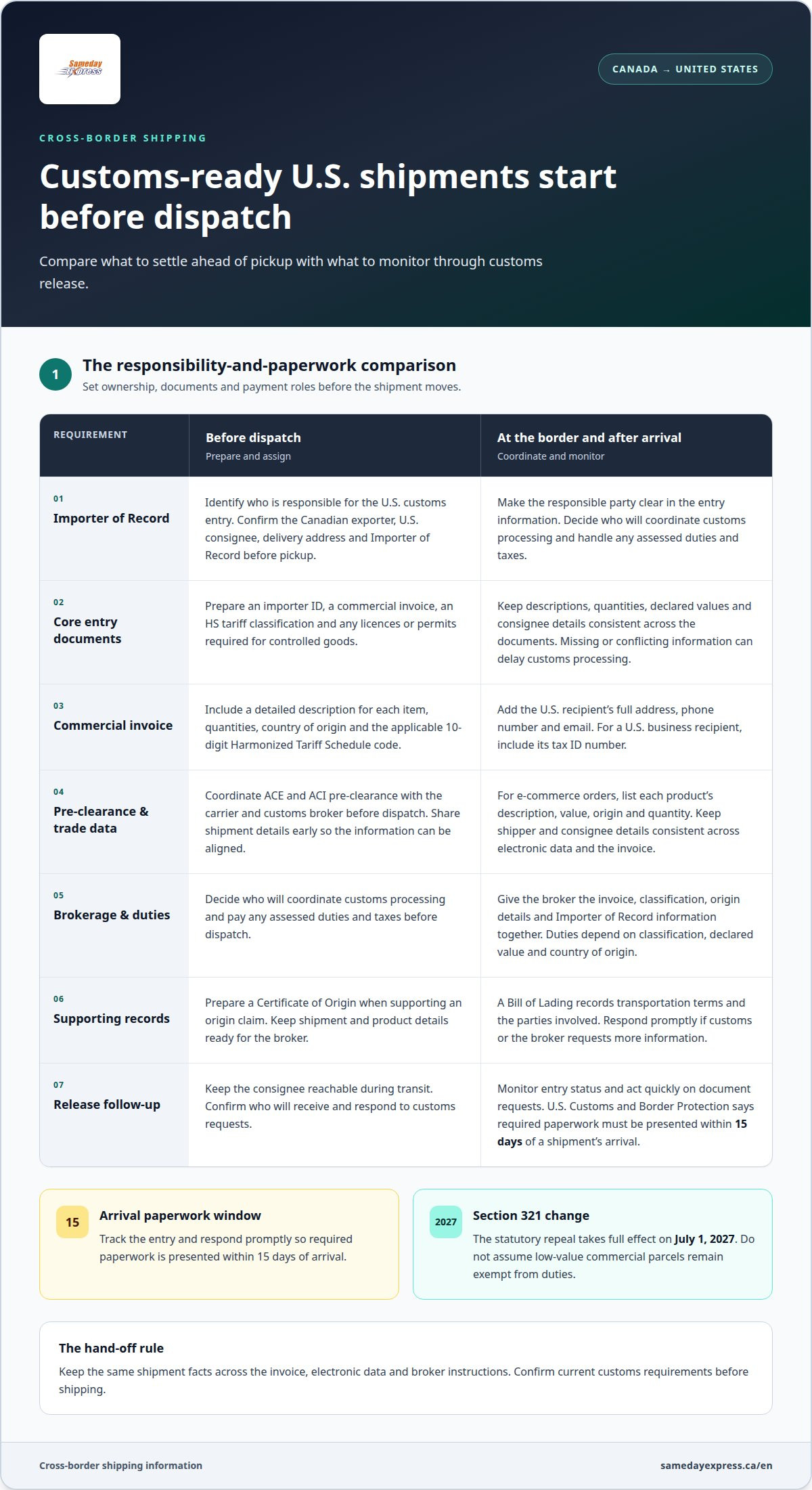
Coordinate shipment details with the carrier and customs broker before dispatch. ACE and ACI pre-clearance coordination gives everyone time to align shipment data before the border crossing. Check that descriptions, quantities, values, and consignee details match across documents. Incomplete or conflicting information can delay customs processing.
-
Check Entry Requirements and Shipping Risks
Identify the Importer of Record and assemble the entry documents before shipping. Commercial goods entering the U.S. typically require an importer ID, a commercial invoice, an HS tariff classification, and any licences or permits required for controlled goods. A U.S. import valued above US$2,500 needs a clearly defined Importer of Record. A Canadian company acting as a Foreign Importer of Record is described as needing a continuous customs bond with a minimum of US$50,000.
Common causes of delay include missing documents, inconsistent descriptions, and unclear responsibility for the customs entry. Before dispatch, determine whether the goods are controlled or need special handling. Some goods may require additional documentation, packaging, or handling arrangements, so check the applicable requirements before dispatch.
- Prepare complete customs documents. Include a commercial invoice for every commercial shipment to the United States. Provide a detailed description for each item, its quantity, unit price, total value, country of origin, and applicable 10-digit Harmonized Tariff Schedule code. For a U.S. business recipient, include its tax ID number. A Customs Invoice presents the value details used to assess duties and taxes. A Certificate of Origin supports origin claims, while a Bill of Lading records transportation terms and the parties involved.
- Classify goods and plan for duties. Customs duties depend on classification, declared value, and country of origin. As an example, a 10% tariff on US$5,000 of leather shoes would produce US$500 in duty. Don’t assume the Section 321 exemption still removes duties on low-value commercial parcels. Its statutory repeal takes full effect on July 1, 2027, so plan entries around the rules applying when goods arrive.
- Set brokerage and payment responsibilities. Decide who will coordinate customs processing and pay any assessed duties and taxes before dispatch. Give the broker the invoice, classification, origin details, and Importer of Record information together. Complete, consistent records help the broker prepare the entry and respond to customs questions without waiting for missing details. Keep the shipment value and product descriptions consistent across all documents.
Shipment pickup, border crossing, and delivery process
- Prepare the shipment before pickup. Confirm the Canadian exporter, U.S. consignee, delivery address, and Importer of Record. Businesses need a business number and an RM account to get commercial goods across the Canadian border. For formal entry, prepare an importer ID number, commercial invoice, HS tariff classification, and any licences or permits required for controlled goods. Match shipment details across documents before pickup. A reliable process for shipping commercial goods to the US starts with clear responsibilities and complete information.
- Complete the commercial invoice and contact details. Every commercial shipment to the United States requires a commercial invoice. Include a detailed description of the goods, quantities, values, country of origin, and classification. Add the recipient’s full address, phone number, and email address to the U.S.-bound documents. Clear descriptions help customs assess the goods and duties. Broad labels can prompt questions, especially when a shipment contains different products or materials.
- Send accurate electronic trade data. Provide shipment information before dispatch so the carrier can prepare customs processing. For e-commerce orders, enter each product’s description, value, origin, and quantity rather than grouping different items under a broad label. Keep shipper and consignee contact details consistent across the electronic data and invoice. If using Canada Post for a U.S.-bound parcel, obtain the 13-character Declaration ID required as proof that duties have been prepaid.
- Plan for duties and border release. Duties depend on the goods’ classification, value, and origin. Before the shipment leaves Canada, establish who is responsible for payment and customs coordination. A broker needs complete entry information to submit the customs declaration and respond to requests. Keep the consignee reachable during transit. Delayed answers or missing documents can hold a shipment at the border and disrupt delivery. For shipping commercial goods to the US, assign these responsibilities before pickup, not after a question about the entry arises.
- Track the paperwork after arrival. U.S. Customs and Border Protection says goods will be transferred to a warehouse and storage charges will apply if required paperwork isn’t presented within 15 days of a shipment’s arrival. Monitor the entry status and respond promptly to document requests. If release is delayed, keep the carrier and consignee informed so they can coordinate the next delivery step and update receiving plans.
- Record freight details for pickup and delivery. For palletized freight, document pallet count, dimensions, total weight, and handling instructions before collection. Courier ground shipments weighing 2 kg to 68 kg are identified as a suitable range; express air courier shipments under 50 kg are another option. Confirm the receiving address and delivery contact before dispatch. For a time-critical Canada-U.S. shipment, cross-border delivery services can support urgent transport planning.
Is shipping to the US duty-free under de minimis?
The US$800 de minimis threshold is scheduled for statutory repeal on July 1, 2027. Separately, qualifying CUSMA-origin goods may receive duty-free treatment when the preference is claimed.
-
Determine Tariff Classification and Country of Origin
Assign each product its 10-digit U.S. Harmonized Tariff Schedule code. Classification identifies the tariff category used for customs assessment. Determine the country of origin separately; a Canadian shipping address alone doesn’t establish Canadian origin. Record the product’s materials and manufacturing details, then use them to support the origin declaration. Keep classification and origin records aligned with the commercial invoice. Incorrect codes or unsupported origin claims can affect clearance and duty treatment.
For mixed shipments, classify each distinct item instead of describing everything as “parts” or “goods.” Different products in one shipment may have different codes and origins. This detail helps customs assess each item under the applicable tariff rules.
-
Verify CUSMA Origin and Eligibility
Assess whether each product meets the applicable CUSMA origin requirements before claiming a preference. CUSMA replaced NAFTA in 2020, but goods shipped from Canada don’t automatically qualify as originating goods. Use manufacturing and sourcing records to support the claim. A Certificate of Origin can document the origin information associated with a shipment; keep its details consistent with the invoice and customs declaration.
As of July 2026, about 80% of imports from Canada and Mexico cleared duty-free by claiming USMCA preference. That figure describes claims made across those imports, not automatic eligibility for every Canadian shipment. Treat each product’s origin as a separate determination.
-
Declare Contents and Country of Origin
Describe every product precisely on the commercial invoice. Include its quantity, unit price, total value, country of origin, and 10-digit tariff classification. For example, identify a finished product by what it is, rather than using a broad label such as “merchandise.” Match the invoice to the goods and supporting origin records. Clear, consistent details help customs assess the shipment and reduce questions during clearance.
Keep supporting evidence for each origin declaration, including relevant production or sourcing information. The country from which goods are shipped is not necessarily their country of origin. This distinction matters when applying CUSMA preferences or assessing other tariffs.
-
Assess De Minimis and Duty-Free Treatment
Separate low-value de minimis treatment from CUSMA tariff preference. The stated de minimis threshold is US$800, with statutory repeal taking full effect July 1, 2027. A qualifying CUSMA-origin product may receive preferential duty treatment through a separate origin claim. Don’t assume a low-value parcel automatically qualifies for CUSMA treatment, or that Canadian dispatch makes foreign-origin goods Canadian.
Review tariff measures against the product’s origin and applicable classification. The Supreme Court struck down IEEPA tariffs in February 2026; the temporary 10% Section 122 tariff expired July 24, 2026. Section 301 tariffs of 10% to 12.5% may apply to imports from about 60 economies. Keep origin evidence and invoice details ready for government customs review.
Choosing postal, courier, or trucking
Choose a transport mode based on package size, delivery deadline, and tracking needs. Whatever the option, Canada-U.S. border shipping requires accurate customs information for the goods.
-
Compare Postal, Courier, and Trucking Options
Compare the shipment’s weight, dimensions, urgency, and delivery address before booking. Postal services can suit small packages that meet the selected service’s limits. Canada Post Letter-post Large Envelopes have a maximum size of 380 mm × 270 mm × 20 mm and a maximum weight of 500 g. Courier services are commonly used for shipments under 100 lbs, while trucking can suit larger freight.
-
Arrange Courier Shipping and Delivery
Choose courier shipping when the shipment needs parcel-level handling and tracking. Courier services often deliver within 1-3 business days, while typical ground delivery ranges from 1 to 7 days. Express air courier delivery typically takes 1 to 3 days. These ranges vary with the destination and route. A parcel going to a major U.S. city may travel faster than one going to a remote location.
- Match transit expectations to the destination. Plan for the route, not just the mode. Typical transit windows are 2-3 days for major U.S. cities, 3-5 days for regional areas, and 5-7 days for remote locations. These windows help with planning, but the shipment’s exact route and service affect the schedule. Leave room in the plan for customs processing and final delivery.
- Use trucking when freight dimensions call for it. LTL trucking combines freight from multiple shipments, which can suit palletized goods that don’t fill a trailer. Typical Canada-to-U.S. LTL delivery takes 2 to 8 days. FTL trucking moves a full trailer load and can suit shipments that need the trailer’s capacity. Compare shipment volume, loading requirements, and delivery timing before selecting either option.
- Include border and delivery needs in the decision. Postal, courier, and trucking shipments must comply with the customs regulations that apply to their goods. Choose a service that can handle the shipment’s size and provide tracking suited to your operations. For example, an e-commerce business sending small packages may prioritize parcel tracking, while a business shipping pallets may prioritize freight handling and delivery coordination.
- Build a practical delivery plan. Confirm the recipient’s address and receiving arrangements before dispatch. For courier packages, check the service’s weight and size limits. For trucking, provide pallet counts, dimensions, and handling details. Match the service to the delivery deadline and allow time for border clearance. This ensures the transport method suits the shipment instead of forcing it into an unsuitable service.
Cross-border LTL and FTL freight services
For palletized freight crossing the Canada-U.S. border, choose LTL or FTL based on shipment size, handling needs, and delivery plans.
- Measure the shipment and assess trailer needs. Record each pallet’s dimensions, weight, count, and handling requirements before choosing a freight service. LTL, or less-than-truckload, combines shipments in a shared trailer. FTL, or full-truckload, dedicates the trailer to one shipment. A smaller shipment may suit LTL, while freight that needs the trailer’s capacity may be better suited to FTL.
Consider the goods’ stability and handling requirements as well as their total volume. For example, several pallets of standard packaged inventory may suit shared freight, while a large consolidated load may suit a dedicated trailer. The right option depends on the shipment, not just the product category.
- Prepare pallets for freight handling. Secure cartons to each pallet to keep them stable during loading and transit. Place a shipping label on each side of every pallet for visibility, a recommended practice for LTL. Include the consignee and shipment reference on the labels. Clear identification helps distinguish freight when a shared load carries goods for several destinations.
Record pallet counts and shipment details consistently across freight documents. If an order contains different product types, describe them clearly rather than treating the entire load as one item. This supports accurate handling and border processing.
- Compare consolidation with a dedicated load. LTL may suit businesses sending partial loads that do not need a full trailer. The freight moves through a carrier network handling other shipments, so transfers and additional handling may be part of the route. FTL dedicates the trailer to one shipment, which can simplify load planning when volume or handling needs call for it.
Consider whether delivery timing, cargo sensitivity, or receiving arrangements favour fewer handling points. A distribution centre with dock access may accept either option; a delivery site with limited unloading capacity may need a more specific plan. Match the freight arrangement to the receiving location.
- Plan border readiness alongside freight booking. LTL and FTL shipments still need complete customs information and a clearly assigned Importer of Record. Align the commercial invoice and shipment details before the load reaches the border. A freight network moves goods but does not replace the customs entry or the importer’s responsibility. Keep the consignee available to respond to questions about the entry.
- Coordinate collection and delivery details. Give the carrier accurate pickup and receiving addresses, pallet count, dimensions, and delivery instructions. Confirm whether the destination can receive the expected freight format and arrange unloading accordingly. For a Canada-U.S. freight movement, match the quote request to your load and delivery requirements using Request a Quote.
Sameday Express
Sameday Express Inc. handles time-critical shipments with same-day delivery, rush delivery, and Sameday Direct drive. These options suit goods that need prompt, direct transport once the customs plan and shipment documents are arranged. Choose a delivery method that fits your schedule, shipment details, and destination.
For a shipment with a tight delivery window, select a service suited to its urgency and route. Sameday Express Inc. handles the transport leg; Importer of Record responsibilities, customs declarations, and duties remain part of your import arrangements. Request a Quote to discuss your shipment and delivery requirements.
Build a repeatable cross-border shipping plan
Turn each shipment into a repeatable process. For a Canadian business, shipping commercial goods to the US is easier to manage when responsibilities are clear before an order is ready: who manages the import entry, provides shipment information, and coordinates delivery. Assign these roles across purchasing, finance, and receiving, then follow the same handoff sequence for future orders.
Set internal routing criteria based on the shipment’s purpose, urgency, and receiving arrangements. A planned replenishment order and an unexpected time-sensitive shipment may call for different delivery choices. Give staff a clear way to escalate exceptions, such as a changed destination or delayed release, so they can respond while keeping the next step in view.
Make your next cross-border shipment the start of a clearer workflow. Request a Quote for a practical approach tailored to your business.
Frequently Asked Questions
Can a Canadian company be the Importer of Record to the USA?
Yes. A Canadian company can act as the U.S. Importer of Record and take responsibility for the import entry. For U.S. imports valued above US$2,500, the Importer of Record must be clearly identified. A Canadian business acting as a Foreign Importer of Record is described as needing a continuous customs bond with a minimum of US$50,000. Establish the importer’s role before the shipment is dispatched.
Do I need a customs broker to ship from Canada to the USA?
A customs broker can coordinate the entry, but the Importer of Record remains responsible for the import. The broker can use the shipment’s invoice, classification, origin details, and importer information to prepare. For example, if a customs officer requests clarification, the importer and broker need a clear process for responding. Decide who will prepare the entry and handle questions before the goods leave Canada.
Does this duty change apply to goods valued over US$800?
The US$800 figure is the de minimis threshold, not a separate duty that applies only to goods above that value. The statutory repeal of the threshold takes full effect on July 1, 2027. Duty treatment also depends on the goods’ classification and origin. Treat the threshold and any CUSMA preference as separate considerations when planning a shipment’s customs entry.
What is a Declaration ID and why is it required?
A Declaration ID is a 13-character identifier required for a Canada Post shipment bound for the United States. It serves as proof that duties have been prepaid. Include it in the required shipment information so the parcel’s duty payment can be associated with its customs processing. It applies to the specified Canada Post process, not as a substitute for a commercial invoice on commercial shipments.
How do you ship parcels from Canada to the USA?
Choose a postal or courier service that suits the parcel’s dimensions, weight, urgency, and destination. For commercial goods, prepare a complete invoice with accurate descriptions, quantities, values, and origin details. Add the recipient’s contact information and any required customs data. For a Canada Post parcel, include the required Declaration ID. Then arrange pickup and keep the recipient available for delivery or customs questions.
What documents are required to ship commercial goods from Canada to the US?
Prepare a commercial invoice, importer ID number, HS tariff classification, and any licences or permits required for controlled goods. A Certificate of Origin can support an origin claim, while a Bill of Lading records freight carriage details. Include the U.S. recipient’s full address, phone number, and email. For shipments to a U.S. business, include its tax ID number in the documentation.
How do US import duties and tariffs apply to goods shipped from Canada?
U.S. duties depend on a product’s tariff classification, value, and country of origin, not simply where it is dispatched from in Canada. Qualifying CUSMA-origin goods may receive preferential duty treatment when the claim is supported. Other tariff measures may apply based on origin and product classification. Keep sourcing and manufacturing records with the invoice to support the declared origin and any preference claim.
What are the differences between courier, postal, air freight, and ground freight for commercial shipments?
Postal services generally suit parcels within their size and weight limits. Couriers handle packages and offer delivery options based on urgency and destination. Air freight may suit larger shipments when transit speed matters, while ground freight carries pallets and other larger loads by truck. Compare dimensions, handling needs, route, and deadline. Whichever mode you choose, include customs documents in the cross-border plan.
Disclaimer
Blog Disclaimer
The information published on the Sameday Express Blog is provided for general informational and educational purposes only. While we strive to keep all content accurate and up to date, Sameday Express makes no representations or warranties of any kind, express or implied, regarding the completeness, accuracy, reliability, suitability, or availability of the information contained in our articles.
The content on this blog does not constitute legal, customs, tax, regulatory, financial, or professional advice. Shipping regulations, carrier policies, customs requirements, and transportation laws may change without notice and may vary by destination. Readers should verify current requirements with the appropriate government authorities, carriers, or qualified professionals before making shipping or business decisions.
Sameday Express is not liable for any loss, damage, delays, or consequences arising from the use of, or reliance on, information published on this website. Any actions taken based on the information provided are at the reader's own risk.
References to third-party companies, products, services, or websites are provided for informational purposes only and do not constitute an endorsement or recommendation by Sameday Express.
All blog content, including text, graphics, images, and logos, is the property of Sameday Express unless otherwise stated and may not be reproduced or distributed without prior written permission.
For specific shipping requirements, pricing, transit times, or logistics solutions, please contact Sameday Express directly for personalized assistance.


