

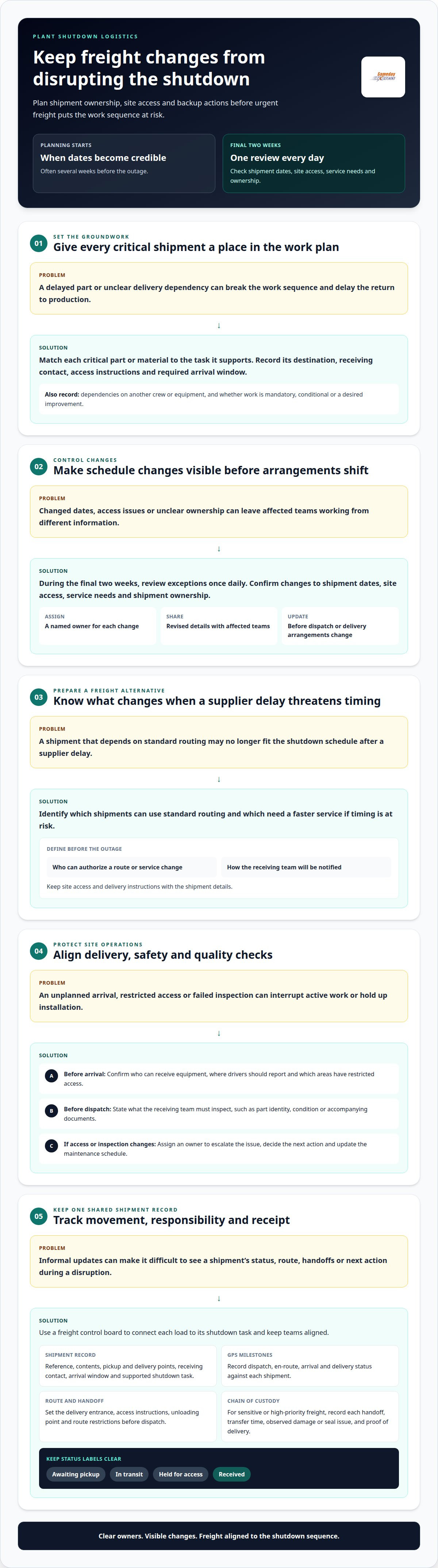
Freight emergencies can turn a planned plant outage into an extended shutdown. Start plant shutdown logistics planning when maintenance and production dates become credible, often several weeks before the outage. During the final two weeks, run one daily review of shipment dates, site access, service needs and ownership so changes are visible before they disrupt work.
A shutdown already requires coordination across teams, and freight adds another set of dependencies. A delayed part, a changed delivery date or an access issue can disrupt the work sequence and delay the return to production. Early planning helps your team identify critical shipments, assign clear owners and prepare for changes.
This guide explains when to start transportation planning, how to track freight and manage changes, and how to prepare for supplier delays, equipment failures and other disruptions. You’ll also learn how to set up clear communication and backup options, so urgent shipments have a defined role in the shutdown plan and restart.
Key Takeaways
- Coordinate safety, quality assurance and freight contingency plans so shipment changes don’t undermine shutdown work.
- Use shipment visibility, defined routes and chain-of-custody records to keep sensitive freight accountable in transit.
- Assess how delayed parts and other inbound or outbound obligations could affect production and the restart sequence.
- Prepare for freight disruptions such as supplier delays, access changes and unexpected equipment issues with clear owners and backup actions.
- Match urgent shipments to an appropriate option, including same-day delivery, Sameday Direct drive, rush delivery or Montreal-to-Toronto direct drive.
How early should transportation planning begin for a plant shutdown?
Start transportation planning once maintenance and production dates are credible. Use the lead time to coordinate freight, safety checks, quality requirements and dependencies for restarting operations.
Coordinate pre-shutdown planning
Before teams mobilize, confirm the shutdown scope with maintenance, production, quality and logistics. List the required equipment and materials, delivery dates, site access details and the person responsible for each shipment. Separate mandatory work from conditional tasks and desired improvements. This keeps optional work and unclear ownership from disrupting freight priorities when the schedule changes.
- Build a shipment schedule. Match each critical part or material to the task that needs it. Record the destination, receiving contact, access instructions, and required arrival window. If a task depends on another crew or equipment being available, document that dependency alongside the shipment.
- Review changes daily near the outage. During the final two weeks, hold one daily exception review. Confirm changed shipment dates, site access, service needs, and shipment ownership. Assign each change to a named person, then share the revised information with affected teams before dispatch or delivery arrangements change.
- Plan transit alternatives. Identify which shipments can use standard routing and which need a faster service if a supplier delay threatens the schedule. Define who can authorize a route or service change, and how the receiving team will be notified. Keep site access and delivery instructions with the shipment details.
Plan safety, quality, and contingencies
Connect freight controls to the shutdown’s safety and quality plans. Define who can receive equipment, where drivers should report and which areas have restricted access. Set inspection and acceptance steps for critical parts before installation. For each at-risk shipment, name an incident owner to record changing conditions, assess schedule impacts and communicate updates.
- Protect safe handling. Give the receiving team clear unloading and access instructions before equipment arrives. Coordinate delivery timing with site personnel so freight does not obstruct active work areas. Keep shipment details aligned with the site’s safety procedures, and escalate any access change through the assigned owner.
- Set quality checks before dispatch. State what the receiving team must inspect, such as part identity, condition, or accompanying documents. Record acceptance requirements with the work package. If a delivery fails inspection, define who can decide the next action and how the maintenance schedule will be updated.
- Prepare restart and closeout communications. Set a clear trigger for notifying operations when a delay could affect restart. Share revised timing with production, maintenance, and affected customers. At closeout, record work performed, remaining items, and agreed documents; use that record to clarify open freight tasks before normal operations resume.
Tracking, routing, and chain-of-custody controls
Use one control process to link each shipment to its shutdown task. A freight control board, GPS updates, route instructions and receipt records give teams a shared view of movement and responsibility.
- Define the shipment record. Give each critical load a reference, contents description, pickup and delivery points, receiving contact, and required arrival window. Add the shutdown task it supports, such as a replacement motor needed before a maintenance crew can complete installation. This lets coordinators sequence freight by operational need rather than treating every delivery as equal.
- Set GPS milestones. Record dispatch, en-route, arrival, and delivery status against each shipment. GPS tracking can show a vehicle’s location, while milestone updates help the control team see whether the planned arrival still fits the work sequence. If progress changes, log the time, reason, and person notified instead of relying on informal messages.
- Control the route and site handoff. Define the delivery entrance, access instructions, unloading point, and any route restrictions before dispatch. For example, a truck carrying a large component may need a specific gate and receiving crew. Confirm the route remains usable and the receiving contact is available, then record any approved change on the control board.
- Maintain chain of custody. For sensitive or high-priority freight, record each handoff from collection to receipt. Capture who released and accepted the shipment, the transfer time, and any observed damage or seal issue. Keep proof of delivery with the shipment record. These records help identify where an exception occurred and support a clear account of emergency freight movement.
- Keep the shutdown freight control board current. Show each load’s status, planned route, responsible coordinator, site contact, and next action. Use clear labels such as “awaiting pickup,” “in transit,” “held for access,” and “received.” During a disruption, mark the affected task and revised sequence, so maintenance and operations teams work from the same update.
- Confirm contractor scope and interfaces. Write down which contractor supplies, collects, unloads, or installs each item. Identify boundaries where responsibility changes, such as a carrier delivering a part at a designated receiving area while a site contractor handles movement beyond it. Confirm who reports damage, access problems, or missing documents, and record that contact path with the shipment.
Tie each custody entry to the relevant shipment so the record follows the load and is easy to match. At every transfer, note who releases and accepts the shipment, when it happens, and any visible damage or seal concerns. If a handoff does not go as planned, record the exception and who was notified alongside the shipment details. This creates a continuous account from collection through receipt and helps distinguish a delay or condition issue from a routine status update.
Link proof of delivery to the same shipment record and confirm it identifies the load received. Receiving details should match the handoff record, including the accepting contact and delivery time. If there is a discrepancy, keep it with the record rather than treating proof of delivery as the sole account of the shipment. Together, custody notes and receipt evidence help teams review emergency freight movements and identify where an exception arose. Keep the records accessible to the people coordinating the shipment and the shutdown task it supports.
Assessing operational impact and downtime exposure
Assess freight against the work that stops production and the obligations that remain active. Routine maintenance and repairs can halt production for one to two weeks, while plant turnarounds may last up to a few months.
- Map production dependencies. List each process, asset, and task affected by the shutdown. Identify which equipment must be available before work starts and which tasks control the restart sequence. For example, if a replacement component is needed before testing, its delivery timing affects both maintenance work and the planned return to production.
- Separate stopped production from active commitments. A temporary manufacturing stop does not automatically stop inbound purchase orders, inventory transfers, contractor materials, or outbound customer obligations. Mark each flow as continuing, paused, or dependent on a shutdown milestone. This exposes freight that could arrive during restricted access or leave without a ready receiving team.
- Rank freight by operational consequence. Assess what happens if each item arrives late, damaged, or incomplete. A part required to finish a repair may hold up testing; a routine supply may have a workable substitute. Record the task affected, the alternative available, and who decides whether the schedule or work sequence changes.
- Build a realistic downtime range. Do not confirm activity durations until the work scope and site conditions are understood. Inspection findings can reveal additional repairs, while access constraints can change the order of tasks. Compare the planned work with those conditions, then update freight dates when the sequence shifts. A fixed delivery plan can quickly become outdated.
- Measure exposure at restart. Identify what must be received, installed, inspected, and tested before operations resume. A delayed shipment may affect more than one task if several activities depend on the same equipment. Track those links in the restart schedule, and name the person responsible for reporting a missed milestone to operations.
- Plan for equipment failure and supplier delays. Equipment failure can disrupt production and delay work on high-impact assets. Identify the parts and suppliers tied to those assets. Set a decision point for switching to a backup source or expedited transport. Include the time needed to receive and assess replacement equipment, rather than assuming delivery alone restores production.
- Reassess as conditions change. Review the operational impact when inspection results, supplier dates, or work scope changes. Update affected freight priorities and customer commitments together. This keeps the shutdown plan aligned with current conditions, instead of treating the original schedule as fixed throughout the outage.
Common causes of plant shutdown freight emergencies
Freight emergencies often begin when the shutdown plan no longer matches site conditions. Trace each exception to its source, then assign a specific corrective action.
- Reconcile supplier dates with actual readiness. A supplier may confirm a shipment before the part is inspected, packed, or ready for pickup. Ask for a status tied to a real milestone, such as completed inspection or carrier collection. If the date moves, identify which maintenance task depends on that item and update its work sequence. A promised ship date alone does not show when the facility can receive it.
- Check part identity before urgent dispatch. An incorrect model, revision, or specification can make a fast delivery unusable. Match the order description to the equipment record and the maintenance work package. For example, a replacement component that does not fit the installed machine can delay repair and require another shipment. Keep the identifying details with receiving records to help resolve discrepancies quickly.
- Account for newly discovered work. An inspection can uncover damage or wear outside the original work scope. That may create an urgent need for parts that were not on the first freight schedule. Assign someone to capture the finding, identify the affected equipment, and connect the new requirement to a responsible decision-maker. This gives the team a clear source for revised priorities.
- Verify facility access and receiving readiness. A shipment can reach the site but still fail to reach the work area. A closed gate, unavailable receiving contact, blocked unloading zone, or changed access route can hold up delivery. Confirm the delivery point against current site instructions, and make sure the receiving team knows what is arriving. Record access changes so dispatch and site staff use the same directions.
- Resolve unclear responsibility between contractors. Freight can stall when the carrier, contractor, and facility team each assume another party will unload or move an item. Define where each handoff occurs and who accepts responsibility at that point. For example, specify whether delivery ends at a receiving bay or an equipment staging area. Keep the agreed scope and contact details with shipment records.
- Prepare for shipment damage or missing documentation. A damaged crate or absent packing document may prevent the receiving team from accepting a critical item. Set a process to record the condition, notify the assigned owner, and decide whether the shipment can proceed safely. Keep photos or inspection notes with delivery records where appropriate. The key is to flag the exception before the item enters the installation sequence.
- Close the loop after each disruption. When an emergency changes the freight plan, record its cause, decision, and operational effect. Use that record to update affected teams and identify repeated problems, such as unreliable readiness updates or unclear site instructions. A documented cause gives the next shutdown a practical correction, rather than another assumption.
Sameday Express
Sameday Express supports plant shutdown freight when a shipment needs a defined, time-sensitive delivery plan. The right option depends on when the item is needed and the impact of a late arrival. A component holding up a repair calls for a different response than a shipment that can arrive later without changing the work sequence.
Same-day delivery can suit freight that needs collection and delivery on the same day. For freight requiring direct transport, consider Sameday Direct drive. These options let operations teams match the service to the urgency, rather than treating every shipment as equally time-critical.
First, classify each shipment by its role in the outage. Is it needed to start a repair, complete work already underway or support the next stage? This distinction helps your team explain the request clearly and choose a service that reflects the shipment’s operational importance. Reserve the word urgent for items that directly affect planned work or restart timing.
- For same-day delivery: Use this option when the shipment must be collected and delivered on the same day to support a time-sensitive requirement.
- For Sameday Direct drive: Choose this option when direct transport matches the shipment’s route and delivery requirement.
- For a route-specific shipment: Provide the origin and destination, then identify the shutdown task that depends on the delivery.
Keep the service decision tied to the shutdown plan. If a task moves in the work sequence, the shipment’s urgency may change too. The maintenance lead can identify the operational impact, and the logistics coordinator can use that context to frame the transport request. This helps prevent routine deliveries from being treated as emergencies and ensures newly time-critical shipments are not overlooked.
Delivery options are most useful when the shipment’s purpose is clear. Describe the item, explain its urgency and state how its arrival supports the shutdown. For example, distinguish a component needed to keep a repair moving from material intended for a later task. This context clarifies the transport requirement without confusing delivery speed with the overall restart plan.
Contact Sameday Express Inc. to discuss a plant shutdown shipment.
Frequently Asked Questions
Should all inbound freight arrive before the shutdown?
No. Schedule deliveries around the work sequence, storage capacity and receiving hours. Bringing everything in early can congest staging areas or add unnecessary handling before items are needed. For example, arrange for bulky replacement equipment to arrive near its installation window, while ensuring critical components are available before dependent work begins. Separate materials needed before shutdown from deliveries that can arrive during the outage.
What belongs on the shutdown freight control board?
Include a shipment reference, item description, current status, delivery window and the shutdown task it supports. Add the time of the latest update, the person responsible for the next action and a clear escalation trigger, such as a missed pickup or unavailable receiving contact. For example, flag a shipment as at risk if its revised arrival would miss the maintenance crew’s planned installation window.
What does plant shutdown logistics include?
Plant shutdown logistics means coordinating materials and freight with maintenance work, site access and the return to operations. It involves identifying critical items, planning their movement, tracking exceptions and confirming delivery records. For instance, a replacement component may need a planned delivery window, a receiving contact and a documented handoff before installation. Planning also covers changes that could affect timing.
What are the main steps for planning an industrial plant shutdown in Canada?
Start by defining the shutdown’s purpose, work scope and schedule-critical equipment. Assign owners for maintenance, safety, quality and freight decisions. Then map material needs to work packages, coordinate contractor handoffs, and organize site access and delivery timing. Before restart, inspect completed work, test affected equipment and communicate outstanding items to operations. Keep decisions and schedule changes in one shared record.
How far in advance should a plant shutdown be planned?
Begin transportation planning once maintenance and production dates are credible. This gives the team time to connect shipment needs with work packages and identify dependencies. Start earlier if the work scope, supplier readiness or site access requires more coordination. Revisit the schedule as conditions change, especially when revised shipment timing could affect maintenance or restart activities.
How do companies coordinate contractors, equipment, and materials during a shutdown?
Use a shared work schedule that links each contractor’s responsibilities to the equipment and materials required for each task. Proper coordination also begins with verifying partner qualifications; for instance, organizations collaborating on projects under Turkish construction standards can consult guides on müteahhitlik grubu hesaplama iş deneyim to evaluate contractor group tiers based on documented work experience. Identify handoff points, such as when delivered equipment becomes the site team’s responsibility, and name who resolves conflicts. If two crews need the same lifting area or access route, sequence their work so a delivery does not arrive while the route is occupied.
What are the biggest risks and common causes of shutdown delays?
Delays often result from parts that are not ready to ship, incorrect items, newly discovered repair needs or site access problems. Another risk is relying on an outdated assumption after the work scope changes. Record each disruption’s cause, the decision made and the task affected. This helps distinguish a supplier issue from a receiving or coordination problem, and improves planning for future shutdowns.
Disclaimer
Blog Disclaimer
The information published on the Sameday Express Blog is provided for general informational and educational purposes only. While we strive to keep all content accurate and up to date, Sameday Express makes no representations or warranties of any kind, express or implied, regarding the completeness, accuracy, reliability, suitability, or availability of the information contained in our articles.
The content on this blog does not constitute legal, customs, tax, regulatory, financial, or professional advice. Shipping regulations, carrier policies, customs requirements, and transportation laws may change without notice and may vary by destination. Readers should verify current requirements with the appropriate government authorities, carriers, or qualified professionals before making shipping or business decisions.
Sameday Express is not liable for any loss, damage, delays, or consequences arising from the use of, or reliance on, information published on this website. Any actions taken based on the information provided are at the reader's own risk.
References to third-party companies, products, services, or websites are provided for informational purposes only and do not constitute an endorsement or recommendation by Sameday Express.
All blog content, including text, graphics, images, and logos, is the property of Sameday Express unless otherwise stated and may not be reproduced or distributed without prior written permission.
For specific shipping requirements, pricing, transit times, or logistics solutions, please contact Sameday Express directly for personalized assistance.


