

A machine is down, and its replacement part is across the Canada-U.S. border. Emergency parts delivery moves critical machinery parts and materials directly to a site, helping reduce delays when equipment needs to get back into operation.
When a crew is waiting, the route and handoffs matter as much as the distance. Direct-drive transport keeps an urgent shipment moving without transfers, terminals or cross-docking. For cross-border deliveries, the dispatch plan must also account for shipment details and border requirements.
This article explains how direct-drive and cross-border transport work, what information helps prepare a dispatch and quote, and how delivery timing is planned. You’ll also learn what to expect from 24/7 availability on advance notice, so you can make a clear plan for an urgent shipment.
Key Takeaways
- Learn when a dedicated direct-drive shipment can help keep a repair or production plan moving, and what makes it different from freight with multiple handoffs.
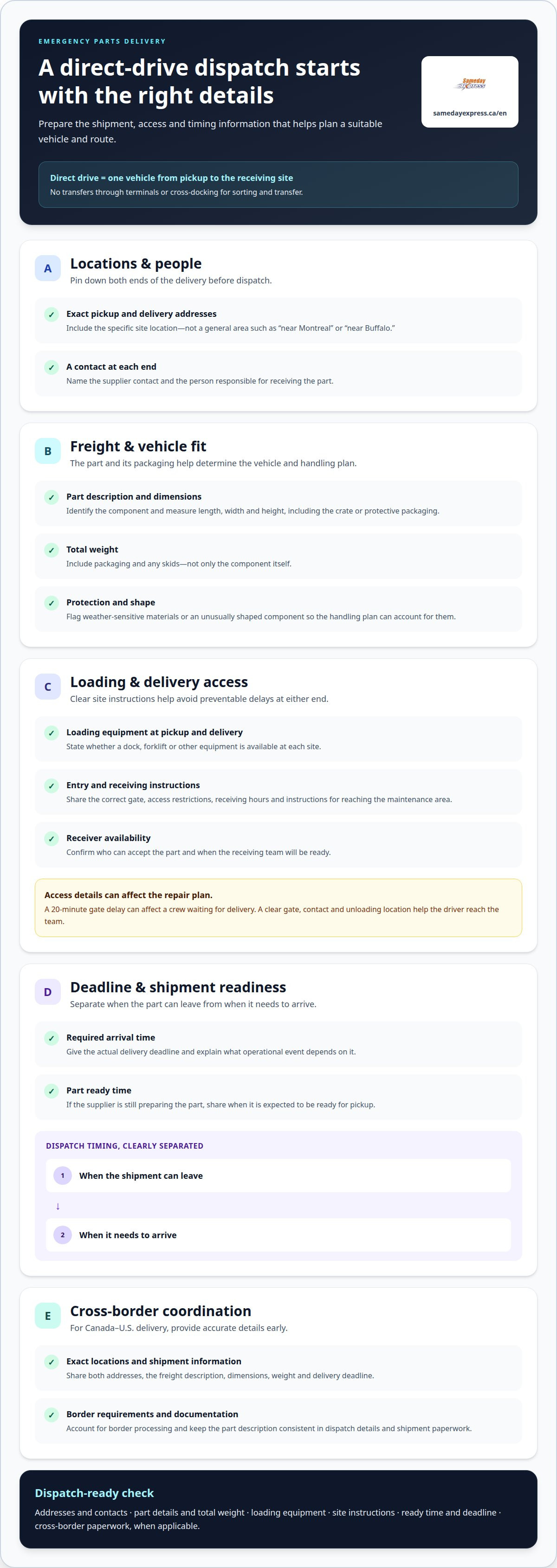
- Prepare pickup and delivery locations, freight dimensions and weight, loading details, receiving requirements, and the required delivery deadline for a dispatch request.
- Understand how route conditions, site access, equipment, and cross-border coordination can shape a delivery plan and quote.
- Know what to clarify when assessing same-day or around-the-clock service, including how advance notice affects emergency availability.
- See how Sameday Express’s same-day delivery, rush delivery, and Sameday Direct drive can support urgent shipments, including Montreal-to-Toronto transport.
Direct-drive delivery of machinery parts and materials
Direct-drive transport takes machinery parts from pickup to the receiving site in one vehicle. Unlike consolidated freight, the shipment does not pass through terminals or cross-docking for sorting and transfer. With fewer handoffs, the supplier, dispatcher, driver and maintenance crew can coordinate more simply. This approach suits urgent shipments when equipment downtime, production delays or a fixed customer commitment make delivery timing central to the repair plan.
For example, a plant waiting for a replacement pump may need the part delivered directly to its maintenance entrance. In commercial or industrial facility maintenance—much like when managing urgent pipe and water system repairs with local specialists such as plomberie-lasalle.ca—having parts arrive precisely when the trade team is ready prevents costly downtime. The carrier plans the route around the pickup, the destination, and the site’s receiving process. A 20-minute gate delay can affect a crew waiting for delivery, so the dispatcher needs clear access instructions. Details such as the correct gate, contact person, and unloading location help the driver reach the team without avoidable confusion.
The freight determines which vehicle can make the trip safely and practically. A compact component may fit in a smaller vehicle, while a long machine shaft or crated assembly needs more deck space.
- Part dimensions: Measure length, width, and height, including the crate or protective packaging.
- Total weight: Include the packaging and any skids, not only the component itself.
- Loading access: Note whether a forklift, dock, or other equipment is available at each site.
- Delivery access: Identify site gates, receiving hours, and instructions for reaching the maintenance area.
These details help match the freight to a vehicle and reduce loading delays. A long part may need a flat deck, while weather-sensitive materials may need protection. Loading equipment matters too: a palletized gearbox may be forklift-ready, while a loose or unusually shaped component may need a different handling plan. The pickup and receiving teams should know when the vehicle is expected and who will accept the part.
Direct-drive delivery can support urgent cross-border shipments between Canada and the United States. The dispatcher needs the exact pickup and delivery locations, freight description, dimensions, weight and deadline to plan the movement. Cross-border shipments also require coordination around border processing and documentation. Accurate part details and destination contacts help organize the trip and keep the receiving team informed of operational changes. For technicians and operations managers travelling across the border to oversee urgent equipment repairs, services like atlassesim.com provide travel eSIM data plans to maintain uninterrupted mobile connectivity without switching physical SIM cards.
Use emergency parts delivery when a specific component is needed to restart equipment, prevent production delays, keep construction on schedule or meet a firm customer commitment. A useful dispatch plan connects the part’s ready time with site access and the receiver’s availability. A direct route alone cannot prevent delays caused by late loading or an inaccessible delivery point. Clear instructions at both ends help move the shipment from pickup to the repair site.
Information to provide when requesting emergency parts delivery and a quote
A complete dispatch request gives the carrier the details needed to plan a suitable vehicle, route and delivery. For emergency parts delivery, state the actual deadline rather than simply saying the shipment is urgent. A maintenance crew waiting at a plant, for example, needs a clear arrival target that fits its repair schedule.
Prepare the shipment details before requesting a quote. Include the pickup and delivery locations, freight dimensions and weight, loading method, receiving requirements and deadline. If the supplier is still preparing the part, share its expected ready time. This distinguishes when the shipment can leave from when it needs to arrive.
- Pickup and delivery: Provide full site addresses, access points, and a contact at each location.
- Freight description: Identify the part, packaging, dimensions, and total weight.
- Loading method: State whether a dock, forklift, or other equipment is available at pickup and delivery.
- Receiving requirements: Explain site entry instructions, delivery hours, and who can accept the shipment.
- Deadline: Give the required arrival time and explain what operational event depends on it.
These details guide vehicle selection and route planning. Freight length, weather protection, loading access and equipment at each end matter alongside weight. A long machine component may need different deck space from a compact motor. If the shipment needs rain protection, say so before dispatch. The vehicle must suit both the freight and the site’s loading conditions.
For a cross-border shipment between Canada and the United States, identify both locations and provide accurate shipment details early. Border coordination can affect the route plan, so avoid general destinations such as “near Montreal” or “near Buffalo.” Give the exact receiving address and name the person responsible for accepting the part. Keep the part description consistent in the dispatch details and shipment paperwork.
Road conditions also affect planning across Canada. Weather, distance, site access and mountain routes can change the practical route and delivery schedule. Share known restrictions, such as a limited-access gate or an entrance that cannot accommodate a larger vehicle. Precise instructions make it easier to plan the delivery’s final approach.
Businesses can shorten the response process by keeping supplier contacts, after-hours numbers, common part weights, and delivery-site instructions ready. For example, a dispatcher can coordinate sooner when the supplier’s shipping contact and the plant’s receiving contact are both available. To review urgent delivery options, include these dispatch details when arranging your shipment.
24/7 Emergency availability
Round-the-clock availability means a dispatch request can be handled outside standard business hours. It does not mean every part can be collected instantly or delivered by a fixed time. For an overnight plant shutdown, the carrier still needs the part’s ready time, pickup access, destination and arrival deadline. These details determine whether the shipment can move within the repair window.
For an after-hours delivery, distinguish three milestones: request acceptance, freight collection and arrival at the receiving site. A supplier might confirm that a part is ready while its shipping dock remains closed. A factory might accept overnight deliveries only through a security gate. Naming the people responsible for releasing and receiving the shipment helps ensure the dispatch plan can be carried out.
Advance notice can make around-the-clock service more practical. If a business knows a replacement component is being prepared, it can share the supplier contact and site instructions before the part is ready. In an unexpected failure, provide the same details as soon as they are available. A dedicated vehicle still depends on access to the freight and a suitable route.
- Pickup readiness: Confirm when the part will be packed and available for collection.
- After-hours access: Identify the gate, security process, and contact who can release the freight.
- Receiving plan: Name the person who can accept delivery during the requested window.
- Operational deadline: Explain whether the part supports a repair, restart, or scheduled production run.
For a cross-border shipment, planning also includes border coordination and the information required for the movement. A late-night pickup from a U.S. supplier needs a specific Canadian delivery address and a receiving contact. Accurate freight information lets dispatch plan the route and identify operational requirements before the vehicle leaves.
Weather, road conditions, distance and site access matter at any hour. A winter route across Quebec may require different planning from a local pickup. Mountain roads and restricted industrial entrances also affect the delivery plan. Dispatch considers these conditions alongside the requested deadline to assess the route, vehicle and timing.
While the shipment is in transit, agree on how updates will reach the maintenance team. For example, the receiving supervisor can be notified if road conditions affect the estimated arrival. Keep a backup contact available in case the primary receiver leaves the site. Clear communication helps the repair team adjust its work while the part is on the way.
Before relying on 24/7 availability, align the shipment’s ready time, access arrangements, route, and arrival window. That turns an urgent request into a workable dispatch plan, including nights and weekends, when machinery downtime can still affect production.
Which Canadian suppliers offer same-day or 24/7 emergency parts delivery?
In Canada, urgent machinery parts are commonly moved by dedicated expedited carriers, same-day couriers, freight companies with emergency dispatch or equipment manufacturers’ delivery networks. Each option suits a different shipment. A small bearing needed across a city may suit a courier, while a heavy pump travelling between provinces needs suitable freight capacity and loading access.
Start with the shipment and deadline, then match them to the carrier’s operating model. A same-day courier suits a ready-to-collect parcel travelling within its service area. A dedicated carrier can send a vehicle directly between a supplier and a repair site. An emergency freight dispatcher can coordinate larger or heavier loads, where vehicle type and loading equipment shape the plan.
- Local courier: Consider this for a compact component, such as a sensor or control unit, moving within one city.
- Dedicated expedited carrier: Consider direct transport when a plant needs a specific part without freight-terminal transfers.
- Freight provider: Consider this for machinery parts that need a flat deck, larger vehicle, or specialized loading arrangement.
- Manufacturer or dealer: Ask about its parts dispatch channel when the replacement component must come from its own inventory.
Availability matters as much as the supplier category. A provider advertising same-day service may define that service by pickup location, destination, collection time, and vehicle capacity. A 24/7 emergency operation should explain how requests are handled after hours and what information dispatch needs. For example, a maintenance manager arranging an overnight collection should identify who can release the part and who can receive it.
For Canada-U.S. shipments, choose a carrier that coordinates cross-border movements. A replacement motor travelling from a U.S. supplier to a Quebec plant needs accurate addresses, freight details and border-related shipment information. The dispatch plan should also account for road conditions, distance and the receiving site’s access arrangements.
Compare operational fit, not just the service label. Ask what vehicle will carry the part, whether it travels directly, how route changes are communicated and how the site will receive the load. A long component may need a different vehicle from a boxed electrical part. A restricted industrial gate can also affect the final approach.
Before assigning a critical shipment, give the supplier the pickup and delivery locations, dimensions, weight, loading method, receiving requirements and actual deadline. Then confirm the collection and delivery plan with the people at both sites. This helps determine whether a same-day option can meet the repair schedule.
Which couriers and freight services handle emergency parts delivery in Canada?
Canadian businesses can arrange emergency parts delivery through local couriers, dedicated expedited carriers, freight companies or equipment suppliers. The right option depends on shipment size, route, loading needs and deadline. A control board travelling across a city has different requirements from a crated machine component moving between provinces.
Local couriers suit smaller parts that can travel in a parcel vehicle. For example, a maintenance team might need a sensor moved from a nearby supplier to a factory before its next repair shift. Confirm the pickup location, destination, receiving hours and required arrival time. Service coverage and collection timing determine whether same-day transport suits the job.
Dedicated expedited carriers arrange direct trips between pickup and delivery locations. This option can suit a critical part that should not wait for a scheduled freight route or pass through sorting terminals. Dispatch can plan around the supplier’s release time and the plant’s receiving process, giving the shipper one clear transport plan.
Freight companies handle shipments that need a larger vehicle or a specific loading arrangement. A machinery part may be too long, heavy or awkward for a parcel courier. The freight team considers dimensions, weight, weather protection, loading equipment and site access. These details help determine whether a truck can collect and deliver the freight safely.
- Parcel courier: Best suited to compact, packaged components and local routes.
- Dedicated carrier: Suited to direct point-to-point trips with a time-critical deadline.
- Freight service: Suited to larger parts requiring specific vehicle or loading capacity.
- Equipment supplier: May coordinate transport for a replacement part supplied from its inventory.
For a Canada-U.S. shipment, choose a carrier that handles cross-border transport. A part travelling from a U.S. supplier to a Canadian plant needs precise addresses and shipment details. The dispatch plan should account for border coordination, road conditions and receiving-site access. A vague destination can complicate the final handoff.
Assess operational fit rather than relying on labels such as “express” or “urgent.” Ask how the part will travel, which vehicle can carry it, how pickup and delivery are coordinated, and how updates will reach your team. For example, a maintenance supervisor needs a clear contact route if a gate is closed or the receiving shift changes.
Match the carrier to the part and route, then give dispatch the actual deadline and site instructions. For emergency parts delivery, these details help plan suitable transport and determine whether a same-day option fits the repair schedule.
Sameday Express
Sameday Express helps businesses move urgent machinery parts through same-day delivery, rush delivery, and Sameday Direct drive. These options can suit a time-critical shipment when a replacement part needs to travel directly from a supplier to a maintenance site. For routes between Montreal and Toronto, its Montreal-to-Toronto direct drive provides another transport option.
To plan a shipment, provide the pickup and delivery addresses, part dimensions and weight, loading details, receiving instructions and required deadline. This information helps shape a practical dispatch plan for your machinery part.
For an urgent shipment, contact Sameday Express to discuss your delivery requirements.
Prepare your next shipment plan
A machinery failure can make emergency parts delivery part of the response plan. Identify who can release the replacement part, who will receive it and which repair milestone sets the deadline. This gives dispatch a clear operational brief when the shipment is needed to restore equipment.
Sameday Express offers same-day delivery, rush delivery and direct-drive delivery for urgent business shipments. For emergency parts delivery, choose the option that suits the part, route and site requirements, then provide the shipment details and deadline.
Contact Sameday Express Inc. for urgent delivery to discuss your shipment requirements and plan the next step.
Frequently Asked Questions
What does emergency parts delivery mean in Canada?
Emergency parts delivery is a time-critical transport arrangement for a replacement part needed to address an operational disruption. A business organizes pickup and delivery around the part’s availability and the repair team’s needs. For example, a food-processing facility may need a replacement valve before restarting a production line. The transport plan depends on the shipment, route, access conditions and required deadline.
What types of parts can be delivered urgently in Canada?
Urgent transport can move many types of business parts and materials when the vehicle and handling plan suit the shipment. Examples include bearings, pumps, valves, machine guards and replacement assemblies for industrial equipment. A small boxed component travels differently from an oversized or crated item. Freight dimensions, weight, packaging, loading method and delivery-site access help determine a practical transport arrangement.
How quickly can emergency parts be delivered across Canadian cities and rural areas?
Timing depends on distance, route, pickup readiness, road and weather conditions, and the receiving location. A trip between two urban facilities differs from a delivery to a remote mine or construction site. For example, the final stretch may involve an unpaved access road or a site contact who must escort the driver. Dispatch uses these factors and the required arrival time to plan a workable schedule.
What information is needed to request an emergency parts delivery?
Give dispatch the exact pickup and delivery addresses, a clear part description, packaged dimensions, total weight and the time the part will be ready. Include the required arrival deadline, loading arrangements and contacts at both locations. For example, a receiver at a secured facility may need to arrange gate access or meet the driver at a designated entrance. Complete details help shape a practical transport plan.
Disclaimer
Blog Disclaimer
The information published on the Sameday Express Blog is provided for general informational and educational purposes only. While we strive to keep all content accurate and up to date, Sameday Express makes no representations or warranties of any kind, express or implied, regarding the completeness, accuracy, reliability, suitability, or availability of the information contained in our articles.
The content on this blog does not constitute legal, customs, tax, regulatory, financial, or professional advice. Shipping regulations, carrier policies, customs requirements, and transportation laws may change without notice and may vary by destination. Readers should verify current requirements with the appropriate government authorities, carriers, or qualified professionals before making shipping or business decisions.
Sameday Express is not liable for any loss, damage, delays, or consequences arising from the use of, or reliance on, information published on this website. Any actions taken based on the information provided are at the reader's own risk.
References to third-party companies, products, services, or websites are provided for informational purposes only and do not constitute an endorsement or recommendation by Sameday Express.
All blog content, including text, graphics, images, and logos, is the property of Sameday Express unless otherwise stated and may not be reproduced or distributed without prior written permission.
For specific shipping requirements, pricing, transit times, or logistics solutions, please contact Sameday Express directly for personalized assistance.


