

When an aircraft is grounded, a missing part can become a time-critical shipment. We coordinate AOG (Aircraft on Ground) shipping with clear, current updates. GPS tracking, shipment milestones, and direct communication help your team follow a part’s progress and respond to delays. An AOG situation arises when a technical issue, failure, or required maintenance prevents an aircraft from flying.
When an aircraft is waiting for a part, knowing where the shipment is matters as much as knowing when it is expected. We help keep deliveries moving with accurate shipment details and coordinated updates. Incomplete part references, paperwork, or delivery instructions can cause avoidable delays.
In this article, we explain how tracking works for urgent aircraft parts, what information helps keep a shipment moving, and how to plan delivery around the route and required timing. You’ll also learn how to identify an AOG emergency and what to expect from shipment coordination, monitoring, and delivery confirmation in Canada.
Key Takeaways
- We explain which shipment milestones and updates help you follow an urgent aircraft part in transit.
- We outline how accurate part details, aviation documents and customs clearance can affect delivery progress.
- We describe when next-flight-out service or an on-board courier may fit an urgent route.
- We clarify the conditions that make a grounded aircraft an AOG emergency and require a coordinated response.
- We explain how same-day delivery, rush delivery and direct-drive options can support time-critical shipments.
AOG logistics: what makes an aerospace shipment “time-critical”?
An aerospace shipment becomes time-critical when a grounded aircraft is waiting for a specific part. For MRO teams, accurate part references, customs paperwork, handling details, and destination instructions help us coordinate each handoff smoothly.
Customs Clearance and Aviation Documentation
Customs clearance involves providing shipment information for goods entering or leaving a country. For AOG logistics, accurate customs details and aviation documentation matter because errors can delay a part before it reaches the maintenance team. We help coordinate the details required for transport.
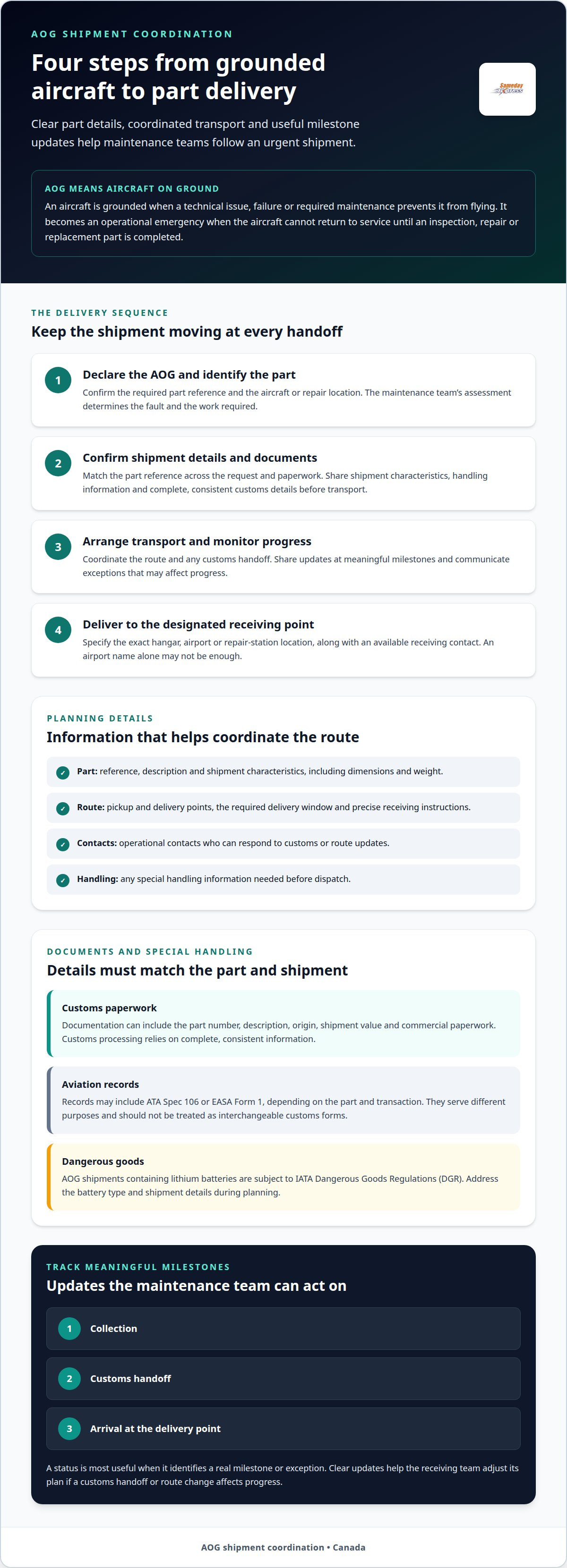
Documentation can include the part number, description, origin, shipment value, and commercial paperwork. Aviation records may include ATA Spec 106 or EASA Form 1, depending on the part and transaction. These records serve different purposes, so they should not be treated as interchangeable customs forms.
For aircraft parts shipped to Canada, import requirements depend on the shipment’s origin, contents, and transaction details. Export requirements depend on the destination country. Customs processing relies on complete, consistent information, so the documents must match the part and its declared details.
To request a quote for an AOG shipment, provide the part reference, dimensions and weight, pickup and delivery points, required delivery window, and operational contacts. We use these details to assess the route, handling needs, and transport options.
Dangerous goods need appropriate identification and handling information before transport. AOG shipments containing lithium batteries are subject to IATA Dangerous Goods Regulations (DGR), so the battery type and shipment details must be addressed during planning.
Aerospace customers and MRO support teams need updates they can act on. We provide tracking updates that identify the shipment’s current milestone, such as collection, a customs handoff, or arrival at a delivery point. This helps maintenance planners monitor progress against the work schedule and coordinate access at the hangar or repair station.
Reducing Delays and Shipment Risks
Preventing delays and damage requires coordinating shipment details, documentation, handling, and updates before each handoff. A part can lose time when its reference, paperwork, or delivery instructions do not match the receiving team’s needs. We coordinate these details to support a smooth delivery.
We can reduce avoidable delays by confirming the part reference, shipment characteristics, delivery point, time window, and contacts. For example, delivery to a repair station needs a precise receiving location and an available contact, not just an airport name.
- Match the part reference across the request and accompanying documents.
- Share dimensions, weight, and handling information before dispatch.
- Provide the exact hangar, airport, or repair-station delivery point.
- Keep shipment contacts available for customs or route updates.
These checks support accurate delivery, but tracking must continue after dispatch. We monitor milestones and communicate exceptions so the MRO team can adjust its receiving plan if a customs handoff or route change affects progress.
What is an AOG (Aircraft on Ground) and when does it become an emergency?
AOG describes an aircraft grounded because a technical issue, failure, or required maintenance intervention prevents it from flying. It becomes an operational emergency when the aircraft cannot return to service until a specific inspection, repair, or replacement part is completed. The response depends on the fault, the aircraft’s status, and the maintenance team’s assessment.
Common technical causes include a failed component, damage found during inspection, or scheduled maintenance that identifies a condition requiring immediate attention. Logistics problems can add to the disruption: the needed part may be elsewhere, its reference may be unclear, or its delivery may not match the repair schedule. For example, a replacement component arriving after the maintenance team’s work window can extend the grounding.
Airlines manage AOG situations by coordinating maintenance, parts sourcing, and transport. We coordinate the part request with the aircraft and repair location, then arrange shipment and delivery. Our process typically involves:
- Declaring the AOG and identifying the required part.
- Sourcing the part and confirming its references and shipment details.
- Arranging transport, tracking progress, and coordinating any customs handoff.
- Delivering to the designated hangar, airport, or repair station.
In Canada, we coordinate the part request, pickup, route, shipment updates, and final delivery point. Clear contacts and a precise delivery location help connect carrier updates with the maintenance team’s plan.
The urgency can extend beyond one aircraft. A delayed flight may affect crew rotation and passenger connections, creating further coordination demands across an airline’s network. Maintenance control needs useful updates to plan work, while the receiving team needs to know when and where the part will arrive. A tracking status is most useful when it identifies a real milestone or exception, not simply that a shipment is moving.
Airline logistics can bring maintenance, procurement, and transport teams into a coordinated response. Airlines may arrange urgent parts on passenger or freighter flights while respecting aircraft weight and balance constraints. The route, cut-off times, handling requirements, and final delivery leg all affect the plan. If a part misses a connection, teams need prompt notice to reassess transport and timing.
For aviation operators, the distinction is practical: a technical issue creates the grounding, while parts availability and shipment coordination influence how quickly the repair can proceed. A clear AOG declaration gives logistics teams the aircraft context, part reference, delivery point, time window, and contact details needed to organize the response. For urgent movement within the broader logistics plan, time-critical shipment coordination can be one part of keeping the delivery aligned with the maintenance schedule.
Next-flight-out and on-board courier delivery
When aircraft downtime depends on a part, the transport plan must fit the repair window. We coordinate next-flight-out and on-board courier options to prioritize movement. Flight schedules and final delivery still determine when the part arrives.
Urgent Parts Delivery and Aircraft Downtime
We move required components toward grounded aircraft using suitable fast routes. Reducing transit time can help maintenance teams begin work sooner, but transport alone cannot determine when an aircraft returns to service.
We book next-flight-out (NFO) shipping on the earliest suitable departing flight. An on-board courier accompanies the shipment and can manage handoffs and updates along the way. We coordinate the option based on cut-off times, flight availability, handling needs, and the delivery point, including whether road transport is needed after landing.
Which Canadian airports and regions have 24/7 AOG shipping services? Coverage depends on the destination, available flight connections, and access to the final delivery location. A remote airport may require a road transfer from a larger hub, while a direct flight can simplify the route.
How fast can AOG parts be shipped within Canada? Timing depends on pickup readiness, airline cut-offs, flight availability, handling constraints, customs clearance, and the final delivery leg. We can move a part on an earlier flight with NFO, or arrange an on-board courier to accompany it. The wait for a suitable departure and completion of handoffs still affect arrival.
Delivery Speed and On-Time Performance
Delivery speed is the time needed to move a part through pickup, transport, and final delivery. We track key milestones against the delivery window, helping maintenance teams plan receiving and repair work.
We monitor every handoff. A flight departure or arrival, customs process, or last-mile transfer can affect the schedule. We provide clear updates so airline and maintenance contacts can adjust receiving plans when an exception changes the expected arrival.
Remote airport delivery adds a coordination step. A shipment may arrive at a regional airport, then continue by road to a hangar, airport-side facility, or repair station. We need the receiving location and contact, not just the airport code, so the final leg reaches the right team.
Airlines may prioritize urgent parts on passenger or freighter flights while respecting aircraft weight and balance constraints. Capacity, cut-offs, and handling requirements determine which flight can carry a shipment. For heavier units, a charter aircraft may be considered as a transport option.
We provide reliable tracking that connects transport decisions to the maintenance schedule. Our updates report collection, flight booking, departure, arrival, customs progress when applicable, and delivery confirmation. This milestone-based view helps teams spot a missed connection or delayed road transfer early and coordinate the next step.
24/7 Emergency response
Our 24/7 AOG response keeps shipments moving outside regular business hours. Aircraft downtime does not pause overnight, so maintenance, parts, and transport teams need a clear way to coordinate urgent decisions whenever an issue arises.
Our response protocol assigns clear roles before an emergency. The maintenance contact confirms the required component and delivery point. The parts contact coordinates release and shipment details. Our transport coordinator monitors progress and escalates route or handoff problems. With responsibilities clear, teams can act without losing time deciding who owns the next step.
For each activation, our response team needs a concise set of shipment details. At minimum, we need:
- The aircraft or maintenance reference and the required component details.
- The pickup location, receiving airport or repair station, and delivery contact.
- The required delivery window and any handling instructions.
- Shipment dimensions, weight, and relevant documentation.
These details support route planning and shipment visibility. For example, a component collected after a flight cut-off may need a different transport plan from one ready before departure. A change in the receiving contact can also affect the final handoff. Recording updates in a shared communication flow helps maintenance and logistics teams work from the same status.
During transit, proactive monitoring should link each milestone to a clear response. Collection, booking, departure, arrival, customs progress where relevant, and final delivery each provide a point to assess the plan. If a flight is missed or a road connection changes, our coordinator can alert the maintenance contact and arrange the next step. Prompt delivery confirmation closes the loop for the team preparing the repair.
For a shipment moving between Canadian provinces, our response plan should account for each transport connection and the final delivery leg. A flight arrival may need to connect with road transport to the receiving facility. Our coordinator should identify who owns each handoff and who receives updates if the schedule changes, keeping the Canadian delivery plan clear from pickup through arrival.
Our around-the-clock readiness also depends on clear escalation paths. If the primary contact cannot respond, our protocol should name an alternate decision-maker. If a shipment is delayed, our escalation path should connect transport updates with the maintenance team’s revised work plan. An agreed process helps teams respond consistently during weekends, overnight periods, and shift changes.
For airlines and maintenance organizations, our 24/7 response is not only about dispatching freight. We combine decision authority, current shipment visibility, and communication through delivery. Our prepared protocol gives each participant a defined role, from confirming the part request to acknowledging receipt at the aircraft or repair facility.
AOG definition and emergency conditions
An AOG situation means an aircraft is grounded because a technical issue, failure, or required maintenance prevents it from flying. It becomes an emergency when maintenance cannot return the aircraft to service until a specific inspection, repair, or replacement component is addressed. The maintenance team determines the aircraft’s status and required work.
Not every delay in the aviation supply chain creates an AOG event. A late shipment for planned maintenance may disrupt a schedule, but a grounded aircraft waiting for a required part presents a more immediate operational problem. For example, if a component failure prevents dispatch, the aircraft remains grounded until maintenance completes the necessary work.
Several conditions can signal an active AOG situation:
- Maintenance identifies a fault that prevents the aircraft from flying.
- A required repair or inspection must be completed before the aircraft returns to service.
- A specific replacement component is needed to continue the repair.
- The part’s delivery timing affects the maintenance team’s planned work.
The disruption can spread beyond the aircraft. A delayed flight can affect crew rotation and passenger connections, requiring airline teams to adjust schedules. If the grounded aircraft serves a route with connecting flights, the operations team may need to coordinate aircraft, crew, and passenger plans while maintenance assesses the repair.
We coordinate a dedicated response that connects maintenance decisions with parts sourcing and shipment coordination. The maintenance team identifies the aircraft and component; procurement or parts teams locate the item; we coordinate its movement to the receiving facility. Each handoff needs a clear contact and delivery point, such as a named hangar or repair station, so the component reaches the team doing the work.
The key distinction is operational: an AOG event concerns an aircraft that cannot fly, while the shipment supports the work needed to address the problem. Delivery alone does not clear the aircraft for service. Maintenance must complete its inspection or repair and determine when the aircraft can return to operation.
For the supply chain, the situation changes as soon as the aircraft is grounded. Planned replenishment can often follow routine timing, but a part needed for an active AOG event requires coordinated attention. We can align the aircraft reference, required component, receiving location, and maintenance contact to reduce confusion during the response.
For urgent aircraft-part movement, coordinate time-critical shipment support around the maintenance team’s delivery requirements.
Sameday Express Inc.
We coordinate urgent aircraft-parts deliveries through same-day delivery, Rush delivery, and Direct Drive options. The right option depends on your pickup point, destination, and required delivery window.
Share the part’s location, delivery address, and timing needs to discuss your shipment plan. For help with an urgent delivery, contact us.
Keep the next AOG shipment moving
Start your next AOG (Aircraft on Ground) shipping plan with the maintenance deadline. Share the part reference, pickup and delivery locations, required timing, and receiving contact. These details help align the transport plan with the aircraft’s needs and the final handoff.
Depending on the route and urgency, we offer same-day delivery, Direct Drive, and Rush delivery. The right option depends on the shipment details and delivery requirements.
When an aircraft is waiting for a part, a clear shipment request is a practical next step. Contact us about your urgent shipment to discuss the delivery requirements and move forward with a plan.
Frequently Asked Questions
How does a provider track AOG shipments in real time?
A provider can combine GPS location with shipment status updates to show where a part is and what stage it has reached. For example, updates can report collection, a transport handoff, arrival, or delivery. Sameday Express Inc. provides real-time GPS tracking for shipments. If a route changes or a delay occurs, timely communication helps the maintenance team adjust receiving plans and keep the right people informed.
What are the most common causes of an AOG?
An AOG usually follows a technical issue, component failure, or maintenance finding that prevents an aircraft from flying. The aircraft’s maintenance assessment determines the precise cause, not the shipment provider. A parts shortage can prolong the situation, but it is a logistics constraint rather than the aircraft fault itself. Identifying the affected component and maintenance requirement helps teams coordinate an appropriate response.
AOG impacts: what are the consequences?
A grounded aircraft can disrupt more than its own departure. Airlines may need to adjust aircraft assignments, revise schedules, and coordinate maintenance resources while the aircraft remains unavailable. A longer disruption can also affect later flights and aircraft availability for planned operations. For maintenance planners, clear delivery status helps organize the work sequence and receiving arrangements around the part’s expected arrival.
Are you available 24/7 for AOG emergencies?
Yes. Sameday Express Inc. provides a 24/7 AOG response. Real-time status updates support communication during an urgent shipment. For an emergency request, the aircraft or maintenance reference, required part, pickup point, destination, and receiving contact help the response team understand the shipment’s needs and coordinate the next steps.
Can you deliver to remote airports?
Sameday Express Inc. offers direct airport delivery for AOG (Aircraft on Ground) shipping parts. For a remote airport, the destination and receiving arrangements need to be clear so the shipment reaches the appropriate airport-side contact or maintenance facility. The route, transport connections, and access for the final handoff affect how delivery is organised. Include the precise delivery point, not only the airport name.
Can you provide customs documentation?
Sameday Express Inc. provides customs documentation and customs clearance assistance for relevant shipments. Paperwork and clearance requirements depend on the shipment’s origin, destination, and transaction details. The shipper and parts supplier should provide accurate information about the item and its movement so documents can be prepared consistently. Clear coordination makes customs requirements part of the transport plan, not an afterthought.
Do you handle AOG shipments on weekends or holidays?
Yes. AOG response is available around the clock, including weekends and holidays, so urgent requests can be coordinated outside standard business hours. Flight schedules, customs processing, and the receiving facility’s access can still affect the shipment plan. Provide the required delivery point and an available receiving contact so the transport team can coordinate the handoff with the maintenance operation.
What is AOG (Aircraft on Ground) shipping?
AOG (Aircraft on Ground) shipping is the urgent transport of a part needed to support an aircraft that cannot fly. Unlike routine parts replenishment, this shipment is tied to an active maintenance need. Tracking follows the part through transport and handoffs; delivery supports the repair process, while the maintenance team determines when the aircraft can return to service.
Disclaimer
Blog Disclaimer
The information published on the Sameday Express Blog is provided for general informational and educational purposes only. While we strive to keep all content accurate and up to date, Sameday Express makes no representations or warranties of any kind, express or implied, regarding the completeness, accuracy, reliability, suitability, or availability of the information contained in our articles.
The content on this blog does not constitute legal, customs, tax, regulatory, financial, or professional advice. Shipping regulations, carrier policies, customs requirements, and transportation laws may change without notice and may vary by destination. Readers should verify current requirements with the appropriate government authorities, carriers, or qualified professionals before making shipping or business decisions.
Sameday Express is not liable for any loss, damage, delays, or consequences arising from the use of, or reliance on, information published on this website. Any actions taken based on the information provided are at the reader's own risk.
References to third-party companies, products, services, or websites are provided for informational purposes only and do not constitute an endorsement or recommendation by Sameday Express.
All blog content, including text, graphics, images, and logos, is the property of Sameday Express unless otherwise stated and may not be reproduced or distributed without prior written permission.
For specific shipping requirements, pricing, transit times, or logistics solutions, please contact Sameday Express directly for personalized assistance.


