

Freight protection starts before the first lift. Knowing how to package freight for shipping means choosing packaging suited to the cargo, labelling every package clearly, guarding against moisture where needed, and securing the load so it cannot shift during handling. Palletizing can make freight easier to handle and help keep it stable.
It’s easy to focus on the contents and overlook how to protect them in transit. The right box, crate, or pallet, combined with clear handling instructions and secure wrapping, helps prepare a shipment for the journey ahead.
This guide covers practical steps for preparing freight in Canada, from choosing packaging and placing labels to stacking, wrapping, and securing a load. You’ll also learn how to guard against moisture and movement, and when to follow special handling instructions for delicate or regulated goods.
Key Takeaways
- Use shipment weight and pallet count to distinguish common freight options, then match the service to the load.
- Choose packaging for the cargo, add clear handling labels, and protect shipments from moisture where needed.
- For dangerous goods, classification, packaging, safety marks, and required consignor certification all matter.
- Build stable pallet loads by distributing weight evenly and securing packages so they’re easier to handle.
- Before dispatch, follow the shipper’s instructions and secure container contents to limit movement in transit.
What is Freight Shipping?
Common freight mistakes include guessing the shipment’s weight, leaving pallet dimensions off the bill of lading, and stacking cargo unevenly. These errors can complicate handling, affect rate estimates, or allow packages to shift and become damaged.
Use the shipment’s total weight and pallet count to choose a freight method. Common descriptions place freight at 150 lb or more, but weight and pallet thresholds can overlap across shipment types.
- Weigh and measure the complete load. Record the weight of the goods, packaging, and pallet together. Measure the pallet’s length, width, and height after loading, from the floor to the highest point. For example, a tall crate changes the shipment’s total height even when the pallet itself is low. Keep these figures together for a rate estimate, and enter the shipment details accurately on the bill of lading.
- Use weight and pallet count to identify the freight category. Less-than-truckload (LTL) freight is commonly described as shipments weighing 150 to 15,000 pounds. Some descriptions place LTL at 150 lb or more and up to 8 or sometimes 10 pallets; another common description uses 1 to 6 pallets. Partial truckload (PTL) shipments usually contain 6 to 12 pallets. These ranges overlap, so record both weight and pallet count when selecting a method.
- Compare the load with a full-truckload threshold. A full-truckload (FTL) shipment often weighs about 15,000 pounds, while typical descriptions place LTL shipments below that figure. Treat 15,000 pounds as a useful planning reference, not a substitute for the shipment’s actual measurements. A load with several heavy pallets may approach that weight before it fills the available space.
- Separate freight from small-package shipments by load profile. A shipment near or above 150 lb may fit a common freight description, especially when it occupies a pallet. Smaller, individually handled parcels may suit a small-package method better. Assess the combined shipment, not just one box: four lighter cartons secured together can create a palletized freight load.
- Distribute weight evenly and limit movement. Place heavier cartons low and centre them across the pallet. Balance the load from side to side, then secure the packages so they don’t slide during handling. A concentrated heavy section can make a pallet unstable, while empty spaces between boxes can allow movement. The finished load should stay aligned when moved as one shipment.
Hazard labels and moisture-resistant packaging
For Canadian freight, identify each package with sender and destination details, and include a bill of lading with the shipment information. Dangerous goods require appropriate classification, packaging, safety marks, and documentation. The applicable requirements depend on the goods.
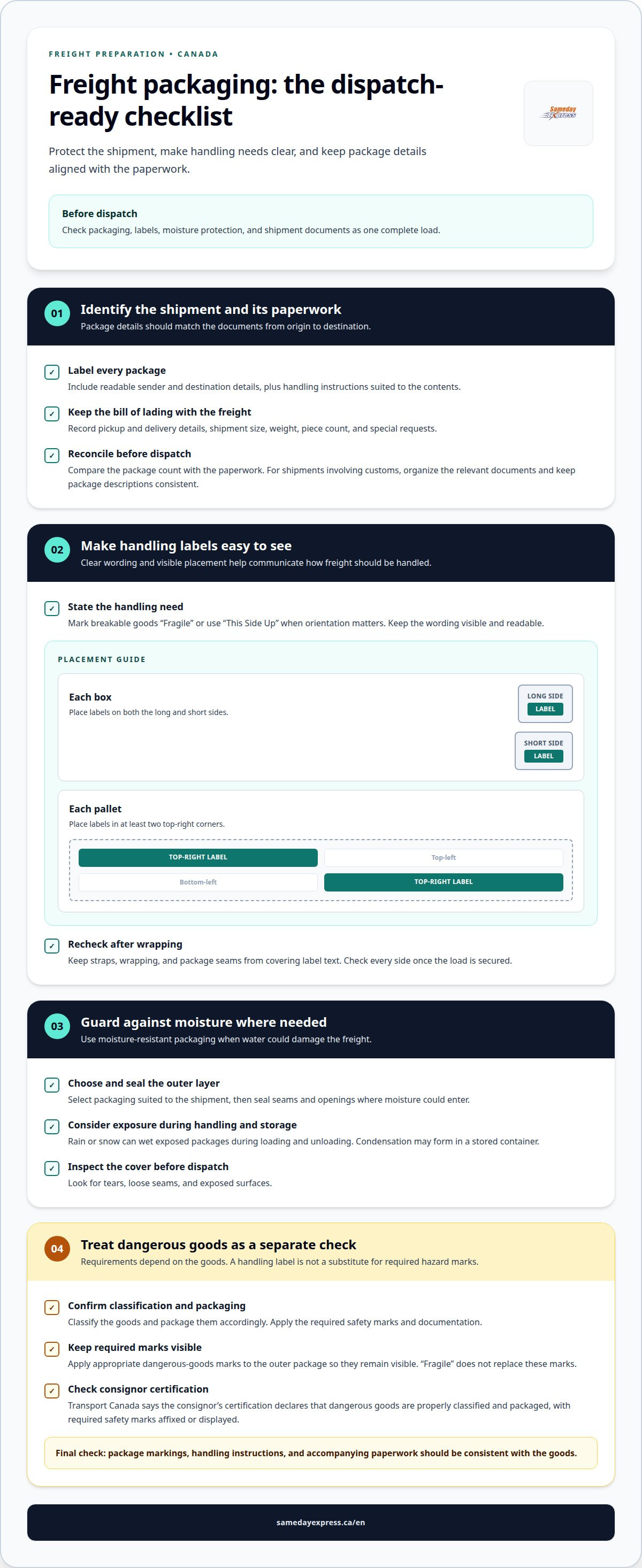
- Match each label to its package. Add readable sender and destination details, along with handling instructions suited to the contents. Mark breakable goods “Fragile” or show “This Side Up” when orientation matters. Make sure the text remains visible during transport, warehouse handling, and delivery. A label should describe the handling need clearly, not rely on colour or placement alone to communicate its message.
- Prepare the shipment documents. A bill of lading records pickup and delivery details, shipment size, weight, piece count, and special requests. Keep it with the freight from origin to destination so the shipment information travels with the load. Compare the package count against the paperwork before dispatch. For shipments involving customs, organize the relevant documents with the shipment records and keep package descriptions consistent.
- Separate handling labels from hazard marks. Don’t treat a “Fragile” label as a substitute for required dangerous-goods marks. Confirm the goods’ classification and package them accordingly. Transport Canada says the consignor’s certification declares that dangerous goods are properly classified and packaged, with required safety marks affixed or displayed. Apply the appropriate marks so they remain visible on the outer package.
Add moisture-resistant packaging
Use moisture-resistant packaging when water could damage the freight. Choose an outer layer suited to the shipment, then seal seams and openings where moisture could enter. Rain or snow during loading and unloading can wet exposed packages, while condensation may form in a stored container. Before dispatch, inspect the wrap or cover for tears, loose seams, and exposed surfaces.
Place labels on every side
Place shipment labels where handlers can see them from different angles. Secure labels on both the long and short sides of each box, keeping them flat and readable. On a pallet, place labels in at least two top-right corners. Keep straps, wrapping, and package seams from covering the text. Check every side after securing the load, since wrapping can obscure a previously visible label.
Identify labels and documents
Use handling signs that state the required action, such as “This Side Up” for freight that must remain in a particular orientation. For consumer commodities covered by the applicable ship regulations, the outer packaging must indicate the danger that could result from release of the contents, according to the Department of Justice Canada. Keep package markings consistent with the goods and accompanying paperwork.
Before dispatch, compare the labels with the bill of lading and confirm that the destination details match. For a shipment with time-sensitive handling needs, consider the delivery plan alongside the packaging and documentation.
Following the freight shipper's packing instructions
For LTL freight in Canada, pack each item in suitable packaging, then secure the shipment according to the carrier’s instructions. Protect fragile goods individually, use durable materials, and prepare the load to remain stable in transit. A clear packing process helps you meet the carrier’s handling requirements.
-
Choose lightweight, durable materials
Choose packaging that protects the item without adding unnecessary bulk. Corrugated cartons, suitable cushioning, and secure outer wrapping can keep goods together during handling. Lightweight, durable materials protect the contents without adding excess shipment weight. Before packing, check each carton for weak corners, open seams, or crushed panels. Replace damaged boxes instead of reusing them.
-
Pack freight in individual boxes
Place items in separate boxes when their shapes or surfaces could cause contact damage. For example, box a metal component separately from a finished panel to prevent scratches. Fill empty space so the item cannot slide inside its carton, then close and secure the flaps. Label each box separately before combining the cartons into one LTL shipment.
-
Pack durable and fragile goods
Use standard packaging for durable goods, then secure them so they stay in place. Give delicate or fragile items extra protection: cushion them, separate them from heavier goods, and prevent contact with the carton walls. A ceramic part, for instance, needs protection from impact on every side. Mark the box clearly so handlers can see its orientation or special care requirements.
- Read the carrier’s packing and handling instructions before closing the shipment. Follow directions for packaging, insurance, or shipping, and compare them with the freight’s contents. Keep the instructions with the shipment details. If the carrier specifies a handling method for an item, prepare the package accordingly rather than relying on a general routine.
- Make packing part of the shipping process, not a last-minute task. Sort goods by size, weight, and fragility, then choose a box or crate for each item. Protect every piece and inspect the closed packages before dispatch. This practical sequence shows how to package freight for shipping while following carrier instructions. Use it to catch loose contents, weak packaging, or missing handling details before pickup.
Lightweight, durable materials can reduce ocean freight volume and weight. Use standard packaging for durable goods, pack and secure fragile goods properly to prevent breakage, and follow the provider’s instructions for packing, handling, insurance, and shipping.
Palletizing freight for handling and space optimization
Choose a packaging unit that suits the cargo, then prepare the load for safe movement from its origin. A correctly sized pallet can make freight easier to handle and organize in transit.
-
Choose boxes, crates, or pallets
Match the outer packaging to the cargo’s shape, weight distribution, and handling needs. Use boxes for grouped items that fit securely inside cartons, or crates for goods that need a rigid enclosure. Choose a pallet when multiple packages should move as one handling unit. For example, stack boxed components together only if the combined load is stable and the packages can be secured without crushing.
-
Select and size the pallet
Measure the footprint of the completed load, then choose a pallet that supports it without excessive overhang. A standard pallet size is 48 inches by 40 inches. Compare that footprint with the cartons or crate before stacking. Leave no package unsupported at the edges, and avoid a pallet that is too large for the cargo, as unused space can make the load harder to secure and manage.
-
Use pallets as handling units
Arrange packages into a compact, balanced load before securing them to the pallet. Pallets make handling more convenient, help optimize space, and support safer movement through logistics operations. Keep the stack aligned with the pallet edges, and place packages so the base remains stable. An average trailer can fit about 26 pallets, so consistent load dimensions can help make trailer space easier to plan.
- Secure freight that ships without a pallet. Wrap the package with foam or tape, then fasten the wrapping so it stays in place during handling. Protect exposed corners and keep loose pieces together as one shipment. For example, if a long item cannot sit on a pallet, secure its protective covering along its full length instead of wrapping only the ends. Check that the finished bundle will not separate when moved.
- Inspect the finished load before dispatch. Check that the pallet is sound, the stack is stable, and no box blocks access to the load’s securement. Examine the shipment from every side, not just the top. If one side extends beyond the pallet or the stack leans, rearrange the packages before transport. A final inspection at origin can catch unstable arrangements before the freight enters the handling process.
Container use and secure handling
Stack freight squarely, wrap it tightly, and secure it to a pallet or skid. In a container, arrange cargo so it cannot move during handling.
-
Stack freight on the pallet
Build a compact stack, with each package resting securely on the layer below. Keep the load centred over the pallet and avoid gaps that could let cartons shift. Align box edges where possible, and place heavier packages lower to support the stack. Before loading, check every side for leaning cartons or unsupported corners. Rearrange unstable pieces before wrapping or securing the load.
-
Wrap cargo with shrink wrap
Apply shrink wrap around the cargo and pallet as one unit, starting low enough to connect the wrapping to the pallet. Work upward in overlapping layers, keeping the film firm without crushing cartons or deforming fragile contents. Cover exposed edges and check that the wrap holds the packages together. Protect sharp corners first so they do not tear the film.
-
Secure freight to a skid
Fasten each large item to the skid with suitable straps or other securement. Place straps around both the cargo and the skid, not just around the item, so the load stays attached during movement. Use multiple securement points if the shape could tilt or slide. Keep straps away from vulnerable edges, and check that they stay tight when the shipment is handled.
- Arrange container cargo to prevent movement. Place packages close together, then use suitable blocking or bracing to fill open spaces. A gap beside a crate can allow it to shift as the container moves, even if the crate is strong. Distribute the load evenly and avoid concentrating heavy items on one side. Before closing the container, check the full space, including gaps near the walls and doors.
- Reduce exposure and theft risk during export handling. Don’t write the contents of boxed items on the outside, as that can reveal what’s inside. Use shrink wrap, seals, or straps to show whether a load has been opened or disturbed. Before dispatch, inspect the seals and securement for damage, and confirm the packages remain fixed in place. Keep shipment paperwork accessible to the people managing the load.
For time-critical freight movements, coordinate your shipment with a clear pickup and delivery plan.
Sameday Express Inc.: same day delivery
Sameday Express Inc. offers same day delivery for business shipments that need to move quickly. For an urgent shipment requiring a direct route, Sameday Direct drive or rush delivery may suit the delivery plan. Businesses moving freight between Canadian destinations can choose an option based on the shipment’s timing and requirements.
Choose an urgent delivery service when timing matters more than fitting a routine freight schedule. Prepare the freight securely, provide accurate pickup and destination details, and share any handling instructions before dispatch. Clear shipment information helps align the delivery plan with the load.
For your next time-sensitive business shipment, contact Sameday Express Inc. to discuss a suitable delivery option.
Plan the shipment beyond the loading dock
Freight preparation works best when the packaging plan and delivery plan support each other. Before dispatch, consider the shipment’s urgency, destination, and how it needs to move after pickup. This context helps you decide whether your usual freight schedule fits or a more direct option is needed.
Planning how to package freight for shipping also means thinking ahead to handoff. Keep shipment details clear, prepare the load for straightforward handling, and match the delivery method to its timing needs. For urgent business shipments, Sameday Express Inc. offers same day delivery, Sameday Direct drive, and rush delivery.
A clear plan can help your team move from packing to dispatch with fewer last-minute decisions. Contact Sameday Express Inc. about freight to discuss a suitable delivery option for your shipment. With the right preparation and a delivery plan that fits, you can send freight forward with confidence.
Frequently Asked Questions
How Do I Ship Freight?
Start by identifying the goods, destination, shipment dimensions, and handling needs. Choose a freight method that fits the load, then prepare the packaging and shipment details. Before pickup, make sure the freight is safely accessible at the collection point and the delivery location can receive it. For example, note whether a warehouse requires a scheduled arrival or has a designated receiving area.
How Do You Prepare a Freight Shipment?
Prepare a freight shipment by matching its packaging to the goods and recording accurate shipment details. Include any protruding parts in the outside dimensions, not just the box or pallet base. Compare the final package count with your packing list, and keep a copy of the shipment information for receiving staff. A clearly documented count helps the recipient confirm that every package arrived.
How do you prepare and package freight for shipping step by step?
First, sort the goods by size, weight, and sensitivity. Select suitable packaging for each item, then close and inspect every box or crate. Group compatible packages into a stable load, secure loose components, and record the finished dimensions and weight. Before dispatch, compare the shipment details with the paperwork and confirm that the destination contact can identify the delivery. This sequence gives staff a clear final check.
What packaging materials are best for palletized freight?
The best materials depend on the freight’s shape, weight, and vulnerability. Use sound corrugated cartons for boxed goods, cushioning to limit impact inside packages, and corner protection where edges could be crushed. Stretch film can bind a stable stack, while straps can secure heavier or awkward loads. For example, protect a machine’s projecting controls with a rigid guard before wrapping the pallet.
What are standard freight pallet dimensions and weight limits in Canada?
A common standard pallet measures 48 inches by 40 inches. There isn’t one universal weight limit for every freight pallet; the allowable load depends on the pallet’s capacity and the handling method. Check the pallet’s condition and construction, then account for the combined weight of goods and packaging. A damaged board or weak support can make a heavy load unsuitable, even if its dimensions fit the pallet.
How to protect fragile, oversized, or irregular freight during shipping?
Give fragile goods separate internal protection, and keep heavy objects from pressing against delicate surfaces. For oversized or irregular freight, create a stable base and protect parts that extend beyond the main shape. Secure the shipment at strong structural points, not at handles, controls, or thin edges. For example, protect a long item’s projecting fittings and support it along its full length.
How do dangerous goods packaging rules apply to freight shipments in Canada?
Dangerous goods must be classified and packaged appropriately, with required safety marks affixed or displayed. Transport Canada says the consignor’s certification declares that the goods are properly classified and packaged and have the required safety marks. The applicable marks and packaging depend on the goods and their classification. Treat ordinary “Fragile” or orientation labels as handling instructions, not substitutes for dangerous-goods marks or documentation.
Disclaimer
Blog Disclaimer
The information published on the Sameday Express Blog is provided for general informational and educational purposes only. While we strive to keep all content accurate and up to date, Sameday Express makes no representations or warranties of any kind, express or implied, regarding the completeness, accuracy, reliability, suitability, or availability of the information contained in our articles.
The content on this blog does not constitute legal, customs, tax, regulatory, financial, or professional advice. Shipping regulations, carrier policies, customs requirements, and transportation laws may change without notice and may vary by destination. Readers should verify current requirements with the appropriate government authorities, carriers, or qualified professionals before making shipping or business decisions.
Sameday Express is not liable for any loss, damage, delays, or consequences arising from the use of, or reliance on, information published on this website. Any actions taken based on the information provided are at the reader's own risk.
References to third-party companies, products, services, or websites are provided for informational purposes only and do not constitute an endorsement or recommendation by Sameday Express.
All blog content, including text, graphics, images, and logos, is the property of Sameday Express unless otherwise stated and may not be reproduced or distributed without prior written permission.
For specific shipping requirements, pricing, transit times, or logistics solutions, please contact Sameday Express directly for personalized assistance.


