

An expedited parcel in Canada may arrive within a couple of business days. Expedited delivery confirmation records that a shipment was delivered, often through an electronic scan or photo, but it does not necessarily require the recipient’s signature. Signature-required delivery is a separate instruction that calls for a physical or electronic signature.
Faster shipping can help when timing matters, but a delivery record is not the same as proof that a specific person received a parcel. Knowing the difference helps you choose the right delivery option and set clear expectations for the recipient.
This article explains how expedited shipping affects delivery speed, service reliability and the factors that shape the quote. It also outlines what tracking and delivery confirmation can show, when a signature requirement matters, and how to interpret the delivery record once it’s available. You’ll have a clearer basis for deciding which details matter most for an urgent business shipment.
Key Takeaways
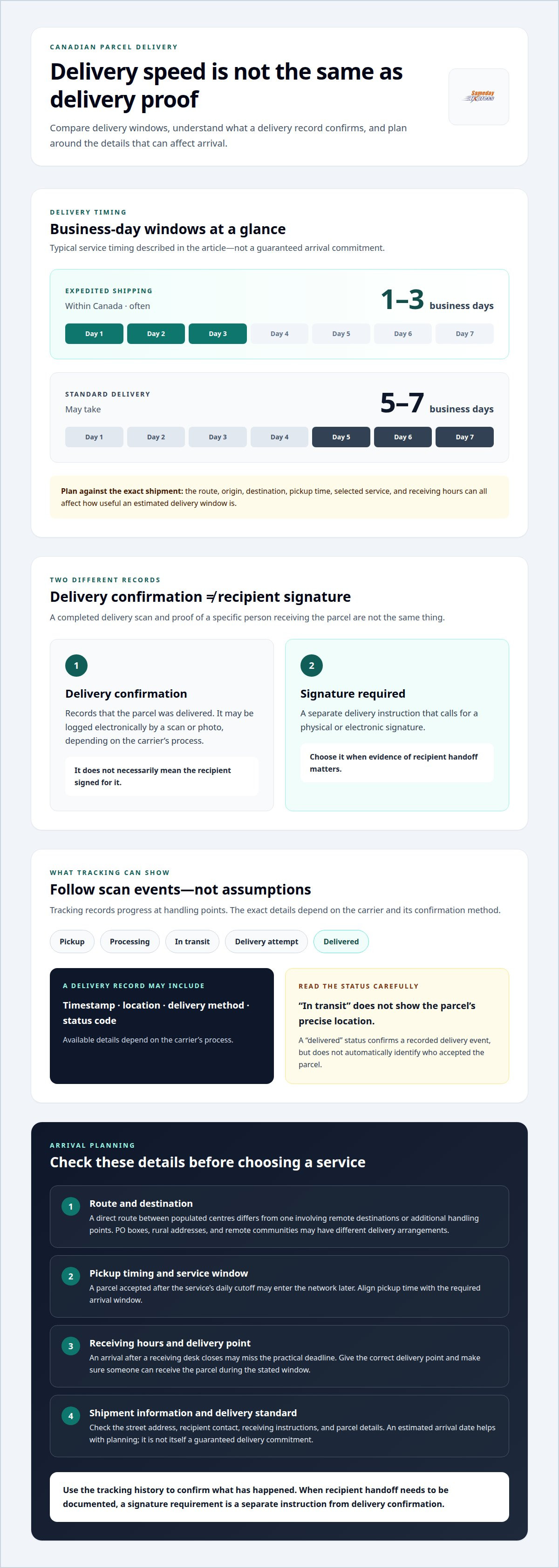
- Expedited shipping within Canada often takes one to three business days, while standard delivery may take five to seven business days.
- Delivery confirmation records that a parcel was delivered; it doesn’t necessarily mean the recipient signed for it.
- Tracking records can show delivery time and shipment status, with other details depending on the carrier’s confirmation method.
- Choose a signature requirement when evidence of recipient handoff matters, rather than relying on a delivery notice alone.
- For urgent shipments from Montreal, compare same-day delivery, rush delivery and direct-drive options against your route and deadline.
Expedited Shipping: What Is It and How Does It Work?
In Canada, an expedited parcel may arrive within a couple of business days. This service prioritizes the parcel’s movement through a carrier’s network compared with routine shipping. The exact route depends on the origin, destination, pickup time, and service selected. A tracking number connects the parcel to scan events recorded along the way. Delivery confirmation adds a final delivery event to that history.
Tracking updates appear when a parcel reaches a recorded handling point. A scan may show pickup, processing, transit, an attempted delivery, or delivery. These events show progress through the network, not necessarily the vehicle’s live location. For example, “in transit” means the parcel has moved beyond its previous scan, but the status does not show its precise location. Faster service can shorten transit time without changing what each scan means.
Carriers commonly record delivery confirmation electronically using handheld scanners, mobile apps, or telematics devices. The device logs an event when delivery is complete. Depending on the carrier’s process, the record may include a timestamp, location, method, or status code. This expedited delivery confirmation helps the sender and recipient distinguish a completed delivery from a parcel still moving through the network.
Look for the tracking number on the shipping receipt, order confirmation, or parcel label. A delivery notice card for an item delivered in Canada has a 15-digit number. Enter the relevant number in the carrier’s tracking page or mobile app. Check the shipment details before searching, since an order number and a tracking number serve different purposes. A tracking page may also show whether the parcel has received its first scan.
Notifications make new scan events easier to follow. A carrier’s tracking page or mobile app may display status changes and delivery details. If notifications are available, use them to monitor a specific shipment instead of repeatedly refreshing the page. For a business order, the tracking record can also feed into order-management or warehouse systems, marking an order fulfilled or delivered when the corresponding event arrives.
Use the tracking history to understand what has happened, not to infer details it does not show. A “delivered” status confirms a recorded delivery event, but it does not automatically identify who accepted the parcel. A timestamp, location, and delivery method can provide useful context. For example, the record may indicate that the parcel was left at a door rather than handed directly to someone.
If tracking shows “delivered” but the parcel is missing, first review the recorded time, location, and delivery method. Check the delivery area and nearby reception points, then contact the carrier or sender with the tracking number and shipment details.
For an urgent shipment, tracking distinguishes transit progress from final proof of delivery. A “delivered” scan closes the tracking sequence, while a signature requirement adds a record of the recipient’s signature. These are separate records. The next section explains how expedited service compares with standard shipping in speed, reliability, and cost.
Expedited versus standard delivery speed, price, and reliability
Expedited and standard services differ mainly in delivery schedules and handling priorities. Start by comparing the delivery date shown for the exact origin and destination. Then consider whether that date fits the receiving location’s operating hours. For a business, a parcel arriving after the receiving desk closes may miss the practical deadline, even if it reaches the address that day.
The route affects how well a delivery estimate fits your shipment. A direct route between populated centres differs from one involving remote destinations or additional handling points. Pickup timing matters too: a parcel handed over after a service’s daily acceptance window may enter the network later. Before choosing a service, align the pickup time, receiving hours, and required arrival window in a single shipment plan.
PO boxes, rural addresses, and remote communities have different delivery arrangements. Postal networks deliver to PO boxes, while courier services generally need a street address. Rural and remote destinations depend on the network serving that address. The destination type therefore affects both the available delivery method and the practical arrival plan.
Delivery standards describe a service schedule or expected delivery window. A guarantee is a separate commitment with stated conditions. Read the terms for the selected service to understand which applies. For example, an estimated arrival date helps with planning, but does not itself establish a guaranteed delivery commitment. Keep the service description with the shipment record so your operations team can distinguish the estimate from the agreed standard.
Reliability also depends on accurate shipment information. A complete street address, recipient contact, receiving instructions, and correct parcel details help prevent avoidable delivery problems. A warehouse team, for example, may need a dock entrance rather than the public front door. Provide the correct delivery point and make sure someone can receive the parcel during the stated window.
Tracking can help teams respond to a route change or missed delivery event. Assign someone to monitor the shipment and notify the receiving contact if its status changes. For an order tied to a production schedule, share the expected arrival window with the team that needs the contents. This turns delivery information into an operational plan, rather than a status update seen after the deadline.
Choose a service based on the consequences of arriving outside the required window. Routine replenishment may fit a wider schedule, while a shipment needed for a scheduled installation requires closer coordination with the receiving team. Match the delivery standard, address type, and handoff plan before dispatch. This helps you choose expedited or standard service without confusing speed with proof of receipt.
Delivery confirmation definition and functionality
A delivery confirmation record marks a shipment as delivered in its tracking history. Its details help senders and recipients distinguish a completed delivery from an express parcel still in transit.
How Delivery Confirmation Works
Expedited delivery confirmation begins when a carrier records the completed delivery event. A handheld scanner, mobile app, or telematics device can capture the event. The record may include a timestamp, location, device identifier, delivery method, proof media, and event status code. These fields make the delivery a traceable entry rather than a status change without supporting details.
After the carrier’s system processes the scan, the event may appear in a tracking view or flow into connected business systems. An order-management system, warehouse-management system, or customer-facing portal can use the record to mark an order delivered. For example, an online shop can update an order when the tracking history records the final delivery event.
Notifications can highlight new tracking events, while a downloadable record can support later order reviews. The postal or carrier system records the event, and a separate business platform can then use it. This distinction matters when a parcel is marked delivered but the customer’s order page has not yet updated.
Proof of Delivery Details
A proof-of-delivery record contains information attached to a completed delivery event. It typically includes the delivery date, time, and tracking number, and may include a recipient’s name or signature. The delivery method can also show whether the parcel was handed over, left at a door, placed in a locker, or returned to the vehicle.
These details help a business investigate a specific shipment instead of treating every “delivered” status as identical. A timestamp narrows down when the event occurred, while the method provides context about the handoff. For example, a parcel left at a door differs from one handed directly to a named recipient. The record’s fields determine what the sender can establish.
GPS coordinates may appear in a delivery record, but location alone does not always identify the recipient’s exact unit. In a multi-unit building, coordinates may identify the property rather than a particular apartment or office. A delivery method or image can add context, while a recipient signature provides a different kind of evidence. The available fields depend on the carrier’s recorded event.
Businesses can also assess delivery confirmation rates, meaning the percentage of shipments with complete delivery evidence. For example, a retailer can compare completed-order records with the shipments it sent. Consistent fields make the review more useful by helping teams spot missing timestamps, unclear methods, or incomplete delivery events.
If a parcel must be picked up or handed to a specific person, distinguish the delivery record from the service instruction. Confirmation documents an event; a signature requirement calls for the recipient’s signature. This difference shapes what a tracking record can prove and which follow-up details matter.
Which Canadian couriers offer expedited shipping with delivery confirmation?
Canadian parcel and courier services can offer expedited delivery with tracking and a recorded delivery event. The available service depends on the route, destination type, shipment details, and requested proof. Compare the actual options for your shipment rather than assuming “expedited” means the same delivery window or evidence with every carrier.
Start by defining the delivery need. Identify the pickup address, destination, required arrival window, parcel dimensions, and handling needs. Then compare services that accept those details. For example, a small parcel going to a staffed business may have different options from a larger shipment bound for a restricted receiving area.
- Route coverage: Check whether the service reaches the exact destination and address type.
- Delivery window: Compare the estimated schedule for the shipment’s origin and destination.
- Shipment eligibility: Review size, weight, packaging, and handling requirements for the service.
- Delivery evidence: Determine whether the record provides a scan, photo, recipient name, or signature.
Pay close attention to the delivery point. A business address may have a receiving dock, front desk, or designated parcel area. A residential address may need a different handoff arrangement. For a PO box or remote destination, confirm that the selected service supports that address format. Address eligibility can affect both the delivery method and the usefulness of the final record.
Consider how shipment information will be used after dispatch. A small business may follow a parcel on a tracking page, while an online store may need delivery events matched to orders. Decide who will monitor the shipment, receive status notifications, and pass the final event to the person responsible for customer updates.
Review the service description for any distinction between a delivery scan and a signature requirement. A carrier may record that a parcel reached its destination without documenting a named recipient. If your receiving process needs proof of a handoff, choose a service whose stated evidence meets that need. Keep the service details with the order or dispatch record.
For a useful comparison, assess the same shipment against each available option: identical addresses, parcel details, delivery window, and proof requirements. This avoids comparing services based on different assumptions. Matching route coverage, receiving arrangements, and delivery evidence makes the choice clearer, especially when the recipient needs a defined handoff rather than a basic completion status.
Canadian parcel and courier services may offer expedited options with tracking and a recorded delivery event. Availability depends on the route, destination type, and shipment details.
What proof of delivery details are available, such as recipient name, time, or signature?
A delivery record can include the delivery date and time, tracking number, and event status. Depending on the carrier’s process, it may also show a recipient name, signature, photo, location, or delivery method. These details help establish what happened at the destination, but a basic “delivered” status does not necessarily show who received the parcel.
Check the record for the evidence you need. A timestamp can place the delivery at a particular time of day. A recipient name can identify the person recorded at handoff. A photo may show where the parcel was left. For example, an image of a lobby entrance provides different context from a signature linked to a named recipient.
- Date and time: Shows when the delivery event was recorded.
- Tracking number: Connects the proof to the shipment history.
- Recipient name or signature: May document a named handoff.
- Photo or location: Can provide context about the drop-off point.
- Delivery method: May indicate a door drop, handoff, locker placement, or return to vehicle.
Delivery confirmation and signature-required delivery are different instructions. Confirmation can rely on an electronic scan or photo without a recipient’s signature. A signature requirement calls for a physical or electronic signature from the recipient. If a shipment must be handed to a particular person, a delivery scan alone may not provide that evidence.
Choose proof that matches the shipment’s purpose. For an ordinary parcel, a timestamp and delivery status may answer whether it arrived. For a sensitive or high-value item, the sender may need a named recipient or signature record. A business can also link the tracking number to the purchaser, delivery address, and order details in its order record.
Review the tracking record promptly if a customer disputes a delivery. Compare the delivery time and method with the recipient’s account, then check whether the record includes a signature or photo. GPS coordinates can identify a property without showing the correct unit in a multi-unit building. The recorded method and any supporting image therefore provide useful context, but are not interchangeable forms of proof.
A signature record does not automatically settle every dispute or determine liability. Responsibility can depend on carrier policies and the shipper’s agreement. Keep the shipment record, order details, and available delivery evidence together. For example, a retailer can save the delivery event with the customer’s order rather than relying only on a status notification.
For urgent business deliveries where timing matters, arrange a same-day shipment with the delivery details your operation requires.
Sameday Express: same day delivery
Sameday Express offers same-day delivery and rush delivery when a business shipment needs to move faster than standard parcel timelines. The right option for a time-critical shipment depends on the destination and required delivery window. Sameday Direct drive and Montreal to Toronto direct drive are options when a direct route fits the task.
These services suit businesses managing urgent documents, parts, or other time-sensitive parcels. When arranging service, share the shipment’s origin, destination, deadline, and delivery confirmation requirements. Clear details help align the delivery plan with the recipient’s handoff needs.
If your shipment has a tight deadline, contact Sameday Express Inc. to discuss the delivery. You can also visit Sameday Express Inc. online.
Set your next urgent shipment up for a clear handoff
Before dispatch, give your team a concise shipment brief: the required arrival window, receiving contact, exact delivery point, and proof needed after handoff. Decide who will monitor tracking and who will act if the delivery status conflicts with the recipient’s report. This keeps the next step clear for both the sender and receiving team.
For expedited delivery confirmation, make the confirmation requirement part of the shipment plan, not an afterthought. State whether a delivery scan is sufficient or a recipient signature is needed. Then match the transport option to the deadline and route. Sameday Express offers same-day delivery, Sameday Direct drive, and rush delivery for urgent business shipments.
Share your delivery requirements with Sameday Express Inc. and discuss your shipment. A clear brief is a practical start to a well-coordinated delivery.
Frequently Asked Questions
How should I plan around a delivery deadline?
Set the deadline based on the recipient’s actual receiving hours, not just the time the parcel should reach the address. Confirm who can accept it, where the handoff should happen, and whether the shipment supports a scheduled business activity. For example, coordinate a parts delivery needed before a maintenance task with the person responsible for receiving and using the part.
What information should I prepare before arranging a shipment?
Have the complete pickup and delivery addresses, recipient contact, parcel dimensions and weight, and any special handling instructions ready. Include the required arrival window and delivery evidence your process needs. For a business location, specify the correct entrance or receiving area. Clear details help distinguish a public entrance, reception desk, loading dock, or designated parcel drop-off point.
What should I do if a delivery exception affects my plans?
Notify the person responsible for receiving the shipment and the team relying on its contents. Review any exception details, then adjust the internal schedule or work plan to reflect the shipment’s current status. For example, a warehouse can alert its operations team before a planned task is disrupted. Keep the order reference and related communications together to maintain a clear record of the issue.
How can I make sure the recipient is ready?
Share the expected delivery window and handoff location with the recipient before dispatch. Confirm who will be available and whether reception, security, or a loading dock needs advance notice. In a multi-department business, name a single receiving contact and tell them which team needs the parcel. These arrangements reduce internal delays after the shipment reaches the workplace.
How should a business organize delivery records?
Keep each shipment’s reference with its purchase order, customer order, or internal job number. Store related delivery communications in the same record so staff can review the shipment without searching separate inboxes. For example, an e-commerce team can link a parcel to the relevant order and customer-service case. A consistent filing method also helps teams resolve handoff questions later.
Disclaimer
Blog Disclaimer
The information published on the Sameday Express Blog is provided for general informational and educational purposes only. While we strive to keep all content accurate and up to date, Sameday Express makes no representations or warranties of any kind, express or implied, regarding the completeness, accuracy, reliability, suitability, or availability of the information contained in our articles.
The content on this blog does not constitute legal, customs, tax, regulatory, financial, or professional advice. Shipping regulations, carrier policies, customs requirements, and transportation laws may change without notice and may vary by destination. Readers should verify current requirements with the appropriate government authorities, carriers, or qualified professionals before making shipping or business decisions.
Sameday Express is not liable for any loss, damage, delays, or consequences arising from the use of, or reliance on, information published on this website. Any actions taken based on the information provided are at the reader's own risk.
References to third-party companies, products, services, or websites are provided for informational purposes only and do not constitute an endorsement or recommendation by Sameday Express.
All blog content, including text, graphics, images, and logos, is the property of Sameday Express unless otherwise stated and may not be reproduced or distributed without prior written permission.
For specific shipping requirements, pricing, transit times, or logistics solutions, please contact Sameday Express directly for personalized assistance.


