

The warehouse closest to your customers can matter as much as the space you rent. Warehousing for online sellers covers storing and managing products before orders ship. The right setup depends on stock levels, order volume and delivery destinations. Options include public or private storage, fulfilment centres, shared space and hybrid models.
Storage capacity matters, but a warehouse also affects how quickly orders can be picked, packed and delivered. A space that fits your inventory but is far from customers may not support the delivery experience you want.
This guide compares warehouse types and explains how inventory management, automation, seasonal demand and last-mile delivery affect your decision. You’ll learn what each option suits and how to match a warehousing setup to your online business, whether you manage fulfilment in-house or outsource part of the process.
Key Takeaways
- Compare public, private, contract and fulfilment options against your order volume, storage needs and preferred level of control.
- Use accurate, regularly updated inventory records to help prevent overselling and spot replenishment needs.
- Match storage and handling processes to your products, order patterns and seasonal demand before committing to a warehouse model.
- Improve picking efficiency by organizing frequently ordered products for easy access and considering automation where it fits your operation.
- Place stock closer to key customer areas when shorter delivery distances and last-mile speed are priorities.
1. Fulfillment, micro-fulfillment, public, contract, and private warehouses
Ecommerce warehousing stores products before orders go to customers. It can cover receiving stock, recording locations, picking products, packing parcels and preparing shipments. Map the order path from supplier delivery through dispatch and returns. For example, a skincare seller may need shelf storage, parcel packing and a process for inspecting returned bottles. Inventory management links these tasks by helping sellers compare recorded stock with available products.
Warehouse models differ in ownership, flexibility and services. A public warehouse lets businesses rent space as needed, which can suit seasonal stock. A contract warehouse provides customized services under a longer-term agreement. A private warehouse gives one company more control over its facility and operations. Cooperative warehouses are shared by businesses, while on-demand warehousing connects sellers with companies that have unused capacity.
Fulfillment centres store products, process orders, and ship them directly to customers. They can suit ecommerce businesses handling high parcel volumes, especially when managing every order in-house strains staff. Micro-fulfillment centres commonly occupy between 3,000 and 20,000 ft². Their smaller footprint can support faster fulfilment for high-demand products near urban customers. A distribution centre, by contrast, usually moves goods through the supply chain rather than focusing on individual customer parcels.
Product characteristics also shape the choice. Consider item dimensions, storage conditions, sales pace and return frequency. Bonded warehouses hold imported goods under customs supervision until customs duties are completed. Cold storage supports temperature-sensitive inventory, while a returns area gives staff room to inspect and sort returned items. Smart warehouses use technologies such as robots and drones to support storage and fulfilment. Choose features that match your products and handling process.
Canadian fulfilment services and Amazon FBA are different fulfilment routes. Canadian third-party logistics services can support storage and parcel processing, while Amazon FBA is Amazon’s fulfilment program. Compare marketplace reach, inventory visibility, returns handling and delivery coverage with the channels your business uses.
For Canadian tax, customs and consumer rules, applicable requirements depend on the product, transaction and destination. Build a review step into your workflow for tax treatment, import paperwork, customer-facing delivery terms and returns before inventory is received or shipped.
Order volume helps determine the right operating model. A seller shipping varied parcels may value flexible shared space, while a high-volume store may need dedicated fulfilment workflows. E-commerce fulfilment centres can process thousands of individual parcels daily. During promotions or holiday peaks, flexible warehouse arrangements can expand capacity and scale back afterwards. Before committing, compare how each model handles receiving, storage, packing, parcel dispatch and returns.
2. Inventory management
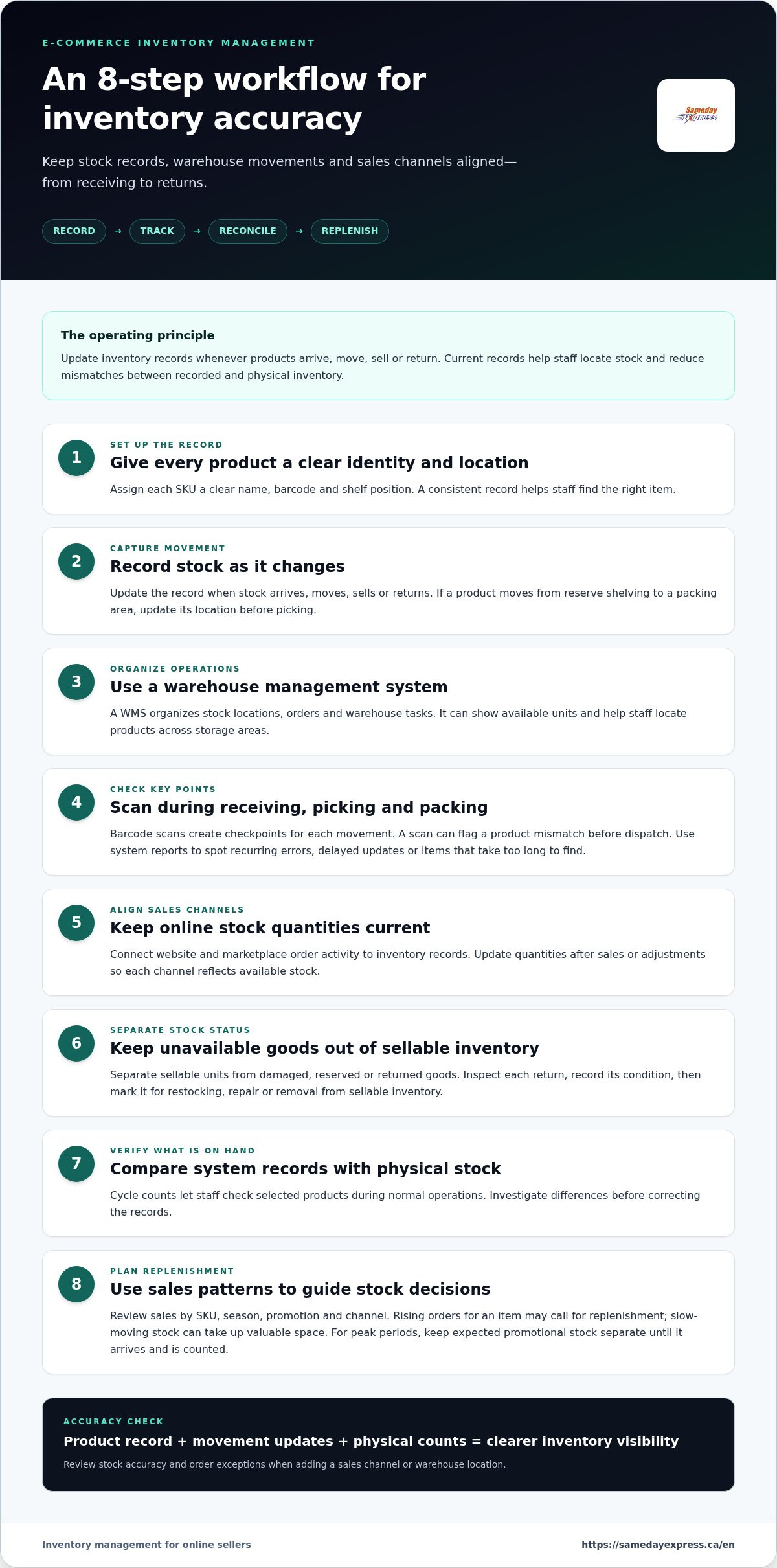
Inventory management starts with a reliable record for every product and storage location. Assign each SKU a clear name, barcode and shelf position. Record stock when it arrives, moves, sells or returns. For example, if a product moves from reserve shelving to a packing area, update its location before picking. This helps staff find the right item and reduces mismatches between recorded and physical inventory. Effective warehouse operations rely on keeping records current.
A warehouse management system, or WMS, organizes stock locations, orders and warehouse tasks. It can show available units and help staff locate products across storage areas. Barcode scans at receiving, picking and packing create checkpoints for each movement. If an order requests a particular size, a scan can flag a mismatch before dispatch. Use system reports to spot recurring errors, delayed updates or products that take too long to find.
Selling through a website and marketplaces creates another accuracy challenge. Shopify, WooCommerce and other channels need current stock information to reduce overselling. Connect order activity to inventory records, then update quantities after sales or adjustments. If the same jacket sells through two channels, both listings should reflect the reduced stock. Separate sellable units from damaged, reserved or returned goods so unavailable products don’t appear ready to ship.
Regular audits compare system records with physical stock. Cycle counts let staff check selected products during normal operations and investigate differences before correcting records. Past sales data can guide demand forecasts and reorder timing. Review sales by SKU, season, promotion and channel rather than relying on one overall total. Rising orders for one item may call for replenishment, while slow-moving stock can take up valuable space.
Returns and damaged goods need separate status records and handling steps. Inspect each return, record its condition, and mark it for restocking, repair or removal from sellable inventory. During peak seasons, use past order patterns to plan receiving, staffing and space. Keep expected promotional stock separate from available inventory until it arrives and is counted. This prevents planned deliveries from being treated as ready-to-ship products.
Scalability depends on keeping inventory visible as products, channels, and warehouse locations change. Review stock accuracy and order exceptions after adding a sales channel or location. For cross-border orders, record dispatch and delivery updates against the correct order. A cross-border shipment between Canada and the United States adds another movement to track. A reliable approach to warehousing for online sellers keeps those movements tied to accurate order records.
3. What are the main factors to consider when choosing the warehouse type for my business?
Start with your order pattern. Count orders by day, product, destination and shipping deadline. A store shipping many small parcels needs efficient picking and packing areas. A seller moving bulky products needs suitable storage and handling equipment. Compare regular demand with promotional and holiday peaks. A model that handles everyday volume may struggle when orders rise sharply. Flexible warehouse arrangements can expand for seasonal demand and contract after the peak.
Product characteristics set practical limits. Measure each item and note its weight, packaging, fragility and storage conditions. A furniture seller needs room for large items and safe handling equipment. Refrigeration or time-sensitive shipping can make marketplace fulfilment more complicated, according to Agriculture and Agri-Food Canada. Match the facility’s handling process to the product, and include returns, inspection and damaged-stock separation in the plan.
Location affects delivery distance and the movement of incoming stock. Map customer destinations and supplier routes, then compare a central warehouse with facilities closer to key customer areas. A business serving customers across Canada could consider one central site or multiple warehouses to reduce shipping times. For example, a seller with concentrated demand in one part of the country can assess whether nearby inventory supports its delivery targets. Balance outbound speed against the extra coordination of storing stock at multiple sites.
Space and equipment should support the full order path. Check receiving access, shelving, packing stations and outbound staging. Allow room for peak inventory without blocking picking routes. A warehouse layout should separate incoming goods from ready-to-ship orders. If products need special handling or dedicated storage, make sure the facility’s setup supports those needs. A poor fit can create extra movement, slower picking and more opportunities for order errors.
A third-party logistics partner should scale its services as your business changes. Review how its warehouse management system connects with your storefront and sales channels. Agree on reporting, order cut-off times, packing speed and shipping performance. Clear service standards help identify delays before they recur. Also map who handles stock discrepancies, returns, damaged goods and seasonal overflow. A hybrid model can keep priority items in-house while using third-party logistics for additional capacity.
What risks should online sellers consider when choosing a warehouse or 3PL in Canada? Key risks include stock records that don’t match physical inventory, limited peak capacity, poor system integration, and a location that adds transit time. For temperature-sensitive products, handling gaps can also threaten inventory condition. Test the proposed workflow with a sample order, from receiving through picking, packing, dispatch, and returns.
Use those findings to compare warehouse options against actual operating needs, not floor area alone. A warehouse that suits a steady local order flow may not fit national distribution or seasonal surges. Revisit the decision when your product range, customer destinations, order volume, or fulfilment channels change.
4. Automation and storage optimisation
Automation works best when it solves a specific warehouse problem. Trace an order from arrival to dispatch, noting where staff search, walk, scan or re-enter information. If pickers repeatedly cross the floor for popular items, adjust storage locations before buying equipment. This review shows whether the main constraint is movement, accuracy or a manual task. Each issue calls for a different response. For warehousing for online sellers, clear goals make automation decisions more practical.
Storage placement can speed up picking without robotics. Place frequently ordered items near packing stations and keep products often ordered together close by. Store bulky goods where appropriate equipment can reach them safely. A warehouse management system can guide staff to recorded locations. After changing the layout, review picking errors and time spent locating stock. If the change reduces unnecessary travel, apply the same approach to other frequently ordered products.
Picking methods also affect workflow. Batch picking combines several orders in one run, reducing repeated trips through aisles. Zone picking assigns staff to specific areas, limiting travel between distant shelves. Wave picking schedules tasks around shipping deadlines or carrier times. A store shipping varied household goods might batch small orders, then organize dispatch around its shipping schedule. Choose a method that fits order size, product placement and packing flow.
Barcode scanning offers a practical way to record item movements. Scan products at receiving, storage, picking and packing to catch selection errors before dispatch. Conveyors can move packed orders between work areas. Robots can support storage and fulfilment tasks, while drones may assist with warehouse operations. AI-powered systems can coordinate some fulfilment activity. These tools depend on accurate stock and location records. Automating incorrect information can speed up mistakes instead of preventing them.
Before investing, define the task equipment must handle and how staff will use it. A smaller operation may start with barcode scanning and a clearer shelf map. A larger operation with steady parcel flow might assess conveyors or robotics. Smart warehouse setups can require costly equipment and software, so weigh reduced workload against installation, maintenance, training and system integration. Keep manual steps clear for exceptions such as damaged items or unreadable barcodes.
Review performance after each change. Track picking accuracy, order delays and the time needed to replenish shelves. If packing becomes the bottleneck, faster picking equipment won’t clear the queue. Adjust workstations or task sequences first. For a multi-item consumer order, test whether staff can pick, verify and pack without backtracking. A measured approach helps warehousing for online sellers support real workflows while leaving room to adapt as operations grow.
5. Distributed warehousing and last-mile delivery
One warehouse can serve a broad customer base, but distance shapes the final delivery leg. A distributed model places inventory closer to key markets, which can reduce transit times and shipping distances. Review order destinations across Canada before splitting stock. The goal isn’t to duplicate every product everywhere. Position fast-moving items near concentrated demand, while slower-moving products remain at a central location.
Start with order destinations, not a map alone. Group recent orders by postal area and identify where delivery delays or long routes occur. Then compare those patterns with supplier locations and warehouse capacity. A seller with frequent orders in a particular customer market can assess whether a nearby site supports its delivery targets. More locations can shorten outbound routes, but they also divide stock and require accurate coordination across facilities.
Distribution planning must account for inventory placement and parcel preparation. Decide which products belong at each site, how replenishment will work and where returns will be inspected. For example, a retailer could store popular accessories near a customer cluster and keep niche items at its main warehouse. Clear location records help prevent a product appearing available in one channel when it’s already reserved at another facility.
Last-mile delivery begins after an order leaves its distribution point. Delivery speed depends on the warehouse’s distance from the customer, the dispatch schedule and the delivery option selected. A nearby urban warehouse can support quicker local fulfilment, while a central facility may serve a wider area along longer routes. Set realistic delivery windows for each market, then review arrival times and exceptions to identify where the network needs adjustment.
Compare a single-site network with distributed storage using actual order records. Track delivery time, stock availability, replenishment frequency and the work required to transfer inventory. A second location may help in a market with sustained demand, but spreading stock too thin can leave popular products unavailable at the closest site. Test a limited product range or market first, then use order and delivery performance to guide any wider rollout.
Match the delivery method to the order’s urgency. Standard parcel shipping can suit routine orders, while time-sensitive customer needs may call for a faster option. If an urgent order needs same-day delivery, arrange same-day delivery to move it promptly to its destination. Keep the warehouse dispatch process aligned with the selected service, including packing readiness, pickup timing, and accurate recipient details.
Sameday Express: same day delivery
Sameday Express provides same-day delivery and rush delivery for urgent orders that can’t wait for routine shipping. If a customer needs a time-sensitive parcel from your warehouse, these services can support the delivery leg after picking and packing are complete. Sameday Direct drive offers another option for direct shipments, while Montreal to Toronto direct drive serves businesses moving urgent items between those cities.
Choose the delivery option that matches the order’s urgency and destination. Prepare the parcel, confirm recipient details, and align dispatch with the selected service. For an urgent order leaving your warehouse, contact Sameday Express to discuss the delivery need. You’re welcome to contact Sameday Express.
Put your warehousing plan into action
A warehousing setup for online sellers should support your business today and leave room for change. Choose one operational priority to improve first, such as stock visibility, order handling or delivery to a key customer area. Use that priority to guide your next logistics decision.
For urgent orders that need to move beyond your regular shipping routine, Sameday Express offers same day delivery, rush delivery and Sameday Direct drive. These services can support time-sensitive shipments while your warehouse setup manages everyday order flow.
Make your next step practical: identify the shipment, destination, and timing your business needs to address. Contact Sameday Express today to discuss a suitable delivery option. With a clear plan for storage and dispatch, you can keep building an operation that serves your customers with confidence.
Frequently Asked Questions
What Is Ecommerce Warehousing?
Ecommerce warehousing is the storage and handling of products sold through online channels before they reach buyers. It can include receiving supplier stock, organizing storage locations, preparing orders and coordinating dispatch. Unlike storage used only for surplus goods, an ecommerce setup connects stock records to online orders. For example, a seller can reserve a product as soon as a customer checks out, reducing the chance of promising stock that’s already sold.
What’s the difference between cross-docking and traditional warehousing?
Cross-docking moves incoming goods quickly from one vehicle to another, while traditional warehousing holds products before their next destination. A retailer receiving cartons for several stores might use cross-docking to sort and redirect them without long-term storage. A business holding seasonal inventory needs a warehouse process that keeps stock accessible until orders arrive. The right approach depends on whether goods need time in storage or can move onward immediately.
What Are the Main Challenges of Traditional Warehouse Leasing?
Traditional warehouse leasing can commit a seller to space and operating arrangements that don’t match changing demand. A growing business may outgrow its storage area, while a seasonal seller may have unused space after peak periods. The seller also needs to coordinate receiving, staffing, equipment and daily warehouse tasks. Before signing, compare expected stock levels and order patterns with the space, location and lease commitments to identify potential mismatches.
What Is E-commerce Warehousing?
E-commerce warehousing is the physical operation that supports online retail orders from stored inventory. Think of it as the behind-the-scenes link between a product listing and a parcel at the customer’s door. Staff or systems must locate the correct item, prepare it for dispatch and keep stock records aligned with sales. For instance, a clothing seller needs clear product and size identification so a picker doesn’t send the wrong variation.
What are the main factors to consider when choosing the warehouse type for my business?
Match the warehouse model to your products, order pattern, storage requirements and desired level of operational control. A seller with fragile goods may prioritize careful handling and clear inspection steps, while a business with fluctuating demand may value flexible space. Also consider how orders reach the warehouse, how returns are handled and how easily systems connect. Compare these requirements with your day-to-day workflow, not just the available floor space.
What warehousing options are available for online sellers in Canada?
Warehousing for online sellers in Canada can include in-house storage, public or shared facilities, contract arrangements and third-party fulfilment services. Some businesses combine models, keeping priority products in-house while using outside space during demand spikes. Imported inventory may also involve bonded storage arrangements. Compare each option by the work it covers, the control you retain and how easily capacity can change as products or sales channels grow.
How do third-party logistics (3PL) warehouses work for Canadian ecommerce sellers?
A 3PL warehouse handles some or all of a seller’s logistics tasks, such as storing stock, preparing orders, and arranging shipment. The seller sends inventory to the facility, then shares order and stock information through agreed processes or connected systems. Sameday Express provides warehousing and distribution services, including inventory management and order preparation. A seller can use this model to outsource logistics while focusing internal staff on product, sales, or customer service work.
How do I choose a warehouse location for an online store in Canada?
Choose a location by mapping where orders go, where inventory arrives from and how quickly parcels need to reach customers. Group order destinations by region, then compare delivery routes from possible warehouse locations. For example, a seller with concentrated demand in one province may weigh proximity to those customers against supplier access. If using multiple sites, plan stock allocation carefully so each location can fulfil local orders without unnecessarily fragmenting inventory.
Disclaimer
Blog Disclaimer
The information published on the Sameday Express Blog is provided for general informational and educational purposes only. While we strive to keep all content accurate and up to date, Sameday Express makes no representations or warranties of any kind, express or implied, regarding the completeness, accuracy, reliability, suitability, or availability of the information contained in our articles.
The content on this blog does not constitute legal, customs, tax, regulatory, financial, or professional advice. Shipping regulations, carrier policies, customs requirements, and transportation laws may change without notice and may vary by destination. Readers should verify current requirements with the appropriate government authorities, carriers, or qualified professionals before making shipping or business decisions.
Sameday Express is not liable for any loss, damage, delays, or consequences arising from the use of, or reliance on, information published on this website. Any actions taken based on the information provided are at the reader's own risk.
References to third-party companies, products, services, or websites are provided for informational purposes only and do not constitute an endorsement or recommendation by Sameday Express.
All blog content, including text, graphics, images, and logos, is the property of Sameday Express unless otherwise stated and may not be reproduced or distributed without prior written permission.
For specific shipping requirements, pricing, transit times, or logistics solutions, please contact Sameday Express directly for personalized assistance.


