

The fastest route isn’t the only factor behind a courier quote. A point-to-point courier service is generally priced according to distance, urgency, shipment size, and whether the vehicle travels directly or makes other stops. The route and service type also affect tracking and package limits.
For Canadian businesses, speed and reliability matter, as does knowing what a service includes before arranging a time-sensitive shipment. A dedicated trip can keep a delivery on a direct route, while a shared service may follow planned pickups and drop-offs.
This guide explains what can affect pricing, how shipment tracking works, what an exclusive route means, and which package details can affect a courier’s ability to carry your shipment. You’ll also learn what to consider when choosing a service for urgent business deliveries, from lab samples and hospital supplies to e-commerce orders and aviation parts. The aim is to help you match the delivery method to the shipment’s needs and understand the practical details that shape the quote.
Key Takeaways
- Match the delivery option to how quickly the shipment needs to arrive and whether it can share a route.
- Clarify what tracking updates are available so your team can follow the shipment’s progress.
- Share the package’s dimensions and weight when arranging delivery to help determine the vehicle and handling requirements.
- Review how the quote is structured, including whether it is calculated per shipment and whether recurring fees apply.
- For an urgent business delivery, consider a direct-drive or rush option when a scheduled route could add delays.
Shipment tracking and real-time updates
Tracking helps your team see where a delivery stands and what needs to happen next. For a point-to-point courier service, distinguish the vehicle’s location from shipment milestones. A map can show movement, while status updates record pickup, transit, arrival, and delivery. These details help the receiving team plan staffing, dock access, and the handoff.
Before booking, identify which events your operation needs to track. A laboratory receiving samples, for example, may need pickup confirmation and a delivery record. An e-commerce team may focus on arrival timing at a customer’s address. Clear requirements make tracking useful, rather than just another screen to monitor.
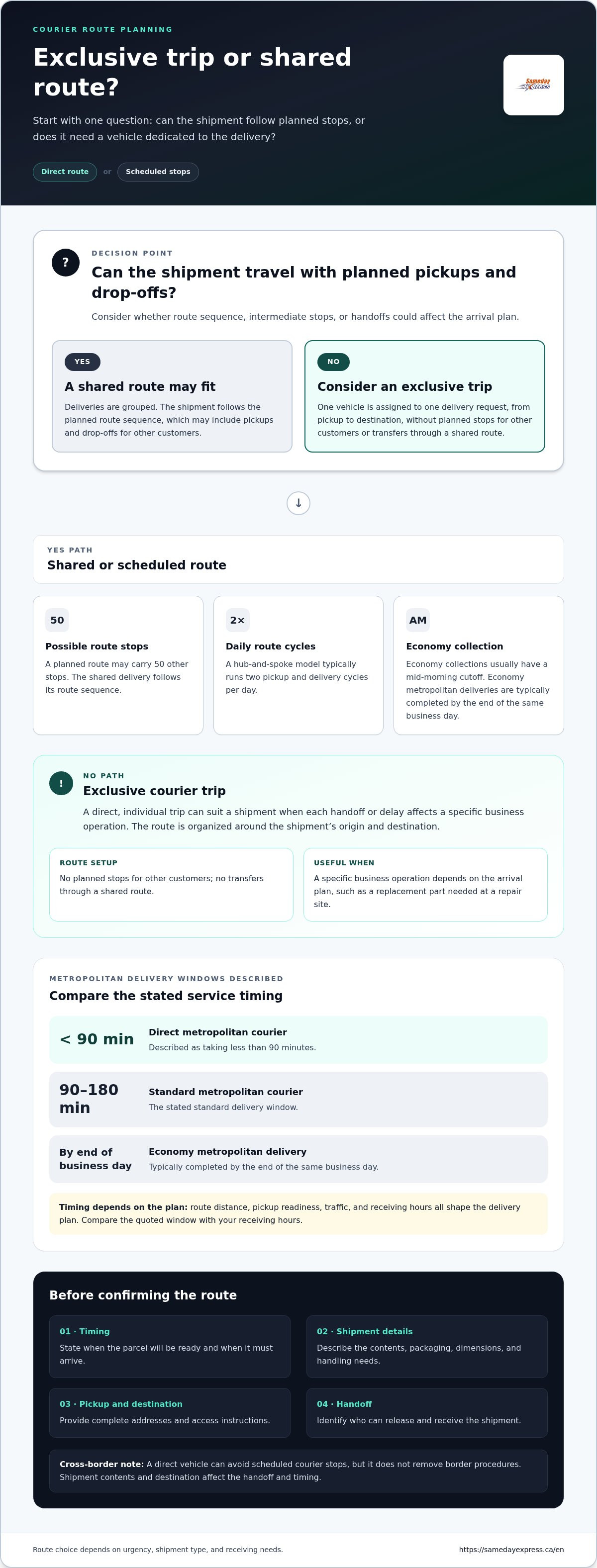
Delivery windows also shape what a tracking update means. Standard metropolitan courier delivery is described as taking 90 to 180 minutes. For standard service, the delivery window should run from booking collection to completed delivery. Economy metropolitan deliveries are typically completed by the end of the same business day. Compare the quoted window with your receiving hours.
Ask how updates are shared and who receives them. The dispatcher, sender, and recipient may each need different details. Choose a clear contact for exceptions, such as a locked receiving area or changed delivery instructions. A warehouse team, for example, can assign someone to receive arrival notices and notify the loading area.
- At booking: Confirm the pickup and delivery addresses, contact names, and delivery window.
- At collection: Record the pickup time and shipment reference for internal coordination.
- During transit: Follow available status or location updates against the planned route.
- At completion: Capture the delivery confirmation and share it with the receiving team.
Scheduled routes work differently from direct trips. A hub-and-spoke model typically runs two pickup and delivery cycles per day, so an update can reflect movement between route stages. Economy collections usually have a mid-morning cutoff. Ask which cycle applies to your booking and how its collection window affects the expected completion time.
Use tracking to manage the handoff, not just to watch a vehicle move. If a delivery supports a production line, hospital supplies, or a time-sensitive customer order, assign someone to respond to each status. Match updates to the shipment’s priority, then share the delivery reference with the people waiting at the destination.
Dedicated courier services
A dedicated courier assigns a vehicle to one shipment or delivery request instead of grouping it with scheduled stops. This can suit urgent business deliveries where route control and a planned handoff matter.
Dedicated delivery options
Dedicated options include direct trips for urgent documents, replacement parts, or parcels moving between business locations. Direct metropolitan courier delivery is described as taking less than 90 minutes. Route distance, pickup readiness, traffic, and receiving hours all shape the delivery plan.
Courier companies in Canada include national parcel carriers, regional courier networks, and local same-day operators. Compare how each service handles pickup, routing, delivery confirmation, and your shipment’s requirements. A national network may suit broad parcel distribution, while a direct courier trip may better fit an urgent request.
Before booking, prepare the details dispatch needs:
- Pickup and destination: Provide complete addresses and access instructions.
- Timing: State when the parcel will be ready and when it must arrive.
- Shipment profile: Describe contents, packaging, dimensions, and handling needs.
- Handoff: Identify who can release and receive the shipment.
For example, a replacement component needed at a worksite requires a clear receiving plan. Ask how the delivery window is measured, from booking or collection, and how completion is recorded.
Interprovincial and cross-border rules
Interprovincial shipments travel between provinces within Canada. Cross-border deliveries between Canada and the United States involve border processing and shipment documentation. Requirements depend on the goods and destination, so describe the contents accurately and provide consistent sender and recipient details.
A direct vehicle can avoid scheduled courier stops, but it does not remove border procedures. For a time-critical part crossing the Canada-US border, plan the pickup and prepare the information needed for processing. The route and shipment contents affect the handoff and timing.
Match the service to urgency, route, shipment type, and receiving needs. For a business delivery that needs direct handling, review courier service details as part of your planning.
Exclusive courier with no other stops or shared routes
An exclusive courier trip assigns the vehicle to one delivery request, from pickup to destination. The parcel travels without planned stops for other customers or transfers through a shared route. This approach suits shipments where each handoff or delay affects a specific business operation.
Shared routes group deliveries to make several pickups and drop-offs on one run. A planned route may carry 50 other stops, while a dedicated taxi courier run serves the individual request. That difference changes how dispatch plans the route: a shared delivery follows its route sequence; an exclusive trip is organized around the shipment’s origin and destination.
Consider a replacement part needed at a repair site. If a technician is waiting to resume work, intermediate stops can complicate the arrival plan. An exclusive route keeps the shipment’s journey focused on that destination. For routine office parcels with flexible arrival times, a shared route may fit better because the delivery can be grouped with other stops.
Before booking, decide whether the shipment needs a dedicated vehicle or can travel with other deliveries. Then give dispatch practical details:
- Pickup readiness: State when the parcel will be packed and available.
- Exact destination: Include the receiving address and access instructions.
- Delivery timing: Identify the business deadline and receiving hours.
- Handoff contact: Name the person who can accept the parcel.
- Shipment needs: Describe the parcel and any handling instructions.
These details help determine whether a dedicated trip fits the request. A document requiring direct delivery to a client’s office, for example, may leave little room for route sequencing. A parcel going to a retail location with a broad receiving window may tolerate a shared itinerary. Choose the service based on the cost of waiting, not just the parcel’s size.
Confirm what “exclusive” means for the booking. Ask whether the vehicle carries only your shipment, whether the route includes other customer stops, and how pickup and delivery completion are recorded. These distinctions matter: a vehicle assigned to your parcel is different from a scheduled service that groups several deliveries.
Plan the receiving handoff, too. A locked loading area, unavailable contact, or incomplete address can interrupt even a direct trip. Share access instructions before dispatch and make sure someone is ready at the destination. For a time-sensitive parcel, align the pickup time, route plan, and receiving window before the vehicle departs.
Align your arrival expectation with the courier’s service scope and the receiving team’s availability. Keep the destination contact reachable while the shipment is in transit, and tell dispatch promptly if access arrangements change. Clear communication can help avoid a failed handoff that disrupts the direct delivery plan. After delivery, confirm that the intended recipient has accepted the parcel and the booking is complete.
When comparing a dedicated trip with another option, consider the vehicle required as well as the route. Larger vehicles are usually charged at an hourly rate with a minimum charge of 3 or 4 hours. Ask dispatch to clarify the applicable vehicle and charging basis before confirming, so the service and expected cost fit the shipment.
Package size and weight limits
Couriers in Canada carry many types of business parcels, but acceptable contents and package limits depend on the service and vehicle. Documents, packaged products, and replacement parts are common examples. Restricted goods or items requiring special handling cannot be treated as ordinary parcels.
There is no single size or weight limit that applies to every courier route. A compact car, cargo van, and larger vehicle have different cargo space and loading capacity. A described hub-and-spoke model caters for 3 kg satchels and 5 kg satchels. Those examples apply to that model, not every courier shipment.
Give the courier accurate measurements before dispatch. Record the parcel’s length, width, height, and weight after packaging. A long, lightweight box may take more cargo space than a dense, compact package. Include the number of pieces, too. Depending on dimensions and handling needs, two cartons may be easier to load than one oversized item.
- Measure the outer packaging: Include protruding handles or protective wrapping.
- Weigh the packed shipment: Use the final package weight, not the product’s weight alone.
- Describe the contents: Identify fragile, temperature-sensitive, or controlled items.
- Share loading details: Note whether the parcel needs a loading dock or special equipment.
Packaging affects whether a parcel can travel safely. A glass component needs secure cushioning and a sturdy outer box. A tall item may need upright handling, while several cartons should be clearly labelled. Accurate packaging details help dispatch match the load to available vehicle space, whatever the route.
What can and cannot be sent depends on the courier’s service, route, and handling requirements. Ordinary business documents, packaged goods, and parts are typical examples; restricted items and goods needing specialized handling may require a different transport arrangement.
Temperature-sensitive medication, lab samples, and biological materials need careful handling. State the item type and required transport conditions when booking. For example, describe a sealed sample shipment accurately rather than entering only “parcel.” This helps determine whether the service can meet the shipment’s needs.
Oversized or unusually heavy shipments may need a larger vehicle, while a small satchel may fit a scheduled route. The decision depends on dimensions, weight, packaging, pickup access, and destination access. A shipment that fits inside a vehicle must still be safe to load, secure during travel, and manageable at delivery.
Before dispatch, compare the packed shipment details with the courier’s stated limits and the job’s handling needs. Accurate measurements and a precise description of the contents reduce loading issues and help prevent a parcel from being assigned to an unsuitable vehicle.
Traditional shipping has a 2:00 PM cut-off; after that, a package may not move until the following day. Factor this timing into dispatch planning alongside the shipment’s final dimensions, weight, and handling needs. Providing those details before the cut-off can help the courier assess the parcel against available vehicle space and determine whether it suits the intended route.
Per-item pricing and absence of subscription fees
For day-to-day planning, treat each delivery request as a distinct operational job. Each shipment has its own purpose, destination, timing, and receiving handoff. Keeping those details together helps your team coordinate deliveries without confusing them with recurring service arrangements or other orders.
This approach is useful when demand changes from week to week. An e-commerce business may have an urgent customer order one day and a replacement component for a warehouse the next. A laboratory may arrange collection only when a particular batch is ready. Separate shipment records help dispatch and internal teams respond to each need individually.
Use a consistent internal record for every booking. Capture the information your operations team needs to coordinate the work and answer follow-up questions:
- Business purpose: Note whether the delivery supports an order, repair, or internal transfer.
- Responsible team: Identify the department coordinating the shipment.
- Shipment reference: Use a purchase order, job number, or customer order identifier.
- Recipient handoff: Record the intended receiving contact and location instructions.
- Completion record: Keep delivery confirmation with the related order or job file.
For example, a manufacturer sending a replacement component can attach the shipment record to the relevant maintenance job. If the delivery supports an e-commerce order, the operations team can link it to that order instead. Connecting each delivery to its business purpose makes internal reconciliation easier.
Separate records also help managers identify changing demand. Reviewing requests by department, destination, or business purpose can show where deliveries support regular operations and where urgent requests arise. Teams can then plan staffing, receiving coverage, and dispatch instructions around their actual workflow, without treating every shipment as part of one recurring route.
Set a simple process for creating and closing each delivery record. The requesting team submits the shipment details, an assigned coordinator tracks the handoff, and the responsible department files the completion information. This keeps ownership clear when several departments send parcels to different locations.
Keep the process flexible. A recurring business need may call for a standing internal workflow, while an occasional urgent delivery may need its own request path. Either way, recording each job’s purpose and owner gives your team a clear view of what is moving and who is responsible for the next step.
Sameday Express: same day delivery
Sameday Express Inc. offers same-day delivery for Canadian businesses with shipments that need prompt transport. Choose rush delivery when timing is critical, or Sameday Direct drive when a direct trip suits the shipment’s route.
These options can suit an urgent business parcel, a time-sensitive replacement part, or a delivery requiring a direct route. Prepare the pickup and destination details, package dimensions, and required delivery timing to help select a suitable service.
For your next time-sensitive delivery, contact Sameday Express Inc.
Set your next delivery in motion
Make the next booking easier by treating delivery as an operational decision, not a last-minute handoff. Identify the shipment’s purpose, the receiving contact, and the timing that matters to your business. A clear brief helps align the courier plan with the real deadline, whether the delivery supports a customer commitment or an internal operation.
A point-to-point courier service can suit a shipment that needs a focused route and coordinated handoff. Sameday Express Inc. offers Same Day Delivery, Direct-drive delivery, and Rush delivery for urgent shipments. Share the route and shipment details to discuss which service fits your delivery needs.
Contact Sameday Express Inc. to discuss your delivery. A clear plan is a practical first step toward keeping your next shipment moving.
Frequently Asked Questions
What is a point-to-point courier service?
A point-to-point courier service moves a shipment between a specified pickup location and destination. The request focuses on those two endpoints rather than a broader delivery schedule. For example, a business can send a signed document directly to a partner’s office. The sender provides the route and shipment details so the delivery can be planned around the recipient and handoff.
What should a Canadian business prepare before arranging a courier delivery?
Prepare the sender and recipient details, shipment contents, packaging information, and the time the parcel will be ready. Identify who can release the item and who can accept it. For example, a company sending equipment to a worksite should provide the receiving contact’s name and entrance instructions. These details help prevent avoidable confusion during collection and delivery.
How can I choose the right courier option for a business shipment?
Start with the shipment’s purpose and deadline. Consider whether the recipient needs a direct handoff, whether the parcel can travel on a planned route, and whether special handling instructions apply. A replacement component needed to restart work may require a different plan from routine paperwork. Matching the service to the operational need helps teams set clear expectations and coordinate receiving staff.
How quickly can point-to-point courier services deliver?
Delivery timing depends on the route, pickup readiness, traffic, and the destination’s receiving hours. A direct metropolitan trip and a scheduled economy delivery follow different timelines. To plan accurately, have the parcel ready for pickup and ensure someone can receive it at the destination. Share the required arrival window when booking so dispatch can align the trip with the business deadline.
How do I book and track a point-to-point courier delivery?
Provide the pickup and destination details, parcel information, and contact names when arranging the delivery. Sameday Express’s Same Day Delivery includes real-time GPS tracking, signature confirmation, and proof of delivery with a photo. Keep the shipment reference available for your team, then use tracking updates to coordinate the recipient’s handoff and file confirmation with the relevant business record.
How does point-to-point courier service compare with same-day and on-demand delivery?
Point-to-point describes movement between pickup and destination. Same-day describes when delivery is completed, while on-demand describes arranging transport in response to a current need. These terms can apply to the same booking. For instance, a business may request an on-demand direct trip for a shipment that must arrive that day. Choose based on the route, deadline, and when the parcel is ready.
Disclaimer
Blog Disclaimer
The information published on the Sameday Express Blog is provided for general informational and educational purposes only. While we strive to keep all content accurate and up to date, Sameday Express makes no representations or warranties of any kind, express or implied, regarding the completeness, accuracy, reliability, suitability, or availability of the information contained in our articles.
The content on this blog does not constitute legal, customs, tax, regulatory, financial, or professional advice. Shipping regulations, carrier policies, customs requirements, and transportation laws may change without notice and may vary by destination. Readers should verify current requirements with the appropriate government authorities, carriers, or qualified professionals before making shipping or business decisions.
Sameday Express is not liable for any loss, damage, delays, or consequences arising from the use of, or reliance on, information published on this website. Any actions taken based on the information provided are at the reader's own risk.
References to third-party companies, products, services, or websites are provided for informational purposes only and do not constitute an endorsement or recommendation by Sameday Express.
All blog content, including text, graphics, images, and logos, is the property of Sameday Express unless otherwise stated and may not be reproduced or distributed without prior written permission.
For specific shipping requirements, pricing, transit times, or logistics solutions, please contact Sameday Express directly for personalized assistance.


