

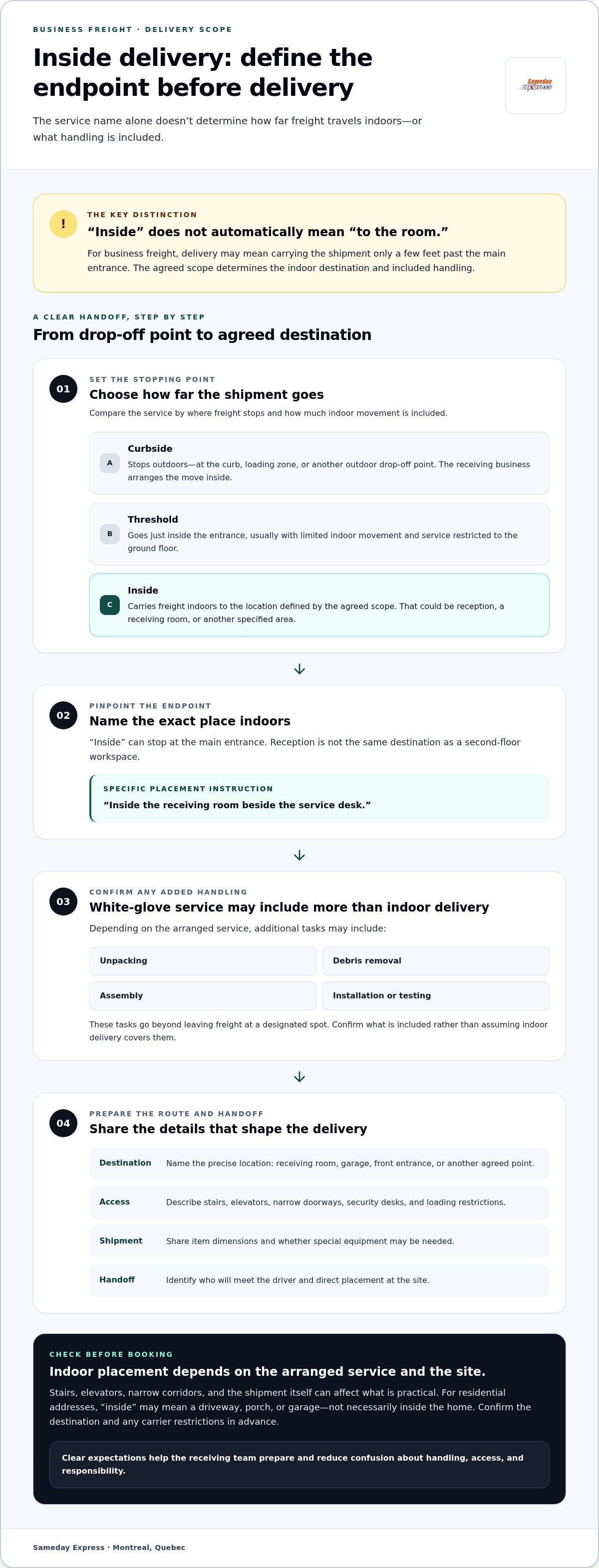
Inside delivery can end just a few feet past the entrance. For business freight, it typically means the driver carries the shipment through the main entrance, not necessarily to a specific room, floor, or workstation. The agreed scope determines how far items go indoors and what handling is included.
It’s reasonable to expect “inside” to mean delivery right where the shipment is needed, but that may require a different service level. This guide explains how inside delivery compares with curbside, threshold, and white-glove service, what can affect extra charges, and how access, placement instructions, and a clear route can help prevent delays or damage. It also explains when a direct, time-critical delivery may better suit urgent business shipments.
Key Takeaways
- Distinguish curbside, threshold, inside, and white-glove delivery by how far items are carried and what handling is included.
- For a business shipment, define the exact drop-off point, floor, access route, and placement expectations before delivery.
- Extra charges can depend on shipment size, weight, distance moved indoors, access challenges, labour, and equipment needs.
- Clear the delivery route and inspect the shipment before signing to help reduce delays, accidents, and damage disputes.
- For urgent shipments that need to move directly, compare same-day delivery or a direct-drive option with standard freight service.
Comparing curbside, threshold, inside delivery, and white-glove service
A delivery label doesn’t always show where freight will arrive. A printer shipment might stop at a loading area, while a large cabinet may need to pass through an office entrance. Compare service levels by the driver’s stopping point, how far items travel indoors, and any extra handling.
Curbside delivery usually ends at the curb, loading zone, or another outdoor drop-off point. The receiving business arranges staff and equipment to move the goods inside. For example, a warehouse with a forklift and loading dock may be able to handle a pallet there. Confirm the exact drop-off point and who is responsible after the driver unloads.
Threshold delivery takes freight just inside the entrance, with limited indoor movement and service typically restricted to the ground floor. It may suit a boxed item going through a storefront door, but it doesn’t mean the driver will carry it to an upstairs office. Stairs, elevators, narrow corridors, and other access details can affect what’s practical.
To see how delivery timing and fulfilment work in practice, watch this overview from The Wall Street Journal:
Inside delivery carries freight through the entrance and may move it to a requested room or area. In business freight, the driver may bring a shipment only a few feet inside the main entrance. Leaving it in reception is different from carrying it to a second-floor workspace. State the destination clearly, such as “inside the receiving room beside the service desk.”
White-glove delivery generally adds preparation or handling beyond carrying freight indoors. Depending on the service arranged, it can include unpacking, debris removal, assembly, installation, or testing. Some services may also remove replaced furniture or equipment. These tasks go beyond leaving a shipment at a designated spot, so clarify what’s included before delivery.
- Curbside: Freight stops outdoors; the business manages the move inside.
- Threshold: Freight goes just inside the entrance, usually with limited indoor movement.
- Inside: Freight is carried indoors, with the destination defined by the agreed scope.
- White glove: The service may add unpacking, assembly, installation, testing, or debris removal.
For example, a retail store receiving display shelving may need indoor placement, while a lab receiving delicate equipment may need a specific room and additional setup. Don’t assume “inside” includes assembly or packaging removal. Confirm the driver’s tasks, access route, and delivery endpoint in writing. Clear expectations help the receiving team prepare and avoid confusion about handling and responsibility.
What is inside delivery?
Inside delivery is a freight service that carries a shipment beyond the vehicle’s drop-off point. The exact endpoint depends on the arranged service, the building, and the shipment. For example, delivery may stop just inside a business entrance or continue to a designated room. The term alone doesn’t define the distance or tasks involved.
At a business, the receiving location shapes what’s practical. A warehouse may have a loading dock and equipment for moving pallets, while a small office may need a driver to carry cartons through reception. A retailer receiving display fixtures may need them placed in a stockroom. Each situation has different access needs and placement instructions.
For residential addresses, inside delivery often means bringing freight to an outdoor spot, such as a driveway, porch, or garage. It doesn’t necessarily mean carrying the item into the home. A boxed appliance, for example, might be left in the garage even though the service is called inside delivery. Confirm the destination before the shipment arrives.
Residential inside delivery options can vary by carrier and shipment. The service may cover a threshold or an agreed indoor location, while stairs, elevators, or a long distance from the entrance can change the work involved. If a recipient expects a sofa in the living room, they should describe the route, doorway, and intended placement rather than relying on the word “inside.”
Before delivery, record practical details that affect the route and handoff:
- Destination: Name the precise place, such as a receiving room, garage, or front entrance.
- Access: Describe stairs, elevators, narrow doorways, security desks, or loading restrictions.
- Shipment: Share the item’s dimensions and whether special equipment may be needed.
- Handoff: Identify who will meet the driver and direct placement at the site.
These details distinguish an indoor drop from placement at a specific point. A business receiving a heavy cabinet, for instance, needs to consider whether it can fit along the route. At a residence, measure the doorway and clear the path before the appointment. If the item cannot pass safely, delivery may stop at the nearest accessible location.
Inside delivery concerns where freight is carried, not how quickly it travels. If timing matters more than indoor placement, explore same-day delivery options for time-sensitive business shipments.
Many carriers prohibit drivers from attempting pickup or delivery inside a residence, partly to avoid property-damage complaints and potential injury liability. Confirm whether the agreed destination is outside or inside the home before booking, and don’t assume a driver can carry freight through the residence.
Confirming service scope and extra charges
Inside delivery is an optional freight service, so the booking should specify the requested tasks and destination. A clear scope helps the carrier and receiving team prepare for the same handoff.
Inside Delivery Scope and Service Availability
Inside delivery means carrying freight from the vehicle’s drop-off point to an agreed location inside the delivery building. Availability in Canada depends on the carrier, route, shipment, and site access. For example, a business without a loading dock may need the shipment brought through its entrance to a receiving area. Describe the building and destination when arranging delivery.
Remote locations and sites with restricted access may require different arrangements from an urban receiving bay. Share receiving hours, elevator access, stairs, and entrance instructions so the delivery plan reflects the actual site.
Booking Inside Delivery with Canadian Carriers
Freight carriers in Canada may offer inside delivery as an optional service, but availability varies by carrier and route. To request it, select inside delivery when booking, then provide the delivery address, shipment dimensions and weight, access details, and exact destination.
For example, describe the delivery as “carry the boxed unit through reception to the ground-floor records room.” Include a receiving contact and any access instructions in the booking. This gives dispatch and the site team a shared description of the requested handoff.
Service Inclusions and Restrictions
Liftgate service, unpacking, and placement are separate scope details. Inside delivery doesn’t automatically include them: state whether the shipment must be lowered from the vehicle, unpacked, or placed in a particular room. Assembly and debris removal also need explicit instructions.
Size, weight, and item restrictions depend on the carrier’s equipment and the access route. Provide accurate shipment measurements and describe narrow doorways, stairs, or elevator limits. A bulky item that cannot pass safely may need to stop at an accessible point.
Extra Charges and Regional Differences
Service rules can vary by province, carrier, and remote delivery area. Access conditions, available equipment, route coverage, and the shipment itself affect how delivery is arranged. For instance, a site without a loading dock may need a different handoff plan from a facility with a dedicated receiving bay.
For a remote destination, include precise directions, receiving hours, and site entry requirements in the booking. Clear details help the carrier plan the service and your team prepare for the delivery.
Customer experience, safety, and damage reduction
A successful inside delivery affects more than a shipment’s arrival. For a retail store receiving furniture, a blocked entrance can disrupt customers, staff, and daily operations. Clear delivery instructions, customer updates, and a safe route help the receiving team prepare and avoid preventable delays.
Responsibility for damage, delays, or a failed delivery depends on the agreed service terms, documented handoff, and evidence of what happened. Record the shipment’s condition, photograph visible damage, and report the issue through the carrier’s claims process. Review your business insurance coverage for delivery-related incidents.
Tracking helps businesses coordinate staff and customer expectations. Depending on the service, it may include GPS updates, automated notifications, two-way communication, delivery photos, or electronic proof of delivery. A retail team can use an arrival update to clear the receiving area and bring the right equipment to the entrance.
Tell staff about delivery arrangements before the driver arrives. Explain which entrance to keep clear, who will receive the shipment, and where it should go. For example, a store manager can alert the stockroom team before shelving arrives, while an office coordinator can arrange access to the correct floor.
For customer orders, connect each delivery message to a specific order and location. Share the expected delivery window, explain the agreed placement, and provide a contact route for changes. If a customer expects furniture inside a suite but the service ends at the threshold, clear communication can prevent a failed handoff.
- Before arrival: Clear the path from the entrance to the agreed placement area.
- At handoff: Have a receiving contact guide the driver and address access issues.
- Before signing: Inspect packaging and visible items; record damage on the delivery paperwork.
- After delivery: Keep photographs, order details, and proof of delivery together.
These steps also support staff safety. A narrow hallway, loose packaging, or obstructed elevator can create hazards during a carry. Clear obstacles before delivery, and don’t direct the driver along an unsafe route or beyond the agreed scope. If the shipment can’t be moved safely, pause the handoff and document the issue.
Consistent updates and a documented handoff give the customer a clearer account of what happened. When a delay occurs, share the revised status through the same channel used for order updates. After delivery, confirm the shipment reached its agreed destination and record any issue promptly. This creates a useful record for resolving concerns and improving future customer communications.
Definition and scope of inside delivery
For a business, delivery scope also defines the handoff between transportation and internal operations. A defined scope for inside delivery for business shipments can identify who records receipt, assigns the shipment to an order, and routes it to the team that needs it. That distinction matters when purchasing, facilities, and inventory staff handle different parts of the same delivery.
Consider a retailer receiving replacement point-of-sale equipment. The shipment may be delivered as agreed, but the business still needs to match its contents to the purchase order, record any missing cartons, and notify the store team. Defining these administrative steps separately from the carrier’s work helps prevent gaps in responsibility.
Scope can also clarify how a business handles multiple pieces in one consignment. For example, a department may need confirmation that all labelled cartons arrived before updating its inventory record. The delivery description can name the receiving contact and the required proof of handoff, such as a signed record or electronic receipt, when the service provides one.
This matters for procurement and operations planning. If a production team is waiting for a replacement component, the receiving process should identify who accepts it and how that person alerts the team. Inside delivery for business operations is more useful when the physical service and the company’s internal handoff are treated as separate responsibilities.
Businesses can document the internal handoff with a short receiving record. Useful fields may include:
- Shipment reference: Match the delivery to its purchase order or internal request.
- Recipient: Record the department or employee responsible for acceptance.
- Receipt status: Note whether the shipment arrived complete or needs follow-up.
- Next action: Identify who updates inventory or alerts the requesting team.
This approach creates a traceable process for routine deliveries without adding unrelated tasks to the carrier’s scope. It also helps businesses compare the service they booked with the internal work still required after receipt. If delivery timing is the priority rather than the receiving workflow, consider same-day delivery options for time-sensitive shipments.
Inside delivery may include placing an item at a location requested by the recipient. A business can specify the location when arranging delivery, giving the receiving contact and carrier a shared understanding of where the item should go. Describe it in terms of the operational need, such as the relevant receiving area or department, rather than treating it as an open-ended request for additional work. This keeps the agreed endpoint distinct from the internal steps that follow receipt.
A business can record whether placement at that location is part of the booked scope, alongside its usual receipt details. Once the item is accepted at the agreed location, the company can handle any separate inventory update, order matching, or notification through its own process. If the requested location is unclear, the receiving contact can clarify the endpoint before relying on the delivery record. Stating the location and service limits aligns the physical handoff with internal responsibilities without implying that placement includes unpacking, assembly, or other tasks.
Sameday Express: same day delivery
Sameday Express Inc. offers same-day delivery for business shipments that need to reach their destination on the day they’re collected. When a time-sensitive shipment can’t wait for a standard freight schedule, this service provides a direct option for getting it to its destination.
For direct transport needs, Sameday Direct Drive is another option. Sameday Express Inc. also offers rush delivery. Choose the service that suits the shipment’s urgency, then provide clear pickup and delivery details.
Inside delivery defines where freight is placed; same-day delivery addresses when it travels. For an urgent shipment, contact Sameday Express Inc. about delivery.
Make the next delivery easier to coordinate
Turn this guide’s decisions into a repeatable receiving process. An inside delivery plan for your business can start with a simple booking brief: identify the shipment, destination contact, access instructions, requested endpoint, and handling expectations. Keep the details together so purchasing, operations, and receiving teams work from the same instructions.
After each delivery, note what worked and what caused friction. A blocked route, unclear placement instruction, or missed update may point to a process change for future shipments. Use those observations to refine your booking template and prepare staff before the next arrival. Clear internal coordination helps your team make consistent delivery decisions as business needs change.
For an urgent shipment that needs a dependable delivery plan, contact Sameday Express Inc. about delivery. A clear next step can help keep your operation moving.
Frequently Asked Questions
What does inside delivery mean for business shipments?
Inside delivery for business shipments means carrying freight beyond the outdoor drop-off point and into the receiving building. For many business freight deliveries, the driver brings items only a few feet inside the main entrance. The agreed endpoint can differ, so a shipment left in a lobby won’t automatically be carried to a stockroom, office, or upper floor. Specify the intended destination in the booking instructions.
What is included in an inside delivery service, and what is excluded?
Inside delivery generally includes carrying freight to the agreed indoor drop-off point. It doesn’t automatically include unpacking, assembly, installation, testing, or debris removal. For example, a boxed workstation placed in a receiving room may still need to be unpacked and assembled by your staff. Treat liftgate service and special equipment as separate requirements, and make sure the service description names every task the driver is expected to perform.
What access requirements must a business meet for inside delivery?
Plan a route that the shipment and delivery equipment can pass through safely. Check door clearances, elevator dimensions, security desk procedures, receiving hours, and loading-area restrictions. Have a facilities contact available to guide the driver and handle access decisions. Clear carts, boxes, and other obstructions before arrival. If a pallet won’t fit in the elevator, identify a suitable ground-floor drop-off point in advance.
How does inside delivery compare with curbside and white-glove delivery?
Curbside service leaves the shipment outside, while threshold service takes it just inside the entrance. Inside delivery carries it to the agreed indoor location, which could be a receiving area or another specified room. White-glove service adds handling such as unpacking, assembly, installation, testing, or packaging removal when included in the arrangement. For example, a retail team receiving fixtures should distinguish indoor placement from assembly before booking.
What are the size, weight, and item restrictions for inside delivery?
Size, weight, and item restrictions vary by carrier, equipment, and access route. A bulky item that can’t pass safely may be left at the nearest accessible point. Provide accurate measurements and details about doorways, stairs, and elevators when booking.
Disclaimer
Blog Disclaimer
The information published on the Sameday Express Blog is provided for general informational and educational purposes only. While we strive to keep all content accurate and up to date, Sameday Express makes no representations or warranties of any kind, express or implied, regarding the completeness, accuracy, reliability, suitability, or availability of the information contained in our articles.
The content on this blog does not constitute legal, customs, tax, regulatory, financial, or professional advice. Shipping regulations, carrier policies, customs requirements, and transportation laws may change without notice and may vary by destination. Readers should verify current requirements with the appropriate government authorities, carriers, or qualified professionals before making shipping or business decisions.
Sameday Express is not liable for any loss, damage, delays, or consequences arising from the use of, or reliance on, information published on this website. Any actions taken based on the information provided are at the reader's own risk.
References to third-party companies, products, services, or websites are provided for informational purposes only and do not constitute an endorsement or recommendation by Sameday Express.
All blog content, including text, graphics, images, and logos, is the property of Sameday Express unless otherwise stated and may not be reproduced or distributed without prior written permission.
For specific shipping requirements, pricing, transit times, or logistics solutions, please contact Sameday Express directly for personalized assistance.


