

The fastest mode isn’t automatically the best fit for expedited industrial freight delivery. Ground transport can provide a direct route with fewer handoffs, air freight suits the tightest deadlines, and a hybrid plan combines air and ground for different legs. The right choice depends on the delivery window, distance, shipment size, and handling requirements.
Urgent freight is often needed when a production delay, missed delivery window, or time-sensitive customer commitment leaves little room for routine schedules. The priority is not simply to move faster, but to match the shipment with a route and service suited to its deadline.
This guide explains how expedited shipping works and compares dedicated ground, air, and hybrid options in Canada. You’ll see how each approach affects transit time and shipment handling, then learn how to match the delivery window with the transport method. The result is a clearer basis for choosing a service that keeps urgent goods moving without unnecessary transfers or stops.
Key Takeaways
- Expedited freight prioritizes a shipment’s deadline with more direct routing and fewer handoffs than standard freight.
- Compare ground, air, and hybrid transport by delivery window, distance, shipment size, and handling needs.
- Match the vehicle to the shipment’s dimensions and weight so the cargo can move efficiently.
- Clear delivery deadlines, accurate shipment details, ready recipients, and complete cross-border paperwork help keep urgent freight moving.
- For urgent shipments requiring expedited industrial freight delivery, compare same-day delivery, rush delivery, and direct-drive options against your required arrival time.
What is expedited freight shipping?
Expedited freight shipping prioritizes a shipment’s delivery deadline over routine schedules. In Canada, businesses may use it when a production interruption, missed commitment, or urgent component makes the standard freight timeline unsuitable.
The transport plan depends on the cargo, route, and required arrival time. Direct routing and fewer handoffs can help reduce delays in transit.
See how urgency and service choices shape expedited freight decisions:
Expedited and Standard Freight
Expedited freight prioritizes direct routing and fewer stops, while standard freight often consolidates loads and follows routine schedules. The distinction matters when a delivery deadline affects production or a customer commitment. If a component is needed to restart a line, fewer handoffs can reduce opportunities for delay or damage. Expedited service focuses on the deadline rather than a carrier’s regular freight schedule.
Expedited Shipment Priorities
Set the urgency by considering what happens if the shipment misses its window. A delayed component might stop production, while a missed launch date could disrupt a business commitment. Perishable goods and medical supplies may also need to move faster than routine inventory. These consequences help determine whether expedited routing is appropriate. The required arrival time, distance, shipment dimensions, and handling needs then shape the transport plan.
Expedited Shipping Process
Start planning with the pickup and delivery locations, deadline, cargo dimensions, weight, and handling requirements. Dispatch uses these details to match the shipment with a vehicle, air service, or combined route. Accurate packaging and measurements help avoid equipment mismatches. For cross-border shipments, prepare complete customs documents before dispatch. Keep the receiver ready to accept delivery, since a closed site or unavailable contact can interrupt the final handoff.
Services, Insurance, and Liability
Canadian expedited options include dedicated ground transport, premium air freight, and hybrid routes. Team drivers alternate at the wheel so a truck can keep moving continuously; hotshot trucking is another option for urgent freight. Overnight shipping delivers by the following business day when pickup occurs within the carrier’s daily cutoff window. Insurance and liability terms depend on the applicable agreement and coverage documents. Review the stated limits, exclusions, and claims process before shipping.
Expedited deliveries may take same-day, next-day, or 2-3 days, depending on distance and service level. Give the carrier a specific arrival deadline and explain what the shipment supports, such as a production restart or a time-sensitive medical need. Those details help shape a practical logistics plan and clarify which service window fits the shipment.
Dedicated ground, air, and hybrid transport options
Expedited freight can move by dedicated ground vehicle, air freight, or a combination of both. The best fit depends on the delivery deadline, route, shipment size, and any special handling needs.
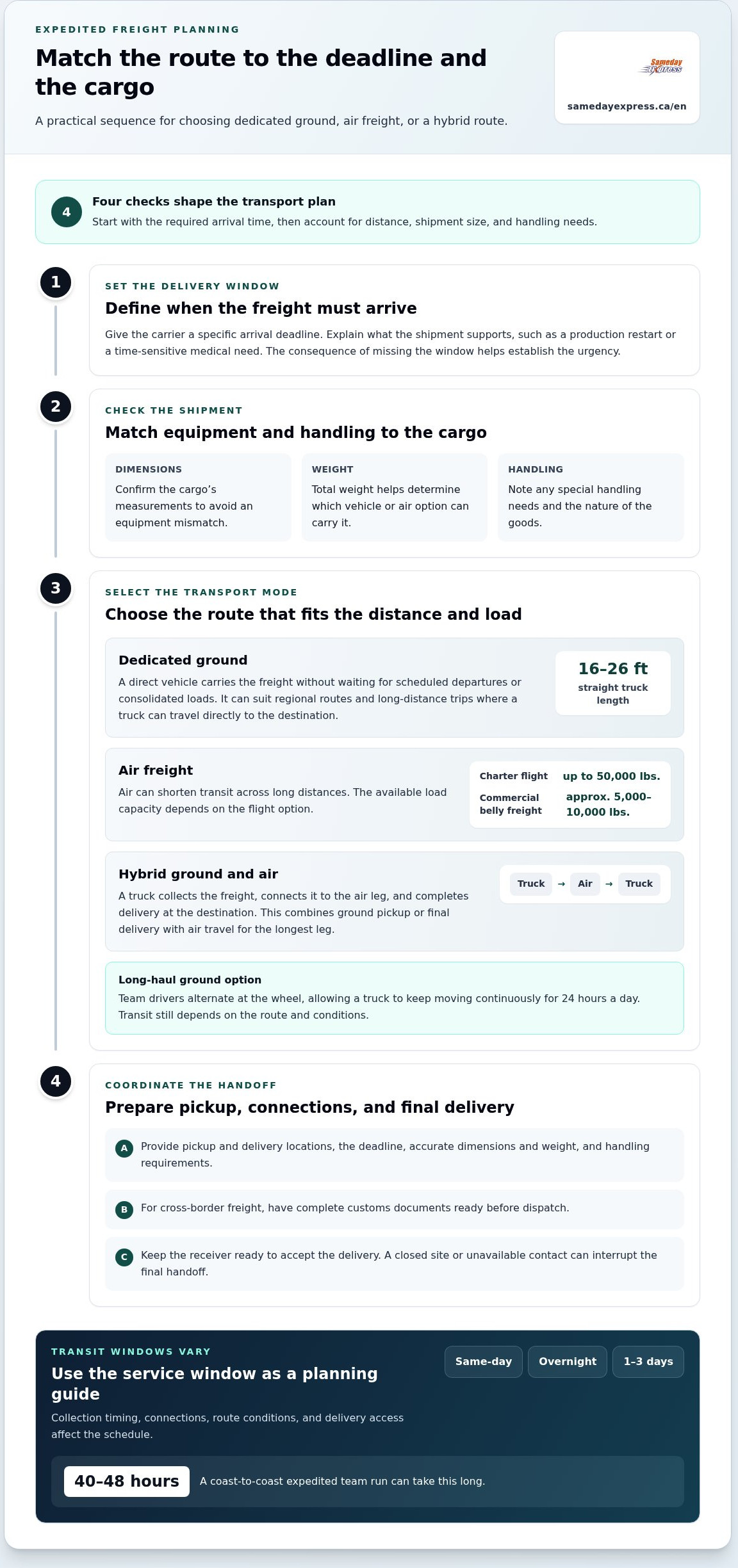
A dedicated vehicle carries urgent freight directly, without waiting for scheduled departures or consolidated loads. Ground transport can suit regional shipments and long-distance routes where a truck can travel directly to the destination. Air freight can shorten transit across long distances, while a hybrid plan uses a truck for pickup or final delivery and an aircraft for the longest leg.
- Dedicated ground: A straight truck between 16 and 26 feet can suit larger shipments that need direct transport.
- Air freight: Charter flights can carry up to 50,000 lbs. of air cargo; belly freight on commercial flights is limited to approximately 5,000-10,000 lbs.
- Hybrid transport: A truck can collect freight, connect it to an air leg, then complete delivery at the destination.
Team driving can keep a truck moving continuously because drivers alternate at the wheel for 24 hours a day. Team driving may reduce transit time on long-haul routes, though the actual schedule depends on the route and conditions. That option can help when a production disruption makes a long ground route too slow, but the schedule still depends on distance, road conditions, and pickup readiness.
Start mode selection with the shipment itself. Cargo dimensions and total weight determine the equipment required. Sensitive goods may need handling suited to their contents, while oversized components may rule out some aircraft or vehicles. Next, compare the distance with the latest acceptable arrival time. A regional route may favour a dedicated truck; a long-distance urgent shipment may favour air or a hybrid connection. The pickup location, transfer points, and final delivery address all affect the practical route.
Transit windows vary by route and service level. Expedited freight may move same-day, overnight, or in 1-3 days. A coast-to-coast expedited team run can take 40 to 48 hours. Use these estimates to frame a plan, then account for collection timing, connections, and delivery access. A ready consignee and accurate shipment details help prevent avoidable delays between transport legs.
For a time-critical shipment within Canada, compare the deadline with the route and handling needs before selecting a mode. Same-day delivery and rush delivery options may suit urgent shipments where a regular schedule leaves too little time.
Carrier selection and delivery coordination
Carrier selection affects route planning, shipment visibility, and how teams respond to delays. Compare coverage and operating support with the shipment’s deadline.
Carrier Networks and Route Coordination
Carrier networks connect vehicles, terminals, and transport partners between pickup and delivery points. Coordinated handoffs help keep every leg aligned with the delivery commitment. Before dispatch, map the route, identify transfer points, and establish who manages each leg. Clear ownership helps teams respond quickly if a missed connection or road disruption threatens production.
Ask how shipment updates are shared between carriers and dispatch teams. For example, a component might travel by truck to an airport, then continue by air and truck. Each transition needs a contact and clear delivery instructions.
Comparing Carriers and Coverage
Compare service areas and operating support with the shipment’s origin, destination, and deadline. A regional carrier may focus on local routes, while a national network can connect more provinces. Confirm that the planned service covers pickup and final delivery, not just a nearby terminal. The right coverage can reduce unnecessary transfers and help align the route with the receiving team’s schedule.
Review geographic coverage, available transport modes, shipment visibility, handling capabilities, and operating hours. A carrier serving the pickup area but not the consignee’s region may require another handoff. For urgent freight, clarify how delays are communicated and who updates your receiving team. These details show how the carrier will coordinate the shipment from dispatch through delivery.
Regulations for Expedited Freight
Expedited service still requires planning around the vehicle, load, and driver schedule. The route, vehicle configuration, shipment weight, and operating conditions shape the dispatch plan. Avoid basing a delivery commitment on uninterrupted travel without accounting for the vehicle and driver requirements that apply to the trip.
When reviewing a schedule, ask how dispatch has accounted for driver time and the vehicle’s permitted load. A faster plan still needs a suitable vehicle and workable driving schedule. For cross-border freight, accurate customs documents and release information also affect whether goods can proceed at the border.
Booking an Expedited Shipment
Booking starts with the required delivery time and complete shipment details. Provide pickup and delivery addresses, shipment dimensions, total weight, and handling needs. Identify whether the load includes sensitive goods or components needed to restart production. This information helps dispatch plan the route and select suitable equipment before collection.
Provide the consignee’s contact details and confirm the receiving location can accept delivery. For cross-border shipments, prepare accurate customs documents before dispatch. Agree on how updates will be shared, who handles escalation, and how delays will be communicated. This gives dispatch and receiving teams a shared plan from pickup through final delivery.
Expedited freight vehicle types and capacities
Vehicle capacity determines how much freight can move safely in one trip. Match the load’s weight, dimensions, pallet count, and destination access to the vehicle before dispatch. A vehicle suited to the shipment can reduce handling and help optimize the route. The figures below are approximate cargo capacities, not a substitute for checking actual shipment measurements and equipment requirements.
Capacity by vehicle type
Vans suit smaller urgent shipments, while trucks accommodate larger loads. Compare approximate capacities by cargo weight and pallet count:
- Sprinter and cargo vans: approximately 500-1,500 lbs. or 1-3 pallets.
- Box trucks: up to 3,500 lbs. or about 4-6 pallets.
- Straight trucks: approximately 5,000-10,000 lbs. or 7-14 pallets.
- Hot shot trucks: approximately 5,000-12,000 lbs.
- 53-foot tractor-trailers: up to approximately 45,000 lbs. of cargo.
These ranges help narrow the equipment choice, but cargo shape matters too. A long component may not fit a van even if its weight falls within capacity. Pallet dimensions, loading access, and how freight is secured can also affect usable space. For example, bulky pallets may require more room than compact ones, even in the same quantity. Share the shipment’s total weight and measurements so dispatch can select a suitable vehicle.
Power-only capacity
Power-only transport uses a tractor unit to pull a shipper’s or another party’s compatible trailer. It can be useful when inventory is already loaded into a trailer and needs to be moved without transferring its cargo. The trailer, rather than the tractor alone, determines much of the available cargo space.
For a power-only move, provide the trailer type, loaded weight, dimensions, pickup location, and delivery destination. Confirm that the trailer is compatible with the tractor and ready for collection. Its capacity depends on the trailer’s specifications and the cargo already loaded, so a tractor’s availability alone does not establish how much freight it can carry. Accurate details help match the equipment and route to the load.
Choose capacity with the delivery task in mind, not simply the largest available vehicle. A van may suit a compact replacement component, while a trailer may accommodate a larger production load. Correct vehicle selection limits unnecessary space, transfers, and handling during the trip. It also gives dispatch the information needed to plan loading and delivery.
Choosing a service based on the delivery window
Choose transport by working backwards from the time the shipment must arrive. In Canada, the delivery window, route, border requirements, and receiving hours all affect the practical choice.
Start with a firm deadline, not a general request for faster delivery. For example, a plant restarting at 7:00 AM needs its component before operations resume, while a routine replenishment may fit a longer window. Include the pickup time, delivery address, and receiving hours. This gives dispatch a useful target and helps identify where the supply chain could lose time.
Match the deadline to the service
Compare the required arrival time with the service’s transit window. Overnight shipping delivers by the following business day when pickup occurs within the carrier’s daily cutoff window. Priority shipping typically falls within two to three business days. Expedited delivery can take same-day, next-day, or 2-3 days, depending on distance and service level.
For long distances, compare transport modes against the actual deadline. A coast-to-coast expedited team run can take 40 to 48 hours. Air freight may suit a shipment with too little time for a full ground route. A hybrid plan can use air for the longest leg, then ground transport to the destination. Choose based on the complete route, not just the fastest leg.
- Same-day window: Consider it when goods must arrive on the day of pickup.
- Next-business-day window: Pickup must fit the carrier’s daily cutoff.
- Multi-day window: Priority or expedited routing may fit, depending on distance and service level.
Set a specific commitment, such as 6:00 AM Tuesday, rather than “first thing Tuesday.” Then count backwards from arrival, allowing time for pickup, transit, border processing where applicable, and delivery access. Canada spans six time zones, so local time at both ends matters. A cross-border shipment also depends on accurate paperwork and release procedures; an urgent schedule cannot remove border steps.
Consider the shipment’s purpose as well as its deadline. A medical shipment may need handling that protects its contents, while a production component may need to reach a plant before a scheduled restart. Confirm that the consignee can receive it at the planned time. A closed loading area or unavailable receiver can undermine even a carefully planned route.
For a time-critical shipment, request urgent delivery service with the required arrival time, origin, destination, and shipment details ready.
Sameday Express Inc.: same day delivery
Sameday Express Inc. offers same-day delivery, rush delivery, and Sameday Direct drive for urgent business shipments. These services can suit a delivery window that cannot wait for a routine schedule. Choose an option based on the required arrival time, pickup and delivery locations, and the shipment’s dimensions and handling needs.
For a time-critical expedited industrial freight delivery, have the deadline, route details, and cargo information ready when arranging service. This helps match the delivery option to your business needs, whether the shipment requires direct transport or prompt local delivery.
Contact Sameday Express Inc. to discuss your delivery needs.
Build a faster response into your freight plan
Use expedited industrial freight delivery as part of a clear response plan, not only as a last-minute fix. Decide which disruptions trigger an urgent shipment, who can approve it, and which team will prepare the freight. A written plan helps purchasing, operations, and receiving staff act quickly when a critical component is unavailable or a production commitment is at risk.
Set those decision points before the next disruption. Record who can authorize the shipment, which details dispatch will need, and which receiving contact is responsible for accepting delivery. This reduces internal delays and gives your logistics team a practical starting point when time matters.
For your next urgent business shipment, discuss your freight needs with Sameday Express. A clear plan and a suitable delivery service can help your team respond with confidence and keep essential work moving.
Frequently Asked Questions
Can heavy industrial freight really be delivered on the same day?
Yes, same-day delivery can work for heavy freight if the vehicle, route, and loading arrangements suit the shipment. For example, a replacement pump may be movable on a dedicated truck if its dimensions suit the equipment and both sites can load and unload it promptly. Weight alone doesn’t determine suitability. Shape, securement, site access, pickup readiness, and distance to the destination all matter.
How does cross-border compliance affect same-day delivery times?
Cross-border procedures add a border step that domestic shipments don’t have, so a same-day plan needs to account for that transition. Progress can depend on accurate, consistent commercial information and the time required for border processing. For example, a delivery window that allows only for driving time leaves little room for a border delay. Build the crossing into the schedule.
Is same-day delivery available for oversized or specialized cargo?
It may be possible when the cargo fits suitable transport equipment and the pickup and delivery sites can accommodate it. Oversized items need assessment of their length, width, height, loading method, and access at both locations. Specialized goods may also need handling instructions that remain practical throughout the trip. A large machine component, for example, may require a loading plan before a vehicle can be dispatched.
What happens if an expedited shipment is delayed at the border?
If a shipment is held at the border, its planned arrival may shift while the issue is resolved. The carrier can share status information so the shipper and receiver can adjust their plans. For example, a receiving team may need to change its unloading schedule or coordinate a revised arrival time. Keep a contact available to respond to requests, and plan for operations that depend on the shipment.
What information do I need to provide for a same-day freight quote?
Along with the route and deadline, provide the number of pieces, each piece’s dimensions, total weight, and a clear description of the goods. Explain whether items are stackable and how they can be loaded. Note site access details, such as dock availability or limits on vehicle entry. These specifics help assess the actual load and avoid a plan based only on estimated shipment size.
What is expedited industrial freight delivery?
It’s a priority transport arrangement for industrial goods that need to meet a tighter delivery commitment than routine freight schedules allow. The term describes the shipment’s urgency, not a specific vehicle or cargo type. A manufacturer could use expedited service for a replacement component needed to keep a maintenance job on schedule. The route and equipment are then matched to the cargo and required arrival time.
How fast can expedited freight be delivered in Canada?
Expedited freight in Canada may arrive the same day, the next day, or in 1-3 days. The suitable window depends on the distance and service level. For example, a nearby delivery may fit a same-day plan, while a shipment crossing a large part of the country needs a different route and schedule. State the required arrival time clearly, including the destination’s local time.
What are typical expedited freight costs in Canada?
A useful planning decision is to match the shipment with the service level its deadline requires. Consider whether the goods need dedicated ground transport, an air segment, or a combination of modes, then weigh that against the route and handling needs. For instance, a production-critical component may need a different transport plan from replenishment stock that can arrive later. Choose based on operational urgency and cargo requirements.
Disclaimer
Blog Disclaimer
The information published on the Sameday Express Blog is provided for general informational and educational purposes only. While we strive to keep all content accurate and up to date, Sameday Express makes no representations or warranties of any kind, express or implied, regarding the completeness, accuracy, reliability, suitability, or availability of the information contained in our articles.
The content on this blog does not constitute legal, customs, tax, regulatory, financial, or professional advice. Shipping regulations, carrier policies, customs requirements, and transportation laws may change without notice and may vary by destination. Readers should verify current requirements with the appropriate government authorities, carriers, or qualified professionals before making shipping or business decisions.
Sameday Express is not liable for any loss, damage, delays, or consequences arising from the use of, or reliance on, information published on this website. Any actions taken based on the information provided are at the reader's own risk.
References to third-party companies, products, services, or websites are provided for informational purposes only and do not constitute an endorsement or recommendation by Sameday Express.
All blog content, including text, graphics, images, and logos, is the property of Sameday Express unless otherwise stated and may not be reproduced or distributed without prior written permission.
For specific shipping requirements, pricing, transit times, or logistics solutions, please contact Sameday Express directly for personalized assistance.


