

A print deadline can leave little time for standard shipping. Rush delivery for print shops depends on when the order is ready for pickup, how far it must travel and whether it needs a direct, same-day run. Match the pickup time and route to the job’s deadline.
When a print order is time-sensitive, speed is only part of the decision. Consider when the finished work will be ready, where it needs to go and how the recipient will accept it.
This guide explains how production deadlines and pickup timing affect delivery, and when rush or express options may suit a print order. You’ll also learn how to compare courier delivery with in-store pickup and direct delivery, and what details to prepare for a time-sensitive shipment.
Key Takeaways
- Set the delivery deadline first, then work backward to plan when the finished print order must be ready for pickup.
- Choose a delivery method based on the destination, shipment size and urgency, not just the requested arrival time.
- Prepare the order and delivery details before arranging pickup to reduce avoidable delays at handoff.
- Compare local courier delivery, rush shipping and in-store pickup according to the recipient’s needs and the job’s timeline.
- For urgent shipments, Sameday Express offers same-day delivery, rush delivery and direct-drive options, including Montreal-to-Toronto service.
Rush shipping for time-sensitive documents
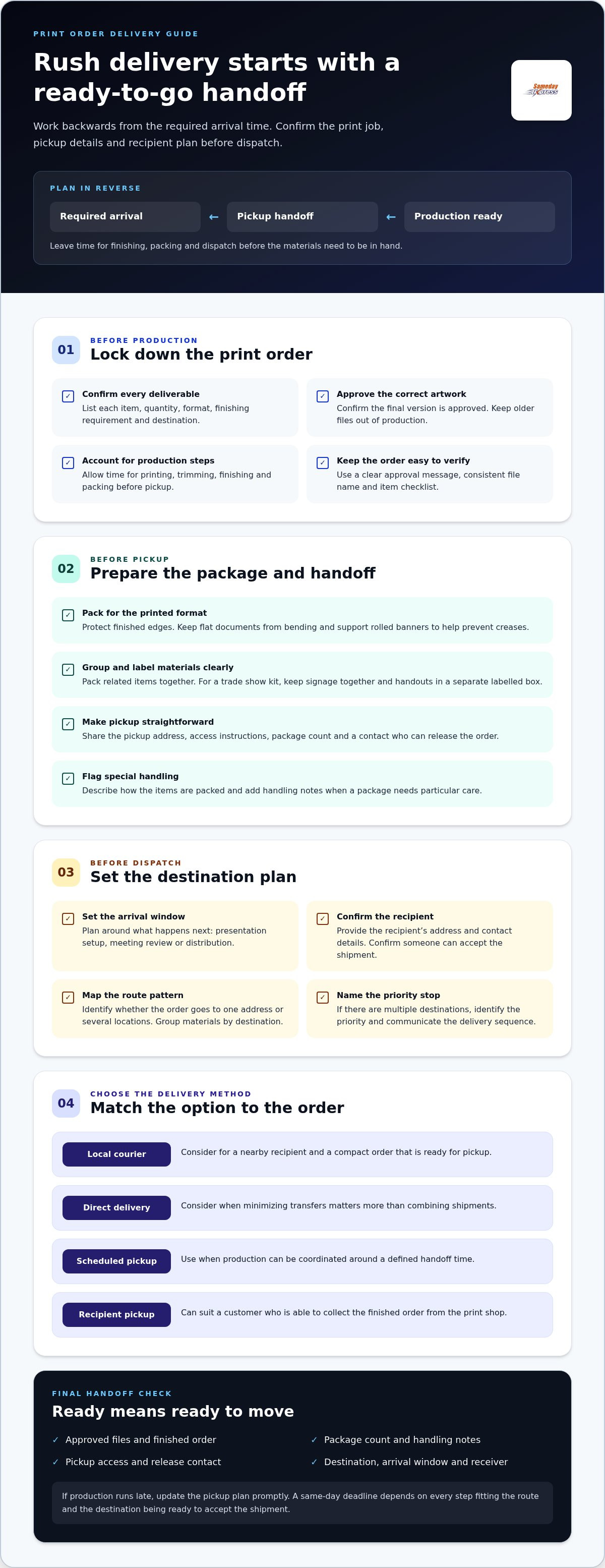
A tight print deadline depends on more than travel time. The shop must complete production, package the order and hand it over before delivery can begin. For an urgent corporate presentation, for example, account for final approval, printing, trimming, packing, pickup and the recipient’s availability. An unfinished step can delay the handoff, even if the destination is nearby.
Work backward from the required arrival time. Confirm when and where the recipient needs the materials, and who can receive them. Then set a production deadline that leaves time for finishing and dispatch. A trade show package might include brochures, banners and signs, each with different packing needs. Confirming the complete order early helps prevent last-minute shipment changes.
Before production, check the supplied files and approval process. A simple workflow can help:
- Confirm the deliverables. List each item, its quantity, format, finishing requirements, and destination.
- Review the artwork. Check that the correct version is ready and that the client has approved it for printing.
- Set the handoff point. Identify the pickup address, access instructions, and a contact who can release the order.
- Prepare the package. Group related materials, protect finished edges, and label separate boxes clearly.
- Share delivery details. Provide the recipient’s address, contact information, and required arrival window.
Production cannot reliably begin with incomplete or unapproved files. For example, a corporate client may upload a revised presentation after reviewing a proof. Identify the final version and keep older files out of production. A clear approval message, consistent file name and item checklist reduce confusion between the person placing the order and the print team.
Choose packaging for the printed item, not just the vehicle. Support rolled banners to help prevent creases, and protect flat documents from bending. For a trade show kit, pack items by booth task, such as signage together and handouts in a separate labelled box. This helps the recipient unpack efficiently and spot missing pieces at handoff. Add handling notes when a package needs particular care.
When comparing delivery methods, consider how the shipment will travel and where it needs to go. A time-sensitive job may need a direct trip rather than a route with several handoffs. Match the option to the package and deadline:
- Local courier: Consider this for a nearby recipient and a compact order ready for pickup.
- Direct delivery: Consider this when minimizing transfers is more important than combining shipments.
- Scheduled pickup: Use this when production can be coordinated around a defined handoff time.
- Recipient pickup: This can suit a customer able to collect from the print shop.
Clear communication keeps the delivery plan practical. Tell the courier what is ready, how many packages need collection, and which destination contact will receive them. If production runs late, update the pickup plan promptly rather than relying on the original timing. For example, a shop finishing revised banners should distinguish those packages from already completed brochures. Accurate details help everyone coordinate the final handoff.
For rush delivery for print shops, the key question is whether the order can be finished and handed over in time to meet the required arrival. Confirm the approved format, production status, package count, pickup access and recipient details before dispatch. A same-day deadline is workable only when every step fits the route and the destination can accept the shipment. Plan the handoff as carefully as the print job.
Delivery charges and cost factors
For a print order, choose a delivery method by matching the route to the deadline and shipment. A stack of business cards going to a nearby Montreal office has different needs from event signage travelling to Toronto. The useful question is whether the delivery plan fits the destination, package, and receiving arrangements. Start by identifying what could interrupt the shipment after it leaves the print shop.
Route shape matters as well as distance. Delivering to one office is simpler than making several stops. For an order serving multiple branches, group the materials by destination before dispatch. Decide which stop has priority and communicate it clearly. Planning around the recipients can help prevent unnecessary backtracking.
Set the delivery window around what the recipient needs to do next. Posters for a client presentation, for example, must arrive before setup begins. Documents for a meeting should arrive with enough time for review and distribution. Set the target around the business activity, not merely the courier’s arrival. This makes it easier to choose a suitable service.
Print formats affect how a shipment can travel. Flat postcards can be grouped together, while large posters may need to stay flat or be rolled. Signage may include several pieces that the recipient needs to assemble or place together. Describe how the items are packed and used to help determine whether one package or separate bundles make sense.
Use a short decision checklist before selecting an option:
- Route pattern: Decide whether the order goes to one address or several locations.
- Arrival window: Set the time the recipient needs the materials in hand.
- Order format: Note if documents, posters, or signage need to remain flat or grouped.
- Recipient workflow: Consider whether someone must sort, inspect, or distribute items after arrival.
- Delivery sequence: Identify which destination or package has priority.
Fast turnaround also depends on coordination between the print shop and recipient. Name the person responsible for receiving presentation materials at the destination. They can direct the courier to the right department or reception point. If the recipient changes, update the instructions before dispatch. A clear contact helps prevent a delivery that reaches the building without a useful handoff.
Make the contents of a multi-part order easy to identify. Separate each department’s documents or label signage by room, booth or installation area. A conference package, for instance, might include directional posters and registration cards. Grouping items by use helps the recipient move from delivery to setup and check that all parts arrived.
Finally, select a delivery arrangement that suits the shipment’s handling and destination. A direct trip may be appropriate when the order has a narrow arrival window or several connected pieces. A local courier can fit a straightforward city delivery, while a recipient may collect items if that better suits their schedule. Consider the route and handoff as one plan, rather than separate decisions. Sameday Express lists business delivery options that can help companies plan time-sensitive shipments.
Canadian print shop rush delivery and pickup options
Yes, Canadian print shops may offer rush production, local courier delivery, or in-store pickup. The available choice depends on the shop, order, destination, and production schedule. For example, a customer in downtown Montreal might collect finished business cards, while a company sending event banners across town may need delivery. Ask which step is urgent: printing, finishing, or transporting the completed order.
Rush production and rush delivery are separate arrangements. A print shop may prioritize printing, but the finished order still needs a delivery plan. A courier can collect packages and take them to an office, venue or recipient. In-store pickup removes the courier leg, but the customer must travel to the shop after production finishes. Clarify which option covers the task you need.
For courier delivery, provide the exact pickup and drop-off addresses, along with the business name, unit or suite, receiving contact and access instructions. A shipment going to a trade show venue may need a specific entrance or loading area. For a staffed reception desk, identify the recipient and delivery window. Clear directions help the driver complete the handoff efficiently.
In-store pickup can work well when the recipient is nearby and available. Confirm the order is ready before travelling, and bring the order details or pickup name. If another employee is collecting it, share the shop’s instructions. For example, a marketing coordinator could collect posters before heading to an event. Confirm the package count at the counter to catch a missing box before leaving.
Each option has different timing requirements. Courier delivery starts after the print job is packed and released for collection. Pickup depends on production completion and the shop’s collection arrangements. If conference signage is needed for setup, coordinate the setup time with the expected production completion. A tight schedule needs a clear handoff plan, not just a fast trip.
Before choosing, compare these practical details:
- Order readiness: Identify when printing and finishing will be complete.
- Recipient location: Check whether the destination is an office, venue, or home.
- Package handling: Note if flat prints, framed pieces, or rolled banners need care.
- Collection access: Confirm pickup hours, entrance details, and who can collect.
- Receiving arrangements: Name a contact who can accept and secure the order.
- Schedule flexibility: Decide whether the recipient can collect or accept delivery.
Multiple destinations require extra organization. Separate packages by address before collection and label each group with its destination and contact name. For an event, group materials by purpose, such as registration documents in one package and directional signs in another. This helps recipients identify their items quickly and reduces confusion at delivery.
Ask the shop how it handles production delays. If a proof needs revision, the finished order may be ready later than planned. Tell the recipient about the revised handoff and adjust pickup or courier arrangements. Don’t send a driver before the package is packed and released. A prompt update prevents an unnecessary collection attempt and keeps the delivery plan aligned with production.
For urgent print orders, choose pickup when you can collect promptly and courier delivery when the recipient needs the order elsewhere. Set the delivery plan around the job’s ready time, not the time the files were submitted. If your business needs a courier for a time-sensitive shipment, arrange an urgent business delivery with the route and handoff details ready.
Sameday Express Inc.: same day delivery
Sameday Express offers same-day delivery and rush delivery for urgent print orders. These options can move finished documents, posters or signage to a recipient on a deadline. For a direct delivery between Montreal and Toronto, Sameday Express also offers Sameday Direct drive and Montreal to toronto direct drive.
Choose a service based on the route and required timing. Have the pickup address, destination, package details and delivery deadline ready when arranging the shipment. Clear information helps define the delivery request for a print-shop order.
For urgent materials moving between Montreal and Toronto, consider the direct-drive option. For other time-sensitive print shipments, choose same-day delivery or rush delivery based on the destination and schedule.
Contact Sameday Express Inc. or visit samedayexpress.ca/en to discuss a print-shop delivery.
Set up your next urgent print shipment
Make the next deadline easier to manage with a ready-to-use delivery brief. Record the pickup contact, destination details, package description and recipient instructions in one place. When a print job becomes urgent, your team can focus on the production handoff instead of rebuilding the delivery plan. Rush delivery for print shops works best when the request reflects the job’s actual deadline and route.
Sameday Express offers same-day delivery, rush delivery and Sameday Direct drive for time-sensitive shipments. These options can support print orders that need prompt or direct delivery. Prepare the shipment details and Request a Quote to discuss the right service for the job.
Contact Sameday Express Inc. about rush delivery and take the next step with a clear plan for your print order.
Disclaimer
Blog Disclaimer
The information published on the Sameday Express Blog is provided for general informational and educational purposes only. While we strive to keep all content accurate and up to date, Sameday Express makes no representations or warranties of any kind, express or implied, regarding the completeness, accuracy, reliability, suitability, or availability of the information contained in our articles.
The content on this blog does not constitute legal, customs, tax, regulatory, financial, or professional advice. Shipping regulations, carrier policies, customs requirements, and transportation laws may change without notice and may vary by destination. Readers should verify current requirements with the appropriate government authorities, carriers, or qualified professionals before making shipping or business decisions.
Sameday Express is not liable for any loss, damage, delays, or consequences arising from the use of, or reliance on, information published on this website. Any actions taken based on the information provided are at the reader's own risk.
References to third-party companies, products, services, or websites are provided for informational purposes only and do not constitute an endorsement or recommendation by Sameday Express.
All blog content, including text, graphics, images, and logos, is the property of Sameday Express unless otherwise stated and may not be reproduced or distributed without prior written permission.
For specific shipping requirements, pricing, transit times, or logistics solutions, please contact Sameday Express directly for personalized assistance.


