

For same day delivery for law firms, choose a courier that can meet a clearly defined delivery window, provide shipment updates, and confirm who received the package. Speed alone is not enough: same-day transport does not change the procedural requirements for serving legal documents. Match the service to the deadline and the handoff you need.
A time-sensitive document can affect a filing, transaction, or next step in a case. Look beyond a general promise of fast delivery: confirm how the courier communicates changes and what record you’ll receive when delivery is complete.
This guide explains how to compare courier reliability, tracking, delivery confirmation, and express windows for legal and corporate shipments in Canada. You’ll also learn how to distinguish routine, rush, and direct delivery options, and which details to weigh when choosing a service for an urgent delivery.
Key Takeaways
- Compare live shipment updates with clear delivery confirmation so your team can track progress and record when documents arrive.
- Choose a service timeline that fits the deadline, and account for booking cut-offs that can affect same-day delivery.
- Match the delivery method to the document’s purpose; same-day transport doesn’t change the procedural requirements for serving legal documents.
- Assess express windows by pickup timing, route, recipient availability, and how the courier communicates if plans change.
- For urgent Montreal-area or intercity shipments, compare same-day, rush, and direct-drive options against the delivery window you need.
1. GPS tracking and delivery confirmation
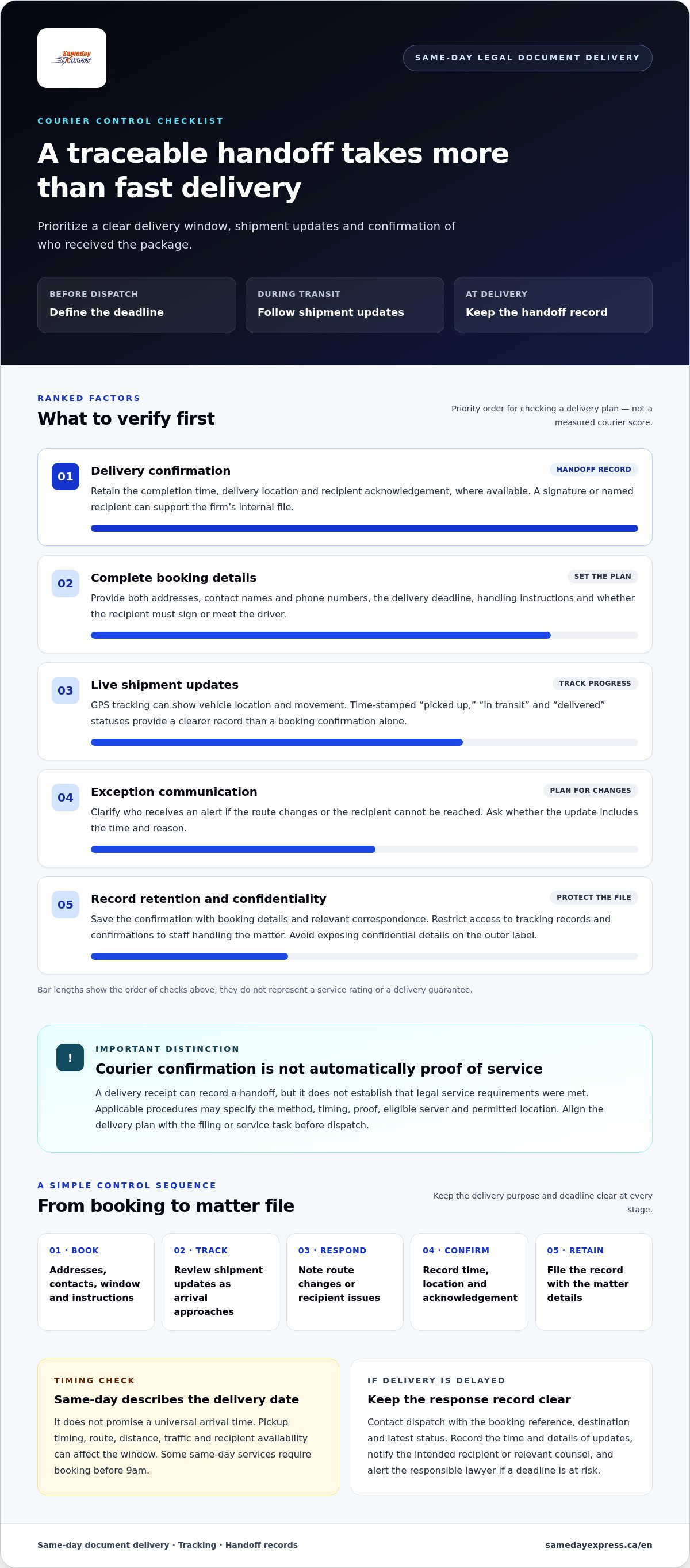
How do law firms book, track, and confirm a same-day delivery? Provide the pickup and recipient details, required delivery window, and handling instructions when booking. Follow shipment updates, then retain the delivery confirmation with the matter file.
Start with a complete booking record: provide the pickup and delivery addresses, contact names, and phone numbers for both locations. Identify the envelope or package without exposing confidential details on its outer label. State the deadline and whether the recipient must sign or meet the driver. For example, an envelope going to a courthouse needs a precise destination and a delivery contact. Accurate information helps prevent confusion at handoff.
Real-time GPS tracking can show a vehicle’s location and movement during transit. Confirm how to view updates and whether staff can access them without calling for each status check. Time-stamped statuses such as “picked up,” “in transit,” or “delivered” provide a clearer record than a booking confirmation alone. Tracking shows progress, but a map location does not prove the named recipient accepted the package.
Set an update routine before dispatch. A legal assistant managing a time-sensitive filing might monitor the shipment as its expected arrival approaches and alert the receiving office. If the route changes or the recipient cannot be reached, a timely update gives staff a chance to respond. Clarify how delivery exceptions are reported, who receives them, and whether the update includes the time and reason. Every minute can matter when a document must arrive before an office closes.
At delivery, retain confirmation showing the completion time, delivery location, and recipient acknowledgement, where available. A signature or confirmation naming the recipient can support the firm’s internal file. Save the record with the booking details and relevant correspondence rather than relying on memory. For confidential documents, restrict access to tracking records and confirmations to staff handling the matter.
Keep courier confirmation separate from legal proof of service. Applicable procedures may specify the method, timing, proof, eligible server, and permitted location. Same-day transport does not change the requirements for serving legal documents. A delivery receipt can record a handoff, but it does not automatically prove that service requirements were met. Before dispatch, align the delivery plan with the filing or service task, then keep the courier record as supporting documentation.
Same-day, rush, and routine service timelines
Same-day couriers transport legal documents to a destination that day; process servers attempt formal service and can record each attempt. Regular courier services follow a less urgent schedule, while rush delivery prioritizes a shipment. Choose according to the task: delivering a sealed envelope to counsel differs from personally serving a recipient.
How quickly can legal documents be delivered within or between Canadian cities? Timing depends on pickup time, route, distance, traffic, and recipient availability. A delivery within one city may have a different window from an intercity trip. Provide both addresses and the deadline when booking.
“Same-day” describes the delivery date, not a universal arrival time. Some services advertised as same-day require booking before 9am. Same-day process serving means a server attempts delivery on the day the request is received, typically within hours. That is an attempt, not a promise that the person will be found or served.
Before choosing an expedited service, compare its delivery window with your actual deadline. Confirm the pickup cut-off, estimated arrival window, update method, and process for communicating route changes. Clarify whether the recipient must sign or whether another handoff is acceptable. If a document is needed before a scheduled meeting, allow time to contact the recipient if delivery is delayed.
For difficult service, give the process server useful details, such as a physical description, workplace, known schedule, or alternative address. This information can support an informed attempt. Ask how each visit is recorded, including its time, location, and outcome. A detailed log can explain what happened if the first visit fails. Skip tracing may help locate a recipient, while repeat visits or alternative service methods may add steps.
What should a law firm do if a same-day legal delivery is late, lost, or misdelivered? Contact dispatch promptly with the booking reference, destination, and latest status, and record the time and details of each update. Notify the intended recipient or relevant counsel, then determine whether to arrange a corrected delivery or take another procedural step. If a filing or hearing deadline is at risk, alert the responsible lawyer immediately. Delayed service can lead a court to continue or deny an emergency motion if proof is not available on time.
Keep routine, rush, and emergency requests distinct in your booking notes. A clear deadline and delivery purpose help match the request to the right window. For a direct same-day shipment, review the same-day delivery service as one option for time-sensitive business documents.
3. Time-sensitive legal and corporate document delivery
Do same-day legal couriers provide court filing and document service? Couriers can collect legal documents and deliver them to a courthouse, client, or opposing counsel that day. Transporting a document is different from filing it with a court or formally serving someone. Clarify the task before dispatch.
Use expedited delivery when timing affects a specific business or legal step. Examples include signed contracts, transaction records, court filings, and original documents needed at a meeting. When booking, provide the destination, deadline, recipient, and handoff requirements. These details help dispatch understand what must arrive and where.
Confidential handling begins with careful preparation at the sending office. Seal the document in an envelope, address it to the intended recipient, and keep sensitive matter details off the outside. Give the courier only the information needed to complete delivery. For example, provide the recipient’s name and office location, not unnecessary case notes.
For evidence or other sensitive material, record who releases the item and who should receive it. Keep a matching internal record of the package description, dispatch time, and delivery confirmation. These steps support a clear handling history but do not replace legal requirements for evidence preservation or formal service, which depend on the task.
Short-notice requests need precise instructions. Confirm the pickup location, receiving office hours, a reachable contact, and the latest acceptable arrival time. If a courthouse or corporate office has a designated intake desk, specify it in the delivery details. A complete handoff plan helps prevent delays caused by unclear access or an unavailable recipient.
Consider a contract that needs a wet signature before 5pm. The sender should identify the signer, state the deadline, and arrange a return handoff if the signed original must come back. A direct route can suit a document with one destination and a narrow window. The plan should account for recipient availability, not just travel time.
Once legal documents are delivered, response timelines may begin, allowing later phases of a case to start sooner. That makes timely, documented delivery important for firms coordinating next steps. Keep the confirmation with the matter file, then notify the lawyer or corporate contact responsible for the document. A delivery record helps the team act on the completed handoff.
When arranging urgent transport, distinguish a delivery request from a filing or service instruction. Specify whether the courier should deliver to a person, reception desk, or courthouse intake point. Include a backup contact and a clear escalation path. For a confidential corporate package, share recipient details only with staff who need them to complete the handoff.
4. Express delivery windows
An express window should specify the pickup point, destination, and acceptable arrival time. For a litigation package, distinguish “deliver today” from “arrive before the court’s filing deadline.” The first gives a date; the second sets a specific operational target. Include the recipient’s office hours and a working contact. The window is useful only if both ends can receive the courier.
Build the request around the event that cannot move. For example, a lawyer may need signed originals before a client meeting, while another package must reach counsel before a court appearance. Record the actual deadline, not just “urgent.” Work backwards through document preparation, pickup access, transport, and recipient availability. This identifies bottlenecks before dispatch and gives staff time to arrange a handoff.
Ask the courier to explain its express window in plain terms. Does it refer to a pickup estimate, an arrival range, or completion by a stated time? Clarify when the clock starts, how delays are communicated, and who receives updates. Dispatch should have a direct contact for changes. Otherwise, reception may close or the named recipient may leave before arrival.
Plan for conditions that can affect the window. A busy business district, controlled building access, or a courthouse intake desk can change the handoff sequence. Share loading instructions, suite details, and receiving restrictions when booking. For deliveries between Canadian cities, route distance and pickup timing shape the practical window. Short-notice requests call for especially complete information.
Set an escalation point before the package leaves. If tracking shows the courier has missed the expected arrival window, contact dispatch with the shipment reference and deadline. Tell the receiving office about the delay, then alert the lawyer responsible for the filing or hearing. Record the time of each update. If a court deadline or urgent motion is affected, the responsible legal team can assess the next procedural step.
Timeliness can affect litigation beyond the courier trip. Delayed service may lead a court to continue or deny an emergency motion if proof of service is not available on time. Set the delivery window around the legal task, not just the drive. A delivery confirmation can record arrival, but does not by itself establish compliance with service rules. Keep transport timing distinct from procedural requirements.
For recurring deliveries, use a consistent booking template with collection and delivery addresses, recipient details, access instructions, deadline, and preferred update contact. Review completed shipments for patterns, such as recurring access delays at a particular office, and adjust the handoff plan. Clear delivery windows help a law firm coordinate staff, recipients, and courts without treating every urgent package as identical.
5. Which courier companies offer same-day delivery for law firms in Canada?
In Canada, same-day legal deliveries are handled by different types of providers, not one dedicated category. Options include national courier networks, regional couriers, direct-drive services, and process servers. Their roles differ: couriers transport packages, while process servers attempt formal document service. Identify the task before comparing services.
A national network may suit a firm sending documents between major centres on established routes. A regional courier may focus on a city or nearby communities. Direct-drive transport can suit a shipment that needs a point-to-point trip rather than a routine network route. A process server is relevant when the requirement is personal service, not simply delivery to an office.
For example, a law firm sending a signed agreement between Canadian cities should compare route coverage, pickup timing, arrival window, tracking, and delivery confirmation. A court filing has a different destination and deadline. Courier transport does not establish that a filing was accepted or that formal service requirements were met.
Compare services using the same shipment details. Provide the pickup and delivery locations, package size, recipient availability, and required arrival time. Then assess the operational fit using these points:
- Route and timing: Does the service handle the specific origin, destination, and requested delivery window?
- Shipment visibility: Can staff follow status updates and receive a completion record?
- Handoff: Can the courier deliver to the named recipient or designated office?
- Exception response: Is there a clear way to report delays, access problems, or a missed recipient?
- Legal task: Is this transport only, or does the matter require a process server?
Ask for the service window in clear terms. “Same day” means delivery on the collection day, but doesn’t describe a specific arrival time. Some same-day services require booking before 9am. Compare that cut-off with your office’s preparation time and the recipient’s hours. For intercity deliveries, route distance and pickup time shape the practical window.
Use a repeatable comparison record for each candidate: service type, route, booking cut-off, update method, delivery evidence, and exception contact. This helps a firm choose consistently instead of relying on a broad “fast courier” label. For a Montreal-based shipment requiring an urgent direct route, review same-day courier options against the delivery window and handoff your matter requires.
Sameday Express: same day delivery
Sameday Express Inc. provides same-day delivery for urgent legal and corporate documents that need direct transport. For a time-sensitive envelope or signed contract, choose between Same Day Delivery, Rush delivery, and Direct-drive delivery according to the route and deadline. Sameday Express Inc. also provides direct-drive transport between Montreal and Toronto. Share the pickup and delivery details, recipient, and required arrival window when arranging the shipment. Courier delivery transports a package; it does not replace formal document service or court filing procedures.
For an urgent shipment, visit Sameday Express Inc. online.
Set your team’s next delivery up for success
Make urgent transport easier to coordinate by establishing a booking process before the next deadline. Decide who can authorize a shipment, what contact details staff must provide, and where delivery records belong in the matter file. A consistent process helps colleagues act quickly while keeping the document’s purpose and handoff requirements clear.
For a time-critical document, Sameday Express offers Same Day Delivery, Rush delivery, and Direct-drive delivery. Match the service to the route and required timing, while keeping courier transport separate from any court filing or formal service steps. A clear request gives your team and the courier a shared operational starting point.
Use the guidance in this article to make your next decision with care. If you’re arranging same-day delivery for law firms, contact Sameday Express to discuss your shipment. A prepared request can help your team move forward with confidence.
Frequently Asked Questions
Looking for a Reliable Courier Service for Your Business?
Choose a courier service that matches the shipment’s route, deadline, and handoff requirements. For signed originals, confirm the recipient can accept them and identify who should receive delivery updates. Consider how the courier handles an unavailable recipient or access issue. A reliable booking process gives staff a clear point of contact and a record to file with the matter.
Need a Courier Who Understands the Legal Sector?
Choose a service that can follow precise delivery instructions and distinguish document transport from formal service. Legal offices may send signed contracts, records, or sealed envelopes to clients and other offices. Provide the required destination and recipient details, but keep privileged information out of unnecessary labels or notes. For a law firm, same-day delivery supports time-sensitive transport, not legal advice or process serving.
What Makes Same-Day Service Successful?
A successful delivery starts with a ready package, a complete address, and a reachable recipient. Provide access instructions, the actual deadline, and any handoff requirements when booking. If a document must reach a particular department, for example, name that department and provide a contact. Keep a staff member available to respond to updates. These steps help prevent delays caused by missing details or unavailable recipients.
Can same-day couriers handle confidential or sensitive legal documents securely?
Couriers can transport sealed legal documents, but the law firm should prepare the package carefully. Use a closed envelope or package, address it to the intended recipient, and keep case names or sensitive contents off the exterior. Share only the delivery information needed to complete the handoff. For highly sensitive material, also limit internal access and record who prepared and released the package.
What proof of delivery, affidavit, or chain-of-custody records are available?
A delivery confirmation records a courier handoff; an affidavit of service is a separate legal document recording service details under applicable procedures. A courier receipt does not automatically replace an affidavit or prove formal service. For evidence or other controlled documents, keep an internal record of release, transfer, and receipt. Tell the receiving lawyer which records the matter requires, then retain the courier confirmation with the related file documents.
What are the cutoff times, service areas, and delivery guarantees for legal couriers in Canada?
Cut-off times and coverage depend on the service and route. Some same-day services require booking before 9am. Sameday Express states that pickup is within 60 minutes and same-day delivery is guaranteed when conditions allow. It offers national service; delivery timing depends on the shipment’s origin, destination, and recipient availability. Confirm the applicable delivery window during booking, and distinguish a courier’s delivery commitment from any court filing deadline.
Disclaimer
Blog Disclaimer
The information published on the Sameday Express Blog is provided for general informational and educational purposes only. While we strive to keep all content accurate and up to date, Sameday Express makes no representations or warranties of any kind, express or implied, regarding the completeness, accuracy, reliability, suitability, or availability of the information contained in our articles.
The content on this blog does not constitute legal, customs, tax, regulatory, financial, or professional advice. Shipping regulations, carrier policies, customs requirements, and transportation laws may change without notice and may vary by destination. Readers should verify current requirements with the appropriate government authorities, carriers, or qualified professionals before making shipping or business decisions.
Sameday Express is not liable for any loss, damage, delays, or consequences arising from the use of, or reliance on, information published on this website. Any actions taken based on the information provided are at the reader's own risk.
References to third-party companies, products, services, or websites are provided for informational purposes only and do not constitute an endorsement or recommendation by Sameday Express.
All blog content, including text, graphics, images, and logos, is the property of Sameday Express unless otherwise stated and may not be reproduced or distributed without prior written permission.
For specific shipping requirements, pricing, transit times, or logistics solutions, please contact Sameday Express directly for personalized assistance.


