

Production depends on materials reaching the right place at the right time. Manufacturing logistics support coordinates the movement, storage and flow of raw materials, production inputs, work in progress and finished goods. It links inbound supply, production needs, inventory handling and outbound delivery to keep each stage moving.
A shortage can interrupt production, while excess stock ties up space and working capital. Freight costs, delivery schedules and changing material needs add pressure. The challenge is not simply moving goods, but aligning transport and inventory with production requirements.
This guide explains how manufacturing logistics works across the production cycle, how transportation planning can help manage freight spending, and where third-party logistics support fits. It also shows how material flow, storage and finished-goods delivery connect, helping you identify which parts of your logistics process need closer coordination.
Key Takeaways
- See how inbound materials, production inputs, work in progress and finished goods connect across the manufacturing cycle.
- Learn how inventory planning balances the risk of production delays against storage space and working capital.
- Identify how routing, shipment data and carrier performance can help manage freight spending and delivery issues.
- Understand where third-party logistics support can help coordinate transport, storage and outbound shipments.
- Explore how same-day delivery, rush delivery and direct-drive options can support time-critical shipments.
What Is Manufacturing Logistics?
Manufacturing logistics coordinates materials and goods as they move into, through and out of production. It connects supplier deliveries, receiving, warehousing and outbound freight so production inputs reach the right work area when needed.
Inbound Materials and Component Delivery
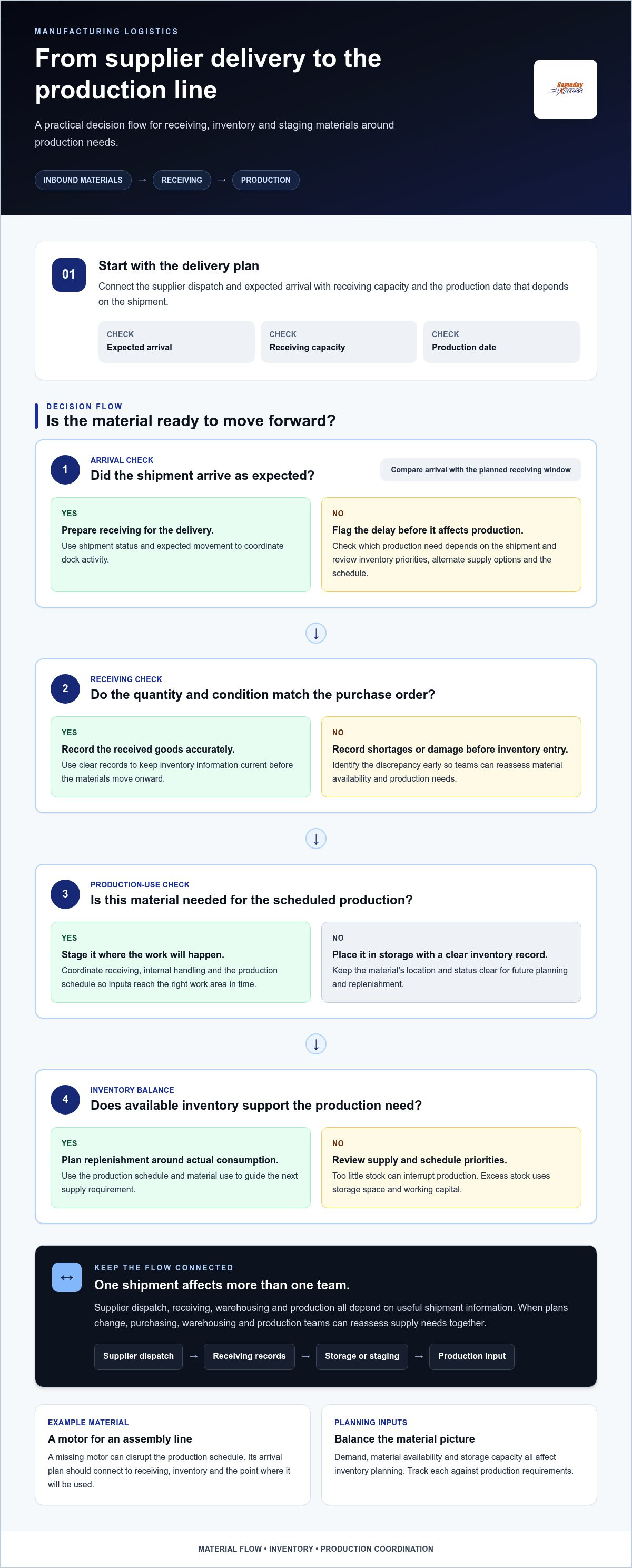
Inbound transportation moves raw materials and components from suppliers to a manufacturer’s receiving area. A missing input, such as a motor needed for an assembly line, can disrupt the production schedule. Planning connects procurement dates with transport, receiving capacity and the point where each item will be used.
At receiving, staff compare delivered goods with purchase orders and inspect their quantities and condition. Accurate records help identify shortages or damaged components before they enter inventory. Materials can then go into storage or be staged for production. Coordinating supplier dispatch, arrival times and receiving tasks reduces avoidable waiting and gives production teams a clearer view of incoming supply.
Procurement and production logistics work together: purchasing secures inputs, while logistics arranges their movement and placement. A production schedule can guide when steel, packaging or electronic components should arrive. Inventory planning must balance two risks: too little stock can interrupt production, while excess stock uses storage space and working capital. Demand, material availability and storage capacity all affect that balance.
Canadian manufacturing logistics does not follow one universal transport rule for every shipment. Requirements depend on the cargo, route and mode, and may involve transportation, workplace handling or product-specific obligations. Manufacturers need to account for the rules that apply to their materials and shipments.
Common challenges include supplier failure, severe weather, natural disasters, geopolitical events and cybersecurity threats. A late component can leave production without a required input, while a disruption to shipping data can reduce visibility. Contingency planning can connect alternate supply options, inventory priorities and production schedules, helping teams identify which materials need attention first.
Inbound and Outbound Freight Visibility
Freight visibility means tracking shipment status and expected movement from dispatch through delivery. For inbound raw materials, it helps receiving teams prepare for arrivals and flag delays before they affect scheduled production needs. Outbound visibility follows finished goods from the facility to customers. Together, these views help teams coordinate dock activity, warehousing and delivery updates.
Cross-border shipping adds customs documentation and possible duties to the movement of materials or finished goods between Canada and another country. Customs processes can affect release timing, while product classification and origin can influence how a shipment is treated. Manufacturers should align shipment details with purchasing and delivery records, since missing or inconsistent information can delay freight and disrupt production or customer delivery schedules.
Manufacturing logistics definition and production-cycle coordination
Manufacturing logistics coordinates how materials, work in progress and finished goods move through production. Its decisions connect the production schedule with internal handling, equipment placement and outbound transportation.
Coordinating Logistics with Production
Manufacturing logistics coordinates material flows, storage and handling with each stage of production. A production line depends on inputs arriving at the right workstation, not simply at the facility. For example, an assembly team needs components staged near its work area before the scheduled build begins.
Coordination links demand forecasts, production schedules and material availability. Teams can use an ERP system to centralize business data and improve coordination between departments. When the schedule changes, purchasing, warehousing and production teams can reassess supply needs together. This helps prevent one department’s update from leaving another with outdated information.
Equipment transport also needs to fit the production plan. A machine moved within a plant must arrive in sequence with its intended installation area and surrounding work. Plant-floor positioning considers where the equipment will operate and how materials will reach it. For a new packaging machine, for instance, the receiving area, installation point and packaging supply route all affect timing.
Once production starts, internal material handling moves inputs from storage or staging areas to the line. Replenishment should reflect actual consumption and the production schedule. Work-in-process inventory, such as partially assembled units waiting for the next operation, also needs a defined location and clear status. Without that organization, teams may waste time locating materials or move items before the next production step is ready.
Freight Planning for Production
Production-focused freight planning matches transport arrangements to manufacturing priorities and delivery requirements. An arrival that misses its receiving window can affect dock activity and material availability. Planners connect supplier dispatch, expected arrival, receiving capacity and the production date that depends on each shipment.
Freight plans also need to account for outbound commitments. A shift in customer demand may change which finished goods should be prepared and moved first. Reviewing shipment requirements, destinations and schedules helps coordinate transportation with production output. Transportation Management Systems can help plan, execute and monitor transport activities, giving teams visibility into shipment status and performance.
For shipments that need a time-sensitive transport plan, compare the available delivery service options with the production requirement. This keeps the decision tied to the shipment’s purpose, destination and timing.
Inventory planning also reflects customer demand, production schedules, material availability and storage capacity. Efficient logistics processes can reduce delays and improve supply chain responsiveness.
Transportation management and freight cost control
Transportation management connects shipment planning, execution and monitoring for inbound materials and outbound finished goods. Effective freight control depends on understanding how routes, capacity, packaging and delivery requirements affect each movement.
Managing Transportation
Transportation management plans and monitors how freight moves between suppliers, manufacturing sites, storage locations and customers. It matters because a missed delivery window can disrupt receiving or delay a customer order. A Transportation Management System helps teams plan shipments, track progress and review transportation performance across carriers and modes.
Start with the shipment’s purpose and constraints. Packaged finished goods may need different handling and scheduling from specialized production inputs. Product type, origin, destination, customer expectations and transportation mode all shape the plan. Matching these details to a route helps reduce unnecessary distance and avoid unsuitable stops.
Tracking adds visibility during transit. Teams can compare expected and actual progress, then respond to delays that may affect production or customer commitments. A TMS can bring carrier performance and shipment status into one view, supporting practical comparisons between routes and transport partners instead of relying on memory or scattered updates.
Transportation choices can include road, rail, maritime or intermodal movements, depending on the shipment and supply chain. Manufacturers can assess whether compatible shipments suit consolidated loads or whether a time-sensitive load needs a separate plan. The decision should account for delivery timing, cargo requirements and how the shipment connects with storage, packaging or the next production stage.
Controlling Transportation Costs
Transportation cost management reviews freight spending against shipment needs and service performance. Fuel, available capacity, weather disruptions and inefficient routing can all affect shipment requirements. Reviewing these factors together helps teams identify avoidable movements without compromising a delivery commitment.
Shipment records provide a practical starting point for that review. Compare route, mode, shipment size, delivery outcome and carrier performance across similar movements. For example, repeated partial loads to one destination may point to an opportunity to consolidate, while recurring late arrivals may indicate a routing or scheduling problem.
Cost control also depends on accurate shipment preparation. Incorrect details, incomplete documents or unsuitable packaging can cause delays and extra handling. Check that shipment information matches the goods, destination and receiving arrangements. For cross-border freight between Canada and the United States, documentation gaps can slow movement and affect planned delivery timing.
Storage decisions can influence transportation plans, too. Holding finished goods may allow orders to be grouped, while an urgent customer requirement may call for direct shipment. The right choice depends on demand, available inventory, delivery expectations and the cost of tying up goods in storage. Regularly reviewing these trade-offs helps align freight decisions with actual operating needs.
Third-party logistics support for manufacturers
Third-party logistics providers can take on selected tasks or coordinate several parts of a manufacturer’s logistics network. Options include freight coordination, routing support, shipment visibility, overflow storage and finished-goods distribution. The right mix depends on facility locations, supplier routes, customer destinations and the work the manufacturer needs to outsource.
Outsourcing can fill a specific gap without transferring every logistics responsibility. A manufacturer facing a seasonal order surge, for example, might need temporary storage coordination and outbound shipment planning. Another may need help arranging freight between suppliers and a production site. Defining the operating problem first helps determine whether focused services or broader coordination make sense.
Third-party support can connect separate logistics steps. A provider may coordinate shipment movements, monitor progress and help organize delivery performance information. That visibility gives a manufacturer a clearer view of delays affecting incoming materials or customer orders. For coordination to work, the manufacturer still needs to share accurate shipment details, production priorities and receiving requirements.
Before outsourcing, map the handoffs between internal teams and external logistics partners. Identify who supplies order data, arranges pickup, tracks the shipment and receives delivery updates. Clear responsibilities reduce duplicated work and missed updates. They also clarify where a service provider’s role ends and the manufacturer’s operational decisions begin.
Useful performance measures should match the outsourced service. For freight coordination, review delivery timing, shipment status and recurring exceptions. For overflow storage, focus on inventory accuracy, access to stock and order readiness. For finished-goods distribution, review order preparation and delivery performance. These measures help teams assess whether the arrangement supports customer commitments and production priorities.
A practical review also considers how a provider’s network connects with the manufacturer’s locations. A facility shipping to customers across Canada may need different routing coordination from one serving nearby customers. Supplier locations, shipment requirements and delivery destinations shape the coverage needed. National logistics support can include freight coordination, storage arrangements, routing assistance and shipment visibility.
External support is less suitable for tasks that depend on immediate plant-floor decisions or specialized knowledge held only by production staff. For example, a production supervisor may need to control how components are staged beside a line. A logistics partner can coordinate transport or storage, while plant teams retain control of production sequencing and internal handling.
The key is to outsource defined logistics workloads, not accountability for production needs. Set service boundaries, share reliable shipment information and review performance against meaningful outcomes. This lets manufacturers use external capacity to address delays or network gaps while keeping production decisions connected to their schedules.
Manufacturers can use freight coordination, routing support, shipment visibility, overflow storage and finished-goods distribution as focused services or part of broader logistics coordination. The right mix depends on facility locations, supplier routes, customer destinations and the tasks the manufacturer wants to outsource.
How much does manufacturing logistics support cost in Canada?
Before setting up logistics coverage, Canadian manufacturers can map where goods move and which teams handle each handoff. A shipment journey may include supplier dispatch, site receiving, internal staging, finished-goods storage and customer delivery. Mapping these stages reveals where information or responsibility changes hands, helping teams define the support their operations need.
Start with shipment records and operational calendars. Note origins, destinations, cargo types, receiving windows and production dates for recurring movements. Add seasonal peaks, planned maintenance and product launches. These details help distinguish regular freight activity from exceptional requests, such as an urgent replacement part or a sudden change to a customer order.
Next, set priorities for exceptions. A production-critical component may need a different escalation path from packaging supplies that can wait for the next planned delivery. Define who can flag a delay, who decides whether production schedules should change and which teams need updates. A clear response path limits conflicting instructions when shipment status changes.
Data quality also shapes day-to-day coordination. Use consistent product descriptions, shipment references, delivery locations and receiving contacts. If a warehouse record identifies a part differently from a purchase order, staff may struggle to match the delivery to the right production need. Shared terminology helps purchasing, logistics and receiving teams work from the same shipment information.
Manufacturers can also plan reverse logistics for goods moving back from customers or production sites. Returned products may require inspection, repair, refurbishment, recycling or disposal. Establishing where each return should go and who records its status helps keep it separate from usable inventory. This supports accurate stock records and clearer decisions about replacement orders.
Review operational performance using measures tied to the workflow. Track missed receiving windows, incomplete shipment details, unplanned handling and delays affecting production milestones. Grouping these exceptions by route, supplier or product type can reveal recurring process gaps. Teams can then address the source, such as unclear receiving instructions or inconsistently entered shipment data.
Document the operating model in a shared reference. Include handoff responsibilities, escalation contacts, shipment data requirements and return routing. When the schedule changes, teams can follow the same instructions rather than relying on informal messages. Review the document when suppliers, production processes or customer delivery patterns change.
This preparation gives manufacturers a clearer basis for organizing logistics across Canada. Defined workflows, accurate records and practical exception procedures help teams coordinate shipments without losing sight of production priorities.
Manufacturers can manage transportation costs by reviewing shipment data, routing and carrier performance. These measures offer practical starting points for assessing logistics support needs and freight spending. Consistent shipment information helps teams assess routes, while performance oversight keeps attention on how carriers handle planned movements.
Moving manufacturing equipment in Canada may involve provincial oversized or overweight permits, escort vehicles, municipal authorizations and cross-border documentation, depending on size and weight. Manufacturers can factor these possible requirements into equipment moves and the support they need. Because requirements depend on the equipment’s size and weight, transportation plans should reflect the specific shipment rather than treating every equipment move alike.
Sameday Express: same day delivery
Sameday Express helps manufacturers move urgent shipments when delays could affect production or a customer commitment. Choose same day delivery or rush delivery for time-sensitive shipments. When a shipment needs a direct route, Sameday Direct drive is another option.
These services fit specific delivery needs, such as moving a replacement component to a facility or sending finished goods to a customer without waiting for a routine shipment schedule. Match the service to the shipment’s origin, destination and required timing so the plan supports the operational priority.
For an urgent business shipment, contact Sameday Express Inc. to discuss the delivery need.
Put Your Next Logistics Decision Into Motion
Use your next shipment or production change to pinpoint where coordination matters most. Identify the timing production depends on, the handoffs that need attention and the information each team needs to act. A focused plan for manufacturing logistics support keeps logistics decisions connected to real operating priorities instead of treating every movement as an isolated task.
For a time-sensitive shipment, define the pickup point, destination and delivery requirement before arranging transport. Clear details make it easier to align the delivery plan with your operational need. If an urgent business shipment needs a dependable next step, contact Sameday Express Inc. to discuss the request.
Keep the next step practical: clarify the priority, share the necessary shipment details and coordinate delivery around your production requirements. With a clear plan, your team can move forward with confidence.
Frequently Asked Questions
How does a 3PL support manufacturing companies?
A third-party logistics provider can take on defined transport, storage or order-handling tasks so manufacturing teams can focus on production. For example, a company might outsource coordination of replacement parts during a supply disruption, then use internal staff to decide how production should be rescheduled. Clear handoffs matter: the manufacturer supplies accurate shipment and priority details, while the 3PL handles the agreed logistics activities and shares relevant updates.
What is industrial logistics?
Industrial logistics manages the movement and handling of goods used in industrial operations, from incoming supplies to finished products and returns. A manufacturer might coordinate component deliveries, move materials between work areas, ship completed orders and route returned products for repair or recycling. These connected activities help manage material flow across purchasing, production, warehousing and distribution, rather than treating each movement as a separate task.
How do Canadian manufacturers choose a logistics provider?
Start by matching the shipment need to the service type, route and delivery timing. A scheduled replenishment load differs from an urgent replacement component or a direct shipment to a customer. Then define the information and handoffs your operation needs, such as pickup details, delivery updates and receiving instructions. Sameday Express offers same day delivery, Sameday Direct drive and rush delivery for businesses with time-sensitive shipments.
Disclaimer
Blog Disclaimer
The information published on the Sameday Express Blog is provided for general informational and educational purposes only. While we strive to keep all content accurate and up to date, Sameday Express makes no representations or warranties of any kind, express or implied, regarding the completeness, accuracy, reliability, suitability, or availability of the information contained in our articles.
The content on this blog does not constitute legal, customs, tax, regulatory, financial, or professional advice. Shipping regulations, carrier policies, customs requirements, and transportation laws may change without notice and may vary by destination. Readers should verify current requirements with the appropriate government authorities, carriers, or qualified professionals before making shipping or business decisions.
Sameday Express is not liable for any loss, damage, delays, or consequences arising from the use of, or reliance on, information published on this website. Any actions taken based on the information provided are at the reader's own risk.
References to third-party companies, products, services, or websites are provided for informational purposes only and do not constitute an endorsement or recommendation by Sameday Express.
All blog content, including text, graphics, images, and logos, is the property of Sameday Express unless otherwise stated and may not be reproduced or distributed without prior written permission.
For specific shipping requirements, pricing, transit times, or logistics solutions, please contact Sameday Express directly for personalized assistance.


