

What if every location could follow the same logistics standards without being forced into the same fulfilment plan? Managing logistics for multiple locations means balancing shared visibility with the different needs of each site.
You already know the friction: inventory and order status can be hard to track across locations, while inconsistent shipment processes leave teams working from different playbooks. Urgent deliveries can also compete with routine fulfilment for staff and resources. A clear, repeatable operating approach helps address these pressures without treating every location alike.
This guide explains how to build consistent processes, improve visibility into inventory, orders and shipments, and set clear priorities for routine and time-critical deliveries. You’ll also learn how Warehousing & Fulfillment supports inventory management and order preparation, and when Same Day Delivery suits an urgent shipment. The goal is a logistics operation that’s easier to coordinate, reliable across locations and adaptable to each site’s requirements.
Key Takeaways
- Make managing logistics for multiple locations easier by standardizing the order, inventory, and shipment details every site records.
- Assign owners for key updates and handoffs so teams can spot gaps and resolve exceptions sooner.
- Match each shipment to its urgency, handling needs, and fulfilment work instead of using one delivery approach for every order.
- Roll out shared procedures through process mapping, a pilot, team training, and regular reviews, with clear escalation paths for urgent or delayed shipments.
- Warehousing & Fulfillment supports inventory and order preparation. Same Day Delivery includes pickup within 60 minutes, real-time GPS tracking, signature confirmation, and proof of delivery with photo.
Why managing logistics for multiple locations becomes difficult
Each site serves local demand, but customers expect reliable service wherever an order begins. Managing logistics for multiple locations becomes difficult when teams can’t see the same inventory and shipment information or agree on who owns each step. A location may have stock on hand, for example, but another team can’t confidently promise it until records are updated and the order handoff is clear.
Multi-location logistics management is the coordination of inventory, order preparation, and shipment movement across sites using shared operating rules and clear ownership. Logistics connects these activities: the Logistics overview describes its role in managing the movement and storage of goods. In practice, a gap in one site’s records can affect planning and customer communication elsewhere.
Where disconnected location processes create friction
Separate stock records make it hard to distinguish available inventory from items already reserved, being prepared, or awaiting transfer. If an order moves between teams without a named owner, preparation or dispatch can stall while staff determine who should act next. The problem isn’t limited to the warehouse: inconsistent shipment details can leave customer service teams chasing status updates or giving different answers about the same order.
Look for recurring blind spots: stock counts updated on different schedules, handoffs with no recorded status, and dispatch routines that capture different details. These gaps make it difficult to tell whether a delay began with inventory, order preparation, or shipment release.
Why standardization should not mean identical operations
Shared rules create consistency without requiring every site to hold the same stock or use the same delivery method. Locations may serve different demand patterns, prepare different order types, or face different dispatch constraints. The aim is to make the status and ownership of each order understandable across the business while preserving room for site-level decisions.
Agree on common definitions for terms such as “available,” “picked,” and “dispatched,” then use the same handoff steps. When each location records the same core information, teams can compare activity and identify exceptions without imposing identical local workflows.
Start with a small set of shared records. For every order, capture:
- Inventory: item, quantity, location, and whether it is available or reserved.
- Order preparation: current status, responsible team, and any hold or exception.
- Shipment: dispatch status, destination, service approach, and tracking or delivery confirmation details.
Then assign an owner to update each record when an action happens. A shared process doesn’t eliminate local judgement; it makes that judgement visible. Teams can adapt fulfilment to site needs while working from dependable information and clearer handoffs.
Build shared visibility across inventory, orders, and shipments
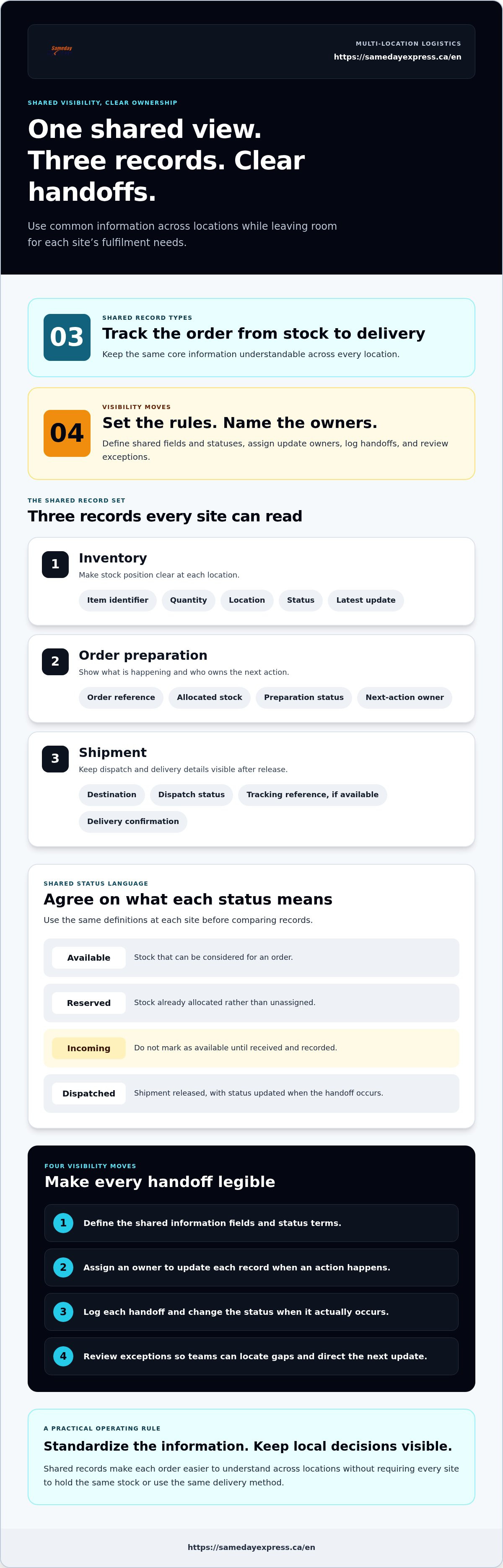
Shared visibility comes from agreed information and clear ownership, not simply from putting data on one screen. When managing logistics for multiple locations, create one working sequence: define the fields and status terms every site uses, assign an owner to update each record, log every handoff, then review exceptions. This lets teams follow an order from available stock through preparation and dispatch to delivery, even when different locations handle each stage.
Inventory visibility shows what stock is available at each location; shipment visibility shows where an order is and what has happened to it after dispatch. Both are needed to answer customer and operations questions accurately.
Set shared rules for order and inventory information
Agree on what “available,” “reserved,” “incoming,” and “dispatched” mean before comparing records across sites. For example, incoming stock should not appear as available until it has been received and recorded. Assign responsibility for updating each status, and make location-specific decisions, such as a stock hold or local allocation, visible to the wider operations team.
Use a consistent record for each order and its stock allocation. At minimum, capture:
- Inventory: item identifier, quantity, location, status, and the time of the latest update.
- Order: order reference, allocated stock, preparation status, and the team or role responsible for the next action.
- Shipment: destination, dispatch status, tracking reference where available, and delivery confirmation.
Keep the same labels and update rules across locations. If a site needs an additional field for its operations, retain the shared core information so other teams can still interpret the record.
Make shipment handoffs visible from dispatch to delivery
Map the shipment’s path and name the owner at each stage: preparation, release, tracking, and receipt. A status should change when the handoff actually occurs, not when someone expects it to happen. This distinction helps teams locate a delay, direct the next update to the right person, and avoid treating an uncollected order as a dispatched shipment.
Record these handoffs in a shared workflow:
- The preparing team confirms the order is packed and ready for release.
- The releasing team records dispatch and adds the tracking reference, if applicable.
- The responsible team monitors progress and logs exceptions that need action.
- The receiving team records delivery confirmation and any relevant exception.
Real-time GPS tracking can show a vehicle’s location and progress while a shipment is moving. It doesn’t identify who must act when a pickup is missed, a delivery is delayed, or confirmation is absent. Keep a named owner and escalation step alongside tracking information. Sameday Express provides real-time GPS tracking for Same Day Delivery. Businesses coordinating fulfilment and delivery can also review its logistics services.
Finally, review exceptions on a regular schedule. Look for missing status changes, unresolved handoffs, and records that don’t match the physical movement of goods. Use the findings to correct the workflow, clarify ownership, and keep shared information dependable across sites.
Match each multi-location shipment to the right logistics approach
Choose a logistics approach by looking at five factors together: urgency, shipment type, handling requirements, fulfilment work, and the tracking or records teams need. A planned online order may need storage, picking, packing, and returns processing. An urgent shipment calls for a delivery option suited to its deadline. Sensitive materials need handling procedures that match their requirements, not an ordinary parcel workflow by default.
Use this comparison to guide decisions across sites. The right choice depends on the shipment’s needs; one approach won’t suit every order.
Separate routine fulfilment from time-critical delivery
Use Warehousing & Fulfillment when orders need secure storage, inventory management, and pick-and-pack services as part of a planned flow. Same-day fulfillment and returns processing support ongoing order activity. For an urgent shipment, Same Day Delivery is a separate option, with pickup within 60 minutes, real-time GPS tracking, signature confirmation, and proof of delivery with photo. Choose based on the order’s deadline and the work required.
Account for sensitive shipment handling requirements
Lab samples, test kits, and biological materials may require more than a routine parcel process. Bioscience & Testing includes temperature-controlled transport, chain-of-custody documentation, and HIPAA-compliant handling. Medical Courier includes temperature monitoring, DG-trained drivers, medical protocol compliance, hospital dock delivery, and Emergency STAT service. Document the shipment’s handling needs and custody steps so each team knows what must be preserved through the handoff.
For managing logistics for multiple locations, make the selection criteria consistent while allowing each site to respond to its actual order mix. Record why an approach was chosen, then carry its handling and tracking requirements into the shared shipment workflow. This makes routine fulfilment easier to plan and urgent or sensitive shipments clearer to coordinate.
Create a repeatable operating plan for every location
A repeatable plan turns shared logistics rules into work teams can follow during routine fulfilment and time-critical shipments. For managing logistics for multiple locations, map the current workflow first, then pilot agreed changes, train the people responsible, and review what happens in practice. Keep the core process consistent, but allow documented local steps where demand or fulfilment needs differ.
Map the workflow before changing it
Trace a representative order from the stock decision through preparation, dispatch, and receipt. Mark each handoff between site staff, fulfilment operations, and delivery support. For every stage, record who owns the next action, what status confirms it’s complete, and where exceptions are logged. This shows whether a delay stems from missing stock, unclear release responsibility, or a delivery issue.
List recurring exceptions, such as an inventory mismatch, a shipment that hasn’t been collected, a delayed delivery, or a sensitive shipment that needs special handling. Assign a response owner and an escalation route to each. Urgent orders need a clear path for prioritization; sensitive shipments need steps that preserve their required handling and custody records.
Pilot shared procedures and improve them
Test the documented workflow with representative orders before introducing it across every site. Include routine fulfilment, an urgent shipment, and any sensitive shipment type relevant to the operation. A pilot exposes unclear instructions and missing handoffs while the process is still limited in scope. Update the procedure based on what teams encounter, rather than assuming the first draft will fit every location.
Train staff on the shared status definitions, required records, handoff responsibilities, and escalation steps. Make sure each person knows how to record a shipment’s release and receipt, and what to do when the expected update is missing. For urgent delivery planning, use the guide Livraison le jour même : Le guide complet pour les entreprises alongside your organization’s escalation plan.
Review the process regularly using operational evidence, not invented performance targets. Useful review topics include:
- Shipment status: Are dispatch, in-transit updates, and delivery confirmations recorded clearly?
- Inventory accuracy: Do recorded quantities and statuses match what the location can actually fulfil?
- Exception handling: Are delayed, urgent, or sensitive shipments routed to the right owner, with actions documented?
- Handoffs: Can teams identify who has responsibility at each stage and what information must travel with the order?
Use review findings to clarify instructions, adjust local steps, and retrain teams where needed. A reliable operating plan takes regular checks and practical revisions. To plan logistics support for your locations, Request a Quote.
How Sameday Express Inc. supports multi-location logistics
Managing logistics for multiple locations calls for dependable delivery, clear fulfilment processes, and shipment information teams can act on. Sameday Express supports businesses with delivery, warehousing, and fulfilment needs. Teams can align planned order preparation with delivery support while selecting services based on each shipment’s urgency and handling requirements.
Coordinate fulfilment and delivery through one logistics partner
Warehousing & Fulfillment brings secure storage, inventory management, and pick-and-pack services together with same-day fulfillment and returns processing. This helps businesses coordinate stock and order preparation, then arrange the next delivery step according to the order’s needs. For urgent shipments, Same Day Delivery includes pickup within 60 minutes, real-time GPS tracking, signature confirmation, and proof of delivery with photo.
Real-time GPS tracking gives teams visibility into a shipment’s progress, while recorded handoffs help clarify who is responsible for the next action. Sameday Express provides delivery and fulfilment support. All shipments fully covered end-to-end.
Support urgent and specialized shipment workflows
Urgent delivery needs differ. Same Day Delivery supports shipments that need to move promptly, while aircraft-on-ground emergencies have a dedicated option: AOG - Aircraft on Ground, available 24/7. For same-day delivery planning, the guide Livraison le jour même : Le guide complet pour les entreprises offers further service context.
For sensitive shipments, handling procedures matter alongside timing. Bioscience & Testing supports the transport of lab samples, test kits, and biological materials with temperature-controlled transport, chain-of-custody documentation, and HIPAA-compliant handling. Medical Courier includes temperature monitoring, DG-trained drivers, medical protocol compliance, hospital dock delivery, and Emergency STAT service. These handling details help teams coordinate the right procedures as shipments move between locations.
To bring warehousing, fulfilment, and delivery needs into a coordinated logistics plan, Request a Quote from Sameday Express.
Put your next logistics improvement into motion
Your logistics network should adapt as customer expectations, order patterns, and site requirements change. Treat each operational change as a chance to strengthen the way locations work together: choose a practical improvement, make ownership clear, and use what teams learn to guide the next adjustment. This steady approach helps keep managing logistics for multiple locations responsive without losing the consistency customers rely on.
Sameday Express brings over 25 years of experience supporting business logistics needs. If your next step is aligning delivery or fulfilment support with your operation, Request a Quote. A clear plan can help move your logistics operation forward.
Frequently Asked Questions
How do you manage inventory across multiple locations?
For managing logistics for multiple locations, pair stock records with routine checks so teams can spot discrepancies before they affect an order. For example, compare recorded quantities with a physical count after a receipt, return, or adjustment, and document the reason for any correction. This helps distinguish a one-off recording error from a recurring issue, such as stock being assigned to orders before the allocation is reflected in the system.
What is the difference between multi-location inventory management and multi-location logistics?
Inventory management helps a business decide how much stock to hold and where to position it. Multi-location logistics concerns how goods move through the operation to meet demand. For example, a stock review may identify that an item is needed at another site; the logistics plan then addresses how that movement fits with committed orders and delivery needs. Reviewing both together can help teams avoid decisions based on stock counts alone.
How can a business reduce shipping delays across multiple locations?
Compare delays with the operating conditions around each shipment, such as order cut-off times, receiving hours, and site-specific dispatch windows. A delivery arriving after a receiving team has left may create a delay even if the shipment moved as planned. Recording these constraints alongside incident details helps businesses adjust schedules and customer updates to the actual cause, rather than applying the same fix to every late order.
Can one logistics process work for every business location?
A shared process can set the minimum information and decisions every location must follow, while a local addendum describes site-specific steps. For instance, one location may need to document an appointment requirement, while another does not. Keep local variations visible and assign someone to approve changes. This helps prevent a useful exception from becoming an undocumented process that other teams cannot interpret.
When should a business use third-party logistics for multiple locations?
Consider outsourcing when a defined activity is taking staff away from core work, is difficult to coordinate across sites, or needs capacity your internal operation cannot consistently provide. Before the work begins, agree on the information exchanged, who handles customer questions, and who resolves discrepancies between business records and fulfilment activity. Sameday Express supports businesses through Warehousing & Fulfillment as part of their logistics arrangements.
How can teams track shipments between multiple locations?
Give each shipment a reference that connects the business order to the delivery record, and use that same reference in internal updates and customer service notes. This makes it easier to find the relevant information without relying on a recipient’s name or scattered message threads. Limit access to staff who need the details, and establish one source for shipment updates so teams don’t circulate conflicting information.
How should businesses handle lab samples across multiple locations?
Use a sample manifest that links each item to its internal identifier, sending location, intended recipient, and any handling instructions supplied by the responsible team. Before release, check that the destination details and receiving contact match the planned transfer. On receipt, record who accepted the shipment and connect that confirmation to the manifest. These steps help teams reconcile sample records across locations without relying on informal notes.
What should a business include in a multi-location logistics plan?
Include a document owner, a revision date, and a process for telling affected staff when instructions change. Keep current procedures easy to locate, and remove outdated copies from shared work areas. Add a continuity note for staff absences or system interruptions, identifying who can take over key decisions. These governance details help keep the plan usable as responsibilities, team members, and operating conditions change.
Disclaimer
Blog Disclaimer
The information published on the Sameday Express Blog is provided for general informational and educational purposes only. While we strive to keep all content accurate and up to date, Sameday Express makes no representations or warranties of any kind, express or implied, regarding the completeness, accuracy, reliability, suitability, or availability of the information contained in our articles.
The content on this blog does not constitute legal, customs, tax, regulatory, financial, or professional advice. Shipping regulations, carrier policies, customs requirements, and transportation laws may change without notice and may vary by destination. Readers should verify current requirements with the appropriate government authorities, carriers, or qualified professionals before making shipping or business decisions.
Sameday Express is not liable for any loss, damage, delays, or consequences arising from the use of, or reliance on, information published on this website. Any actions taken based on the information provided are at the reader's own risk.
References to third-party companies, products, services, or websites are provided for informational purposes only and do not constitute an endorsement or recommendation by Sameday Express.
All blog content, including text, graphics, images, and logos, is the property of Sameday Express unless otherwise stated and may not be reproduced or distributed without prior written permission.
For specific shipping requirements, pricing, transit times, or logistics solutions, please contact Sameday Express directly for personalized assistance.


