

Could the fastest delivery estimate still be the wrong choice for a high-stakes shipment? Choosing a high value courier service Canada businesses can rely on means looking beyond speed alone. A delayed aircraft part can hold up a repair, while a sensitive lab sample may need careful handling and a clear chain of custody.
Urgency, shipment size, route and handling requirements all matter. A small, time-critical parcel may need a different delivery model than a full truckload or biological materials. The right match supports the delivery timeline and helps protect the shipment in transit.
This guide explains how to match urgency and route with a courier service, plan tracking and custody, and prepare shipment details before dispatch. Sameday Express offers same-day, rush and Direct Drive services for time-critical shipments. Direct Drive carries a shipment on a dedicated route, with no transfers, no terminals and no cross-docking. GPS-tracked vehicles support visibility in transit. With more than 25 years of experience, we help businesses plan urgent shipments across Canada and on Canada-U.S. routes.
Key Takeaways
- Assess a shipment’s operational impact, sensitivity and time pressure, not just its monetary value.
- Match delivery speed and model to the route, shipment size and handling requirements.
- Prioritize route control, tracking and clear delivery coordination when choosing a high value courier service in Canada.
- Prepare shipment details and handling instructions in advance, then document receipt to support a clear chain of custody.
- Use the decision checklist to prepare a precise courier request for your urgent business shipment.
What Makes a Courier Shipment High Value for a Canadian Business?
A shipment’s value isn’t measured only by its replacement price. A delayed lab sample can interrupt a research workflow. A medical device may be needed for planned care, and a critical aviation part can affect the return of an aircraft to service. Legal documents and business materials can also carry firm deadlines, even if they’re small or inexpensive to replace.
A high-value courier shipment is one whose delay, loss or mishandling could disrupt a business operation, time-critical commitment or sensitive process, regardless of its monetary value. This definition shifts the focus from what an item costs to what depends on it arriving safely and on time.
Assess the shipment as part of the process it supports. A document may need to reach a signing party before a scheduled transaction. A test kit may be needed before a laboratory can begin planned work. A replacement component may be required before a maintenance task can proceed. In each case, the delivery requirement comes from the next step in the workflow.
Which business shipments need time-critical courier service?
Time-critical needs arise wherever the next step depends on an item arriving by a particular deadline. A healthcare team may be waiting for lab samples, test kits, medications or a medical device. A research team may need materials before scheduled analysis can proceed. In aviation, a grounded aircraft may be waiting for a required part. Legal teams may have documents that must reach a recipient before a filing or signing deadline, while commercial operations may depend on a replacement component or customer order.
A delay can interrupt a workflow, appointment, repair or business commitment. Before choosing a delivery model, define the timing and handoff requirements:
- Deadline: When must the shipment arrive? Is there a fixed appointment or cutoff?
- Recipient readiness: Who will receive it, and can they accept delivery at the expected time?
- Sensitivity: Does the item need specific handling or a documented handoff?
These details help match urgency with a practical delivery model. If the shipment must arrive on the day of pickup, state that requirement when planning the delivery.
When does shipment value go beyond the item itself?
Value can also reflect how difficult an item is to replace, what depends on its arrival and how sensitive it is in transit. A specialized component may be difficult to source quickly. Biological materials may require careful handling for their intended use. Consider the operational role of the contents as well as their physical and financial value.
A declared monetary value or insurance amount isn’t the same as operational importance. Those figures describe financial aspects of a shipment, but don’t explain the effect of a missed deadline or interrupted process. A supply chain security plan also considers how items are protected and accounted for as they move between people and locations.
To make effective use of a high value courier service Canada businesses can depend on, describe the item, deadline, route, recipient and handling requirements clearly. These details give the delivery team practical information to plan around the shipment’s real importance.
How High-Value Courier Services Move Urgent Shipments
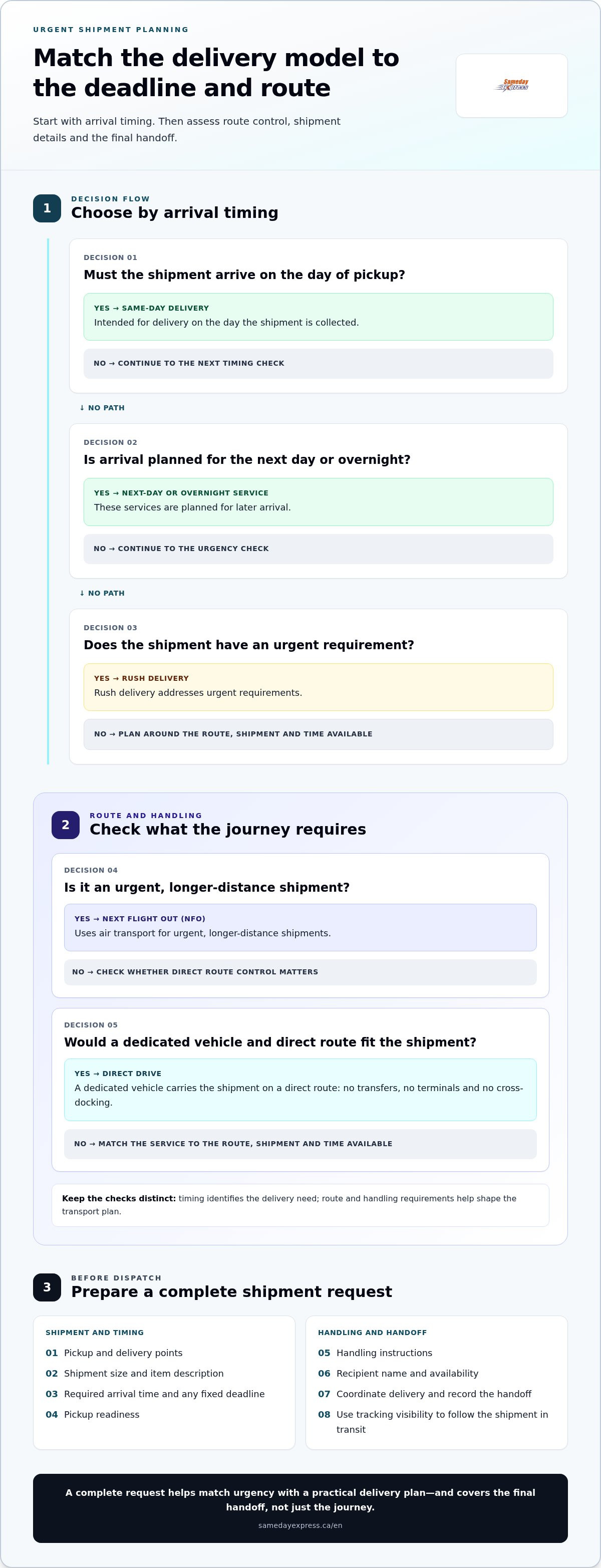
Urgent delivery starts with a complete request. Provide the pickup and delivery points, shipment size, required arrival time, item description and handling instructions. Dispatch can then match the request with a service model and coordinate pickup, transport and handoff. Include the recipient’s availability and any fixed deadline, so the plan covers the final handoff as well as the journey.
Each service addresses a different timing need. Same-day delivery is intended for delivery on the day of pickup. Next-day and overnight services are planned for later arrival, while rush delivery addresses urgent requirements. Direct Drive uses a dedicated vehicle for a direct route rather than moving the shipment through a shared network. The right fit depends on the route, shipment and time available.
- On-demand dispatch: Arrange transport in response to a specific request, rather than waiting for a daily lane or scheduled network movement.
- Pickup and preparation: Provide shipment details and handling instructions, then coordinate collection.
- Transport and delivery: Move the shipment using the selected service and route, then record the handoff.
Plan around the actual route, pickup readiness and delivery coordination. Confirm when the shipment will be ready and make sure the recipient can accept it. Those details help set a practical delivery plan without treating an estimate as a guarantee.
How does Direct Drive reduce unnecessary shipment transfers?
Direct Drive assigns a vehicle to carry the shipment from pickup to destination. No transfers means the shipment isn’t passed between vehicles. No terminals means it doesn’t travel through sorting hubs. No cross-docking means it isn’t moved between inbound and outbound transport during a hub stop. Fewer handoffs can make custody easier to follow, though they don’t remove every transport risk. When a direct journey matters, share the route and timing requirements when arranging the service.
When might air-linked or next-flight transport fit?
Next Flight Out (NFO) uses air transport for urgent, longer-distance shipments. It differs from Direct Drive, which uses a dedicated road vehicle on a direct route. Neither model is automatically right for every shipment. Air transport may suit a route where distance makes road travel a poor fit, while Direct Drive may suit a shipment that needs a dedicated road journey.
Planning still depends on practical details: when the shipment will be ready, the route and how the recipient will collect or receive it. Coordinate the handoff before dispatch, especially when delivery supports a time-critical operation. For urgent requests, Sameday Express offers rush and direct-drive delivery options.
Compare Courier Service Models for High-Value Deliveries
The fastest option isn’t automatically the best operational fit. Match the delivery model to the deadline, shipment dimensions, handling requirements and level of route control required. Choose a courier model by matching the shipment’s urgency and handling needs to the route control it requires.
Use this comparison to narrow the options. The right choice depends on the route and the service arrangement.
| Service model | Urgency | Shipment size | Handling needs | Route control and availability |
|---|---|---|---|---|
| Network parcel delivery | Planned, less urgent | Generally parcel-scale | For shipments suited to a standard parcel process | Moves through a carrier network and its scheduled operations |
| Same-day courier | Arrival needed on pickup day | Often envelopes or parcels | Useful when a defined delivery deadline matters | Arranged for a specific shipment; route depends on the request |
| Next-day delivery | Needed the following day | Often parcel-scale | For shipments that can follow a next-day schedule | Follows the service’s planned network or dispatch model |
| Direct Drive | Time-critical or transfer-sensitive | Can range from an envelope to a full truckload | Can suit shipments where fewer handoffs are preferred | Dedicated direct road route, arranged for the shipment |
| Air-linked option | Urgent, often over longer distances | Depends on shipment and transport arrangements | Requires coordination around shipment readiness and handoff | Uses air transport; route depends on the shipment |
When is a standard courier network a suitable fit?
A network service can suit planned parcel movements when the delivery window allows the shipment to move through scheduled sorting and transport. The UPS Store describes standard and express domestic shipping approaches, while Canada Post presents Priority as its fastest domestic parcel service, subject to its stated conditions. These are examples of published service approaches, not a guarantee that either option fits every shipment.
When should a business consider dedicated or rush delivery?
Consider same-day or rush delivery when a fixed deadline leaves little room for a network schedule. Direct Drive can be a practical choice when a shipment needs a direct route or fewer transfers. Shipment size can range from an envelope to a full truckload, so size alone doesn’t determine the service model. Include cross-border Canada-U.S. movement in the plan when the shipment crosses the border.
When choosing a high value courier service Canada businesses can use, weigh the deadline against handling needs and route control. A standard parcel network may fit a routine movement, while a dedicated service may better suit an urgent shipment requiring a direct journey. Select the model that meets the operational requirement, not simply the one described as fastest.
Plan Handling, Tracking, and Custody for Sensitive Shipments
Sensitive shipments need clear instructions before pickup, not assumptions during transit. Lab samples, test kits, biological materials, medications and medical devices can each have different handling needs. Identify the requirements for the specific item, then share them with the courier so the pickup, journey and handoff can be planned accordingly.
Use this sequence to prepare a shipment request:
- Identify the item and sensitivity. Describe what is being sent and any handling requirements provided by the responsible healthcare or research team.
- Prepare shipment details. Provide pickup and delivery addresses, contact names, deadline, shipment size and instructions for the recipient.
- Coordinate pickup. Have the shipment ready and ensure the person handing it over understands the relevant instructions.
- Monitor the journey. Use shipment updates and GPS vehicle tracking to follow progress during transport.
- Document receipt. Record who accepted the shipment and when, following your organization’s process.
What should businesses plan for medical courier shipments?
Be specific about the item type, sensitivity, required handling, destination and time-critical nature. A lab sample may have different instructions from a test kit or medical device. For medications or biological materials, communicate applicable healthcare regulations and temperature requirements accurately, using the requirements supplied by the responsible organization. Don’t assume one item’s instructions apply to another.
Chain of custody means documenting who is responsible for a shipment at each handoff, from pickup through receipt. Our drivers are trained to handle sensitive materials and maintain appropriate chain-of-custody procedures. Keep shipment records aligned with your organization’s requirements, and make handoff responsibilities clear before dispatch.
How can tracking and delivery coordination support reliability?
Sameday Express vehicles are GPS-tracked. GPS tracking can show vehicle location during transport, helping teams monitor progress and coordinate with the receiving location. It doesn’t replace clear pickup and delivery instructions. Confirm that the shipment is ready at the agreed pickup point and that the recipient knows when and where to accept it. This matters when a time-sensitive delivery depends on someone being available to receive it.
Clear custody records make each handoff easier to account for. They show who accepted responsibility and help resolve questions about receipt without relying on memory alone. Keep the required delivery record with the shipment’s related documentation.
For a high value courier service Canada businesses can use for sensitive deliveries, share accurate handling instructions and coordinate the recipient handoff in advance. Arrange a time-critical shipment with Sameday Express and provide the details needed to plan its movement.
Choose a High-Value Courier Partner for Canadian Business Logistics
The right logistics partner should support urgent shipments and the way your business operates over time. Start with the delivery need in front of you, then consider whether recurring storage, order preparation or distribution support would help your commercial logistics. We’re a Canadian B2B logistics partner with more than 25 years of experience supporting time-sensitive business shipments.
- Urgency: Set the delivery deadline and note any fixed appointment or cutoff.
- Shipment type: Describe the contents, dimensions and whether it’s an envelope, parcel, pallet or larger load.
- Handling: Share relevant instructions for sensitive materials, based on your organization’s requirements.
- Route: Provide complete pickup and delivery details, including whether the shipment crosses the Canada-U.S. border.
- Coordination: Identify pickup and receiving contacts, and make sure someone can accept the shipment.
This checklist turns an urgent need into a clear, actionable request. Use it to align the service with the shipment and your wider logistics requirements.
Which logistics partner fits recurring business shipments?
A one-off urgent delivery calls for a different plan than ongoing fulfilment. If your business regularly stores products, prepares customer orders and sends them out, our warehousing, third-party logistics (3PL) and pick-and-pack fulfillment services can support those recurring operations. These services help e-commerce businesses coordinate storage, order preparation and dispatch as part of their wider commercial logistics plan.
Consider how often orders need preparation, which storage and dispatch tasks your team manages, and how delivery fits into the workflow. We support time-critical shipments and ongoing commercial logistics, with a plan for each that reflects its operational requirements.
What information helps start an urgent courier request?
Prepare the pickup and delivery addresses, contact names, shipment description, size, required timing and handling instructions. For sensitive shipments, share the relevant requirements and identify who will receive the item. We’re available 24/7 for urgent delivery requests. Complete details help us plan the request, but they don’t guarantee a particular arrival time.
For an urgent shipment or ongoing logistics support, contact us to plan your delivery.
Make Your Next Urgent Shipment Easier to Coordinate
Turn your delivery requirements into a simple dispatch brief your team can reuse. Record who authorizes the shipment, who prepares it, who receives it and who confirms delivery. For recurring needs, keep approved handling instructions and recipient details accessible, then update them when contacts or procedures change. This gives everyone a clear next step when a time-critical request comes in.
A high value courier service Canada businesses depend on should fit the shipment’s operational needs. Give your logistics partner a precise request, including the deadline, route, shipment description and special instructions. Clear information helps move planning forward without avoidable back-and-forth.
Have an urgent delivery to arrange? Contact Sameday Express to plan an urgent delivery. Share the shipment details and deadline to start planning with our team.
Frequently Asked Questions
What is considered a high-value courier shipment?
A high-value courier shipment is one where the business impact of a delay, loss or mishandling deserves special attention. Ask: if the item arrives late or unusable, could a scheduled task, client commitment or operational handoff be disrupted? An original legal document, a medical device needed for an appointment or a replacement part can meet that test, even if its purchase price is modest.
How fast can a courier deliver a shipment across Canada?
Delivery timing depends on the route, pickup readiness and service model, so there isn’t one arrival time for every shipment across Canada. Same-day, next-day, overnight, rush and Direct Drive options address different deadlines. A shipment with a firm same-day requirement needs a different plan from one that can arrive the following day. Share the required delivery time and route to help determine a suitable option.
Is Direct Drive different from regular courier delivery?
Yes. Direct Drive is arranged for a shipment to travel on a direct road route, while regular network courier delivery moves through a carrier’s scheduled network. Direct Drive can suit a request where the pickup and recipient need close coordination, such as a component sent from a supplier to a maintenance site. The choice depends on the deadline and the level of route control the shipment requires.
Can a courier transport lab samples and biological materials?
Yes. Sameday Express provides specialized medical courier services for lab samples and biological materials. Before arranging transport, identify the material clearly and share the handling instructions supplied by your laboratory or healthcare organization. Include the receiving department and its contact so delivery can be coordinated with the people expecting it. Requirements vary by shipment, so follow the applicable instructions rather than assuming all samples need the same process.
Can courier services move shipments between Canada and the United States?
Yes. Sameday Express offers cross-border shipment services between Canada and the United States. For a high value courier service Canada businesses can use on a cross-border route, prepare the pickup and delivery details, shipment description, required timing and recipient contact in advance. Clear information helps coordinate movement and handoff. Plan it as a cross-border shipment from the outset, rather than treating it as a domestic delivery with a different destination.
Can a courier handle both small parcels and large freight shipments?
Yes. Sameday Express handles shipments ranging from envelopes and parcels to full truckloads. The shipment format helps determine what information is needed to plan collection and delivery. Describe what is being sent, its approximate size and load type, pickup access and delivery arrangements. For a larger commercial load, include the receiving contact and any site coordination details so the plan fits the shipment rather than treating it like a small-parcel pickup.
What information should I provide when requesting an urgent courier delivery?
Provide the pickup and delivery addresses, contact names, shipment description, size, required timing and handling instructions. Note whether the shipment is ready for pickup and whether the recipient can accept it at the expected time. For sensitive materials, follow the instructions from your organization’s responsible team. Sameday Express accepts urgent delivery requests 24/7; complete details help our team plan the request without implying a guaranteed arrival time.
Disclaimer
Blog Disclaimer
The information published on the Sameday Express Blog is provided for general informational and educational purposes only. While we strive to keep all content accurate and up to date, Sameday Express makes no representations or warranties of any kind, express or implied, regarding the completeness, accuracy, reliability, suitability, or availability of the information contained in our articles.
The content on this blog does not constitute legal, customs, tax, regulatory, financial, or professional advice. Shipping regulations, carrier policies, customs requirements, and transportation laws may change without notice and may vary by destination. Readers should verify current requirements with the appropriate government authorities, carriers, or qualified professionals before making shipping or business decisions.
Sameday Express is not liable for any loss, damage, delays, or consequences arising from the use of, or reliance on, information published on this website. Any actions taken based on the information provided are at the reader's own risk.
References to third-party companies, products, services, or websites are provided for informational purposes only and do not constitute an endorsement or recommendation by Sameday Express.
All blog content, including text, graphics, images, and logos, is the property of Sameday Express unless otherwise stated and may not be reproduced or distributed without prior written permission.
For specific shipping requirements, pricing, transit times, or logistics solutions, please contact Sameday Express directly for personalized assistance.


