

Could the fastest-looking delivery option still be the wrong choice for a critical part? When a missing component delays maintenance, production, or an aircraft’s return to service, every timing and handling decision matters. Critical parts logistics is not simply about moving a package quickly. It means matching the part, route, and deadline with a suitable delivery plan.
A late shipment can keep essential work on hold. A part that needs careful handling also requires clear instructions and coordination. The right approach depends on how far it must travel, when it is needed, and what handling or custody requirements apply.
In this guide, we compare Direct Drive, rush delivery, same-day delivery, and Next Flight Out, including when an air-linked option may suit a long-distance urgent shipment. We also cover what to prepare before dispatch, from dimensions and pickup timing to delivery instructions. At Sameday Express Inc., we support urgent commercial shipments with delivery options for different routes and shipment sizes. Use the steps below to make a clear, informed choice when time matters.
Key Takeaways
- Plan critical parts logistics around the operational deadline, part requirements, and receiving arrangements, not distance alone.
- Compare Direct Drive, rush, same-day delivery, and Next Flight Out against the route, shipment size, and need for direct handling.
- Prepare a clear part description, dimensions, packaging details, handling instructions, and pickup and delivery contacts before dispatch.
- Identify when the part is needed and coordinate with the recipient to avoid delays at handoff.
- Choose a service that fits the shipment’s needs, including AOG support for urgent aircraft parts.
What Critical Parts Logistics Means When a Shipment Cannot Wait
A replacement component can fit in a small parcel and still hold up a major operation. What makes a shipment urgent is not its size or category, but the work that cannot proceed while the part is unavailable.
Critical parts logistics is the planning and urgent transport of a component needed to prevent or limit disruption to an operation. Routine replenishment supports planned inventory levels. An urgent replacement shipment addresses a specific operational need. General logistics covers the movement of goods and related information, as outlined in What is Logistics? Critical-parts transport focuses that coordination on getting a needed component to its recipient in time for the next operational step.
This video offers a broader look at service parts logistics and uptime strategies:
Which shipments count as critical parts?
A shipment is critical when its contents are holding up work and delivery can help move that work forward. This may be an aircraft component needed during an aircraft-on-ground (AOG) event, or a production, maintenance, or repair part required by a business. The practical test is the component’s role in the recipient’s operation.
An urgent request may involve a single replacement part rather than a planned stock replenishment. That distinction matters: inventory planning maintains supply over time, while an urgent dispatch addresses a known need at a specific destination. A clear part description and a brief explanation of the work waiting for it help define the request.
Why does a missing part create time pressure?
A repair or maintenance task may not proceed until the required component arrives. In production, a missing part can interrupt a dependent step. During an AOG event, an aircraft remains grounded while the needed part is unavailable. The delivery plan is therefore tied to an operational sequence, not just an address.
Start with the recipient’s actual deadline. A part needed before scheduled maintenance may call for a different response than one holding up an active repair. Before arranging transport, identify what work is waiting, when the component is needed, and who can receive it. These details help dispatch assess the request and coordinate a suitable urgent delivery option. Effective critical parts logistics begins with the operational impact, then plans transport around it.
How Critical Parts Logistics Works From Dispatch to Delivery
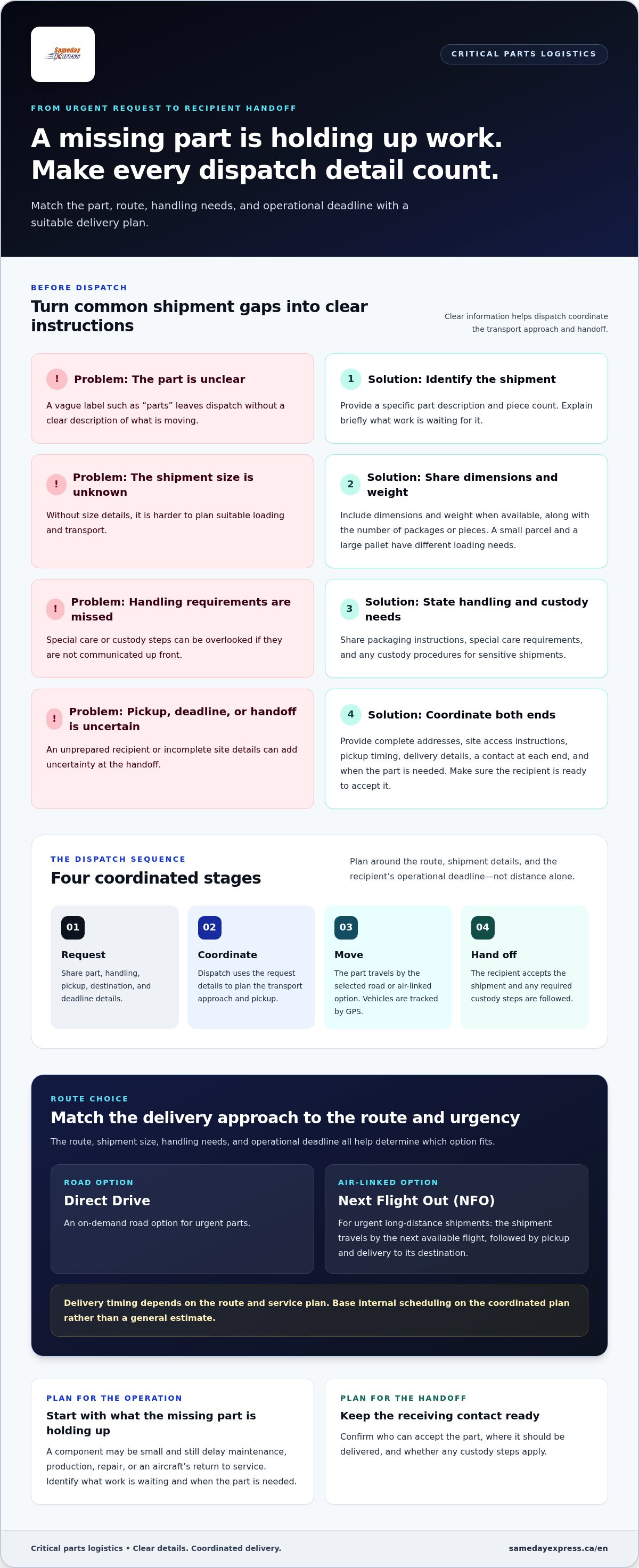
A time-critical shipment moves through a coordinated sequence: the shipper provides the request details, dispatch assesses the shipment and route, a delivery approach is arranged, and the recipient accepts the part. Clear communication at each stage helps avoid delays caused by missing information.
Complete shipment details help dispatch coordinate the transport approach sooner and reduce uncertainty at handoff. For critical parts logistics, explain what is moving, where it must go, how it should be handled, and when the recipient needs it.
What information should a dispatch request include?
Prepare the details needed to identify the shipment, plan for its size, and coordinate pickup and delivery. Include:
- Part information: A specific description and piece count. Avoid vague labels such as “parts.”
- Shipment size: Dimensions and weight, when available, plus the number of packages or pieces.
- Handling needs: Packaging instructions, special care requirements, and custody procedures for sensitive shipments.
- Pickup and destination: Complete addresses, site access instructions, pickup timing, and delivery details.
- Contacts and deadline: A contact at each end and the time the part is needed for the next operational step.
Accurate dimensions and weight help dispatch plan for an appropriate vehicle or transport approach. A small parcel and a large pallet have different loading needs. Sameday Express handles envois de toutes tailles, from envelopes and parcels to full truckloads, so clear shipment details support practical planning.
How does the delivery move through the network?
Once the request is clear, dispatch coordinates the service around the route and urgency. Direct Drive is an on-demand road option for urgent parts. Next Flight Out (NFO) is an air-linked option for urgent long-distance shipments: the shipment travels by the next available flight, followed by pickup and delivery to its destination. The route and service plan affect delivery timing, so base your internal schedule on the coordinated plan rather than a general estimate.
- Request: The shipper shares part, handling, pickup, destination, and deadline details.
- Coordination: Dispatch uses those details to plan the transport approach and pickup.
- Movement: The part travels by the selected road or air-linked option. Vehicles are tracked by GPS.
- Handoff: The recipient is ready to accept the shipment, and any required custody steps are followed.
Before dispatch, make sure the receiving contact knows a delivery is coming and can accept the part. For urgent business shipments, Sameday Express coordinates from request through recipient handoff with its urgent delivery services.
Direct Drive, Rush, or Next Flight Out: Which Option Fits?
The right urgent delivery option depends on the route, shipment size, handling needs, and operational deadline. Direct Drive and Next Flight Out describe different transport approaches. Rush and same-day delivery describe timing. Compare the options below, then match the service to the shipment and the work waiting for it.
| Service | Urgency and route fit | Shipment size and handling |
|---|---|---|
| Direct Drive | On-demand road transport for time-critical shipments on routes suited to direct driving. | Share the shipment’s dimensions and weight so the transport approach can account for its size. |
| Rush delivery | An expedited option for urgent requests. The route and required delivery timing inform the plan. | Handling needs and shipment size help guide coordination. |
| Same-day delivery | For a shipment collected and delivered on the same day, where the route and timing allow. | Confirm that the recipient can accept the shipment within the required timeframe. |
| Next Flight Out | An air-linked option to consider for urgent, longer-distance shipments. | Air travel is followed by pickup and delivery to the destination. Plan for shipment size and receiving arrangements. |
These options are not interchangeable. Same-day describes the delivery timeframe, while Direct Drive and Next Flight Out describe different transport approaches. Rush delivery is designed for urgent requests, with the route and deadline guiding coordination. Share the shipment details and required delivery timing so dispatch can plan the service appropriately.
When is Direct Drive the better fit?
Direct Drive is an on-demand road option for urgent commercial shipments when the route suits road transport and direct coordination is a priority. For example, a component needed at a maintenance site may require a plan built around the site’s receiving hours and the work deadline. Sameday Express offers Direct Drive for time-critical business shipments.
When should a team consider Next Flight Out?
Consider Next Flight Out for an urgent long-distance shipment when an air-linked route fits the need. The shipment travels by the next available flight, followed by pickup and delivery to the destination. Direct Drive keeps the journey on the road, so distance and route conditions inform the comparison. Both options require a plan that accounts for the deadline and the recipient’s ability to receive the part.
Choosing a faster option does not mean giving up operational oversight. Set the required arrival timing and identify who will accept the shipment, so your team can align its next steps with the delivery plan. For critical parts logistics, choose the service that matches the route and urgency, not simply the most appealing service name.
How to Prepare a Critical Parts Shipment for Dispatch
A clear pre-dispatch plan gives the logistics team the details needed for pickup, transport, and handoff. Before requesting service, identify the part, its handling needs, the operational deadline, and the person who will receive it. Critical parts logistics relies on accurate, consistent information from shipper to recipient.
Use this checklist to prepare the request:
- Identify the part: Provide a specific description and piece count. Include dimensions and weight when available.
- Prepare the packaging: Secure the part in packaging suited to its shape, size, and fragility. Have the package ready for collection.
- Document handling needs: Note any sensitivities, handling instructions, or chain-of-custody requirements before dispatch.
- Set the deadline: State when the part must arrive to support the next repair, maintenance task, or business operation.
- Confirm both ends: Provide pickup and delivery addresses, site access instructions, contact names, and working phone numbers.
- Check receiving arrangements: Make sure someone can accept the shipment and follow any required handoff procedure.
How should a team prepare the part and its handling details?
Choose secure packaging that protects the component during transport. The appropriate material and packing method depend on the part. Keep the description and instructions consistent across the dispatch request, package information, and recipient communications. If a component needs careful handling or documented custody, state that clearly and identify who is responsible at each handoff. Clear instructions give everyone involved a practical reference.
How can dispatch avoid preventable delays?
Confirm that pickup staff know the shipment is ready and that the recipient can accept it during the required arrival window. Share access details such as the correct entrance, delivery location, or contact procedure. Communicate any special receiving arrangements before dispatch. For a road shipment, Google Maps driving time plus one hour can serve as a basic planning estimate where applicable. Use it as a planning aid, then account for route conditions and the selected service.
For broader planning around urgent business deliveries, use this same-day delivery guide for businesses. The same preparation habits help teams set priorities and have a recipient ready. To arrange a time-critical commercial shipment, review our urgent delivery services and share the part details, deadline, and handling instructions with dispatch.
How Sameday Express Inc. Supports Critical Parts Logistics Across Canada
Urgent commercial shipments need delivery approaches matched to the shipment. We support businesses across Canada with options for envois de toutes tailles, from small parcels to full truckloads. The part’s size, route, handling requirements, and operational deadline help shape the plan. That gives operations teams a practical way to coordinate urgent transport instead of trying to fit every request to one service.
What does the service approach offer operations teams?
Our Direct Drive delivery is an on-demand road option for time-critical parts. Rush delivery supports urgent business requests, while Next Flight Out offers an air-linked approach for urgent long-distance shipments. Each service addresses a different transport need. The best fit depends on the shipment and destination.
For aircraft-on-ground situations, our AOG service operates 24/7 for urgent aviation parts delivery. This service supports coordination when an aircraft is grounded and a critical part is needed. Sameday Express brings over 25 years of experience to urgent delivery and commercial logistics, supporting businesses with time-sensitive shipment needs.
For planning beyond a single delivery request, our guide to specialized transportation offers broader context. When you have the shipment details and deadline ready, we can help coordinate an urgent delivery.
What should a business do next?
Start with a clear part description, shipment dimensions and weight when available, pickup and destination details, and handling instructions. Identify the operational deadline and provide the receiving contact and delivery arrangements. These details give our team a practical basis for coordinating the shipment and selecting an appropriate delivery approach.
Keep the relevant staff aligned on the deadline and receiving plan. If the destination, contact, or shipment requirements change, share the update promptly so coordination reflects the latest information. A prepared request helps your business act quickly when a critical part is holding up work.
Ready to arrange an urgent delivery? Discuss your time-critical shipment with our team.
Make Your Next Urgent Shipment Easier to Activate
Set a clear internal trigger for urgent transport. Decide who can authorize a time-critical shipment, who will coordinate with the receiving site, and where staff can find the details needed to act. A simple process helps your team move from identifying a missing component to arranging delivery without losing time to unclear responsibilities.
Review the process after each urgent shipment. Note where communication worked well and where a handoff or decision took longer than expected. These observations can help refine your approach to critical parts logistics before another component is needed.
Have a time-critical shipment to plan? Discuss your time-critical shipment with our team and take the next step.
Frequently Asked Questions
Can critical parts be shipped across Canada on an urgent basis?
Yes. Sameday Express supports urgent commercial shipments across Canada. Depending on the origin, destination, deadline, and handling needs, options may include Direct Drive, rush delivery, same-day delivery, or Next Flight Out. If a repair team is waiting for a replacement assembly, share when work can resume and who will receive the part. Dispatch can coordinate the request around those details.
What information should I provide when arranging critical parts logistics?
For critical parts logistics, give dispatch a clear part description, piece count, dimensions, and weight when available. Include pickup and delivery addresses, contacts for both ends, and the time the part is needed. Explain what operation or repair is waiting, too. That context helps the team understand the request’s priority. Handling or custody instructions help everyone prepare for transport and handoff.
Can a courier deliver an aircraft part for an AOG situation?
Yes. Sameday Express provides a 24/7 AOG service for urgent aircraft parts delivery. Share the component description, pickup and destination details, receiving contact, and operational deadline. If a maintenance crew is waiting to resume work, include that context when arranging the shipment. Direct Drive or air-linked transport may suit the request, depending on the route and plan.
How are sensitive or high-value parts handled during urgent transport?
Handling should follow the part’s stated requirements. Sameday Express drivers are trained to handle sensitive materials and follow appropriate chain-of-custody procedures. Tell dispatch what the package contains, how it should be handled, and whether custody needs to be documented at handoff. Use packaging suited to the component and make sure the recipient knows what to expect. State any specific handling requirements when arranging the shipment.
Is Direct Drive delivery different from standard parcel shipping?
Yes. Direct Drive is an on-demand option for urgent commercial shipments, while routine parcel services follow their own routing and handling processes. A maintenance team sending a replacement component may need transport coordinated around a defined work deadline rather than a routine parcel schedule. The route, shipment size, handling needs, and receiving arrangements help determine whether Direct Drive is a suitable fit.
What happens if a critical part must travel a long distance?
Next Flight Out is an air-linked option for urgent long-distance shipments. Direct Drive may also suit some routes, depending on the destination and operational deadline. To help dispatch coordinate, provide the part’s dimensions, handling requirements, pickup details, receiving contact, and required arrival timing. A team supporting a remote maintenance task should also ensure someone is ready to accept the shipment at its destination.
Disclaimer
Blog Disclaimer
The information published on the Sameday Express Blog is provided for general informational and educational purposes only. While we strive to keep all content accurate and up to date, Sameday Express makes no representations or warranties of any kind, express or implied, regarding the completeness, accuracy, reliability, suitability, or availability of the information contained in our articles.
The content on this blog does not constitute legal, customs, tax, regulatory, financial, or professional advice. Shipping regulations, carrier policies, customs requirements, and transportation laws may change without notice and may vary by destination. Readers should verify current requirements with the appropriate government authorities, carriers, or qualified professionals before making shipping or business decisions.
Sameday Express is not liable for any loss, damage, delays, or consequences arising from the use of, or reliance on, information published on this website. Any actions taken based on the information provided are at the reader's own risk.
References to third-party companies, products, services, or websites are provided for informational purposes only and do not constitute an endorsement or recommendation by Sameday Express.
All blog content, including text, graphics, images, and logos, is the property of Sameday Express unless otherwise stated and may not be reproduced or distributed without prior written permission.
For specific shipping requirements, pricing, transit times, or logistics solutions, please contact Sameday Express directly for personalized assistance.


