

What if the weak point in your fulfilment process isn’t storage or delivery, but the handoff between them? A small business fulfillment center can free up time for core business work, but only if inventory stays accurate and orders move reliably from pick-and-pack to delivery. When those steps don’t connect, stock errors and dispatch delays can affect customer confidence.
You need a workflow that supports current orders and can adapt as your business grows. This guide explains what a fulfilment centre does, compares in-house and outsourced approaches, and sets out practical criteria for choosing a partner. You’ll see how warehousing, order preparation, and delivery fit together, including how Sameday Express Inc.’s fulfilment and logistics services support business shipments.
Key Takeaways
- A small business fulfillment center can take inventory handling and order preparation off your team while connecting fulfilment with delivery.
- Map each order’s path from stored stock through picking, packing, dispatch, and final delivery to identify handoffs that could cause errors or delays.
- Compare in-house and third-party fulfilment by considering operational control, staff time, storage responsibility, workflow, and delivery coordination.
- Document product identifiers, order instructions, packaging needs, and delivery urgency to support accurate, consistent order preparation.
- Understand how warehousing and pick-and-pack fulfilment can connect with same-day, next-day, overnight, direct-drive, and rush delivery options.
What a Small Business Fulfillment Center Does for Your Orders
A small business fulfillment center stores products and prepares customer orders for shipment. It can take routine inventory handling and order preparation off your team, leaving more time for sales, customer service, and other core work.
A fulfilment centre stores stock and prepares orders; a courier transports ready-to-ship items to their destination. These are connected steps, but each has a distinct role. Warehousing covers storing inventory, pick-and-pack covers selecting and preparing orders, and delivery gets the shipment to its destination. For a broader overview of the concept, see What is a Fulfillment House?
For a visual look at fulfilment work in practice, watch this behind-the-scenes video:
What happens between inventory arrival and order dispatch?
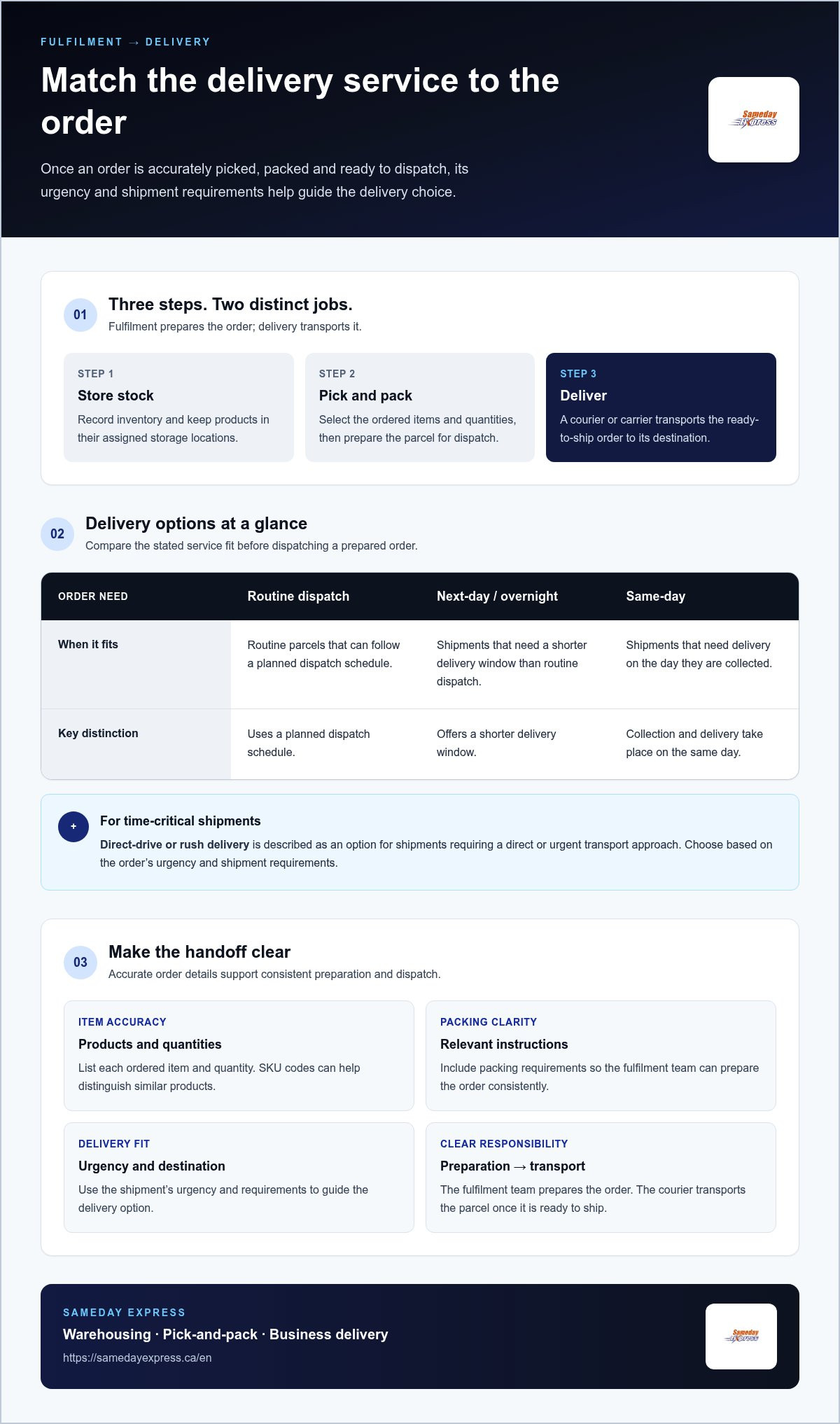
The workflow typically follows a clear sequence: stock is received, recorded, and stored. When an order comes in, the required items are picked, packed, and prepared for dispatch. A courier or carrier then transports the shipment to its destination.
Accurate information supports every step. Stock records show what is available and where it is stored. Product identifiers, such as SKU codes, help staff select the correct items and quantities, while clear packing instructions support consistent preparation. The fulfilment team manages storage and order preparation; the courier’s role is to transport parcels that are ready to ship.
When does a small business need outsourced fulfilment?
Consider outsourcing when packing orders regularly takes time away from core business work, storage space is becoming difficult to manage, or rising order volumes are putting pressure on your team. Seasonal peaks can add to the workload, while serving customers across a wider area can increase delivery coordination.
There’s no single order count that determines when to make a change. Review your own workflow: how much time goes to storing stock and preparing parcels, whether errors or dispatch delays are increasing, and whether your space and staff can keep pace. A small business fulfillment center can connect warehousing and pick-and-pack with delivery options. Sameday Express Inc. provides warehousing, third-party logistics, and pick-and-pack fulfilment, alongside delivery services for business shipments.
How a Fulfilment Centre Connects Inventory, Pick-and-Pack, and Delivery
A reliable order journey depends on clear handoffs. Stock is recorded and stored, ordered items are picked, and each order is packed and prepared for dispatch. A delivery service then moves the shipment to its destination. Fulfilment covers order preparation; delivery moves the shipment. Keeping these roles distinct helps you identify where accuracy matters and where timing comes into play.
For example, if a customer orders two products, the order details must identify both items and their quantities. The picker matches those details to the products in storage. Once packed, the parcel is ready for dispatch using a service suited to its destination and urgency.
How inventory records support accurate order preparation
Clear stock records and product identifiers, such as SKU codes, help distinguish similar items and reduce picking confusion. If two products look alike, an exact identifier helps staff select the right one instead of relying on a brief description or memory.
Keep order details aligned with handling instructions. Include the items and quantities, relevant packing requirements, and the shipment’s urgency. Consistent instructions help the fulfilment team prepare orders accurately and make the delivery handoff clearer. A small business fulfillment center depends on these details, not just on having space for stock.
Where same-day and other delivery services fit
Choose a delivery service based on how quickly an order needs to move and what the shipment requires. Routine parcels may fit a planned dispatch schedule. An urgent order may call for a time-sensitive option. Sameday Express Inc. offers several delivery services for business shipments:
- Same-day delivery: for shipments that need delivery on the day they are collected.
- Next-day or overnight delivery: for shipments that need a shorter delivery window than routine dispatch.
- Direct-drive or rush delivery: for time-critical shipments requiring a direct or urgent transport approach.
These services address different needs. Let the order’s urgency and shipment requirements guide your choice. They don’t replace accurate picking and packing; they connect prepared orders with an appropriate delivery option. For more detail, see our same-day delivery guide for businesses.
Warehousing, pick-and-pack fulfilment, and delivery can work as connected logistics steps. Explore Sameday Express logistics services to see how fulfilment and business delivery options fit together.
In-House Fulfilment vs. a Small Business Fulfilment Centre
Choosing between in-house and outsourced fulfilment depends on how your products, order patterns, and available capacity fit together. Keeping orders in-house gives you direct control over stock and preparation. Outsourcing lets you assign agreed warehousing and pick-and-pack tasks to a logistics partner. The right model depends on your operation.
Compare the day-to-day responsibilities before choosing a small business fulfillment center or continuing to manage orders internally:
| Consideration | In-house fulfilment | Outsourced fulfilment |
|---|---|---|
| Control | Your team manages stock and order preparation directly. | You define the tasks assigned to the logistics partner, which handles those agreed tasks. |
| Staff time | Staff handle picking, packing, and shipment preparation alongside other duties. | Outsourcing agreed tasks can reduce the time your team spends on routine order preparation. |
| Storage responsibility | Your business provides and manages the space for inventory. | A fulfilment partner can provide warehousing for the products included in the arrangement. |
| Workflow | Your team sets and follows its own stock-handling and packing process. | You provide clear product identifiers and order instructions for the partner’s pick-and-pack work. |
| Delivery coordination | Your business prepares shipments and arranges delivery. | Order preparation can connect with delivery services through the logistics partner. |
When keeping fulfilment in-house may suit your business
Self-fulfilment may work well if orders remain manageable, you have suitable space for stock, and your team can prepare shipments without disrupting other work. You retain close oversight of inventory and packing decisions. The trade-off is ongoing responsibility: staff still need to monitor stock, pick the right items, pack each order, and prepare it for shipment. If these tasks start competing with customer service or business growth, reassess the workload.
When outsourced fulfilment may better fit operations
Outsourcing may be a better operational fit if storage is tight, order preparation takes too much staff time, or demand varies enough to strain your internal workflow. A third-party logistics (3PL) partner can take on agreed warehousing and pick-and-pack responsibilities. Connecting those tasks with delivery options can help manage time-sensitive shipments within one logistics workflow.
Sameday Express Inc. provides warehousing, third-party logistics, and pick-and-pack fulfilment alongside delivery services for business shipments. Explore our business logistics services to see how these needs can connect.
How to Evaluate a Fulfilment Partner for Your Small Business
Choose a partner by comparing its services with the work your orders require. Look beyond storage: consider product handling, pick-and-pack tasks, delivery needs, shipment visibility, and who is responsible at each handoff. Use this checklist to define your requirements before comparing a small business fulfillment center with your current process.
- 1. Define your products. Record product dimensions, identifiers, handling needs, and packaging requirements. Include the range of items you expect the fulfilment team to handle.
- 2. Map each order task. List the steps from receiving and storing stock through picking, packing, and dispatch. Note which tasks your team wants to keep and which it could assign to a logistics partner.
- 3. Identify delivery needs. Describe typical destinations, order frequency, dispatch urgency, and which situations call for time-sensitive delivery. Separate routine parcels from urgent shipments.
- 4. Compare service scope. Match your needs against the partner’s warehousing, pick-and-pack, and delivery services. Make responsibilities clear so there’s no confusion about who prepares an order and who transports it.
Match fulfilment services to your products and orders
Your shipment profile should reflect what moves through your business, not just an average order. Consider product size, handling needs, order frequency, and dispatch urgency. Sameday Express Inc. handles shipments ranging from envelopes and parcels to full truckloads, with warehousing and pick-and-pack fulfilment for business customers.
For sensitive healthcare shipments, specialized medical courier services cover lab samples, test kits, and biological materials. Sameday Express Inc.’s drivers are trained to handle sensitive materials and maintain the appropriate chain of custody. Include the shipment type and urgency in your instructions so the handling requirements are clear.
Assess delivery visibility and operational handoffs
Set out when responsibility shifts from fulfilment to delivery and what information should accompany each shipment. Clear handoffs help your team trace an order’s progress and respond to customer questions. Confirm what shipment visibility is available during transport, and record dispatch details consistently in your internal process.
Sameday Express Inc.’s vehicles are GPS-tracked, providing visibility into vehicle location during transport. This applies to vehicles, not warehouse inventory. Keep those records distinct: stock accuracy depends on inventory handling, while GPS tracking relates to vehicle location.
For a workflow that connects warehousing, pick-and-pack, and business deliveries, explore our logistics and fulfilment services.
How Sameday Express Supports Small Business Fulfilment and Delivery
Storage, order preparation, and transport work best when planned as connected parts of your logistics workflow. Sameday Express Inc. provides warehousing, third-party logistics, and pick-and-pack fulfilment for business customers, then connects prepared shipments with delivery options suited to different schedules and levels of urgency. For a small business fulfillment center, this connection can narrow the gap between getting an order ready and moving it to its destination.
Delivery options include same-day, next-day, overnight, direct-drive, and rush services. Match the shipment’s urgency with an appropriate delivery approach instead of treating every order the same way. Sameday Express Inc. serves commercial customers across Canada and provides cross-border services to the United States.
A logistics partner for time-sensitive business shipments
Some orders follow a regular workflow. Others need urgent attention. Sameday Express Inc. is available 24/7 for urgent delivery requests, supporting businesses with time-critical shipment needs. Shipments range from envelopes and parcels to full truckloads, giving commercial customers options for different shipment sizes.
With over 25 years of experience, Sameday Express Inc. supports business fulfilment and delivery with a range of logistics services. The service mix can connect warehousing and pick-and-pack with same-day, next-day, overnight, direct-drive, or rush delivery. Clear order details and dispatch priorities help define how each shipment moves through the workflow.
Plan the next step for your fulfilment workflow
Before setting up a fulfilment arrangement, outline the products you ship, the order tasks you need handled, and any packaging or inventory instructions. Then describe your shipment profile: typical size, destination, dispatch frequency, and which orders are time-sensitive. This gives the fulfilment plan a practical starting point and helps align the workflow with your business requirements.
Bring your storage, pick-and-pack, and delivery needs together in a business logistics plan with Sameday Express Inc. Discuss business logistics services.
Build a Fulfilment Workflow That Can Grow
The right small business fulfillment center connects accurate inventory records and order preparation with delivery. Choose in-house or outsourced fulfilment based on your products, order patterns, available space, and the time your team can commit. Clear product identifiers, packing instructions, and dispatch priorities help keep each handoff organized.
Sameday Express Inc. provides warehousing, third-party logistics, and pick-and-pack fulfilment, with delivery options for routine and time-sensitive business shipments. With over 25 years of experience and 24/7 availability for urgent delivery requests, we help businesses connect storage, preparation, and transport in one logistics workflow.
Start by outlining what you ship, which fulfilment tasks you need handled, and how urgent your deliveries can be. Then take the next step with a clear plan. Discuss your business logistics needs and connect your fulfilment and delivery workflow.
Frequently Asked Questions
What does a small business fulfilment centre do?
A small business fulfilment centre stores products and prepares customer orders for shipment. Depending on the arrangement, its work can include receiving stock, maintaining inventory records, picking ordered items, packing them, and preparing them for dispatch. Delivery is a related but separate step: a courier or carrier transports the prepared shipment. Clear product identifiers and order instructions help staff pick and pack the right items.
Is a fulfilment centre the same as a 3PL?
Not exactly. A fulfilment centre is a facility where products can be stored and customer orders prepared. Third-party logistics, or 3PL, describes a business relationship in which an outside logistics provider handles agreed logistics tasks for another business. Those tasks may include warehousing and pick-and-pack fulfilment. Define which activities your business wants the partner to manage and which it will keep in-house.
When should a small business outsource fulfilment?
Consider outsourcing when order preparation regularly takes staff away from other work, storage space is limited, or increasing order volumes make dispatch harder to manage. Seasonal peaks or serving a wider customer base can add pressure. There’s no single order threshold that suits every business. Assess your team’s capacity, available space, order patterns, and whether stock errors or dispatch delays are becoming harder to prevent.
Can a small business keep some fulfilment in-house?
Yes. A business can keep selected tasks in-house and outsource others. For example, your team might retain oversight of inventory and order instructions while a logistics partner provides warehousing or pick-and-pack fulfilment for agreed products. Define who manages each step, from stock records to packing and the delivery handoff, to avoid gaps.
What should I look for in a small business fulfilment centre?
Look for a service scope that fits your products, orders, and delivery needs. Compare storage, pick-and-pack responsibilities, handling requirements, shipment visibility, and how tasks pass from fulfilment to delivery. Document product identifiers, order instructions, packaging needs, and dispatch urgency before comparing options. A clear understanding of responsibilities makes it easier to assess whether the workflow supports accurate preparation and dependable delivery.
How does pick-and-pack fulfilment work?
Pick-and-pack fulfilment starts when an order comes in. The fulfilment team uses order details and product identifiers to select the requested items from stored stock, checks the quantities, packs the order according to the instructions, and prepares it for dispatch. Accurate inventory records help staff locate the right products, while clear packing directions support consistent preparation. Delivery follows as a separate transport step once the shipment is ready.
Can a fulfilment provider support cross-border shipments?
Yes. A logistics provider can connect order preparation with cross-border transport. Sameday Express Inc. provides cross-border shipment services between Canada and the United States, alongside warehousing and pick-and-pack fulfilment for business customers. Include clear shipment details and delivery priorities so fulfilment and transport can be coordinated as part of your business workflow.
Disclaimer
Blog Disclaimer
The information published on the Sameday Express Blog is provided for general informational and educational purposes only. While we strive to keep all content accurate and up to date, Sameday Express makes no representations or warranties of any kind, express or implied, regarding the completeness, accuracy, reliability, suitability, or availability of the information contained in our articles.
The content on this blog does not constitute legal, customs, tax, regulatory, financial, or professional advice. Shipping regulations, carrier policies, customs requirements, and transportation laws may change without notice and may vary by destination. Readers should verify current requirements with the appropriate government authorities, carriers, or qualified professionals before making shipping or business decisions.
Sameday Express is not liable for any loss, damage, delays, or consequences arising from the use of, or reliance on, information published on this website. Any actions taken based on the information provided are at the reader's own risk.
References to third-party companies, products, services, or websites are provided for informational purposes only and do not constitute an endorsement or recommendation by Sameday Express.
All blog content, including text, graphics, images, and logos, is the property of Sameday Express unless otherwise stated and may not be reproduced or distributed without prior written permission.
For specific shipping requirements, pricing, transit times, or logistics solutions, please contact Sameday Express directly for personalized assistance.


