

A shipment reaching a city isn’t the same as reaching its customer. Final mile carrier services handle the last leg, moving goods from a distribution point, fulfilment hub, or retail location to the person or business receiving them. This final handoff depends on more than distance: routing, timing, coordination, and clear communication all matter.
For businesses, this stage affects how reliably customers receive orders and how smoothly urgent shipments reach their destinations. The right delivery approach depends on the goods, destination, timing, and handling requirements.
This guide explains how final mile delivery works in Canada and which industries rely on it, from e-commerce and retail to healthcare and aviation. You’ll learn how carrier selection, delivery coordination, tracking, and customer communication fit together, and what to compare when choosing a delivery approach for your business.
Key Takeaways
- Understand where the final delivery stage begins and ends, and which handoffs and coordination steps help complete it.
- See how delivery needs vary across e-commerce, retail, healthcare, aviation, and other industries.
- Compare carrier options by destination, shipment requirements, service level, and how well each fits your delivery network.
- Learn how tracking updates and clear customer communication help make deliveries easier to follow.
- Identify when same-day delivery, rush delivery, or a direct drive can suit a time-sensitive business shipment.
How does final mile delivery work?
Final mile delivery completes the movement of goods from a distribution point to the recipient. The route, dispatch, handling, and handoff all shape how a shipment reaches its destination.
Final Mile Delivery Definition
The final mile, also called the last mile, is the final transportation stage from a distribution centre, fulfilment hub, or retail location to the end customer. It may involve several stops, route changes, and direct coordination with recipients. When assessing this stage, identify where the carrier takes responsibility and how delivery is completed.
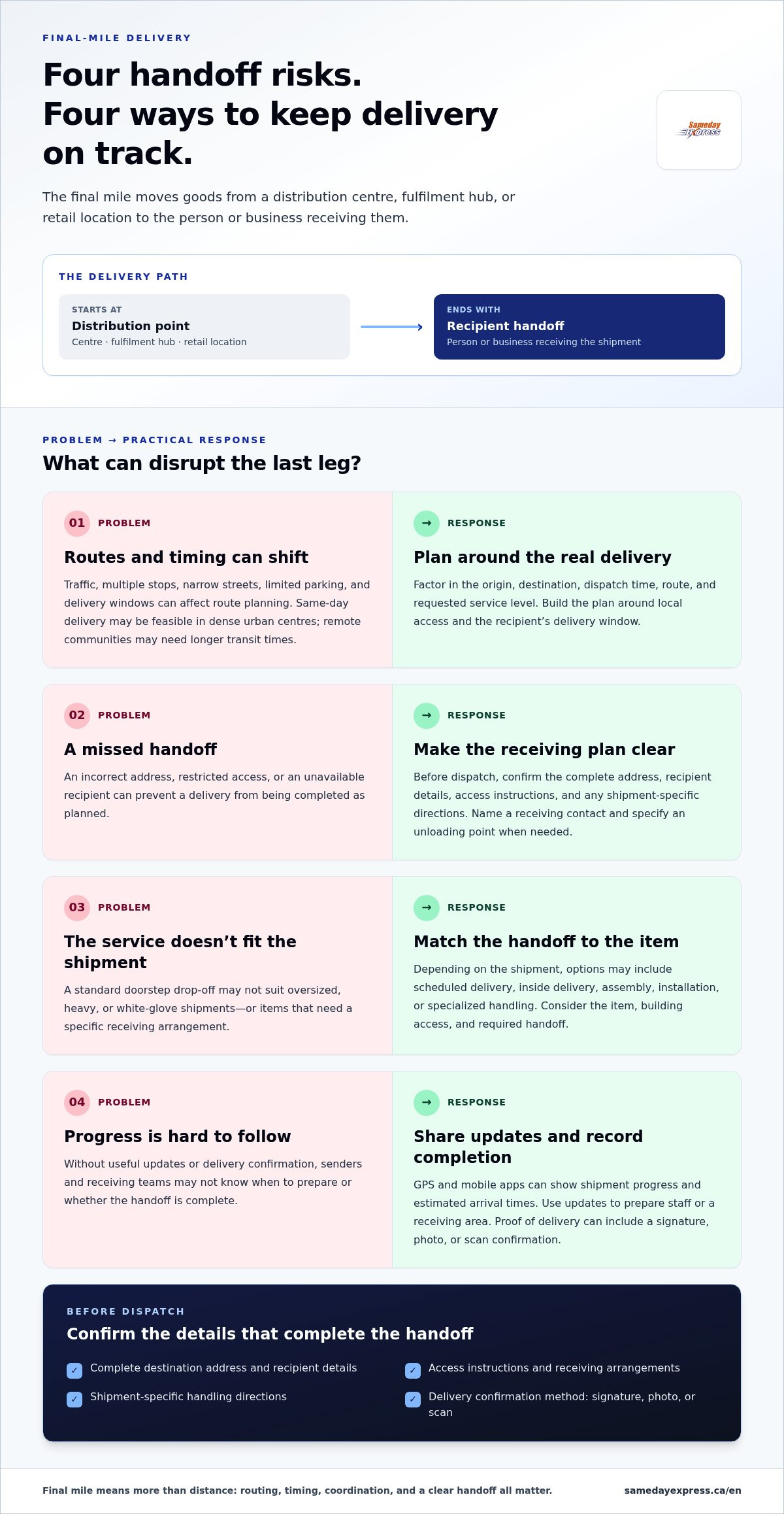
For oversized, heavy, or white-glove shipments, options may include scheduled delivery, inside delivery, assembly, installation, or specialized handling. Match the service to the item, building access, and required handoff. For example, a large appliance may need an appointment and inside placement rather than a standard doorstep drop-off.
Delivery Speed and Route Planning
Delivery speed depends on the origin, destination, dispatch time, route, and requested service level. In Canada, same-day delivery may be feasible in dense urban centres, while remote communities may require longer transit times. Traffic, multiple stops, narrow streets, limited parking, and delivery windows can all shape route planning.
Urban access restrictions can make routes longer and less efficient, according to the European Commission. Future approaches include electric vehicles, autonomous delivery vans, drones, and AI-driven route planning. Route-optimization AI can reduce road-fleet carbon emissions by as much as 25%.
Tracking and Customer Experience
GPS and mobile apps can show shipment progress and estimated arrival times. A business can use an update to prepare a receiving area or notify staff before the driver arrives. Proof of delivery may be recorded with a signature, photo, or scan confirmation, giving the sender a record of the completed handoff.
Common risks include traffic delays, restricted access, incorrect addresses, and an unavailable recipient. Reduce avoidable problems by checking the destination and access instructions before dispatch, sharing relevant updates, and recording delivery confirmation. For example, a receiving business can name a contact and specify an unloading point.
Regulations and Delivery Requirements
According to the Government of Canada, a courier service is an enterprise that transports consignments door to door for overnight or earlier delivery. This definition describes a courier service, but not every shipment’s handling requirements. Those depend on the goods, destination, and receiving arrangements.
Before dispatch, provide a complete address, recipient details, access instructions, and any shipment-specific handling directions. For example, a business can identify a designated receiver and delivery window. These details help the carrier coordinate the route and complete the handoff according to the shipment’s practical requirements.
Industries using final mile logistics
Final mile logistics connect a distribution point with a business or household at the shipment’s destination. E-commerce, retail, grocery, parcel delivery, and furniture and appliance businesses rely on this stage, but their operational needs differ. Routes and handoff processes depend on what’s being delivered and who must receive it.
For e-commerce businesses, each parcel must travel from fulfilment to the customer’s address with clear delivery details. A clothing order, for example, may go to a home, while a business supply order may need reception staff to accept it. Retailers also use final mile delivery to send purchases from a store or distribution location to customers who can’t take items home themselves.
Grocery delivery requires coordinating orders with recipients and suitable delivery windows. Parcel networks handle shipments across many addresses, while furniture and appliance deliveries may require a scheduled arrival, inside placement, or installation. These differences affect vehicle choice, staffing, route planning, and what the recipient needs to prepare before the driver arrives.
Healthcare organizations and laboratories can use final mile logistics to move lab samples, test kits, medications, or hospital supplies. Aviation operators may need a part delivered to a maintenance team when an aircraft is grounded. In both cases, clarify the destination, handling instructions, and named receiving contact before dispatch. A missed handoff can disrupt work that depends on the shipment. Similarly, while cargo couriers handle time-sensitive components, corporate personnel and flight teams travelling between regional terminals often rely on dedicated ground transport such as Long island islip MacArthur Airport Car Service for punctual connections.
Reverse logistics adds a return journey to the delivery plan. A retailer might collect a returned online purchase, while an appliance business may retrieve a unit for repair or asset recovery. Confirm the pickup address, item condition, receiving location, and return instructions before dispatch. For reusable equipment, recording its identity and transfer at each handoff helps track where the asset goes next.
Third-party logistics (3PL) partnerships can combine storage, order preparation, distribution, and final delivery. For example, an online retailer may keep inventory at a 3PL facility, then assign orders to delivery networks based on destination and service needs. Define who manages dispatch, shares delivery updates, handles exceptions, and records completion. Clear ownership at each step helps prevent a shipment from being delayed between the warehouse and carrier.
Map your regular shipment types, destinations, receiving hours, and return flows before setting up a logistics partnership. If a delivery is time-critical, select a service built for that shipment’s deadline and destination. Businesses can explore business delivery options for urgent shipments.
Carrier-network coordination and selection
A delivery network should match your supply chain, shipment profile, and customer destinations. Most high-performing e-commerce brands use 2-4 carriers, routing shipments by geography, package weight, and service level. That approach can balance coverage and delivery needs without assigning every order to the same route.
Start by mapping where orders originate and where they need to go. A carrier serving major urban centres may suit dense delivery routes, while another network may cover destinations beyond those areas. Compare each carrier’s service area with your actual shipping addresses, not just its general coverage map. For a business shipping from one warehouse, the best fit may differ from that for a retailer dispatching orders across several regions.
Next, group shipments by practical requirements. Record parcel dimensions, weight, delivery windows, and handling instructions. A standard parcel, an oversized item, and a time-sensitive shipment may need different vehicles or service levels. Highly specialized shipments—such as heavy equipment or commercial vehicles managed by transport providers like Done Wright Towing & Transport—may also require dedicated fleet equipment and handling procedures. Match these needs to the carrier’s capabilities before assigning routes.
Set clear dispatch rules. For example, assign a shipment to a carrier that serves its destination and accepts its size, then consider the required service level. Keep the rules simple enough for staff to follow as order volume changes. If a carrier can’t take a particular shipment, a documented alternative helps the team act quickly without disrupting the rest of the supply chain.
Coordination also depends on clear ownership. Decide who sends order details, confirms pickup, communicates exceptions, and records delivery completion. In a third-party logistics setup, specify who updates inventory when an order leaves the warehouse. A missed update can leave a product appearing available after its shipment has been dispatched.
Build visibility into handoffs between the warehouse, carrier, and recipient. Use consistent shipment identifiers and status definitions so teams can distinguish “picked up” from “out for delivery” or “delivered.” If a delivery attempt fails, for example, assign responsibility for recording the reason and communicating the next step. Shared records give customer service and operations teams the same view.
Review carrier performance using consistent measures, such as on-time delivery, successful first attempts, damage reports, and exception response. Compare the same service levels and destination areas across carriers. A carrier that performs well on local parcel routes may not suit heavier shipments or specialized handling. Adjust routing rules as order patterns, inventory locations, or customer destinations change.
Real-time tracking and customer communication
Tracking connects warehouse dispatch with the recipient’s view of a package’s progress. A clear booking process also gives drivers accurate destination details and businesses useful delivery updates.
Real-Time Delivery Tracking
GPS and mobile apps can show a shipment’s location and estimated arrival time. Useful tracking lets staff see key events, such as pickup, progress towards the destination, and delivery completion. Compare which events the system records and how easily your team can find them.
Proof of delivery may include a signature, photo, or scan confirmation. For example, a receiving team can use a recorded signature to confirm that a package reached the intended contact. Tracking can also reveal an exception, such as a failed delivery attempt, so staff can act instead of waiting for a customer to report the issue.
Distance alone doesn’t explain every delay. A driver may encounter traffic, building access restrictions, or an unavailable recipient. Use status updates to distinguish a shipment that’s moving from one awaiting action. This visibility helps customer service provide specific information instead of a generic arrival estimate.
Booking and Customer Updates
To book and track a final mile delivery in Canada, provide the pickup and destination addresses, package details, requested service level, and recipient contact information. After booking, share the shipment identifier with the recipient, monitor status updates, and review proof of delivery or any exception. These steps connect dispatch, drivers, warehouse staff, and customer communications.
Use a consistent booking checklist for each shipment:
- Enter complete pickup and destination addresses, including business names, unit numbers, and access instructions.
- Record package dimensions, weight, handling directions, and the requested delivery window.
- Add a recipient contact who can respond if the driver needs help reaching the delivery point.
- Share the tracking reference and explain which shipment updates the recipient will receive.
Tie messages to actual shipment events. A pickup confirmation tells the recipient the package has left the warehouse. An out-for-delivery update signals that the driver is approaching the destination, while proof of delivery closes the loop. If an exception occurs, tell the customer what happened and what action is needed, such as providing access instructions or arranging another handoff.
For business deliveries, assign a team member to review exceptions during operating hours. A named owner can coordinate with the warehouse, customer, and carrier when an address needs clarification. This process makes tracking useful for decisions, not just checking a location.
Carrier comparisons
Canadian businesses can compare national parcel networks, regional carriers, courier services, and specialized delivery providers. The right fit depends on destination coverage, shipment type, delivery window, and how each carrier coordinates handoffs.
Carriers Operating in Canada
Canada’s carrier options include national networks for broad coverage, regional carriers serving defined areas, and couriers handling local or time-sensitive shipments. Specialized providers may suit deliveries with particular handling or service requirements. Compare each network with your actual delivery addresses, not its broadest advertised footprint.
For each option, review service areas, shipment size limits, pickup arrangements, tracking visibility, and proof of delivery. A carrier suited to routine parcels may not fit a large or time-critical shipment. Compare like with like: use the same origin, destination, package details, and service needs when assessing providers of final mile carrier services.
Build a comparison around your own delivery profile. A retailer sending orders from one fulfilment centre can assess recurring routes and common package sizes. A business with occasional urgent deliveries should also consider how the carrier handles exceptions and communicates changes. A clear comparison helps operations teams assign shipments consistently instead of choosing a carrier anew for every order.
Provincial and Remote-Area Coverage
Coverage and delivery speed can vary across provinces and communities. Same-day delivery may be feasible in dense Canadian urban centres, while remote communities may require longer transit times. Routes, distance, dispatch location, and local access all affect how a carrier serves the final destination.
Check whether coverage applies to the specific origin and destination, rather than assuming service is province-wide. For example, a carrier may serve a city regularly but use different arrangements for a more remote address. Compare pickup frequency, estimated transit, service days, and handoff points for every route your business uses.
Urban and remote shipments require different planning. In a dense centre, traffic, building access, and recipient availability can shape the delivery window. For a remote destination, distance from the dispatch point and the carrier’s route structure may matter more. Match the service to the actual address and delivery priority.
Before assigning a route, map recurring destinations and separate urban, rural, and remote addresses. Record which carriers serve each group and what tracking updates they provide. This creates a practical routing guide for dispatch staff and helps prevent orders from entering a network that doesn’t fit their destination.
For a time-sensitive business shipment, review business delivery options suited to the route and deadline.
Sameday Express: same day delivery
Sameday Express Inc. provides Same Day Delivery for businesses with shipments that need to reach their destination quickly. For urgent point-to-point transport, Direct-drive delivery and Rush delivery offer alternatives when a regular delivery schedule doesn’t fit. Direct-drive delivery can suit shipments travelling between business locations when a direct route is preferred.
Choose an option based on the pickup and delivery locations, shipment details, and required timing. For example, a time-sensitive business shipment may call for Direct-drive delivery, while a local order with a same-day deadline may suit Same Day Delivery. Clear pickup and delivery details help define the request.
Contact Sameday Express Inc. to discuss your business delivery.
Put your delivery plan into action
Turn your delivery priorities into a short operating brief for each shipment. Record its purpose, the required handoff, and who will manage communication if plans change. Clear assignments help staff make consistent decisions during busy periods and reduce confusion among dispatch, warehouse teams, and the recipient.
For urgent business shipments, Sameday Express offers Same Day Delivery, Direct-drive delivery, and Rush delivery. When requesting a delivery, provide the pickup and destination details, shipment requirements, and delivery timeframe. This practical context helps identify an appropriate option for the shipment.
Well-matched final mile carrier services can support a more dependable handoff and a smoother customer experience. Use your delivery brief as the starting point, then contact Sameday Express Inc. to discuss your delivery. A clear request helps move the conversation from general delivery needs to the specific shipment your business is planning. With the right details prepared, your team can take its next step with confidence.
Frequently Asked Questions
What Is A Last Mile Carrier?
A last mile carrier is responsible for completing the delivery leg to the recipient. In a business supply chain, that role may begin after another transport provider or warehouse hands over the shipment. For instance, the original shipper may remain responsible for customer service while the carrier manages delivery. Define who handles exceptions to prevent confusion if a handoff or address issue arises.
What are final mile carrier services and what do they include?
These services organize the final delivery around the shipment and the recipient’s needs. Clarify whether the carrier is expected to collect from a warehouse, deliver to a receiving dock, or coordinate access with a named contact. For a business with limited receiving hours, sharing those hours before dispatch helps align the delivery plan with daily operations.
What should businesses assess when planning a final mile delivery in Canada?
Assess the shipment’s readiness, destination access, receiving hours, and who is responsible for accepting it. For example, a retailer replenishing a store can coordinate delivery with staff availability and stockroom access. A business receiving equipment can prepare a suitable unloading area. Adding these details to dispatch instructions gives the delivery team practical information beyond the address.
What shipment details should businesses prepare before dispatch?
Prepare pickup and delivery contacts, complete addresses, a package description, handling instructions, and access details. Add the recipient’s operating hours and a clear delivery point, such as a loading dock or reception desk. For recurring shipments, keep a standard record and update it when a location changes. Accurate instructions help reduce avoidable calls and handoff confusion.
How do final mile carriers compare for speed, coverage, and reliability?
Assess how each carrier handles exceptions, not just routine deliveries. Ask your operations team to record missed handoffs, damaged goods, and delays, then review their causes and the response process. A carrier’s ability to communicate a disruption and provide a clear next step matters when a delivery supports a scheduled business operation. Use shipment records to guide future assignments.
Do Canadian final mile carriers offer same-day and scheduled delivery?
Yes, Canadian delivery options can include same-day service and scheduled appointments. A same-day shipment may help address an unexpected stock shortage, while a scheduled arrival can support planned receiving or installation work. The right choice depends on when the goods are ready and when the recipient can accept them. Include the delivery purpose in dispatch instructions so teams can prepare for the handoff.
How are final mile delivery rates calculated in Canada?
Rates depend on the shipment’s origin and destination, dimensions and weight, delivery window, handling needs, and requested service level. Compare coverage and services against those requirements.
Disclaimer
Blog Disclaimer
The information published on the Sameday Express Blog is provided for general informational and educational purposes only. While we strive to keep all content accurate and up to date, Sameday Express makes no representations or warranties of any kind, express or implied, regarding the completeness, accuracy, reliability, suitability, or availability of the information contained in our articles.
The content on this blog does not constitute legal, customs, tax, regulatory, financial, or professional advice. Shipping regulations, carrier policies, customs requirements, and transportation laws may change without notice and may vary by destination. Readers should verify current requirements with the appropriate government authorities, carriers, or qualified professionals before making shipping or business decisions.
Sameday Express is not liable for any loss, damage, delays, or consequences arising from the use of, or reliance on, information published on this website. Any actions taken based on the information provided are at the reader's own risk.
References to third-party companies, products, services, or websites are provided for informational purposes only and do not constitute an endorsement or recommendation by Sameday Express.
All blog content, including text, graphics, images, and logos, is the property of Sameday Express unless otherwise stated and may not be reproduced or distributed without prior written permission.
For specific shipping requirements, pricing, transit times, or logistics solutions, please contact Sameday Express directly for personalized assistance.


