

What if the cost savings you expect from consolidated freight are actually hidden taxes on your cargo's security? You likely agree that every time a pallet is moved by a forklift or sits in a distribution centre, the risk of damage or delay climbs. It's frustrating to watch a time-critical shipment get bogged down in a network of cross-docking facilities when your patient or production line needs it now. Choosing between direct drive vs ltl shipping isn't just a matter of budget; it's about protecting your chain of custody.
We promise to help you discover the critical differences between these strategies to ensure your high-stakes cargo arrives safely and on time. You'll learn how to eliminate logistical friction and maintain 100% security for sensitive materials. We'll also break down the cost-to-speed ratio for the 2026 Canadian transport market, focusing on why a "no transfers" and "no terminals" approach is the only way to handle STAT pickups. This guide prepares you to make the right call for your BioScience, Aviation, or "Hot Shot" logistics needs.
Key Takeaways
- Understand the operational trade-offs of direct drive vs ltl shipping to determine which model best protects your cargo from unnecessary handling and terminal delays.
- Identify why eliminating cross-docking is essential for maintaining a strict chain of custody for BioScience, pharmaceutical samples, and other high-sensitivity materials 🧪.
- Learn how to calculate realistic delivery windows using the "Google Maps + 1 hour" formula for time-critical "Hot Shot" and STAT shipments.
- Evaluate the cost-to-speed ratio to decide when LTL savings are appropriate and when the security of a dedicated vehicle is non-negotiable.
- Discover why Sameday Express Inc. is the preferred 24/7 partner for navigating the Montreal, Ottawa, and Toronto corridors with 100% security 🚀.
Understanding the Fundamentals: Direct Drive vs. LTL Shipping
Choosing between direct drive vs ltl shipping often feels like a choice between speed and savings. For businesses operating in Montreal, Toronto, or across the border, this decision impacts more than just the bottom line. It dictates the security of the cargo and the reliability of the delivery window. High-stakes logistics require a clear understanding of how these two models function under pressure, especially when dealing with time-critical materials.
What is Direct Drive Transport?
Direct Drive is a premium logistics model where a vehicle is dedicated exclusively to your shipment. Once the driver loads your materials, they head straight to the destination. There are no stops at terminals, no transfers between trucks, and zero cross-docking. This "no transfer" approach is the gold standard for "Hot Shot" and STAT deliveries. We calculate arrival times using a simple, reliable formula: Google Maps driving time plus one hour. This accounts for traffic and loading, giving you a realistic, predictable window. It's the fastest way to move critical AOG parts or medical samples without the friction of a traditional freight network. For a specialized route like a Montreal to Toronto direct drive, this means your cargo never leaves the vehicle until it reaches its final destination.
What is LTL (Less-Than-Truckload) Shipping?
LTL shipping is a consolidated model. Multiple shippers share space in a single trailer to reduce costs. While efficient for palletized freight that isn't time-sensitive, it introduces layers of complexity. Your goods will likely visit several distribution centres and terminals before reaching their final stop. Each stop involves a forklift and a potential change of custody. This model works well for routine inventory but presents risks for sensitive cargo. If your shipment can wait a few days and isn't prone to damage from handling, LTL offers cost savings for Canadian businesses. It's a volume-based system where your pallet is just one of many in a vast network.
High-stakes industries like BioScience and healthcare don't just prefer direct drive; they rely on it. A single transfer at a terminal can compromise a temperature-controlled medical sample or delay a grounded aircraft. When you choose direct drive, you're buying a dedicated chain of custody. You aren't waiting for "daily lanes" or for a truck to fill up. The service is on-demand, 24/7, and focused entirely on your specific mission. Understanding the core difference between direct drive vs ltl shipping helps you decide when to save and when to prioritize the security of a dedicated vehicle. You can explore our range of same day delivery options to see which model fits your current operational requirements.
The Power of Direct Drive: Speed, Security, and No Transfers
The true power of a dedicated vehicle lies in what doesn't happen. Your cargo doesn't sit in a terminal. It doesn't get sorted by a conveyor belt. It doesn't wait for a second truck to become available. When evaluating direct drive vs ltl shipping, the security of a closed-loop system is often the deciding factor for high-stakes industries. By keeping the shipment on a single truck from the moment of pickup until it reaches the recipient's hands, we eliminate the risk of misrouting and physical damage that occurs during frequent loading and unloading.
For our BioScience and pharmaceutical partners, this isn't just about convenience. It's about maintaining a strict, documented chain of custody 🧪. Sensitive medical samples or expensive medications cannot afford the temperature fluctuations or handling errors common in a multi-stop LTL environment. Our 24/7 availability ensures that when a STAT pickup is required, the mission begins immediately. We don't wait for scheduled routes or daily lanes; we move when you need us.
Eliminating Logistical Friction
Traditional courier networks rely on a "hub and spoke" system. This means a package from Montreal destined for Ottawa might first travel to a central sorting facility, adding hours or even days to the timeline. Direct drive bypasses these bottlenecks entirely. We provide direct routes to major hubs like Montreal, Ottawa, and Toronto, ensuring your time-critical shipments arrive as fast as the road allows. This is particularly vital for Aviation (AOG) shipments ✈️. Every hour an aircraft is on the ground costs thousands of dollars. By using a "Hot Shot" direct drive service, we get those parts to the hangar without the friction of terminal delays.
High-Security and Sensitive Cargo
Confidentiality is a non-negotiable requirement for legal firms and government agencies. In a direct drive model, the driver who picks up the documents is the same driver who delivers them. This transparency provides peace of mind that LTL simply cannot match. Additionally, temperature-sensitive materials remain stable because they stay in a climate-controlled vehicle rather than sitting on a warehouse dock. If your business requires reliable rush delivery, the direct drive model offers the highest level of protection against loss or theft.
LTL Shipping: When Cost-Efficiency Outweighs Absolute Urgency
While our direct drive services provide the fastest possible transit for critical cargo, we recognize that cost-efficiency is a major driver for routine operations. Less-than-truckload (LTL) shipping offers a pragmatic solution for businesses with flexible delivery windows. It's the industrial workhorse for moving durable goods that don't require the immediate, dedicated attention of a "Hot Shot" run. When comparing direct drive vs ltl shipping, the choice often comes down to whether your timeline allows for the consolidation process.
LTL shipping thrives on a vast network of distribution centres across North America. This model is best suited for shipments that are sturdy, well-packaged, and not time-sensitive. Because the trailer is shared among multiple clients, the pricing is standardized. Costs are typically calculated based on freight class, weight, and the specific density of the cargo. This makes it a predictable expense for companies managing large-scale, non-urgent inventory.
The Economics of Shared Freight
The primary advantage of LTL is that you only pay for the space your pallet occupies. You aren't responsible for the cost of the entire vehicle, which significantly lowers the price point for smaller shipments. This is ideal for B2B inventory replenishment and shipping non-critical supplies where a delay of a day or two won't halt production. Many of our clients leverage our warehousing services in conjunction with LTL to create a seamless distribution strategy. By storing goods at our Dorval hub, you can deploy them via LTL to Montreal, Toronto, or Ottawa as demand dictates.
Managing the Risks of LTL
The shared nature of LTL introduces more touchpoints than a dedicated drive. Your pallet will likely be moved by forklifts at multiple terminals as it's sorted and reloaded. This increased handling means that fragile or high-value items face a higher risk of damage. If you choose this route, you must prioritize robust packaging. We recommend using heavy-duty pallets and securing your load with industrial-grade shrink wrap to prevent shifting during transit.
For shipments that require a balance between the two models, our "Next-Day" service often acts as the perfect middle ground. It provides more speed than standard LTL without the full cost of a dedicated direct drive vehicle. However, the fundamental truth of direct drive vs ltl shipping remains: LTL saves money, but direct drive saves time and ensures maximum security. We help you evaluate your cargo's sensitivity to ensure you aren't sacrificing safety for a lower invoice.
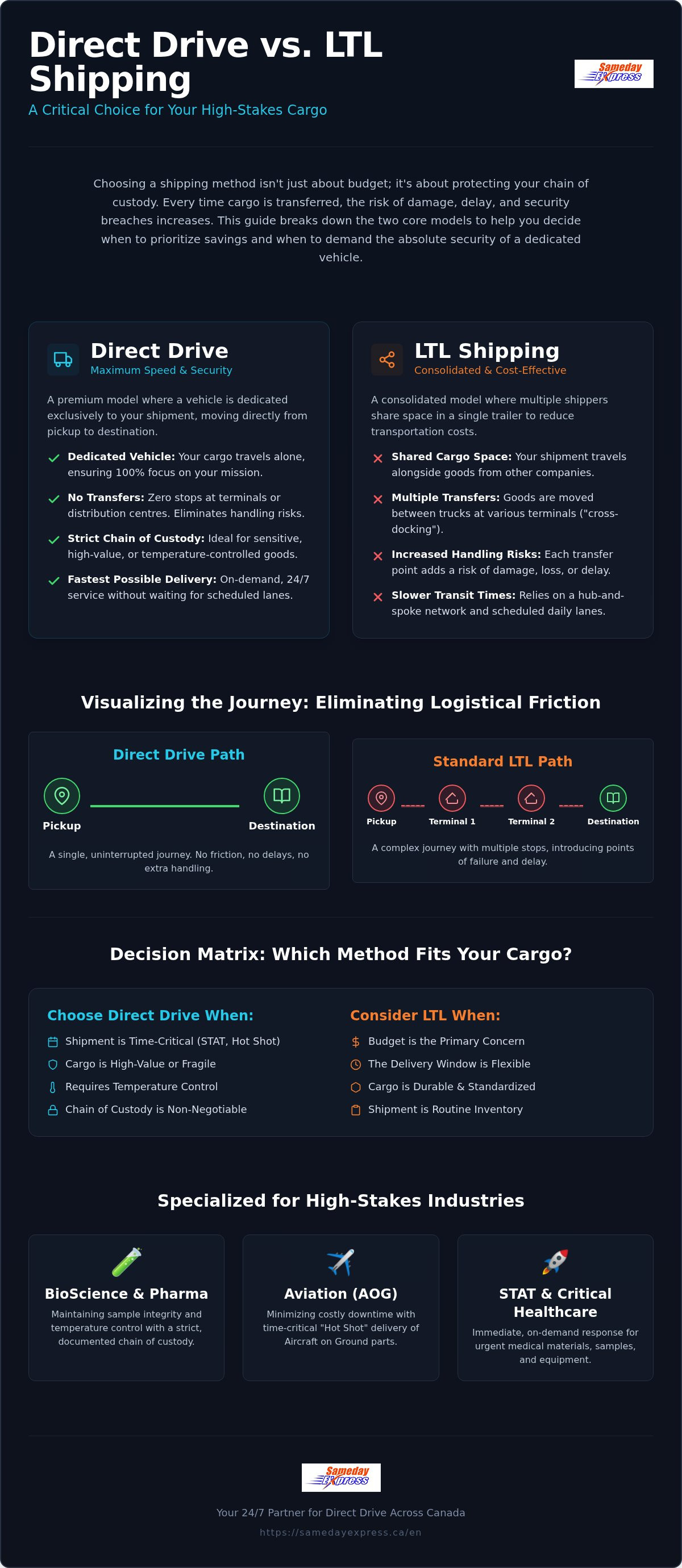
Decision Matrix: Which Shipping Method Fits Your Critical Cargo?
When you're standing on the loading dock, the choice between direct drive vs ltl shipping comes down to one question: what is the cost of failure? For a routine shipment of office supplies, a two-day delay is an inconvenience. For a grounded aircraft or a life-saving medical sample, that same delay is a catastrophe. You need a clear framework that weighs the immediate price of transport against the potential long-term cost of downtime.
Urgency vs. Budget
Urgency is the most significant factor in your decision. If you have a mission-critical requirement that needs to move now, direct drive is the only viable path. This service level eliminates the "hub and spoke" delays and terminal transfers that characterize LTL. However, if your logistics are planned well in advance and you have a lead time of 3 to 5 days, LTL offers the cost savings your budget might require. For a clear understanding of the financial trade-offs, we encourage you to contact Sameday Express Inc. for a detailed quote before you book.
Industry-Specific Requirements
Different sectors have non-negotiable standards that dictate the shipping model. In the BioScience and medical fields, maintaining a strict chain of custody and precise temperature control is paramount 🧪. We always recommend direct drive for these materials because warehouse storage and multiple touchpoints increase the risk of spoilage or loss. Similarly, in Aviation (AOG), the cost of an airplane waiting for a part far exceeds the premium of a dedicated vehicle ✈️. For these industries, direct drive isn't a luxury; it's a security strategy. Conversely, general retail or construction materials that are durable and non-urgent are perfectly suited for the shared-space model of LTL.
You must also consider if the shipment is "Customs-ready." Cross-border shipments between Canada and the USA require specific documentation and a carrier that understands the nuances of the border. Whether you're moving "Hot Shot" freight or routine inventory, ensuring your transport partner is proactive about customs will prevent your cargo from sitting at the boundary. We specialize in navigating these regulations to keep your timeline intact.
For shipments continuing across the United States, partnering with specialists in Freight Transportation and Logistics provides the over-the-road reliability needed for the American leg of your journey.
If you need to eliminate logistical friction today and ensure your cargo reaches its destination without transfers, request a same day delivery quote and let our team handle your most sensitive materials.
Sameday Express Inc.: Your 24/7 Partner for Direct Drive Across Canada
Our headquarters in Dorval puts Sameday Express Inc. at the heart of Montreal's logistics network. This strategic location near the airport allows us to respond to AOG and STAT medical requests with unmatched speed. For over 20 years, we've specialized in high-stakes transport, ensuring that the choice between direct drive vs ltl shipping is backed by proven performance. We don't just provide a driver; we provide a dedicated security strategy for your most sensitive cargo.
Critical missions don't wait for business hours. That's why Sameday Express Inc. operates 24/7/365, offering a diverse fleet of vehicles tailored to your specific load:
- Dedicated cars and SUVs for local pharmacy and laboratory deliveries.
- Cargo vans for rapid "Hot Shot" shipments and aviation parts.
- Straight trucks and full truckloads for larger freight that cannot risk terminal handling 🚛.
The Sameday Express Inc. Advantage in Quebec and Ontario
We have mastered the Montreal, Ottawa, and Toronto corridors through two decades of hands-on experience. This local expertise allows us to navigate traffic and weather patterns that would stall less experienced carriers. While we've discussed the general merits of direct drive vs ltl shipping, the Sameday Express Inc. difference lies in our proactive communication. You receive real-time updates and a single point of contact, ensuring total transparency from the moment of pickup until the final signature is captured. This level of accountability is essential for maintaining the strict chain of custody required in the specialized transport sector.
Ready for Immediate Action?
If your production line is down or a patient is waiting for a critical sample, you don't have time for terminals or cross-docking. Choosing a reliable transport partner means choosing a team that is always customs-ready and prepared for immediate dispatch. Experience the peace of mind that comes with a dedicated vehicle and a driver focused solely on your shipment. Call Sameday Express Inc. now to get your "Hot Shot" quote and see how we eliminate logistical friction today.
Secure Your Logistics Strategy for 2026
Deciding between direct drive vs ltl shipping determines how much risk you're willing to accept for your most sensitive cargo. You now understand that while LTL offers significant cost savings for routine inventory, it cannot match the specialized security of a dedicated vehicle. For industries like BioScience and Aviation, the "no transfers, no terminals" model isn't a luxury; it's a necessity to maintain a strict chain of custody and eliminate the risk of damage during cross-docking.
We've spent over 20 years perfecting our role as Montreal-Toronto direct experts. Operating 24/7 out of our Dorval hub, we provide the immediate action required for STAT medical pickups and AOG shipments. You don't have to wait for daily lanes or scheduled routes. Our team ensures your time-critical materials move directly from point A to point B without any logistical friction. It's time to prioritize reliability and speed for your high-stakes deliveries.
Ready to experience 100% security for your next shipment? Get a Direct Drive Quote Now and let our specialists handle your 24/7 urgent delivery needs. We look forward to becoming your trusted partner for specialized medical logistics and beyond.
Frequently Asked Questions
What is the main difference between direct drive and LTL shipping?
The primary difference lies in the vehicle's exclusivity and the route taken. Direct drive involves a dedicated vehicle moving your cargo straight from pickup to delivery without any stops. LTL, or less-than-truckload, mixes your goods with other shippers' freight in a shared trailer. This consolidation requires multiple terminal stops and transfers. While LTL is cost-effective for routine cargo, direct drive eliminates the risks associated with shared space and frequent handling.
When should I choose direct drive over LTL for my business?
You should opt for direct drive when the cost of a delay outweighs the shipping premium. This includes STAT medical pickups, urgent AOG parts, or high-value legal documents. If your shipment can wait three to five days and isn't sensitive to handling, LTL is a budget-friendly alternative. Comparing direct drive vs ltl shipping helps you determine if your priority is absolute speed or operational savings for that specific cargo.
Is direct drive shipping safer for fragile or medical items?
Direct drive is significantly safer because it eliminates the "hub and spoke" sorting process. In this model, your fragile or medical items stay on one truck until they reach the final destination. This "no transfer" approach prevents the physical damage often caused by forklifts at busy terminals. For medical samples, it also ensures a stable environment without the temperature fluctuations found on warehouse docks during the consolidation process.
How do you calculate the delivery time for a direct drive shipment?
We use a transparent formula to provide reliable arrival times for our clients. We calculate the delivery window as the standard Google Maps driving time plus one hour. This extra hour accounts for loading, unloading, and typical traffic patterns along the route. This method gives our clients a realistic expectation for their time-critical shipments. Unlike LTL, which relies on complex terminal schedules, direct drive follows the most efficient road route available.
Can Sameday Express Inc. handle cross-border direct drive to the USA?
Yes, we provide customs-ready transport for shipments moving between Canada and the USA. Our drivers are experienced in cross-border regulations to ensure your cargo doesn't get stalled at the boundary. Whether it's a Montreal to Toronto direct drive or a "Hot Shot" run to a major American hub, we manage the logistics so your time-critical freight keeps moving. We focus on eliminating the friction often found at international borders.
What industries benefit most from direct drive courier services?
High-stakes industries like Aviation, BioScience, and Healthcare benefit the most from dedicated courier services. Any sector where downtime costs thousands of dollars per hour, such as Aircraft on Ground (AOG) situations, requires the speed of direct drive. Legal firms and government agencies also rely on this model for the strict chain of custody it provides. It's the preferred choice for any mission where security and speed are non-negotiable.
Is 24/7 pickup available for both LTL and direct drive?
We offer 24/7/365 pickup for all direct drive and urgent requests. While LTL shipping typically follows standard business hours and terminal loading schedules, our specialized services are always available. This on-demand nature ensures that your STAT pickups or emergency parts move the moment they're ready. You don't have to wait for daily lanes or for a truck to fill up before our driver departs for your destination.
What happens if my shipment is AOG (Aircraft on Ground)?
AOG shipments are treated as high-priority emergencies with immediate dispatch. We recognize that every minute a plane is grounded represents a massive financial loss for the operator. We bypass all terminals and cross-docking to deliver parts directly to the hangar. By using our Dorval hub proximity to the airport, we ensure the fastest possible turnaround for aviation components across the Montreal, Ottawa, and Toronto corridors.
Disclaimer
Blog Disclaimer
The information published on the Sameday Express Blog is provided for general informational and educational purposes only. While we strive to keep all content accurate and up to date, Sameday Express makes no representations or warranties of any kind, express or implied, regarding the completeness, accuracy, reliability, suitability, or availability of the information contained in our articles.
The content on this blog does not constitute legal, customs, tax, regulatory, financial, or professional advice. Shipping regulations, carrier policies, customs requirements, and transportation laws may change without notice and may vary by destination. Readers should verify current requirements with the appropriate government authorities, carriers, or qualified professionals before making shipping or business decisions.
Sameday Express is not liable for any loss, damage, delays, or consequences arising from the use of, or reliance on, information published on this website. Any actions taken based on the information provided are at the reader's own risk.
References to third-party companies, products, services, or websites are provided for informational purposes only and do not constitute an endorsement or recommendation by Sameday Express.
All blog content, including text, graphics, images, and logos, is the property of Sameday Express unless otherwise stated and may not be reproduced or distributed without prior written permission.
For specific shipping requirements, pricing, transit times, or logistics solutions, please contact Sameday Express directly for personalized assistance.


