

A static status update that merely reads "in transit" is entirely useless when an assembly line shutdown, a grounded aircraft, or a scheduled surgery hangs in the balance. If you manage time-sensitive cargo across Montreal, Ottawa, and Toronto, you already know the anxiety of watching essential freight vanish into sorting terminals for hours on end. Inaccurate arrival estimates create chaos at receiving bays and drain valuable operational resources. That is why dependable real-time shipment tracking for business has evolved from a convenient convenience into an indispensable safeguard against costly delays.
This guide shows you how real-time tracking eliminates supply chain blind spots, maintains an unbroken chain of custody, and protects critical commercial deliveries across Canada. You will discover how direct-drive transport and continuous GPS monitoring pinpoint live locations on demand, satisfy strict regulatory requirements, and replace guesswork with precise arrival times. Here is how modern tracking visibility keeps your highest-priority shipments moving without interruption.
Key Takeaways
- Understand how continuous telematics monitoring differs from passive milestone scans, providing active coordinate visibility throughout transit.
- Learn how real-time shipment tracking for business eliminates terminal blind spots and protects high-priority freight across key Canadian trade corridors.
- Discover why dedicated direct-drive transport removes sorting facility delays, handoffs, and physical transfer risks for healthcare and AOG shipments.
- Evaluate carrier tracking architectures to verify 24/7 live dispatch access, Canadian regulatory compliance, and unbroken chain of custody.
- Optimise receiving bay staffing and eliminate manual tracking inquiries with automated, precise arrival alerts.
What Real-Time Shipment Tracking for Business Delivers Today
Commercial logistics can no longer rely on sporadic updates. Standard tracking tools notify you only after an event occurs, leaving hours of uncertainty between checkpoints. In contrast, modern real-time shipment tracking for business provides continuous telematics monitoring directly from the vehicle throughout transit. This constant stream of live telemetry gives logistics managers immediate operational clarity, allowing dispatch teams to intercept route bottlenecks before they disrupt operations.
Traditional package tracking systems built around legacy checkpoint scans simply confirm past departures. True commercial visibility continuously transmits live satellite coordinates and vehicle telemetry. This operational precision enables warehouse teams to stage receiving bays accurately, schedule specialized labour, and prevent costly dock congestion.
To see how active telemetry transforms commercial freight oversight, watch this brief overview:
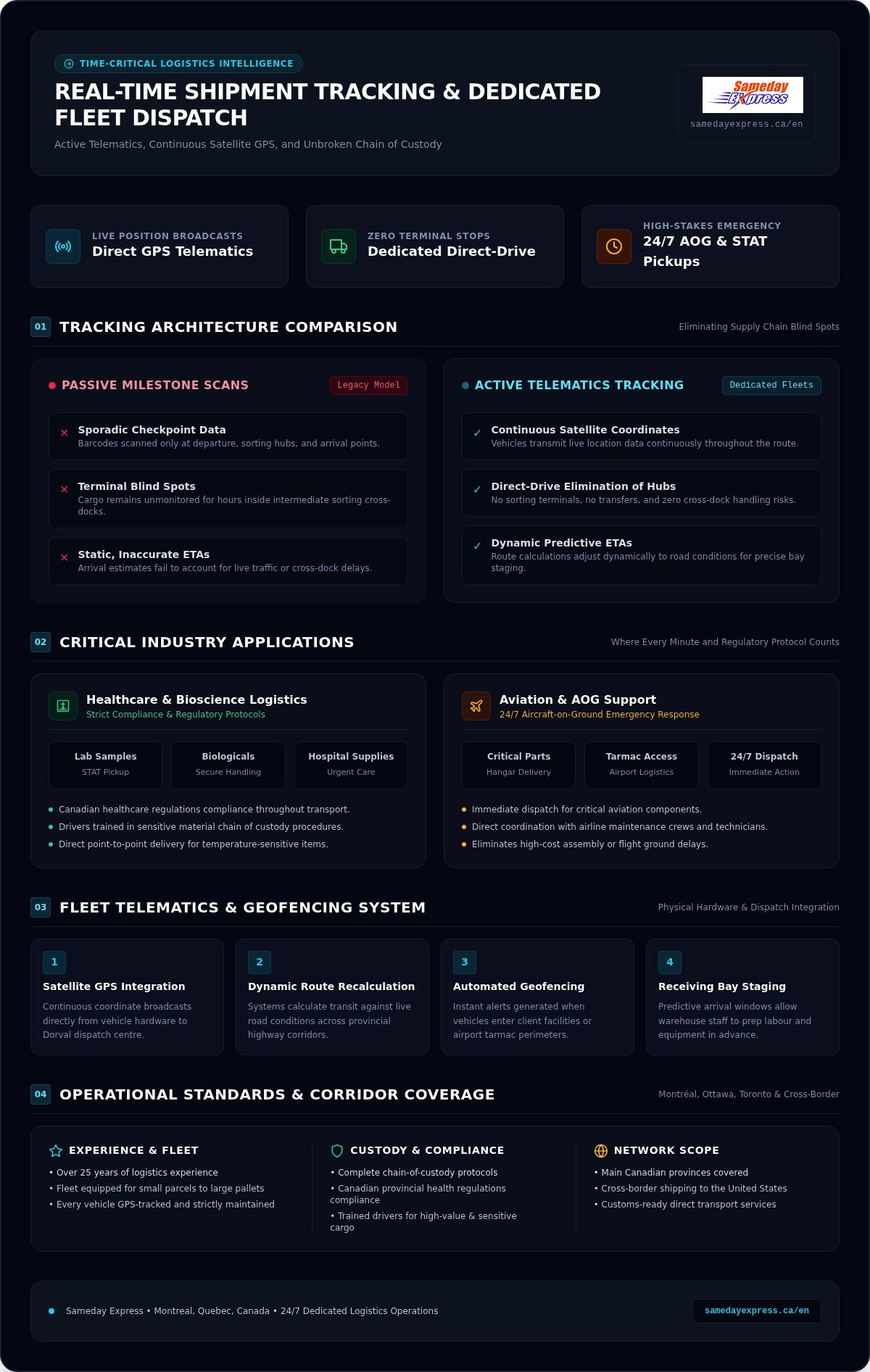
Passive Milestone Scans vs Active Telematics Tracking
The difference between passive barcode logging and active GPS tracking is substantial:
- 🚚 Passive Milestone Scans: Barcodes are scanned only at departure, intermediate cross-docks, and arrival. Cargo sits in multi-hour visibility dead zones inside sorting facilities.
- 🛰️ Active Telematics: Vehicles broadcast live coordinates every few seconds. Dispatchers and clients monitor progress continuously on dynamic maps.
- ⏱️ Dock Efficiency: Predictive, live ETAs allow receiving teams to prep forklifts and staff precisely when the truck arrives.
Why Industrial and Healthcare Operations Require Live Visibility
Time-critical cargo cannot tolerate blind transit intervals. We operate across high-stakes sectors where minutes dictate operational outcomes:
- 🧪 Healthcare Logistics: Patient care requires strict transit integrity for biological materials, hospital supplies, and lab samples. Maintaining Canadian healthcare regulations and an unbroken chain of custody demands absolute transparency from pickup to drop-off.
- ✈️ Critical Aviation Parts: Grounded aircraft generate thousands of dollars in downtime every hour. Dedicated 24/7 AOG service ensures maintenance crews track flight-critical components down to the exact street corner.
- ⚙️ Direct-Drive Reliability: By using dedicated vehicles with no transfers, no terminals, and no cross-docking, real-time shipment tracking for business delivers total oversight without terminal delays.
Core Technologies Powering Modern Business Shipment Visibility
True visibility requires physical hardware integrated into the transport vehicle, not just third-party software scraping carrier websites. Advanced real-time shipment tracking for business connects vehicle engine diagnostics, dedicated GPS transponders, and cellular IoT devices into a continuous data stream. When managing critical freight across the Montreal-Toronto corridor or cross-border lanes, this direct telematics link eliminates information lag completely.
Vehicle Telematics and Satellite GPS Integration
Dedicated commercial transport relies on continuous satellite reporting rather than batch-processed mobile apps. Every vehicle in our fleet broadcasts precise coordinates at regular intervals directly to our Dorval dispatch centre.
- 🛰️ Continuous Coordinate Broadcasts: Live tracking pinpoints exact vehicle coordinates along provincial highways without depending on intermittent cell tower pings.
- ⏱️ Dynamic Route Calculation: Dispatch systems recalculate transit times continuously against live traffic conditions, giving receiving bays realistic arrival windows instead of static estimates.
- 📍 Automated Geofencing: Virtual boundaries automatically trigger departure and arrival alerts the moment our driver enters the client facility or airport tarmac perimeter.
Environmental Sensors and Chain of Custody Logging
High-stakes sectors like BioScience and aerospace demand physical telemetry that extends beyond basic truck coordinates. Cargo protection requires verifiable data inside the vehicle bay:
- 🌡️ Cold Chain Monitoring: Cellular IoT data loggers track internal cargo temperatures for sensitive lab samples, vaccines, and biological materials, flagging temperature variations immediately.
- 🔒 Chain of Custody Verification: Tamper-evident seals and digital custody logs record every handover, preserving unbroken audit trails required by Canadian healthcare regulations.
- 📱 Instant Electronic Proof of Delivery: Drivers capture digital signatures and timestamps on glass the instant a shipment arrives, uploading delivery verification straight to your system.
Whether moving critical aviation parts for an AOG emergency or urgent pharmaceuticals, relying on dedicated telematics protects your schedule. Explore our specialized courier services to see how dedicated tracking protects your time-critical cargo.
Tracking Architecture: Software Platforms vs Dedicated Carrier Fleets
Most commercial visibility tools on the market are software overlays. These platforms scrape tracking APIs across dozens of freight brokers and common carriers, aggregating status updates into a single dashboard. While helpful for broad supply chain administration, an application cannot fix broken physical operations. If a package sits buried in an overcrowded distribution hub, a dashboard notification simply documents your delay after the fact. High-stakes operations need direct physical oversight rather than passive aggregators.
True real-time shipment tracking for business is achieved only when the tracking system is directly tied to the wheels turning on the highway. Direct carrier fleets integrate physical transport with telemetry, removing the multi-carrier data gaps that compromise critical shipments.
The Hub-and-Spoke Visibility Gap
Traditional freight carriers use consolidation networks to maximize vehicle capacity. This architecture introduces severe visibility risks for high-value cargo:
- ❌ Sorting Facility Black Holes: Freight enters intermediate consolidation terminals where parcels sit unmonitored for hours between conveyor belt scans.
- ❌ Handoff Vulnerabilities: Every physical transfer between local drivers, terminal staff, and line-haul haulers multiplies the risk of misplacement or physical damage.
- ❌ Consolidated Delay Cascades: A single late trailer can delay hundreds of urgent parts bound for critical receiving facilities.
Evaluating Visibility: Software Overlays vs Direct Drive
The solution to tracking black holes is eliminating intermediate handoffs altogether. Our Sameday Direct Drive model connects the pickup point straight to the delivery destination, delivering absolute visibility:
- ⚡ Zero Terminals and No Cross-Docking: Your cargo is loaded onto a dedicated vehicle and stays there until handoff. There are no depot layovers, no sorting lines, and no mixed freight.
- ⏱️ Predictable Arrival Precision: Transit calculations follow a transparent, proven formula: Google Maps driving time plus one hour for loading and dispatch. You know the exact arrival window before the vehicle rolls.
- 🔒 Direct Dispatch Connection: Telematics feed straight from the operating vehicle into our 24/7 Dorval operations room. You speak directly with our team, not an offshore call centre or an automated bot.
When selecting real-time shipment tracking for business, evaluate the physical route your goods take. A sophisticated tracking interface paired with a multi-terminal freight network still leaves your cargo vulnerable to sorting delays. Dedicated direct-drive transport ensures that what you see on your map reflects unbroken forward movement on the road.
How Canadian Businesses Select the Right Tracking Solution
Selecting a visibility partner requires assessing real operational capabilities rather than software dashboard features. While software aggregators track ordinary retail parcels, enterprise operations demand physical accountability across specific transit corridors. Effective real-time shipment tracking for business depends on whether your logistics provider operates the vehicles, manages the drivers, and provides active communication when timelines tighten.
Geographic Coverage and Critical Corridor Capabilities
Evaluating a transport provider begins with their core transit routes and regional infrastructure:
- 🚛 Key Industrial Corridors: Fast transport along the vital Montreal, Ottawa, and Toronto lanes requires dedicated vehicles ready to roll immediately. Look for dedicated rush delivery and Montreal to Toronto direct drive capacity that bypasses regional sorting terminals.
- 🇺🇸 Cross-Border Capabilities: Moving urgent freight between Canada and the United States demands customs-ready transport. Seamless GPS tracking must remain active while clearing border points to keep both dispatchers and customs brokers aligned.
- 📍 Strategic Hub Proximity: Operating from distribution hubs near major transport infrastructure, such as our headquarters in Dorval, ensures rapid response times for airport cargo pickups and urgent manufacturing dispatches.
Compliance, Security, and Operational Support Standards
High-consequence supply chains need specialized handling protocols backed by verifiable custody tracking:
- 🧪 Healthcare and BioScience Compliance: Transporting diagnostic specimens, vaccines, and medical devices requires strict compliance with Canadian healthcare regulations. Look for drivers trained in temperature monitoring, chain of custody logs, and local pharmacy delivery requirements.
- ✈️ Round-the-Clock Critical Support: Grounded aircraft and plant stoppages happen outside standard office hours. Your partner must provide 24/7 dedicated dispatch for AOG shipment emergencies, putting you in direct contact with live coordinators instead of automated portals. For an in-depth breakdown of carrier selection criteria, review our guide on choosing specialized transport for critical shipments.
- 📦 Fleet Adaptability: Your logistics partner should support envois de toutes tailles, dispatching everything from compact cars for rush document delivery to dedicated straight trucks for heavy industrial freight.
Do you need immediate tracking transparency and zero terminal delays for your critical freight? Contact our 24/7 dispatch team today to coordinate your next time-critical delivery.
Securing Unbroken Visibility with Dedicated Logistics Partners
Eliminating blind spots ultimately comes down to direct control over the vehicle. When cargo moves under a dedicated model, tracking certainty shifts from a probabilistic estimate to a concrete physical fact. Point-to-point dedicated transport provides the absolute peak of transit security because the driver who loads your freight is the exact same driver who unloads it. Implementing dedicated real-time shipment tracking for business protects mission-critical operations against the disruptions inherent in multi-tenant courier networks.
Zero Transfers, Zero Terminals, Complete Visibility
Every additional touchpoint in a supply chain introduces risk. Consolidating shipments across shared depots repeatedly exposes sensitive goods to sorting mistakes, physical drops, and administrative delays:
- 🚀 Dedicated Direct-Drive Protection: Non-stop point-to-point routing means zero transfers, zero terminals, and no cross-docking. Your cargo remains securely locked inside one vehicle until final handover.
- 🔒 Unbroken Chain of Custody: Dedicated handling guarantees custody logs remain pristine. This procedural control is critical for confidential legal filings, proprietary technology prototypes, and biological specimens requiring verifiable audit trails.
- ⏱️ Operational Continuity: Keeping mission-critical freight in constant forward motion protects your plant lines from costly shutdowns. Learn more about regional transit workflows in our overview on same-day delivery options for Canadian businesses.
Deploying Rapid Business Courier Solutions Across Canada
Backed by over 25 years of specialized Canadian logistics experience, Sameday Express Inc. provides tailored transport solutions built for immediate deployment. We operate without fixed daily lane restrictions or arbitrary cutoffs, dispatching dedicated vehicles the moment your booking is confirmed.
- 📍 Centralized Dorval Coordination: Our headquarters operates directly within Montreal's primary aviation and distribution hub. Dedicated dispatchers oversee regional movements 24/7, answering status requests in seconds.
- 🚛 Modern Multi-Class Fleet: We deploy GPS-tracked vehicles matching your precise payload requirements. Explore our vehicle specifications directly on our fleet capabilities page to see options ranging from fuel-efficient compact units to 26-foot straight trucks.
- 🇨🇦 Cross-Border and Interprovincial Authority: We provide comprehensive coverage across Canada's main industrial corridors alongside customs-ready transport into the United States.
Dependable real-time shipment tracking for business is not about monitoring delays on a screen. It is about preventing them before they happen through dedicated vehicles, disciplined drivers, and round-the-clock operational oversight.
Take Full Control of Your Time-Critical Supply Chain
Uncertainty has no place in mission-critical logistics. Relying on passive milestone scans exposes your operations to sorting delays, idle crews, and broken audit trails. Implementing dedicated real-time shipment tracking for business eliminates those blind spots, giving you continuous telematics, accurate arrival times, and complete peace of mind.
With over 25 years of time-critical delivery experience across Canada, Sameday Express keeps your highest-priority cargo moving forward without friction. Our strategic logistics hub in Dorval coordinates 24/7 rapid dispatch across a modern GPS-tracked fleet equipped for parcels up to full truckloads. From flight-grounding AOG components to temperature-controlled lab samples, our direct-drive transport preserves unbroken chain of custody from door to door.
Eliminate terminal risks and take control of your commercial freight schedule today. Track your critical business shipments with Sameday Express and keep your business running smoothly around the clock.
Frequently Asked Questions
What is the difference between milestone tracking and real-time tracking?
Milestone tracking records a static status update only when a parcel passes through a physical checkpoint or depot barcode scanner. In contrast, true real-time shipment tracking for business provides continuous GPS coordinates and telemetry straight from the moving vehicle. Instead of guessing where freight is between terminals, dispatchers and clients see live positional data, updated estimated arrival times, and immediate alerts without waiting hours for an intermediate depot scan.
How does real-time tracking work for medical and biological samples?
Medical transport combines active GPS vehicle telemetry with cellular IoT sensor logging. Data loggers continuously record interior cargo temperatures to protect vaccines, blood products, and lab samples. Drivers follow strict chain of custody protocols, logging handoffs with electronic signatures on glass. This creates a tamper-evident audit trail meeting Canadian healthcare regulations while verifying that biological materials remained within required temperature thresholds throughout the direct-drive route.
Can businesses track cross-border shipments between Canada and the United States?
Yes, cross-border shipments maintain unbroken satellite tracking across the Canada-US border. Dedicated direct-drive vehicles carry pre-cleared customs documentation alongside live GPS transponders that transmit uninterrupted across international boundaries. Both dispatchers and receiving docks monitor the vehicle as it clears customs checkpoints and proceeds down interstate or provincial highways, eliminating the typical multi-day blind spots associated with consolidated cross-border freight transfers.
Why do parcels often stop updating in traditional carrier tracking systems?
Parcels stop updating because traditional carriers rely on hub-and-spoke networks where items sit in sorting depots for hours between manual scans. If a barcode is not scanned during sorting, or if freight sits on a loading dock awaiting an available line-haul trailer, the tracking system shows no movement. Implementing dedicated real-time shipment tracking for business with point-to-point transport eliminates these terminal black holes entirely by avoiding sorting hubs altogether.
What tracking technologies are used for AOG aviation parts deliveries?
Aircraft on Ground (AOG) deliveries use high-precision satellite GPS, automated geofencing, and 24/7 telematics monitoring. Transponders broadcast live coordinates directly to dispatchers in Dorval, who track the delivery vehicle right onto airport perimeters or tarmac access points. Instant geofence triggers notify maintenance crews the moment the vehicle enters the facility, enabling mechanics to stage repair bays and install flight-critical components without losing precious operational minutes.
How quickly can an emergency shipment be dispatched with live tracking?
Emergency shipments are dispatched immediately upon booking confirmation through our 24/7 Dorval operations centre. Because we operate an on-demand fleet with no daily lane schedules or consolidation waiting periods, a dedicated driver is assigned right away. Live GPS tracking activates the moment the driver departs for pickup, allowing you to monitor the courier's route in real time from initial collection straight to final destination.
Disclaimer
Blog Disclaimer
The information published on the Sameday Express Blog is provided for general informational and educational purposes only. While we strive to keep all content accurate and up to date, Sameday Express makes no representations or warranties of any kind, express or implied, regarding the completeness, accuracy, reliability, suitability, or availability of the information contained in our articles.
The content on this blog does not constitute legal, customs, tax, regulatory, financial, or professional advice. Shipping regulations, carrier policies, customs requirements, and transportation laws may change without notice and may vary by destination. Readers should verify current requirements with the appropriate government authorities, carriers, or qualified professionals before making shipping or business decisions.
Sameday Express is not liable for any loss, damage, delays, or consequences arising from the use of, or reliance on, information published on this website. Any actions taken based on the information provided are at the reader's own risk.
References to third-party companies, products, services, or websites are provided for informational purposes only and do not constitute an endorsement or recommendation by Sameday Express.
All blog content, including text, graphics, images, and logos, is the property of Sameday Express unless otherwise stated and may not be reproduced or distributed without prior written permission.
For specific shipping requirements, pricing, transit times, or logistics solutions, please contact Sameday Express directly for personalized assistance.


