

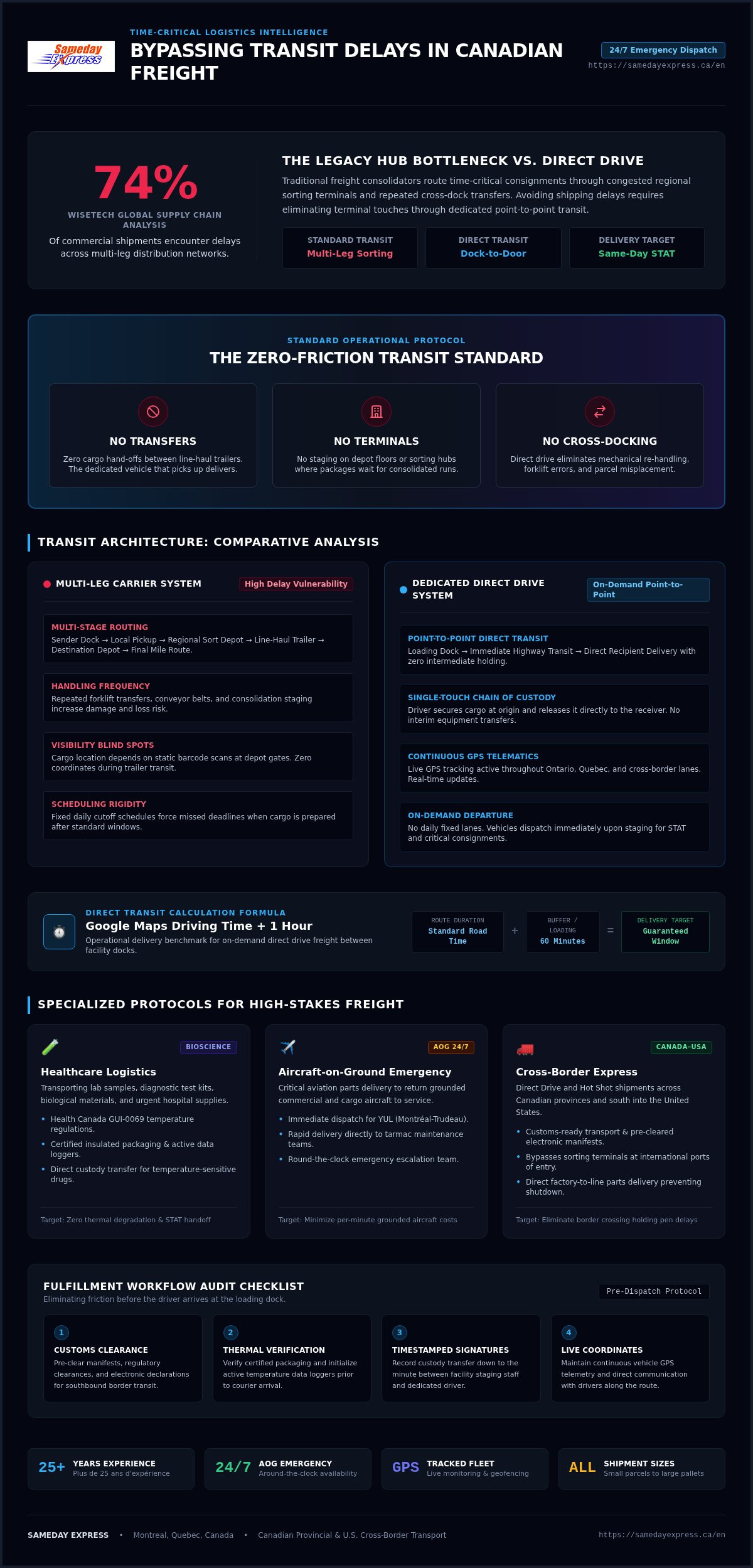
According to supply chain analyses from WiseTech Global, up to 74% of commercial shipments face delays across standard multi-leg distribution networks. When your operations depend on strict delivery windows, avoiding shipping delays for business isn't just a routine scheduling goal; it's vital for protecting client trust and preventing costly operational downtime.
You already know the frustration of watching urgent parts, lab specimens, or commercial inventory sit stranded inside a sorting facility while critical deadlines slip away. Conventional carrier networks rely on multiple terminal transfers, cross-dock holding, and tracking blind spots that leave your team powerless when minutes matter.
You'll discover how to bypass hub bottlenecks through dedicated point-to-point transit, maintain an unbroken chain of custody, and keep time-critical cargo moving on schedule. We walk through the direct operational strategies needed to eliminate transit friction across Canadian and cross-border lanes, giving your business complete control and real-time tracking from pickup to delivery.
Key Takeaways
- Discover why replacing terminal networks with dedicated direct drive transport is the primary step for avoiding shipping delays for business.
- Learn how pre-clearing transit documentation and streamlining internal staging eliminate administrative holds before drivers depart.
- See how enforcing a strict policy of no transfers and no cross-docking prevents handling damage and preserves delivery windows.
- Explore essential compliance protocols for high-stakes healthcare logistics, including active temperature control and continuous chain of custody.
- Identify the core capabilities to look for in a Canadian courier partner, from 24/7 on-demand dispatch to live GPS tracking.
Why Traditional Shipping Models Cause Business Delivery Delays
Conventional shipping networks are engineered for volume consolidation rather than rapid delivery. When you place urgent commercial freight into a standard system, your shipment routes through regional sorting facilities, transfers between line-haul trailers, and undergoes repeated mechanical handling. For commercial teams focused on avoiding shipping delays for business, this legacy structure creates built-in bottlenecks that disrupt daily operations and jeopardize client commitments.
The Hidden Vulnerabilities of Hub-and-Spoke Networks
Hub-and-spoke logistics funnel thousands of unrelated packages into crowded central facilities. During regional volume surges, these depots quickly become congested. Cargo sits idle on sorting floors, missing connecting line-haul departures and turning time-critical dispatches into multi-day backlogs.
This traditional terminal cross-docking model introduces operational vulnerabilities that standard freight carriers rarely resolve:
- Excessive transfer handling: Every forklift transfer and conveyor sort increases cargo damage rates and misplacement risks.
- Tracking blind spots: Visibility vanishes between static barcode scans, leaving logistics dispatchers guessing actual shipment coordinates.
- Rigid cutoff schedules: Inflexible pickup windows prevent immediate action, forcing high-priority consignments to wait for the next scheduled lane run.
Relying on scheduled hubs forces dispatchers to compromise between transit speed and operational predictability. Dedicated point-to-point dispatch resolves this conflict by putting critical shipments on direct transit paths immediately.
High-Stakes Risks for Healthcare and Manufacturing Sectors
When transit stalls inside traditional distribution terminals, the operational fallout is immediate. In clinical healthcare settings, delayed hospital supplies postpone scheduled procedures. Diagnostic test kits and biological materials face dangerous temperature excursions when held in unconditioned sorting terminals outside strictly validated storage parameters.
Industrial facilities face equal pressure. A missing component can halt an active production line, stranding maintenance teams, racking up plant downtime expenses, and damaging relationships with commercial accounts. We eliminate these risks by providing dedicated on-demand transit. Adopting a strict standard of no transfers, no terminals, and no cross-docking ensures your time-critical freight moves directly from your loading dock straight to the final destination.
Audit Your Fulfilment Workflow to Eliminate Transit Delays
Eliminating transit friction starts long before a driver arrives at your facility. Even the fastest delivery vehicle cannot compensate for unverified paperwork or stalled staging bays. A rigorous internal audit across your fulfillment operations is crucial for avoiding shipping delays for business, ensuring your packages move without hesitation from dock to door.
Streamlining Staging and Customs-Ready Documentation
Administrative errors cause unnecessary holding pen holdups at border crossings and regional checkpoints. Prepare your cargo before dispatching a courier by auditing manifests, commercial invoices, and regulatory clearances in advance.
For cross-border freight moving south, prepare electronic declarations prior to pickup. For pharmaceutical and clinical shipments, cargo staging must comply with Health Canada GUI-0069 standards, verifying certified insulated packaging and active data loggers before collection.
Establishing Real-Time Tracking and Custody Verification
Visibility gaps create operational blindness. When cargo moves across Ontario, Quebec, or cross-border lanes, your dispatch team requires immediate answers rather than delayed status updates. We replace legacy tracking scans with active, live GPS tracking that provides continuous coordinates throughout transit.
Our direct communication structure connects your dispatchers directly to drivers, enabling immediate decisions if highway conditions or site access issues arise. Maintaining an unbroken chain of custody requires structured physical handoff protocols:
- Timestamped signatures: Loading personnel and couriers record transfer times down to the minute.
- Seal verification: Security seals and container numbers match manifest records precisely.
- Direct-drive transit: Dedicated vehicles carry your cargo directly to its destination with no transfers, no terminals, and no cross-docking.
Review your internal workflows to ensure your team is equipped for immediate dispatch. If your operation requires rapid, dedicated routing for critical freight, review our specialised transportation solutions or partner with our dedicated logistics services to keep your commercial supply chain moving without interruptions.
Direct Drive vs. Terminal Cross-Docking: Comparing Transit Reliability
When supply chains stall, the root cause is almost always intermediate handling. Standard consolidated carriers direct your freight into regional sorting centres, forcing cargo through multiple dock transfers alongside thousands of unrelated parcels. For companies prioritizing avoiding shipping delays for business, choosing between terminal cross-docking and dedicated point-to-point transit determines whether critical deliveries arrive as promised or get stuck in transit queues.
Point-to-Point Transport: Zero Terminals, Zero Cross-Docking
Direct-drive transport dedicates an entire vehicle exclusively to your consignment. Once loaded at your facility, the driver heads straight to the delivery address without entering sorting hubs or detouring for secondary drops. This single-vehicle commitment removes the main triggers of transit failure:
- No sorting hub transfers: Cargo remains secured in the same cargo hold from pickup to drop-off, eliminating forklift impacts and drops.
- Zero misdirected freight: Eliminating intermediate sortation belts removes the risk of your freight loading onto the wrong outgoing trailer.
- Uninterrupted corridor travel: Direct runs between key commercial centres like Montreal, Ottawa, and Toronto bypass the systemic freight bottlenecks and transit congestion common to regional processing yards.
By enforcing an unyielding rule of no transfers, no terminals, and no cross-docking, your time-critical freight moves with complete operational transparency.
Calculating Delivery Deadlines with Practical Formulas
Consolidated carriers rely on broad multi-hour or multi-day arrival windows. In contrast, on-demand direct-drive transport uses clear, route-based calculations. We calculate reliable transit times using a simple operational formula: Google Maps driving time + 1 hour.
This extra hour accounts for commercial vehicle inspections, city approach traffic, and loading dock check-in procedures. Factoring this buffer into verified highway speed limits and seasonal weather patterns allows your dispatch team to provide exact arrival commitments to downstream recipients.
Selecting the right vehicle profile prevents both overloading delays and wasted capacity. Direct-drive operations deploy specialized equipment matching your cargo dimensions:
- Sedans and small cargo vans: Ideal for rapid transit of lab specimens, legal files, and compact replacement parts.
- Sprinter vans and straight trucks: Built for multi-pallet industrial machinery, hospital supplies, and high-value commercial runs.
Matching cargo volume directly to vehicle capacity eliminates delays caused by waiting for full trailer loads. You can review available configurations on our commercial delivery vehicles page to ensure your urgent shipments move on the right platform every run.
Proven Protocols for Time-Critical and Temperature-Sensitive Freight
Certain shipments cannot tolerate ordinary commercial transit delays. When biological specimens or grounded aircraft components enter transit, an operational pause creates serious downstream consequences. For organizations managing life sciences or active aviation fleets, avoiding shipping delays for business demands strict procedural compliance, uninterrupted monitoring, and immediate on-demand dispatch.
🧪 Handling STAT Pickups for Medical and Biological Materials
Healthcare logistics requires zero tolerance for transit variance. Diagnostic lab samples, clinical test kits, and hospital supplies lose viability when subjected to temperature swings or delivery holds. Maintaining specimen integrity relies on disciplined protocols from collection to delivery:
- Active environmental control: Drivers verify calibrated monitoring devices and validated insulated packaging before loading, preventing temperature excursions during transport.
- Trained chain-of-custody drivers: Couriers certified in dangerous goods regulations document every physical handover with precise timestamps and signed confirmations.
- Point-to-point delivery: Dedicated vehicles transport biological materials straight to testing laboratories without intermediate facility stops.
These measures ensure specimen viability remains uncompromised across regional healthcare networks. Organizations seeking dependable cold-chain distribution across the province can consult our guide to selecting a courier service in Quebec.
✈️ Managing 24/7 AOG Emergency Deliveries for Grounded Aircraft
When an aircraft is grounded due to mechanical failure, every minute on the tarmac racks up operational friction. Routine cargo schedules cannot address these urgent demands. Our Aircraft on Ground (AOG) service operates 24/7, providing immediate hot shot dispatch for critical aviation parts delivery.
Located in Dorval next to Montreal's primary aerospace and transit corridors, our fleet deploys immediately to secure replacement avionics, landing gear components, or turbine assemblies. These emergency runs operate with pure point-to-point execution: no transfers, no terminals, and no cross-docking. The driver who loads the part at the parts depot drives it straight to the airport maintenance hangar or runway gate.
By bypassing standard freight depots, your maintenance crews receive replacement parts on predictable schedules, protecting flight operations and passenger commitments. When unscheduled downtime threatens your operational schedule, contact our 24/7 dispatch team to launch an immediate direct-drive delivery.
Selecting the Right Commercial Courier Partner in Canada
Selecting a commercial logistics partner is a strategic operational decision that directly affects your bottom line. If a carrier relies on rigid daily cutoffs or routes your cargo through regional sorting facilities, your business schedule remains vulnerable to external bottlenecks. When evaluating transport providers, avoiding shipping delays for business requires vetting their physical fleet assets, dispatch flexibility, and geographic positioning.
Assessing Carrier Fleet Diversity and Geographic Coverage
Commercial shipping needs shift constantly. A provider with a limited vehicle selection forces your team to split consignments or wait for oversized transport to become available. Look for a carrier operating a diverse, GPS-tracked fleet capable of handling shipments of all sizes, from urgent legal files in compact cars to multi-pallet freight in straight trucks.
Corridor capability is equally critical. Verify that your logistics partner maintains direct-drive routes connecting Montreal, Ottawa, and Toronto, along with rapid cross-border lanes into the United States. For transborder freight, couriers must operate with customs-ready documentation and verified electronic manifests before departure to prevent inspection bay holds. Drivers must also hold professional training in secure cargo loading and documented chain-of-custody handovers.
Securing On-Demand Dispatch for Immediate Freight Needs
Traditional freight carriers stop processing dispatches in the late afternoon, stranding evening orders until the following business day. Urgent manufacturing, technology, and clinical operations cannot halt production to accommodate standard office cutoffs. You need a logistics partner offering genuine 24/7 emergency dispatch with zero waiting times.
With over 25 years of operational experience, we base our central dispatch in Dorval, right in Montreal's primary logistics and aerospace corridor. This location provides our dedicated fleet with immediate access to Montréal-Trudeau International Airport and major highway arteries. Our direct-drive model operates without fixed lane schedules, sorting terminals, or cross-dock delays. Whether you require urgent parts replacement or critical medical transport, discover how dedicated routing secures tight operational deadlines through our guide to same-day business delivery.
Eliminate Logistics Friction and Protect Your Schedules
Protecting commercial operations from transit gridlock requires a deliberate operational shift. Bypassing congested sorting facilities, auditing internal staging workflows, and adopting dedicated point-to-point transport provide the operational certainty your business demands. When mission-critical components, hospital supplies, or commercial cargo need to move immediately, avoiding shipping delays for business isn't about hoping for the best; it's about securing dedicated direct routes with zero intermediate stops.
With over 25 years of proven commercial delivery experience across Canada, we ensure your cargo reaches its destination without terminal layovers. Our dedicated fleet operates with 24/7 on-demand dispatch, live GPS tracking, and an uncompromising standard of no transfers and no cross-docking. When your deadlines cannot afford compromises, request 24/7 emergency dispatch and time-critical delivery to keep your supply chain moving with complete confidence.
Frequently Asked Questions
What are the most frequent causes of shipping delays for commercial businesses?
The primary causes stem from multi-tier sorting facilities, cross-dock holding times, and administrative errors on shipping documentation. When freight moves through traditional hub-and-spoke networks, intermediate parcel transfers multiply the chances of misrouting or physical cargo damage. For managers focused on avoiding shipping delays for business, relying on consolidated line-haul schedules creates systematic bottlenecks whenever regional depots experience volume surges or mechanical issues.
How does direct-drive shipping eliminate terminal handling delays?
Direct-drive shipping assigns an exclusive vehicle to your consignment immediately upon dispatch, transporting cargo straight from your loading bay to the final receiving facility. Because the vehicle never enters intermediate sorting terminals or regional distribution hubs, your cargo avoids offloading, sorting conveyor belts, and secondary reloading. Enforcing this policy of no transfers and no cross-docking prevents misdirection and protects your delivery schedule.
Can rush delivery handle cross-border shipments between Canada and the United States?
Yes, expedited rush courier transport supports urgent commercial freight moving between Canada and U.S. markets. Dedicated vehicles bypass multi-stop consolidations, heading straight to border crossings with pre-cleared electronic manifests and commercial invoices. Ensuring paperwork is customs-ready prior to driver departure avoids administrative holds at customs plazas, keeping transborder operations moving without highway delays.
What protocols protect urgent medical lab samples and biological materials during transit?
Protecting biological materials requires validated thermal packaging, calibrated real-time temperature loggers, and strict chain-of-custody documentation. Couriers adhere to established transport compliance regulations, using trained drivers who complete signed handover records at collection and drop-off points. Avoiding shipping delays for business in clinical healthcare means specimens travel via dedicated direct-drive transit, preventing delays that compromise temperature thresholds or sample viability.
How quickly can an emergency courier respond to an AOG aviation breakdown?
Our emergency AOG aviation dispatch operates 24/7, providing immediate vehicle deployment rather than waiting for daily scheduled freight runs. Based in Dorval right beside Montreal's aerospace hub and Montréal-Trudeau International Airport, our fleet quickly secures replacement turbine parts, structural components, or avionics. A dedicated hot-shot vehicle drives the part directly to the designated airfield hangar or runway gate without delay.
Why is live GPS tracking essential for high-value business freight?
Live GPS tracking provides continuous geographic visibility throughout the transit journey, eliminating the information voids associated with static barcode scans. Real-time telematics let your dispatch team monitor vehicle progress, observe highway conditions, and verify exact delivery coordinates. If transit adjustments become necessary, direct-driver connectivity ensures prompt communication, protecting valuable equipment and maintaining recipient confidence.
What information must businesses prepare before requesting on-demand dispatch?
Prepare complete collection and delivery addresses, including specific facility gate numbers, site contact details, and receiving hours. Your team should provide accurate weight, outer dimensions, and packaging specifications so dispatch assigns the appropriate vehicle class. For sensitive materials or cross-border loads, have commercial customs documentation, temperature requirements, and dangerous goods declarations ready before the driver arrives.
Disclaimer
Blog Disclaimer
The information published on the Sameday Express Blog is provided for general informational and educational purposes only. While we strive to keep all content accurate and up to date, Sameday Express makes no representations or warranties of any kind, express or implied, regarding the completeness, accuracy, reliability, suitability, or availability of the information contained in our articles.
The content on this blog does not constitute legal, customs, tax, regulatory, financial, or professional advice. Shipping regulations, carrier policies, customs requirements, and transportation laws may change without notice and may vary by destination. Readers should verify current requirements with the appropriate government authorities, carriers, or qualified professionals before making shipping or business decisions.
Sameday Express is not liable for any loss, damage, delays, or consequences arising from the use of, or reliance on, information published on this website. Any actions taken based on the information provided are at the reader's own risk.
References to third-party companies, products, services, or websites are provided for informational purposes only and do not constitute an endorsement or recommendation by Sameday Express.
All blog content, including text, graphics, images, and logos, is the property of Sameday Express unless otherwise stated and may not be reproduced or distributed without prior written permission.
For specific shipping requirements, pricing, transit times, or logistics solutions, please contact Sameday Express directly for personalized assistance.


