

If you need a clear answer to what is last mile delivery, it is the final leg of the supply chain that moves shipments from a regional hub directly to the end destination. Across Canadian logistics markets, standard urban courier operations demand direct routing to prevent costly delays and chain-of-custody failures. The decision you face is practical: when do you need dedicated same-day routing, when does scheduled service suffice, and how do you protect time-critical freight without extra terminal stops? Specialized same-day delivery solutions eliminate cross-docking so your urgent parcels move without terminal holds.
Key Takeaways: Last mile delivery is the final leg of the supply chain where goods move from a regional distribution hub directly to the end recipient.
- Direct transport is essential unless your inventory is non-urgent and can survive terminal holds.
- Choose direct-drive routing for high-stakes healthcare or aviation freight to eliminate cross-docking delays.
- The calculation in the article shows that final stage logistics often exceed 50% of total shipping costs.
Choosing the right last mile option for your business
Matching final delivery (last-mile delivery) options to your operational demands prevents delays. Three situations come up often:
- Daily e-commerce parcels: you need scalable routing that absorbs volume spikes; dedicated drivers avoid costly hub transfers when orders surge.
- Grounded aircraft (AOG): you need 24/7 response that moves components straight to the tarmac with no waiting time.
- Healthcare and lab freight: you need direct transport for biological materials, lab samples, and hospital supplies, because consolidation networks risk temperature failures and broken chain-of-custody protocols.
With clients we see that e-commerce brands depend on scalable routing to handle daily parcels efficiently, while aviation and clinical freight cannot absorb a single extra handoff. Selecting a specialized provider such as Sameday Express keeps your cargo on strict compliance paths, direct routes, and live tracking. Each shipment can use dedicated vehicles without cross-docking stops. Use direct-drive service for high-stakes items and standard scheduled routes for non-urgent inventory.
Understanding last mile delivery
Final delivery is the closing leg of a supply chain, moving cargo from a hub straight to the end destination. From direct observation, this stage shapes your operational reputation because speed and accountability are what the recipient judges first. Urban logistics put heavy pressure on efficiency, so bottlenecks form quickly when parcels loop through extra stops. Direct-drive routing removes those stops: no terminals and no cross-docking.
To keep security intact, specialized couriers run strict chain-of-custody protocols for lab samples, biological materials, and hospital supplies. Real-time GPS tracking (Suivi GPS en temps réel) gives you full visibility on time-critical shipments. For emergency dispatch, a dedicated courier such as Sameday Express supports rapid release with minimal delay. Dedicated drivers keep critical freight moving without idle holds between hubs.
What are the steps of last mile delivery?
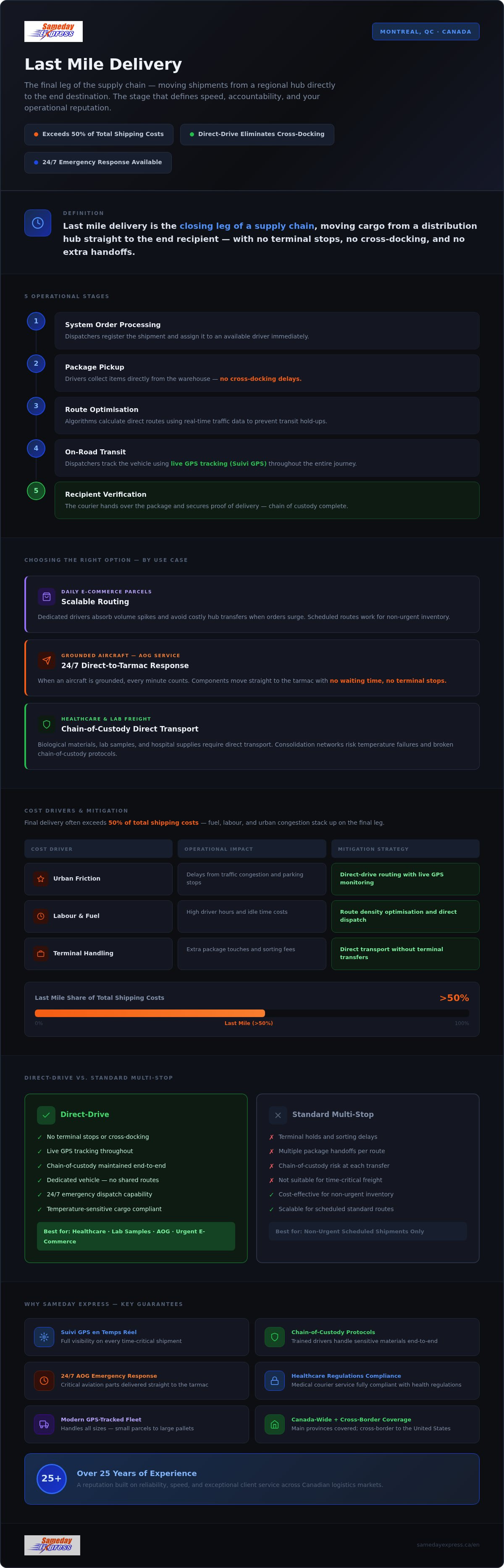
Final delivery follows five operational stages that take goods from a distribution centre to the end recipient.
- System order processing: Dispatchers register the shipment and assign it to an available driver.
- Package pickup: Drivers collect your items directly from the warehouse without cross-docking delays.
- Route optimization: Algorithms calculate direct routes using real-time traffic data to prevent transit hold-ups.
- On-road transit: Dispatchers track the vehicle using live GPS tracking throughout the journey.
- Recipient verification: The courier hands over the package and secures proof of delivery.
Eliminating intermediate terminal transfers cuts risk and delay in one move, because direct transport protects cargo from extra touches. For urgent shipments, contact the dispatch team for immediate driver release. Urgent freight belongs on dedicated direct-drive service; routine orders fit standard scheduled routes.
How much does last mile delivery cost?
Final delivery raises expenses because fuel, labour, and urban congestion stack up on the final leg. Hands-on work with clients shows that high driver pay alongside recurring traffic jams puts heavy financial pressure on time-sensitive deliveries. Sending individual couriers into dense city centres means dedicated vehicle routes and frequent idle time. For urgent shipments, dedicated Same Day Delivery removes intermediate terminal stops and lowers systemic delay risk. A direct-drive approach bypasses sorting hubs and prevents unnecessary parcel handling. Based on current market rates, typical courier services reflect these final-leg expenses across different operational models; market regional rates average C$15 to C$30 per standard parcel delivery.
| Cost Driver | Operational Impact | Mitigation Strategy |
|---|---|---|
| Urban Friction | Delays from traffic congestion and parking stops | Direct-drive routing with live GPS monitoring |
| Labour & Fuel | High driver hours and idle time costs | Route density optimization and direct dispatch |
| Terminal Handling | Extra package touches and sorting fees | Direct transport without terminal transfers |
Choosing dedicated transport when the clock is tight protects your margin on the shipments that cannot slip.
Tip: Assess route density before choosing carrier tiers to control per-package expenses.
Overcoming urban friction and delivery challenges
Final delivery stalls when urban congestion, missed drop-offs, and tight delivery windows break scheduled routes. When your urgent shipment hits city gridlock, traditional multi-stop routes fail. Practical analysis shows that direct-drive transport removes extra drop-offs, and vehicles with live tracking (Suivi GPS) support immediate rerouting around roadblocks.
Urban freight adds congestion that calls for dedicated logistics paths rather than shared multi-stop loops. Moving lab samples or critical aviation parts requires strict chain-of-custody protocols without handling delays. By using direct routes without terminal stops, same-day delivery can still complete during peak traffic hours on corridors your network already covers across major Canadian provinces and direct U.S. cross-border routes.
Leverage live tracking to cut delivery friction
Selecting a transport partner means confirming real-time GPS tracking that you can verify in operation, not only on a sales sheet. Full operational visibility should reach beyond pin location to include chain-of-custody tracking for every shipment. Without strict handoff records, end-to-end status breaks down at intermediate stages.
Tracking systems should also document regulatory compliance parameters, such as temperature logs, beside location coordinates. That dual monitoring helps hospital supplies and lab samples stay inside required safety protocols. When you compare providers, direct-drive routes suit time-critical biological materials, while standard routes fit everyday e-commerce fulfillment. Continuous tracking on the fleet supports dependable final delivery across your Canadian and cross-border supply chains.
Calculate multi-carrier ROI to negotiate terms
Calculating your volume split across multiple providers can reduce final delivery costs while protecting core service level agreements. From logistics management experience, pairing a regional direct carrier with primary national networks creates rate bargaining power during annual contract talks. Splitting volume lowers surcharges, and treating volume allocation as a diversified set of lanes reduces operational risk if one network slows down.
Evaluate your current network using this formula:
- Sum all base rates and fuel surcharges.
- Add failed attempt penalty fees.
- Divide by total completed order volume.
Comparing that baseline with a dedicated direct-drive strategy shows your true cost per successful drop. Premium direct routing removes expensive terminal re-handling fees. For time-critical e-commerce operations, local direct carriers can deliver speed and precise contract terms without restrictive daily lane minimums, which helps protect margins on high-urgency volume.
Situation → solution → result: a client needed a same-evening personal delivery after regular cutoffs. Dispatch released a driver at 7 PM, picked up from the home address, and completed delivery to Saint-Jérôme in under an hour. Among Sameday Express Inc.'s Google reviews, one customer (5★) wrote:
"I called them at 7 PM hoping they could help me surprise my boyfriend. Within minutes, they picked up the gift from my house and delivered it to St. Jerome in under an hour. I was so relieved, they absolutely saved me!"
Rapid direct routing is what made that window possible. Request a custom quote when you want tailored contract rates for high-urgency lanes.
When direct-drive local carriers make business sense
Direct-drive local carriers make financial sense when time-critical shipments need final delivery without intermediate terminal handling.
Situation → solution → result: routed transit networks raise the risk of delayed biological materials or damaged test kits at transfer stages. Bypassing sorting hubs removes that friction for high-stakes cargo. A dedicated fleet cuts cross-docking delays on urgent same-day delivery shipments, with coverage across major Canadian provinces and cross-border services to the United States. AOG (Avion au Sol) service operates continuously with dedicated emergency response, so grounded aircraft parts move on a 24/7 clock. Vehicles run active live tracking of shipment status and location (suivi en temps réel) so you see timeline progress in transit. Direct routes fit aerospace and healthcare logistics when custody and clock both matter.
Tip: Verify 24/7 dedicated dispatch availability when contracting critical aviation parts delivery.
When outsourcing last mile courier services fails
Outsourcing final delivery fails when high-stakes shipments lose dedicated oversight, strict temperature control, or direct routing. Standard 3PL (Third-Party Logistics) networks often mix sensitive biological materials or critical aviation parts with general consumer cargo, and that structure invites delay.
Practical observations show that standard postal schedules and generic external couriers struggle in real crises. Third-party terminals add handling points that weaken chain-of-custody protocols for lab samples. An internal fleet can work on predictable local routes, yet internal vehicles rarely stay cost-efficient during sudden volume spikes or 24/7 STAT (Service urgence STAT) demand.
Specialized direct-drive options outperform generic network shipping for these loads: no cross-docking and no extra stops. Ask for an individualized estimate tailored to your lanes, or call to walk through urgent custom requirements. Dedicated transport keeps high-value assets moving under the controls you specify.
Frequently asked questions
What is the last mile in transportation?
Final delivery is the movement of goods from a transport hub to the end recipient. It is the closing leg of your supply chain. A direct-drive model bypasses sorting hubs, cross-docking, and intermediate terminals so critical shipments can move from pickup straight to the final destination.
Why is the last mile called a problem?
The mile problem (last-mile logistics optimization) refers to the inefficiency, congestion, and high friction tied to completing final deliveries. Routing through multiple distribution hubs creates bottlenecks. When your shipment involves time-critical biological materials, hospital supplies, or aircraft-on-ground service (AOG), delay compounds fast. Removing waiting time and using on-demand transport with real-time tracking addresses that bottleneck directly.
How much of delivery cost does the last mile represent?
Final delivery expenses typically account for more than half of the total shipping cost because of frequent stops and complex routes. Managing these steps takes precise planning, especially for specialized courier work, since individual parcel stops consume far more resource than line-haul bulk shipping. Ask staff for a price estimate built around your freight profile.
How does last mile delivery work?
Final delivery operates by picking up cargo from a local facility and taking it straight to the customer doorstep. The process drops daily lane waits once you request dispatch: a GPS-tracked fleet secures lab samples or other urgent cargo, and trained drivers hold chain of custody until the recipient signs for the package.
How much does last mile delivery cost?
Final delivery costs depend on shipment dimensions, total distance, temperature control requirements, and how quickly the package must arrive. According to current logistics market sampling data, standard regional final transport prices typically vary between 15 and 30 dollars per package (C$15 to C$30). Specialized emergency services, such as 24/7 aviation response, need dedicated equipment and custom handling. Reach out for a personalized quote matched to your operational schedule.
Optimizing your final delivery operations
Solving the mile problem takes speed, transparent status, and reliable handling for time-critical shipments. Managing supply chains across Canadian provinces or cross-border routes works best when you remove cross-docking delays and run direct execution on the lanes that cannot wait.
More than 25 years of specialized experience covers freight from biological materials to urgent AOG aviation parts delivery. Constant control relies on real-time GPS tracking and strict chain-of-custody protocols. For aircraft-on-ground emergencies, 24/7 emergency response dispatch starts without daily lane waiting times.
Secure the final delivery setup your operations actually need: request a quote and align critical transport with the urgency profile you run day to day. More on this: Sameday Express.
Disclaimer
Blog Disclaimer
The information published on the Sameday Express Blog is provided for general informational and educational purposes only. While we strive to keep all content accurate and up to date, Sameday Express makes no representations or warranties of any kind, express or implied, regarding the completeness, accuracy, reliability, suitability, or availability of the information contained in our articles.
The content on this blog does not constitute legal, customs, tax, regulatory, financial, or professional advice. Shipping regulations, carrier policies, customs requirements, and transportation laws may change without notice and may vary by destination. Readers should verify current requirements with the appropriate government authorities, carriers, or qualified professionals before making shipping or business decisions.
Sameday Express is not liable for any loss, damage, delays, or consequences arising from the use of, or reliance on, information published on this website. Any actions taken based on the information provided are at the reader's own risk.
References to third-party companies, products, services, or websites are provided for informational purposes only and do not constitute an endorsement or recommendation by Sameday Express.
All blog content, including text, graphics, images, and logos, is the property of Sameday Express unless otherwise stated and may not be reproduced or distributed without prior written permission.
For specific shipping requirements, pricing, transit times, or logistics solutions, please contact Sameday Express directly for personalized assistance.


