

What if a shipment’s biggest delay happens between carriers, not on the road? For Canadian businesses, improving supply chain efficiency starts with finding where time is lost: avoidable handoffs, unclear responsibilities or a delivery service that doesn’t match the shipment’s urgency. Moving every order faster isn’t the answer if the process still creates friction.
If delays are hard to explain and shipment progress is difficult to track, reliable operations depend on practical measures, clear handoffs and a delivery plan suited to each shipment. Urgent deliveries need a dependable path, while routine orders may fit a different fulfilment approach.
This guide explains how to identify and prioritize inefficiencies using measures such as on-time delivery, perfect order rate and inventory turnover. You’ll learn how to match delivery options to urgency, assess handoff points and improve visibility so teams can respond sooner when plans change. For businesses shipping from Montreal, Dorval or elsewhere in Canada, the goal is simple: fewer avoidable delays and more dependable deliveries when timing matters.
Key Takeaways
- Improving supply chain efficiency means reducing avoidable delays and handoffs without overlooking shipment handling or delivery requirements.
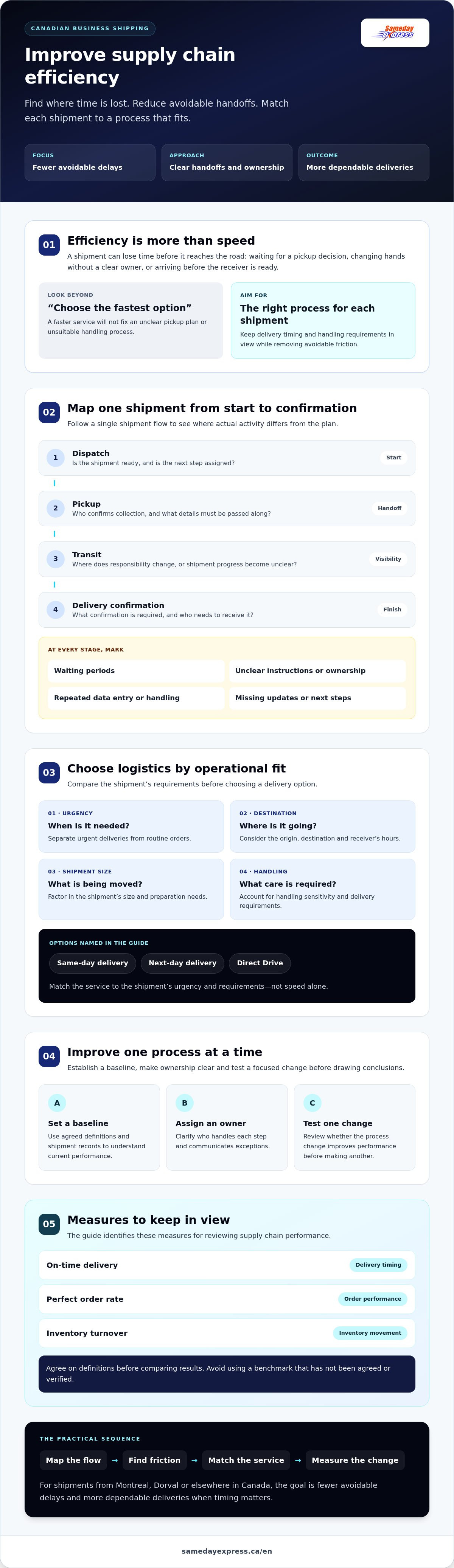
- Map one shipment flow from dispatch to delivery confirmation to pinpoint delays and clarify how exceptions are communicated.
- Compare delivery options by urgency, destination, shipment size and handling needs before selecting a service.
- Set a baseline, assign an owner and test one process change at a time to see whether it improves performance.
- Consider options such as same-day delivery, next-day delivery and Direct Drive for shipments with specific business requirements.
What Improving Supply Chain Efficiency Means for Canadian Businesses
For a business in Montreal, a shipment can lose time before it reaches the road. An order may wait for a pickup decision, pass between teams without a clear owner, or arrive before the receiving team is ready. Improving supply chain efficiency means moving the right shipment through the right process with fewer avoidable delays and handoffs, while still meeting delivery and handling requirements.
That’s different from simply choosing the fastest transport option. A useful starting point is understanding supply chain management, which coordinates the flow of goods and related activities. In practice, efficient shipping also depends on clear responsibilities, suitable handling, dependable delivery and useful shipment information.
For a practical overview, watch 3 Ways to Improve Supply Chain Efficiency:
Which supply chain problems should businesses look for first?
Start with one shipment flow and trace it from order readiness to delivery confirmation. Mark where it waits, changes hands, needs rework or lacks a clear next step. For example, a Montreal-area distributor might find that a shipment is ready for pickup but no one has been assigned to confirm the collection.
Before changing suppliers or workflows, separate recurring process issues from one-off disruptions. Ask operations, customer service and receiving teams where shipments commonly lose time. Their answers may point to different parts of the same problem, such as incomplete dispatch details, missing updates or uncertainty about who should resolve an exception.
Why shipment urgency and handling needs belong in the plan
Classify shipments by required delivery timing, destination, size and handling sensitivity. A routine parcel, hospital supplies and lab samples may need different processes. Requirements can affect preparation, handoffs, communication and the delivery option selected. A faster service won’t fix an unclear pickup plan or an unsuitable handling process.
Before dispatch, define the service expectations: when the shipment is needed, who will receive it, what confirmation is required and who should be contacted if the plan changes. These details give teams a consistent basis for choosing a process and reviewing whether it worked.
Efficiency means reliable movement through a suitable process, not speed alone.
How to Find Delays and Handoffs Across Your Supply Chain
A useful audit follows a shipment from dispatch to confirmed delivery. The goal is to find where actual activity differs from the plan, not to assume every delay has the same cause. Keep the review focused: choose one shipment flow and document each step before changing a supplier or process.
Build a useful shipment map before changing the process
Record each stage, who is responsible, where the shipment changes hands and what information must be passed along. Compare local, interprovincial and cross-border flows separately if their steps differ. For Montreal operations, include the shipment’s origin and destination, the receiver’s hours and whether an airport-linked option may be relevant to the route. This context helps distinguish a process gap from a timing constraint at the destination.
Use this audit sequence:
- 1. Select a flow. Choose a shipment type and route with clear start and end points.
- 2. Map each step. Include dispatch, pickup, transit, delivery confirmation and exception communication.
- 3. Record handoffs. Note each responsible party, transfer point and required information.
- 4. Investigate friction. Mark waiting periods, repeated data entry, unclear instructions, repeat handling and missing next steps.
Use consistent definitions throughout the review. For example, decide when a shipment counts as dispatched, what qualifies as a missed pickup and what information is needed for delivery confirmation. Then compare the planned service requirements with shipment records. Avoid introducing a benchmark that hasn’t been agreed or verified. If urgent shipments are part of the flow, this same-day delivery business guide can help frame the planning questions.
Choose measures that reveal service problems
Track on-time completion against the delivery requirement agreed for each shipment, using the same start and end points in every review. Add measures that help explain a missed requirement, rather than recording the outcome alone:
- Missed or delayed pickups, with the reason when known.
- Exceptions, when they were communicated and who received the update.
- Repeat handling or transfers that weren’t part of the plan.
- Time spent waiting for shipment status or a decision on the next step.
For a broader view of performance measures, consult Stanford Graduate School of Business’s Supply Chain Performance Measures. For order fulfilment, a perfect order rate can help show whether orders arrive on time, complete and in the expected condition. Inventory turnover looks at how often stock is sold or used and replenished over a period, so it can complement delivery measures when inventory management is part of the review.
Confirm whether GPS tracking or real-time updates are available and whether the intended users can access them before treating them as useful audit data. If the audit identifies urgent shipments that need a closer look, review Sameday Express Inc. business delivery options as one possible part of the plan.
Compare Logistics Options by Urgency, Handling, and Operational Fit
The right delivery option depends on the shipment’s deadline, destination, size, handling requirements and communication needs. Faster or more direct transport may suit a time-critical shipment, but it isn’t automatically the best choice for every order. Improving supply chain efficiency means matching the service to the requirement, then confirming the route and service details before dispatch.
| Option | When it may fit | Confirm before dispatch |
|---|---|---|
| Routine delivery | Shipments with a planned delivery window and no immediate time pressure. | Destination, receiving hours, shipment size and expected updates. |
| Same-day delivery | Time-sensitive shipments that need delivery on the day they’re collected. | Pickup readiness, destination, timing requirements and service availability. |
| Direct Drive | Shipments where a direct route may reduce transfers or handoffs. | Route, vehicle suitability, handling needs and delivery instructions. |
| Next-day delivery | Shipments that can meet their requirement with delivery the following day. | Origin, destination, collection timing and confirmed service terms. |
| Air-linked options | Shipments for which an airport-linked route may suit the destination and timing. | Route availability, ground handling steps, shipment size and status updates. |
When can direct or expedited delivery reduce process friction?
Direct Drive and same-day delivery are options to consider for time-sensitive shipments, subject to service confirmation. A more direct route may involve fewer transfers, which can simplify handoffs. It doesn’t remove the need to confirm pickup readiness, recipient availability, handling instructions and the communication plan.
For example, a laboratory arranging an urgent transfer of lab samples may need an assigned pickup, a confirmed destination contact and timely communication if an exception occurs. An aviation team sourcing a critical part for a grounded aircraft may have a different destination and level of urgency. In either case, choose transport based on the shipment requirements, not speed alone. See this specialized transportation guide for further critical-shipment considerations.
When should a business consider fulfilment or 3PL support?
Delivery is only one part of the process. Warehousing and pick-and-pack fulfilment may be relevant when inventory handling, order preparation or dispatch coordination is putting pressure on internal workflows. Compare keeping those tasks in-house with assigning agreed responsibilities to an external provider. First, define who manages stock, prepares each order, confirms dispatch details and handles exceptions. Then assess which approach fits the operation.
For local or time-critical delivery needs, review the Sameday Express Inc. delivery services and confirm that the service fits your shipment, route and timing requirements.
How to Put Supply Chain Improvements into Practice and Measure Them
A practical improvement plan starts with one shipment flow, not a sweeping process overhaul. Set a baseline using records you already have, such as dispatch times, pickup completion, delivery confirmation and exceptions. Then choose an issue with a clear operational impact, assign an owner and test one change at a time. This makes it easier to see whether the change helped or introduced new friction.
Create a controlled improvement plan
Document the current process before making a change. Record the proposed adjustment, the team responsible and a review date. Define success in terms of the business requirement, such as clearer pickup coordination or more consistent delivery confirmation. Avoid adopting an unverified industry benchmark as your target. Review your results against the service expectations agreed for that shipment flow.
Keep urgent shipment procedures clear while testing changes to routine orders. For example, a team could adjust how routine pickups are prepared without changing the escalation steps for a time-critical shipment. If you’re comparing providers, use a structured checklist covering service fit, communication and shipment handling. The transport partner selection guide can help organize that review.
Use visibility and communication to manage exceptions
Before dispatch, agree on the information required for pickup, the delivery requirement, who will receive status updates and how delivery will be confirmed. Set a clear escalation path for delays or other exceptions, including who makes decisions when the planned next step is no longer possible.
Confirm whether real-time or GPS updates are available for the selected service and whether the intended users can access them. Don’t assume a tracking feature is included. For sensitive shipments, confirm applicable handling, security, confidentiality and chain-of-custody procedures with the provider before tender. Requirements can depend on the shipment, so document what has been agreed rather than relying on assumptions.
- Record the exception: Note what happened and when it was reported.
- Assign follow-up: Identify who will investigate and communicate the next step.
- Review for patterns: Use recurring issues to decide what to test in the next process review.
Improving supply chain efficiency is a measured process: establish the baseline, make a controlled change and review performance against the actual business need. To discuss delivery options for your business shipments, explore Sameday Express delivery services.
How Sameday Express Can Support More Efficient Business Shipments
Sameday Express Inc. is a B2B logistics provider based in Dorval, serving Montreal businesses with interprovincial shipment options. Its delivery services may fit specific needs within a wider supply chain plan. Improving supply chain efficiency still starts with identifying the shipment requirement, then confirming that the selected service, route and handling arrangements fit.
For time-sensitive shipments, businesses can ask about same-day delivery, rush delivery or Sameday Direct Drive. Cross-border shipments between Canada and the United States may also be an option, subject to route and service confirmation. Sameday Express Inc. also handles medical courier shipments that include lab samples, medical devices and pharmaceutical products. Share any special handling or chain-of-custody requirements directly and confirm the procedures that apply before tender.
Not every process issue calls for faster delivery. If your challenge is order preparation or inventory coordination, assess whether your operation needs warehousing, 3PL or pick-and-pack fulfilment. Confirm the provider's available services and responsibilities rather than assuming those options are included in a delivery plan.
What to prepare before discussing a shipment plan
Clear shipment details help a provider assess service fit. Prepare:
- Origin and destination, including receiving hours and contact details.
- Shipment size and the delivery timing your business requires.
- Whether the shipment contains sensitive items or needs specific handling or chain-of-custody procedures.
- How often the shipment moves, where the current process encounters friction and what status or delivery information your team needs.
For cross-border shipments, ask the provider to confirm the route, service availability, required documentation and applicable requirements. Don't assume that a process used for a domestic shipment applies unchanged across the border.
Choose a next step based on your shipment requirements
Ask which available service best fits the timing, route, shipment size and handling needs. Confirm availability and operating details before relying on a proposed service. For an urgent request, use the company's contact path and state the time-critical requirement clearly, including the pickup and delivery details.
Share your shipment requirements with Sameday Express Inc. through its business logistics services page to discuss which delivery option may suit your operation.
Make Your Next Shipment Plan More Reliable
Improving supply chain efficiency starts with identifying where shipments wait or change hands, then measuring performance against your actual delivery requirements. Map one shipment flow, assign responsibility for each step and test one process change at a time. Match each shipment to its urgency, destination and handling needs rather than choosing the fastest option by default.
For Montreal businesses, Sameday Express is a B2B logistics provider based in Dorval, serving Montreal and other major Canadian metropolitan areas. Available services include same-day delivery, Direct Drive, warehousing, 3PL and pick-and-pack fulfilment. Medical courier services include transportation for laboratory samples, medical devices and pharmaceutical products. Confirm service availability and any shipment-specific requirements directly with the provider.
Ready to review a delivery need or time-critical shipment? Discuss your business shipment requirements with Sameday Express. A clear plan is a practical first step towards more dependable business shipments.
Frequently Asked Questions
How can a business improve supply chain efficiency?
Start by mapping one shipment flow from order readiness through delivery, noting wait times, handoffs and who owns each step. Prioritize issues that affect your business requirements, then remove avoidable transfers or clarify responsibilities where appropriate. Record a baseline before testing one process change at a time. Review the same measures regularly, such as on-time completion and exceptions, to understand whether the change fits your operation.
What are the most common causes of supply chain delays?
Possible causes to investigate include unclear handoffs, incomplete shipment information, waiting for a pickup or decision, repeat handling and weak communication when an exception occurs. These aren’t universal causes, so trace a specific shipment flow before changing a supplier or process. Check whether dispatch details reached the carrier, whether the receiving contact was available and whether someone was assigned to share updates or resolve a delay.
Can same-day delivery improve supply chain efficiency?
Same-day delivery may suit a shipment with an urgent requirement, such as a time-sensitive business document or needed medical item, if the route and service are available. It isn’t necessary for every order. First clarify the required timing, destination, shipment size and handling needs. Then compare available services against those requirements. A suitable routine delivery process may be a better fit for shipments without an urgent deadline.
How do you measure supply chain efficiency?
Use consistently defined measures that reflect your business requirements. Track on-time completion against the agreed delivery requirement, along with missed pickups, exceptions, repeat handling and the time teams spend waiting for shipment updates. Define when measurement starts and ends, and what counts as an exception, before comparing records. Review results over time against your own service expectations. Avoid adopting an industry benchmark unless it’s verified and relevant to your operation.
When should a business outsource warehousing or fulfilment?
Consider outsourcing when internal capacity, inventory handling, order preparation or dispatch coordination needs review. Map the current tasks first: who receives stock, prepares orders, checks shipment details and coordinates dispatch? Compare those responsibilities with what a potential provider would take on. For example, a business managing frequent online orders may assess whether external pick-and-pack fulfilment fits its workflow. Confirm service scope and responsibilities before making a decision.
How can businesses improve visibility across shipments?
Agree on which status updates matter, who will send and receive them, and how delivery will be confirmed. Set clear escalation steps for delays, missed pickups or other exceptions, so the next action has an owner. Ask the provider whether GPS tracking or real-time shipment updates are available for the selected service and whether your team can access them. Record updates consistently to help identify communication gaps during process reviews.
What should a business consider when shipping medical samples?
Confirm the shipment requirements before arranging transport, including timing, destination, packaging instructions and any handling sensitivity. Establish who is responsible for confidentiality and each chain-of-custody step, if required for the shipment. Ask the provider to confirm its relevant service capabilities and procedures. Also verify which healthcare regulations apply with appropriate internal or regulatory experts. Don’t assume that a process suitable for routine parcels will meet medical shipment requirements.
Disclaimer
Blog Disclaimer
The information published on the Sameday Express Blog is provided for general informational and educational purposes only. While we strive to keep all content accurate and up to date, Sameday Express makes no representations or warranties of any kind, express or implied, regarding the completeness, accuracy, reliability, suitability, or availability of the information contained in our articles.
The content on this blog does not constitute legal, customs, tax, regulatory, financial, or professional advice. Shipping regulations, carrier policies, customs requirements, and transportation laws may change without notice and may vary by destination. Readers should verify current requirements with the appropriate government authorities, carriers, or qualified professionals before making shipping or business decisions.
Sameday Express is not liable for any loss, damage, delays, or consequences arising from the use of, or reliance on, information published on this website. Any actions taken based on the information provided are at the reader's own risk.
References to third-party companies, products, services, or websites are provided for informational purposes only and do not constitute an endorsement or recommendation by Sameday Express.
All blog content, including text, graphics, images, and logos, is the property of Sameday Express unless otherwise stated and may not be reproduced or distributed without prior written permission.
For specific shipping requirements, pricing, transit times, or logistics solutions, please contact Sameday Express directly for personalized assistance.


