

Could a single classification error cost your facility thousands in fines or compromise months of critical research? With the June 17, 2026, amendments to the TDGR now in full effect, the margin for error has never been thinner. We understand that navigating biological specimen transport regulations in Canada often feels like hitting a moving target. Between mandatory site registrations in the Client Identification Database and the technical nuances of Category A versus Category B infectious substances, the stakes are incredibly high. It's stressful to manage time-critical samples when the threat of transport delays or specimen degradation looms over every shipment.
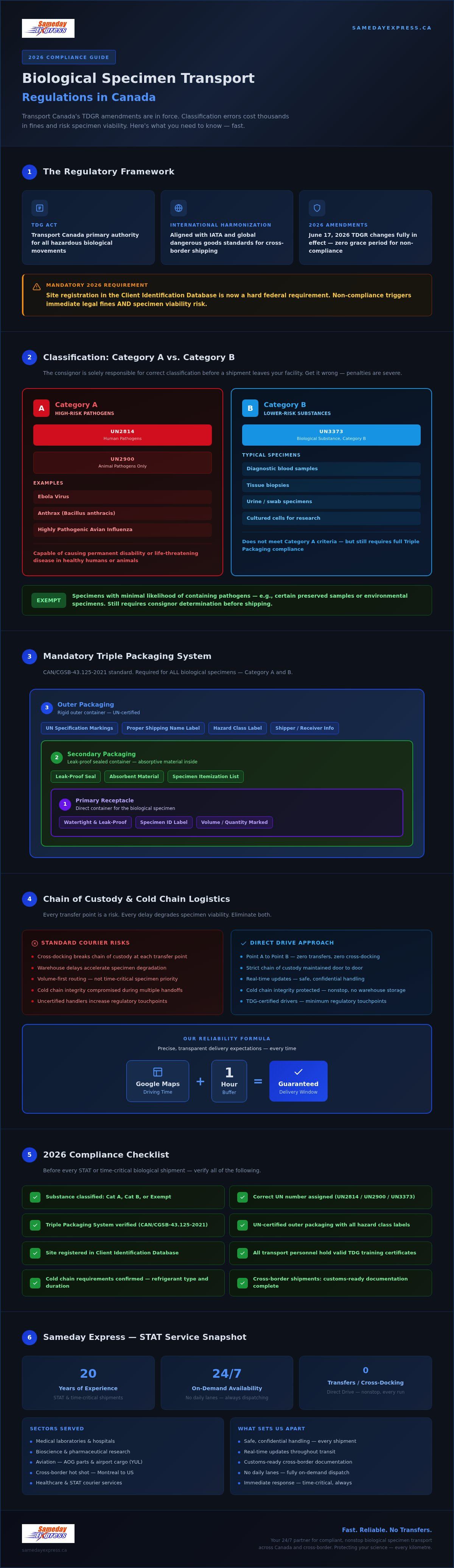
This guide provides the clarity you need to master TDG complexities and ensure your sensitive shipments remain compliant, secure, and nonstop. We'll simplify the latest Transport Canada requirements, including the CAN/CGSB-43.125-2021 packaging standards and the recent harmonization with international protocols. You'll learn how a Direct Drive approach eliminates the risks of cross-docking, maintains a strict chain of custody, and delivers results using our "Google Maps driving time plus one hour" reliability formula. From STAT medical deliveries to cross-border logistics, here is how to achieve zero-delay transport while staying fully compliant in 2026.
Key Takeaways
- Accurately classify infectious substances as Category A or B to ensure full compliance with the latest Transport Canada safety standards.
- Implement the mandatory Triple Packaging System and precise UN labelling to satisfy current biological specimen transport regulations and prevent shipment rejections.
- Protect sample integrity by mastering cold chain logistics and maintaining a secure, documented chain of custody from pickup to delivery.
- Eliminate the risks of cross-docking and transport delays with a nonstop Direct Drive strategy that prioritizes time-critical STAT shipments.
- Use our transparent "Google Maps driving time + 1 hour" formula to set precise, reliable expectations for every sensitive biological delivery.
Understanding the Regulatory Landscape for Biological Specimen Transport
Transport Canada acts as the primary authority for hazardous movements under the Transportation of Dangerous Goods (TDG) Act. For medical facilities and research labs, biological specimen transport regulations serve as the mandatory blueprint for safety. These Canadian laws are designed to harmonize with international dangerous goods regulations, ensuring a consistent standard for handling pathogens across borders. Whether you are shipping between Montreal and Toronto or across the US border, staying current with these rules is the only way to avoid costly litigation and safety breaches.
In 2026, the focus has shifted toward digital accountability and enhanced chain of custody. The mandatory site registration in the Client Identification Database, which became a hard requirement in late 2024, now allows for tighter federal oversight. Non-compliance is expensive. Beyond legal fines, the safety risks to the public are severe. There's also the logistical cost: lost specimen viability. When a shipment sits in a warehouse because of a paperwork error, the science inside suffers. We don't just deliver packages; we protect the integrity of your work through strict adherence to these evolving standards.
To better understand the global context of these requirements, watch this helpful video:
The Role of the TDG Act in Canada
Federal laws organize how hazardous biological materials move through our provinces. Section 1.4 of the TDG Regulations specifically defines "Infectious Substances" as those containing viable micro-organisms known or reasonably believed to cause disease. You can't just hand these to a standard courier. Every person involved in the transport chain must hold a valid training certificate. At Sameday Express, we realize that regulations are complex. That's why we focus on Direct Drive transport. By moving your samples directly from point A to point B, we eliminate the need for transfers. This reduces regulated touchpoints and keeps your chain of custody intact.
Key Stakeholders in the Transport Chain
Compliance is a shared responsibility. The consignor, or the shipper, holds the initial responsibility for classification and packaging. However, the carrier must ensure the shipment remains secure and nonstop. Choosing a specialized medical courier is a strategic move for any bioscience firm. General freight providers often prioritize volume over precision. We provide 20 years of expertise in STAT and time-critical shipments. Our "Google Maps driving time + 1 hour" formula gives you a realistic, reliable window for delivery. This level of transparency is essential for maintaining compliance and sample integrity in high-stakes environments.
Classification: Determining Category A vs. Category B Substances
Classification is the foundation of compliance. It dictates your packaging, your paperwork, and your choice of courier. Under biological specimen transport regulations, the responsibility for this classification falls squarely on the consignor. You must determine if a substance is Category A, Category B, or exempt before it ever leaves your facility. Get it wrong; the penalties are severe. Beyond the legal risk, an incorrectly labelled package can lead to dangerous exposure for handlers or the total loss of specimen viability.
Category A: High-Risk Pathogens
Category A substances are infectious materials capable of causing permanent disability or life-threatening disease in otherwise healthy humans or animals. These are assigned UN2814 for human pathogens or UN2900 for those affecting only animals. Think of high-consequence pathogens like Ebola, Anthrax, or highly pathogenic avian influenza. Because the risk to public safety is so high, these shipments trigger the most stringent requirements under the TDG Act.
You'll need specialized training, specific TDG documentation, and a carrier capable of nonstop, secure transport. There's no room for transfers or delays here. For these high-stakes shipments, it's best to consult with a specialized medical courier to ensure every protocol is followed. Nonstop service is the only way to minimize the window of risk.
Category B: Routine Diagnostic Samples
Category B (UN3373) covers biological substances shipped for diagnostic or investigational purposes that don't meet the high-risk criteria of Category A. This is the most common classification in daily medical logistics. It includes samples for clinical trials, routine diagnostic tests, and most laboratory research. While the risk profile is lower, the rules are still strict. You must follow the triple packaging system and include clear labelling.
Speed remains a priority for Category B. Even if the substance isn't life-threatening, it's often time-critical. Specimen viability degrades quickly; a sample is only useful if it arrives at the lab within its stability window. Reliability is key. We focus on door-to-door transport to ensure these routine samples stay within the required temperature and timeframe.
Not every sample is a "dangerous good." Exempt human or animal specimens are those where there's a minimal likelihood that pathogens are present. Examples include routine cholesterol checks or blood glucose monitoring. However, you must still use leak-proof packaging and mark the outer container as "Exempt human specimen." When in doubt, don't guess. Refer to Transport Canada's official guidelines for the full list of regulated substances. If a sample falls into a grey area, consult your institutional biosafety officer. Professional judgment is a legal requirement under the TDG Act.
Packaging and Documentation Requirements under TDG Regulations
Compliance starts with the container. If your packaging fails, your entire chain of custody is compromised. Strict adherence to biological specimen transport regulations ensures that even if a vial breaks, the pathogen remains contained. This isn't just a best practice; it's a legal requirement under the TDG Act. Proper packaging prevents environmental contamination and protects every person who handles the shipment, from your lab staff to our specialized drivers.
The "No Transfers" advantage is central to our logistical strategy. Traditional couriers use hub-and-spoke systems where packages are sorted, tossed on conveyor belts, and cross-docked multiple times. Each transfer is a point of failure. Our Sameday Direct drive service eliminates these risks. Your specimens stay in one vehicle, handled by one driver, from your door to the destination. Less handling means less chance of a packaging breach.
The Triple Packaging Standard
The CAN/CGSB-43.125-2021 standard mandates a triple packaging system for all infectious substances. You can't cut corners here. The system requires three distinct layers:
- Primary Receptacle: A leak-proof vial or tube containing the specimen.
- Secondary Packaging: A second leak-proof layer that encloses the primary receptacle. You must place enough absorbent material between these two layers to soak up the entire liquid content in case of a leak.
- Rigid Outer Packaging: A durable box or container that meets specific pressure and drop test standards. It must protect the inner layers from physical damage during transit.
Accurate Labelling and Marking
Labels are the primary way handlers identify the risks inside a package. For Category B shipments, the UN3373 diamond mark must be clearly visible on the outer container. Category A shipments require even more rigorous marking, including the UN2814 or UN2900 labels. You must also include orientation arrows if the primary receptacles contain more than 50 ml of liquid. Every package must display a 24-hour emergency telephone number where a person can provide technical information about the substance. Ensure all labels are waterproof and securely attached; a missing label can lead to an immediate shipment rejection by the carrier.
Documentation Checklist for Shippers
Paperwork is just as critical as the physical box. Shippers must provide a TDG shipping document that includes the date, the consignor’s name and address, and a full description of the goods. For more details on exact requirements, refer to Transport Canada's regulations for shipping infectious substances. You're legally required to keep copies of these transport documents for two years. Before the driver leaves, verify they have their own valid TDG training certificate. We ensure all our medical couriers are fully certified and carry the necessary documentation in the vehicle at all times. This level of rigour is why we've been a trusted partner in medical logistics for over 20 years.
Logistics Strategy: Maintaining Chain of Custody and Temperature
Time is the greatest threat to specimen integrity. While federal laws focus on how you pack the box, the logistical execution determines whether the contents are still useful upon arrival. Even the most robust packaging under biological specimen transport regulations cannot stop the clock. If a sensitive sample sits in a sorting facility for twelve hours, its viability drops. We prioritize speed and direct movement to ensure the science remains valid and the results are accurate. In a high-stakes medical environment, delays aren't just inconvenient; they're potentially catastrophic.
Our strategy relies on a 24/7 service environment where precision and speed are the primary objectives. We don't use daily lanes or wait for vehicles to fill up. When a STAT request comes in, we move. This on-demand approach is essential for maintaining the strict thermal and security requirements of modern bioscience. By focusing on the logistical mechanics of the journey, we eliminate the variables that lead to specimen degradation.
Cold Chain Integrity for Biologicals
Choosing the right refrigerant is vital. Whether your specimen type requires dry ice for frozen stability or gel packs for refrigerated samples, the thermal environment must remain constant. Our team manages temperature-sensitive specialized transportation with a focus on nonstop movement. The Direct Drive benefit is clear: specimens spend the absolute minimum amount of time out of controlled storage. We don't stop for other pickups or route your package through a warehouse. We drive straight to the receiving laboratory, ensuring the cold chain is never broken by unnecessary dwell time.
Securing the Chain of Custody
Safety requires eliminating cross-docking. Every time a package changes hands or moves to a different vehicle, the chain of custody weakens. We use a strict "No Transfers" policy. One driver handles your shipment from the moment of pickup until it's signed for at the destination. This is especially critical in the busy Montreal-Toronto and Ottawa corridors, where traditional freight often gets bogged down in sorting centres. We provide real-time updates and immediate notification upon delivery, eliminating the anxiety of "where is my sample?" for both the shipper and the receiver.
Transparency is a core part of our professional identity. We utilize a specific formula for our delivery expectations: Google Maps driving time + 1 hour. This gives you a realistic, honest window for arrival without the fluff of vague "same day" promises. If you need to ensure your time-critical samples remain secure and compliant, it's time to book a Sameday Direct drive and experience the difference of a truly nonstop medical courier service.
Sameday Express: Your Partner for Compliant STAT Transport
Nonstop. Reliable. Direct. We provide the specialized expertise required to navigate high-stakes biological specimen transport regulations across the Montreal, Toronto, and Ottawa regions. No fluff. Just precision. We realize that in medical logistics, speed is the only metric that matters. Our infrastructure is built to eliminate delays and protect your critical samples at every kilometre.
Direct Drive Medical Courier Services
We provide on-demand, door-to-door transport for Category A and B biologicals. No sorting hubs. No daily lanes. Your shipment is our only priority from the moment of pickup. Our same day delivery model is engineered for maximum security.
- 🚀 Nonstop Direct Drive: Your specimens stay in one vehicle with one dedicated driver.
- 🛑 Zero Transfers: Eliminating cross-docking risks to maintain absolute sample integrity.
- 🕒 STAT Availability: 24/7 immediate response for emergency lab and AOG shipments.
- 📍 Regional Focus: Rapid transit across the Montreal-Toronto-Ottawa corridor.
Professional Handling You Can Trust
Our team combines 20 years of medical logistics experience with technical accuracy. Safe. Confidential. Customs-ready. We provide the transparency you need for high-stakes bioscience and healthcare shipments.
- 📜 Certified Drivers: All personnel maintain valid TDG training certificates for 2026 compliance.
- ⏱️ Transparent Timing: We use our "Google Maps driving time + 1 hour" formula for every trip.
- 📦 Chain of Custody: Real-time updates and secure signature-at-delivery protocols.
- 🧪 Industry Expertise: Specialized handling for hospitals, research labs, and pharmaceutical firms.
Don't risk your compliance with general freight providers. We offer the speed and precision your time-critical samples deserve. Contact us today for a pricing quote on your biological transport needs. Immediate. Secure. Nonstop.
Securing Your Biological Logistics for 2026 and Beyond
Mastering biological specimen transport regulations isn't just about avoiding fines. It's about protecting the integrity of your research and the safety of the public. We've seen that correct classification and the triple packaging system are the bedrock of compliance. However, even the best packaging can't compensate for a broken cold chain or unnecessary delays at a sorting hub. Direct Drive transport remains the gold standard for high-stakes bioscience. It eliminates the risks associated with cross-docking and multiple handlers. Fast. Reliable. No transfers.
Reliability is our priority. With 20 years of specialized medical logistics experience, we provide a service that is nonstop and transparent. Our "Google Maps driving time plus one hour" delivery guarantee ensures your lab is always ready for arrival. Don't let your critical samples sit in a warehouse. Choose a partner that prioritizes speed and security for every STAT shipment across Montreal, Ottawa, and Toronto. You can have peace of mind knowing your specimens are in professional hands.
Get a STAT Quote for Your Biological Transport
Frequently Asked Questions
What is the difference between Category A and Category B biological substances?
Category A substances are high-risk pathogens capable of causing life-threatening disease or permanent disability; Category B includes substances shipped for routine diagnostic or investigational purposes. Category A (UN2814/UN2900) requires the most stringent packaging and documentation. Category B (UN3373) is more common in daily medical courier work. Both classifications must strictly follow biological specimen transport regulations to ensure public safety and sample integrity.
Who is responsible for classifying a biological specimen for transport in Canada?
The consignor, or the person offering the goods for transport, is legally responsible for classification. You must determine if the substance meets Category A, Category B, or exempt criteria before the courier arrives. This decision requires professional judgement and technical knowledge of the specimen. If you're unsure, we recommend consulting your institutional biosafety officer to ensure your facility remains compliant with the TDG Act.
What are the triple packaging requirements for UN3373 specimens?
Triple packaging requires a leak-proof primary receptacle, a leak-proof secondary packaging, and a rigid outer container. You must place enough absorbent material between the primary and secondary layers to soak up the entire liquid volume in case of a leak. This system ensures that even if the primary vial breaks, the substance remains contained within the secondary layer. The outer packaging must be durable enough to pass specific drop and pressure tests.
Do I need a special permit to ship biological samples between Montreal and Toronto?
No specific federal permits are required for the routine domestic transport of diagnostic specimens between Montreal and Toronto. However, you must still comply with all TDG packaging and labelling rules. If you're transporting high-risk human or animal pathogens, you may need specific permits from the Public Health Agency of Canada (PHAC) or the Canadian Food Inspection Agency (CFIA). Always check the latest 2026 site registration requirements in the Client Identification Database.
What documentation must accompany an infectious substance shipment?
Every infectious substance shipment must be accompanied by a formal TDG shipping document. This document must include the date, the consignor's name and address, the proper shipping name, and the UN number. You also need a 24-hour emergency telephone number where technical information is available at all times. We ensure our drivers carry valid training certificates to satisfy biological specimen transport regulations during every time-critical trip.
How does Direct Drive transport improve specimen viability?
Direct Drive transport improves viability by eliminating the risks of cross-docking and sorting facility delays. Your specimens stay in one vehicle from pickup to delivery. This "No Transfers" approach minimizes the time samples spend in uncontrolled environments. It's the most effective way to maintain a strict chain of custody for STAT shipments, ensuring the sample arrives at the lab exactly as it left your facility.
Can Sameday Express handle temperature-controlled biological shipments?
Yes, we provide specialized transportation for biologicals requiring dry ice, gel packs, or refrigerated environments. We prioritize nonstop movement to keep the cold chain intact. Our team utilizes a "Google Maps driving time + 1 hour" formula for total transparency. This ensures your temperature-sensitive samples arrive at the lab within their stability window. We focus on door-to-door delivery with zero transfers to protect your high-stakes samples.
What training is required for staff handling biological specimen transport?
Any staff member who handles, offers for transport, or transports dangerous goods must hold a valid TDG training certificate. This certification is valid for three years for ground transport in Canada. For air shipments, IATA training is required and must be renewed every two years. We verify that all our medical couriers maintain up-to-date certification. This ensures every handler understands the latest safety protocols and emergency response procedures.
Disclaimer
Blog Disclaimer
The information published on the Sameday Express Blog is provided for general informational and educational purposes only. While we strive to keep all content accurate and up to date, Sameday Express makes no representations or warranties of any kind, express or implied, regarding the completeness, accuracy, reliability, suitability, or availability of the information contained in our articles.
The content on this blog does not constitute legal, customs, tax, regulatory, financial, or professional advice. Shipping regulations, carrier policies, customs requirements, and transportation laws may change without notice and may vary by destination. Readers should verify current requirements with the appropriate government authorities, carriers, or qualified professionals before making shipping or business decisions.
Sameday Express is not liable for any loss, damage, delays, or consequences arising from the use of, or reliance on, information published on this website. Any actions taken based on the information provided are at the reader's own risk.
References to third-party companies, products, services, or websites are provided for informational purposes only and do not constitute an endorsement or recommendation by Sameday Express.
All blog content, including text, graphics, images, and logos, is the property of Sameday Express unless otherwise stated and may not be reproduced or distributed without prior written permission.
For specific shipping requirements, pricing, transit times, or logistics solutions, please contact Sameday Express directly for personalized assistance.


